Nov 2015 p13 q10
1285
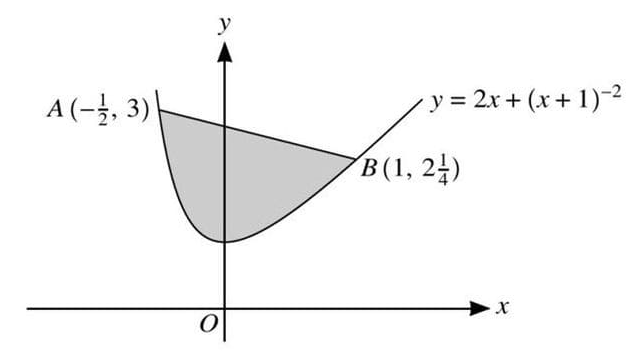
The points \(A\left(-\frac{1}{2}, 3\right)\) and \(B\left(1, 2\frac{1}{4}\right)\) lie on the curve \(y = 2x + (x+1)^{-2}\), as shown in the diagram.
(ii) Find the distance \(AB\).
(iii) Find, showing all necessary working, the area of the shaded region.
Solution
(ii) To find the distance \(AB\), use the distance formula:
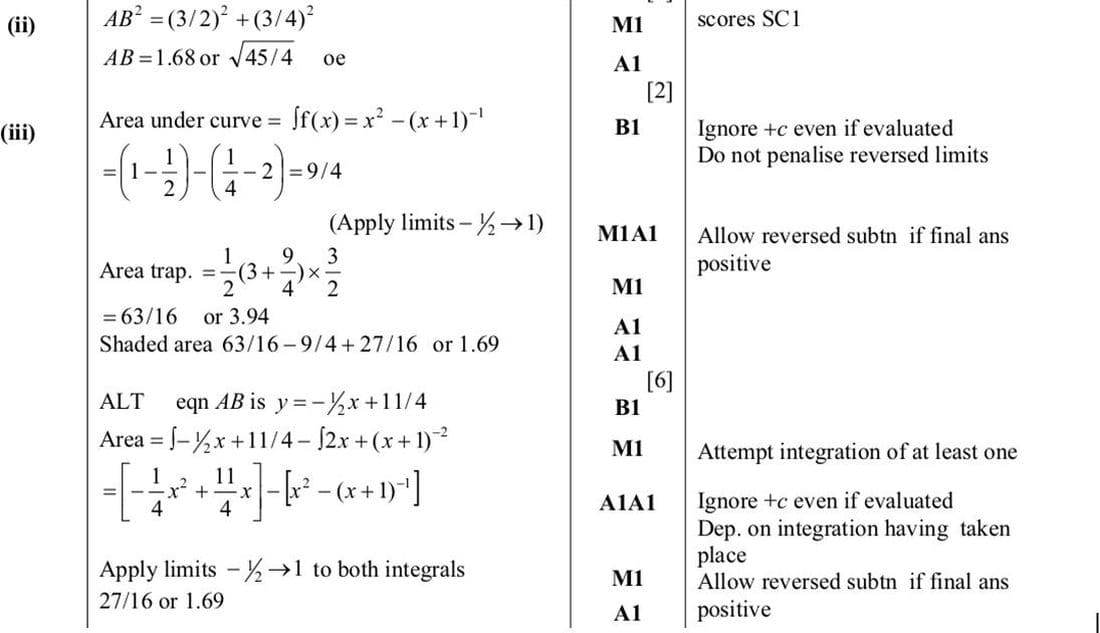
\(AB^2 = \left(3/2\right)^2 + \left(3/4\right)^2\)
\(AB = \sqrt{\frac{45}{4}} \approx 1.68\)
(iii) To find the area of the shaded region, calculate the area under the curve \(y = 2x + (x+1)^{-2}\) from \(x = -\frac{1}{2}\) to \(x = 1\).
The area under the curve is:
\(\int_{-1/2}^{1} \left( x^2 - (x+1)^{-1} \right) \, dx = \left[ \frac{1}{4}x^2 + \frac{11}{4}x \right]_{-1/2}^{1} - \left[ x^2 - (x+1)^{-1} \right]_{-1/2}^{1}\)
Apply limits \(-\frac{1}{2} \to 1\) to both integrals:
\(= \frac{27}{16} \approx 1.69\)
Log in to record attempts.