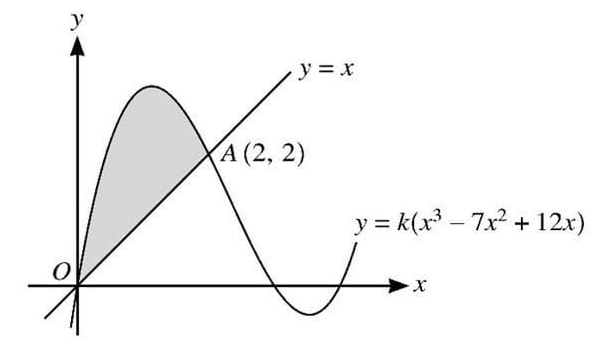
(i) To find \(k\), use the point \(A(2, 2)\) on the curve:
\(2 = k(2^3 - 7 \times 2^2 + 12 \times 2)\)
\(2 = k(8 - 28 + 24)\)
\(2 = k \times 4\)
\(k = \frac{1}{2}\)
(ii) Verify the curve meets \(y = x\) at \(x = 5\):
Substitute \(x = 5\) into the curve equation:
\(y = \frac{1}{2}(5^3 - 7 \times 5^2 + 12 \times 5)\)
\(y = \frac{1}{2}(125 - 175 + 60)\)
\(y = \frac{1}{2}(10) = 5\)
Since \(y = 5\) when \(x = 5\), the curve meets the line \(y = x\).
(iii) Find the area of the shaded region:
The area is given by the integral:
\(\int_0^2 \left( \frac{1}{2}(x^3 - 7x^2 + 12x) - x \right) \, dx\)
Integrate term by term:
\(\int_0^2 \left( \frac{1}{2}x^3 - \frac{7}{2}x^2 + 5x \right) \, dx\)
\(= \left[ \frac{1}{8}x^4 - \frac{7}{6}x^3 + \frac{5}{2}x^2 \right]_0^2\)
Evaluate the definite integral:
\(= \left( \frac{1}{8}(16) - \frac{7}{6}(8) + \frac{5}{2}(4) \right) - 0\)
\(= 2 - \frac{28}{3} + 10\)
\(= \frac{8}{3}\)