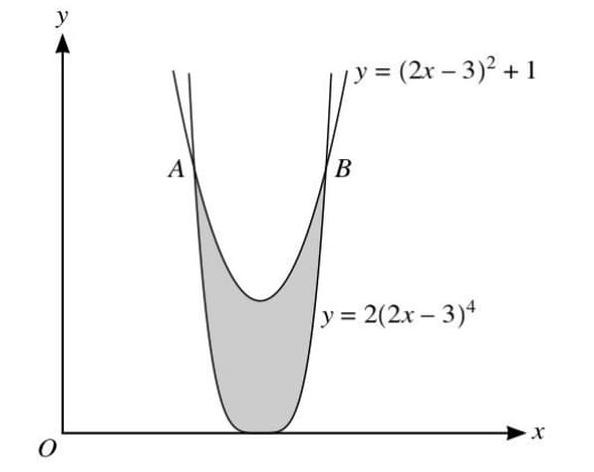
The diagram shows the curves with equations \(y = 2(2x - 3)^4\) and \(y = (2x - 3)^2 + 1\) meeting at points \(A\) and \(B\).
(a) By using the substitution \(u = 2x - 3\), find, by calculation, the coordinates of \(A\) and \(B\). [4]
(b) Find the exact area of the shaded region. [5]
Solution
(a) Let \(u = 2x - 3\). Then the equations become \(y = 2u^4\) and \(y = u^2 + 1\).
Equating the two: \(2u^4 = u^2 + 1\).
Rearrange to form: \(2u^4 - u^2 - 1 = 0\).
Factor or solve using the quadratic formula: \((2u^2 + 1)(u^2 - 1) = 0\).
Thus, \(u = \pm 1\).
For \(u = 1\), \(2x - 3 = 1\) gives \(x = 2\).
For \(u = -1\), \(2x - 3 = -1\) gives \(x = 1\).
Coordinates are \((1, 2)\) and \((2, 2)\).
(b) Integrate the functions: \(\int_{1}^{2} \frac{(2x-3)^3}{3 \times 2}\) and \(\int_{1}^{2} \frac{2(2x-3)^5}{5 \times 2}\).
Calculate: \(\left[ \frac{1}{6} + 2 \right] - \left[ \frac{1}{5} - \frac{1}{5} \right]\).
Subtract the two areas: \(\frac{4}{3} - \frac{2}{5}\).
Final area: \(\frac{14}{15}\).
Log in to record attempts.