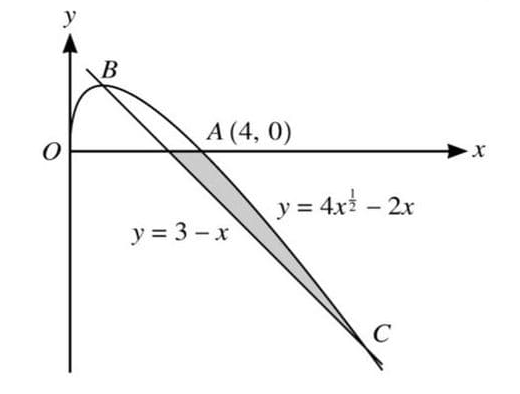
(a) To find the x-coordinates of \(B\) and \(C\), set the equations equal: \(4x^{\frac{1}{2}} - 2x = 3 - x\).
Rearrange to form a quadratic: \(4x^{\frac{1}{2}} - x - 3 = 0\).
Let \(u = x^{\frac{1}{2}}\), then \(4u^2 - u - 3 = 0\).
Factorize: \((u - 1)(u - 3) = 0\), giving \(u = 1\) or \(u = 3\).
Thus, \(x = 1^2 = 1\) or \(x = 3^2 = 9\).
(b) Differentiate the curve: \(\frac{dy}{dx} = 2x^{-\frac{1}{2}} - 2\).
Set \(\frac{dy}{dx} = 0\) for a stationary point: \(2x^{-\frac{1}{2}} - 2 = 0\).
Solve: \(x^{-\frac{1}{2}} = 1\), so \(x = 1\).
Thus, \(B\) is a stationary point.
(c) The area of the shaded region is the area under the line minus the area under the curve from \(x = 4\) to \(x = 9\).
Area under the line: \(\int_4^9 (3 - x) \, dx = \left[ 3x - \frac{x^2}{2} \right]_4^9 = 18 - 14 = 4\).
Area under the curve: \(\int_4^9 (4x^{\frac{1}{2}} - 2x) \, dx = \left[ \frac{8}{3}x^{\frac{3}{2}} - x^2 \right]_4^9 = 18 - 14\frac{1}{3} = 3\frac{2}{3}\).
Shaded area = \(4 - 3\frac{2}{3} = 3\frac{2}{3}\).