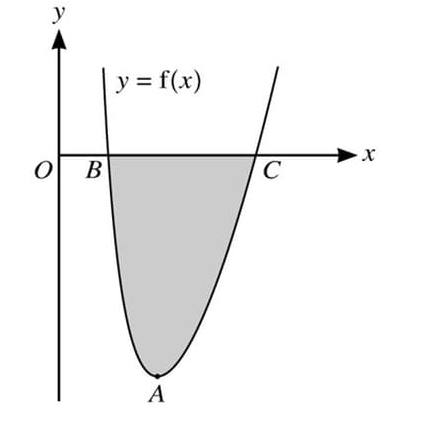
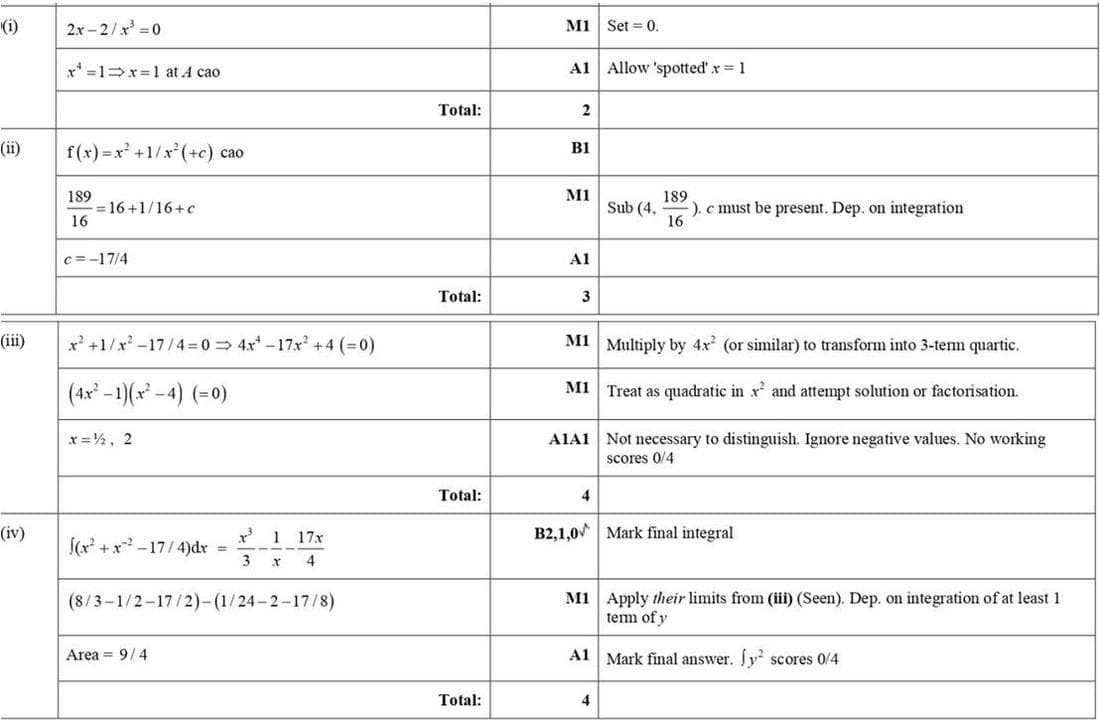
(i) To find the \(x\)-coordinate of \(A\), set \(\frac{dy}{dx} = 0\):
\(2x - \frac{2}{x^3} = 0\)
\(2x = \frac{2}{x^3}\)
\(x^4 = 1\)
Thus, \(x = 1\) at \(A\).
(ii) To find \(f(x)\), integrate \(\frac{dy}{dx} = 2x - \frac{2}{x^3}\):
\(f(x) = \int (2x - \frac{2}{x^3}) \, dx\)
\(f(x) = x^2 + \frac{1}{x^2} + c\)
Using the point \(\left(4, \frac{189}{16}\right)\):
\(\frac{189}{16} = 16 + \frac{1}{16} + c\)
\(c = -\frac{17}{4}\)
Thus, \(f(x) = x^2 + \frac{1}{x^2} - \frac{17}{4}\).
(iii) To find the \(x\)-coordinates of \(B\) and \(C\), solve \(f(x) = 0\):
\(x^2 + \frac{1}{x^2} - \frac{17}{4} = 0\)
Multiply by \(4x^2\):
\(4x^4 - 17x^2 + 4 = 0\)
\((4x^2 - 1)(x^2 - 4) = 0\)
\(x = \frac{1}{2}, 2\)
(iv) To find the area of the shaded region, integrate \(f(x)\) from \(x = \frac{1}{2}\) to \(x = 2\):
\(\int_{1/2}^{2} \left(x^2 + \frac{1}{x^2} - \frac{17}{4}\right) \, dx\)
\(= \left[ \frac{x^3}{3} - \frac{1}{x} - \frac{17x}{4} \right]_{1/2}^{2}\)
\(= \left( \frac{8}{3} - \frac{1}{2} - \frac{17}{2} \right) - \left( \frac{1}{24} - 2 - \frac{17}{8} \right)\)
Area = \(\frac{9}{4}\)