Browsing as Guest. Progress, bookmarks and attempts are disabled.
Log in to track your work.
June 2019 p13 q10
1272
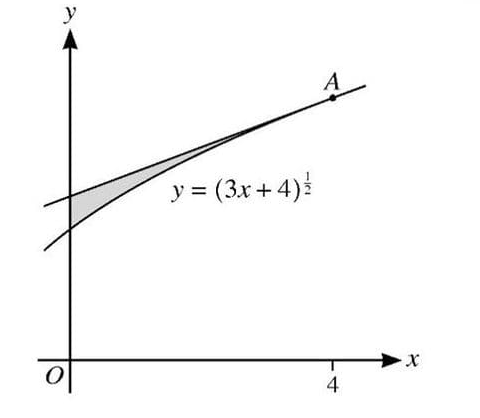
The diagram shows part of the curve with equation \(y = (3x + 4)^{\frac{1}{2}}\) and the tangent to the curve at the point A. The \(x\)-coordinate of A is 4.
(i) Find the equation of the tangent to the curve at A.
(ii) Find, showing all necessary working, the area of the shaded region.
(iii) A point is moving along the curve. At the point P the \(y\)-coordinate is increasing at half the rate at which the \(x\)-coordinate is increasing. Find the \(x\)-coordinate of P.
Solution
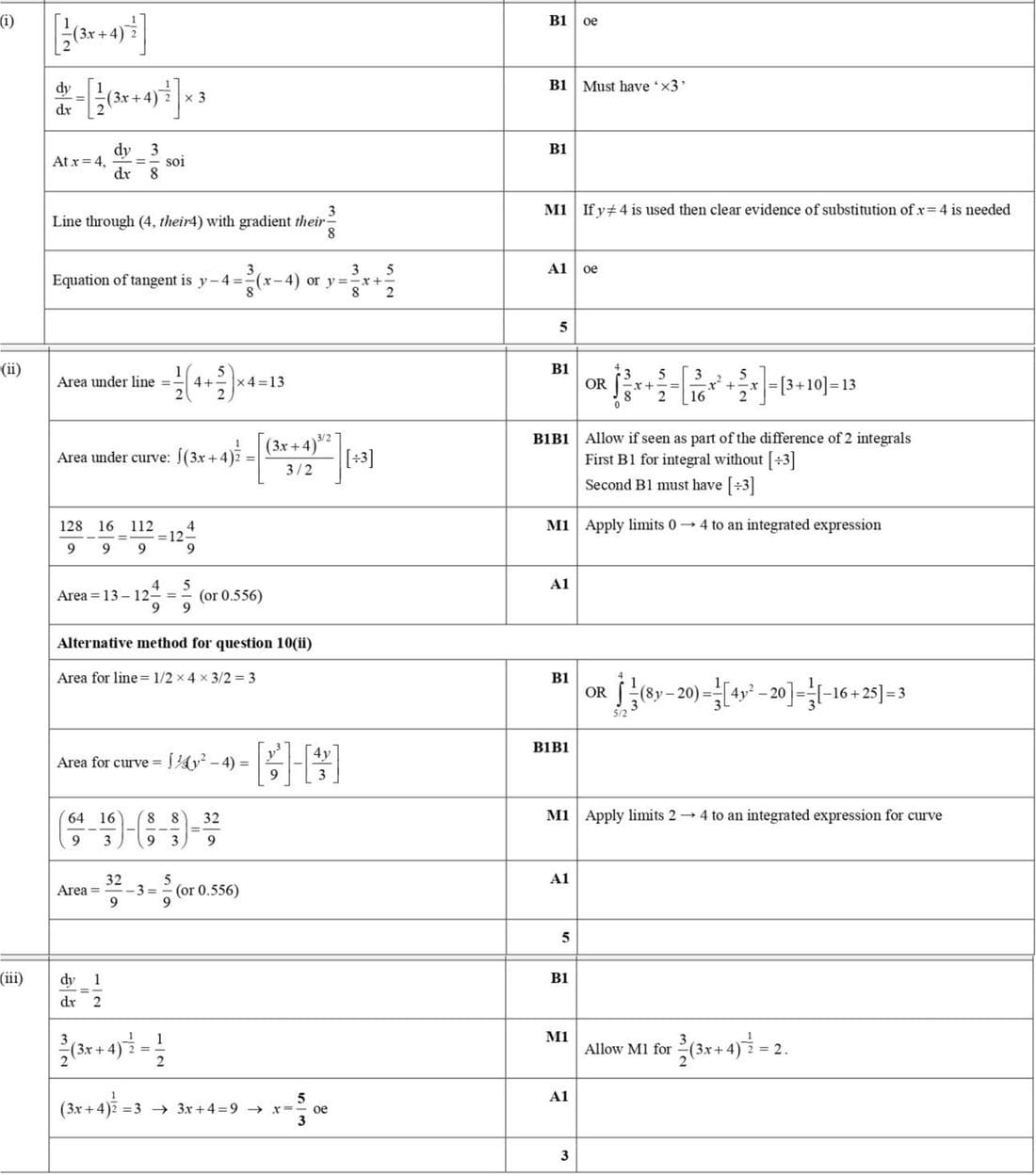
(i) Differentiate \(y = (3x + 4)^{\frac{1}{2}}\) to find the gradient: \(\frac{1}{2}(3x + 4)^{-\frac{1}{2}} \times 3 = \frac{3}{2}(3x + 4)^{-\frac{1}{2}}\).
At \(x = 4\), \(\frac{dy}{dx} = \frac{3}{8}\).
The equation of the tangent is \(y - 3 = \frac{3}{8}(x - 4)\), which simplifies to \(y = \frac{3}{8}x + \frac{5}{2}\).
(ii) The area under the line is \(\frac{1}{2} \times 4 \times 3 = 3\).
The area under the curve is \(\int_0^4 (3x + 4)^{\frac{1}{2}} \, dx = \left[ \frac{2}{3}(3x + 4)^{\frac{3}{2}} \right]_0^4 = 13\).
The area of the shaded region is \(13 - 12 = \frac{5}{9}\) (or 0.556).