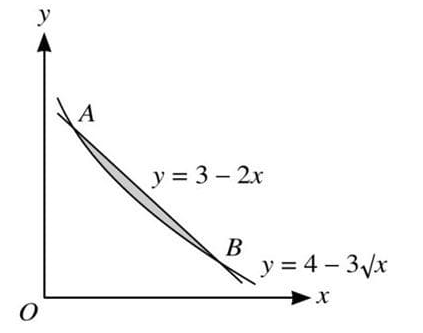
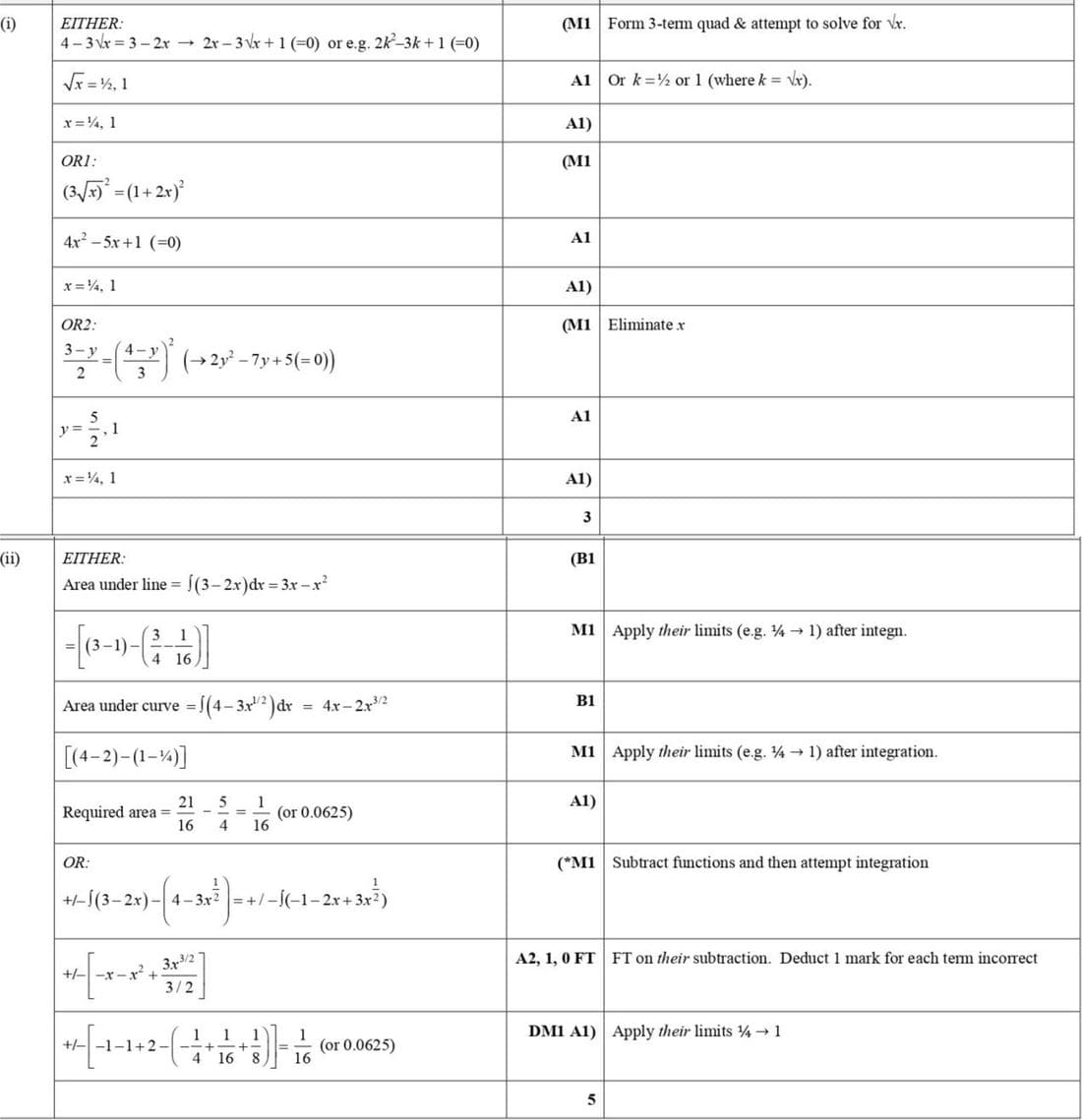
(i) To find the \(x\)-coordinates of \(A\) and \(B\), set the equations equal: \(3 - 2x = 4 - \frac{3}{\sqrt{x}}\).
Rearrange to form a quadratic: \(2x - \frac{3}{\sqrt{x}} + 1 = 0\).
Let \(k = \sqrt{x}\), then \(2k^2 - 3k + 1 = 0\).
Solving this quadratic gives \(k = \frac{1}{2}\) or \(k = 1\).
Thus, \(x = \left(\frac{1}{2}\right)^2 = \frac{1}{4}\) or \(x = 1\).
(ii) To find the area of the shaded region, calculate the area under each curve and subtract.
Area under \(y = 3 - 2x\) from \(x = \frac{1}{4}\) to \(x = 1\):
\(\int_{1/4}^{1} (3 - 2x) \, dx = [3x - x^2]_{1/4}^{1} = \left(3(1) - 1^2\right) - \left(3\left(\frac{1}{4}\right) - \left(\frac{1}{4}\right)^2\right) = \frac{21}{16}\).
Area under \(y = 4 - \frac{3}{\sqrt{x}}\) from \(x = \frac{1}{4}\) to \(x = 1\):
\(\int_{1/4}^{1} \left(4 - 3x^{1/2}\right) \, dx = [4x - 2x^{3/2}]_{1/4}^{1} = \left(4(1) - 2(1)^{3/2}\right) - \left(4\left(\frac{1}{4}\right) - 2\left(\frac{1}{4}\right)^{3/2}\right) = \frac{5}{4}\).
Required area = \(\frac{21}{16} - \frac{5}{4} = 0.0625\).