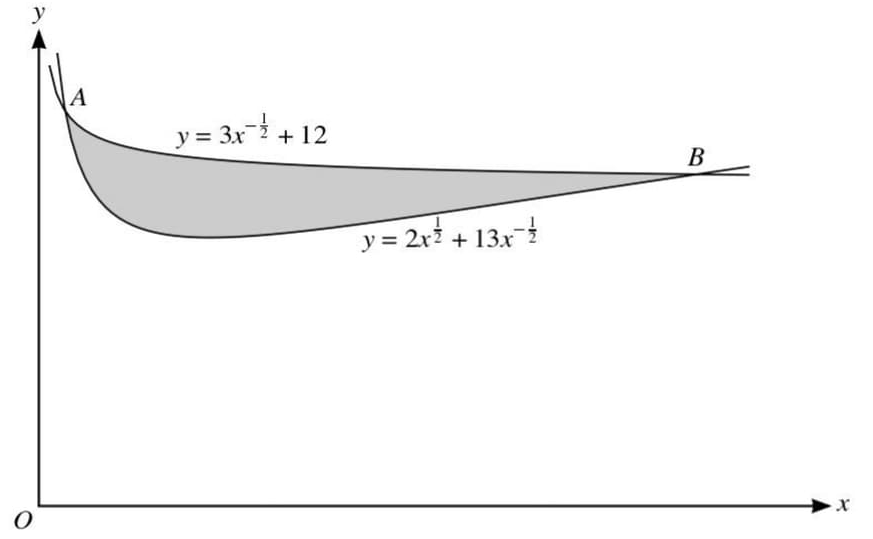
(a) To find the coordinates of \(A\) and \(B\), equate the two expressions for \(y\):
\(2x^{\frac{1}{2}} + 13x^{-\frac{1}{2}} = 3x^{-\frac{1}{2}} + 12\)
Rearrange to isolate terms:
\(2x^{\frac{1}{2}} + 13x^{-\frac{1}{2}} - 3x^{-\frac{1}{2}} - 12 = 0\)
\(2x^{\frac{1}{2}} + 10x^{-\frac{1}{2}} - 12 = 0\)
Multiply through by \(x^{\frac{1}{2}}\) to clear the fraction:
\(2x + 10 - 12x^{\frac{1}{2}} = 0\)
Rearrange to form a quadratic in \(x^{\frac{1}{2}}\):
\((x^{\frac{1}{2}} - 1)(x^{\frac{1}{2}} - 25) = 0\)
Solving gives \(x = 1\) and \(x = 25\).
Substitute back to find \(y\):
For \(x = 1\), \(y = 2(1)^{\frac{1}{2}} + 13(1)^{-\frac{1}{2}} = 15\).
For \(x = 25\), \(y = 2(25)^{\frac{1}{2}} + 13(25)^{-\frac{1}{2}} = \frac{128}{5}\).
(b) To find the area of the shaded region, integrate the difference between the curves from \(x = 1\) to \(x = 25\):
\(\text{Area} = \int_{1}^{25} \left( 2x^{\frac{1}{2}} + 13x^{-\frac{1}{2}} - (3x^{-\frac{1}{2}} + 12) \right) \, dx\)
\(= \int_{1}^{25} \left( 2x^{\frac{1}{2}} + 10x^{-\frac{1}{2}} - 12 \right) \, dx\)
Integrate each term:
\(\int 2x^{\frac{1}{2}} \, dx = \frac{4}{3}x^{\frac{3}{2}}\)
\(\int 10x^{-\frac{1}{2}} \, dx = 20x^{\frac{1}{2}}\)
\(\int -12 \, dx = -12x\)
Evaluate from 1 to 25:
\(\left[ \frac{4}{3}(25)^{\frac{3}{2}} + 20(25)^{\frac{1}{2}} - 12(25) \right] - \left[ \frac{4}{3}(1)^{\frac{3}{2}} + 20(1)^{\frac{1}{2}} - 12(1) \right]\)
\(= \frac{128}{3}\) or approximately 42.7.