Browsing as Guest. Progress, bookmarks and attempts are disabled.
Log in to track your work.
Problem #1284
Metadata not filled yet
1284
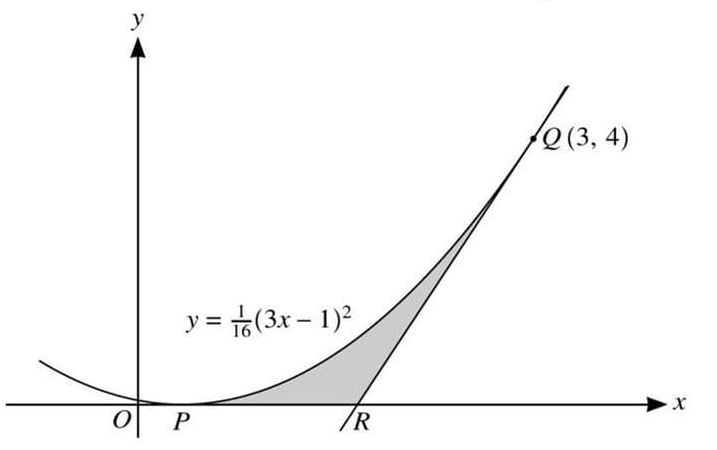
The diagram shows part of the curve \(y = \frac{1}{16}(3x-1)^2\), which touches the \(x\)-axis at the point \(P\). The point \(Q (3, 4)\) lies on the curve and the tangent to the curve at \(Q\) crosses the \(x\)-axis at \(R\).
(i) State the \(x\)-coordinate of \(P\).
Showing all necessary working, find by calculation
(ii) the \(x\)-coordinate of \(R\),
(iii) the area of the shaded region \(PQR\).
Solution
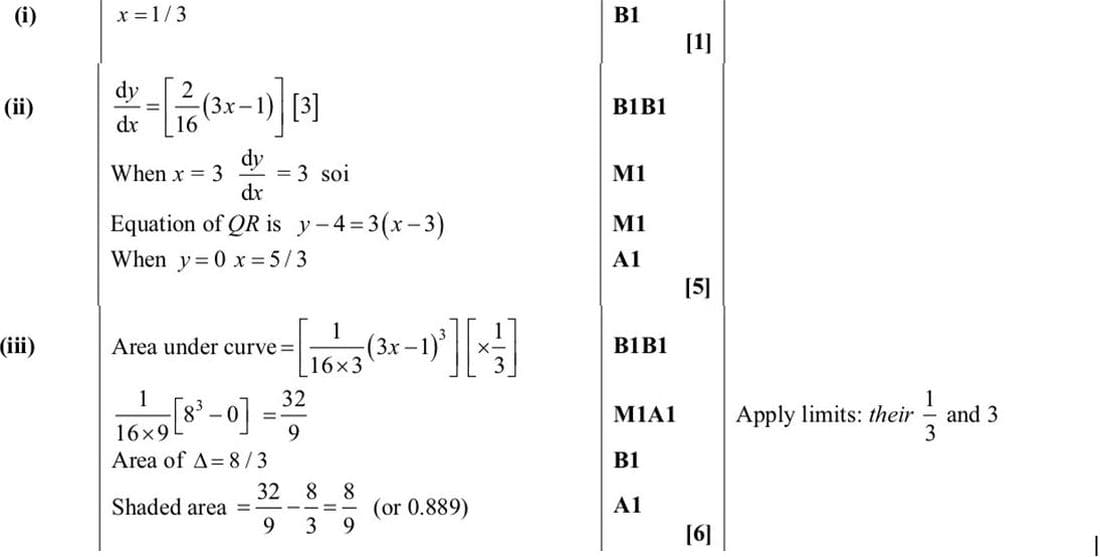
(i) To find the \(x\)-coordinate of \(P\), set \(y = 0\) in the equation \(y = \frac{1}{16}(3x-1)^2\). Solving \(\frac{1}{16}(3x-1)^2 = 0\) gives \(3x-1 = 0\), so \(x = \frac{1}{3}\).
(ii) Differentiate \(y = \frac{1}{16}(3x-1)^2\) to find the gradient at \(Q\). \(\frac{dy}{dx} = \frac{2}{16}(3x-1) \times 3 = \frac{3}{8}(3x-1)\). At \(x = 3\), \(\frac{dy}{dx} = 3\). The equation of the tangent at \(Q\) is \(y - 4 = 3(x - 3)\). Setting \(y = 0\) to find \(R\), \(0 - 4 = 3(x - 3)\) gives \(x = \frac{5}{3}\).
(iii) The area under the curve from \(x = \frac{1}{3}\) to \(x = 3\) is \(\int_{1/3}^{3} \frac{1}{16}(3x-1)^2 \, dx\). This evaluates to \(\frac{1}{16 \times 3}[(3x-1)^3]_{1/3}^{3} = \frac{32}{9}\). The area of triangle \(\Delta\) is \(\frac{1}{2} \times (3 - \frac{1}{3}) \times 4 = \frac{8}{3}\). The shaded area \(PQR\) is \(\frac{32}{9} - \frac{8}{3} = \frac{8}{9}\) (or 0.889).