Past Exam Questions
← Back9709 P31 - Jun 2010 - Q3
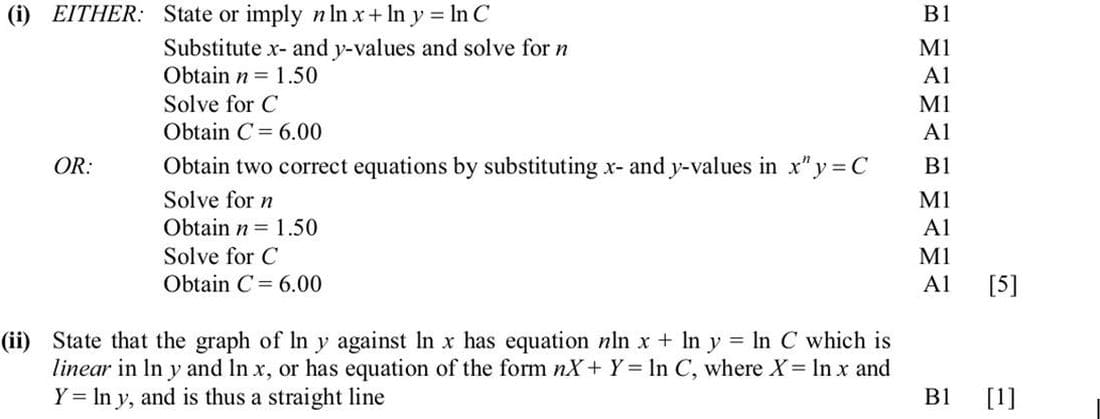
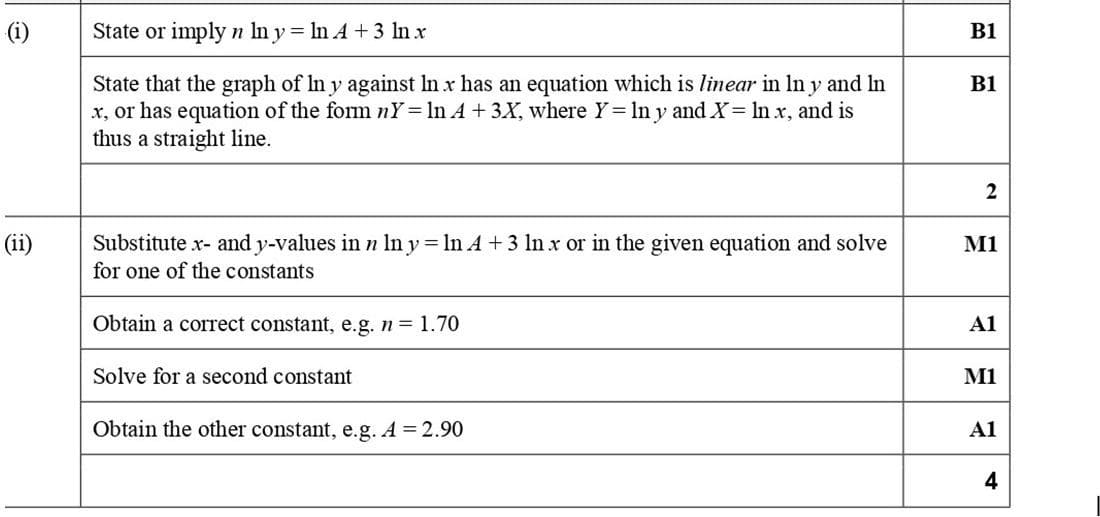
The variables x and y satisfy the equation xny = C, where n and C are constants. When x = 1.10, y = 5.20, and when x = 3.20, y = 1.05.
(i) Find the values of n and C.
(ii) Explain why the graph of ln y against ln x is a straight line.
9709 P3 - Nov 2005 - Q2
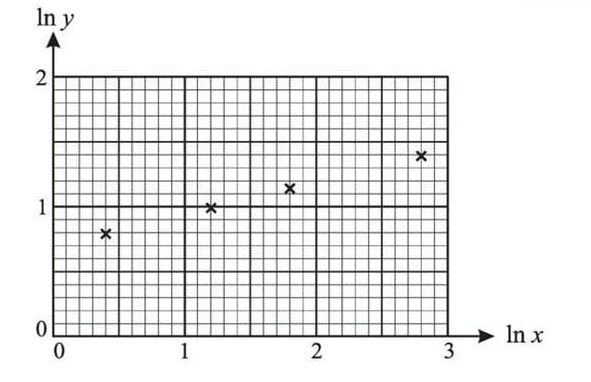
Two variable quantities x and y are related by the equation \(y = Ax^n\), where A and n are constants. The diagram shows the result of plotting \(\\ln y\) against \(\\ln x\) for four pairs of values of x and y. Use the diagram to estimate the values of A and n.

9709 P32 - Mar 2022 - Q3
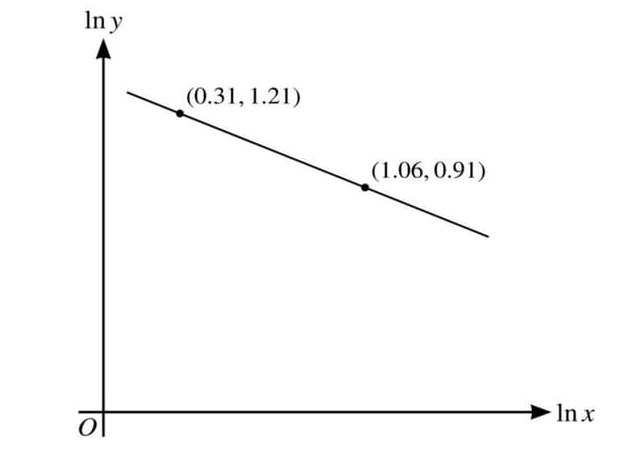
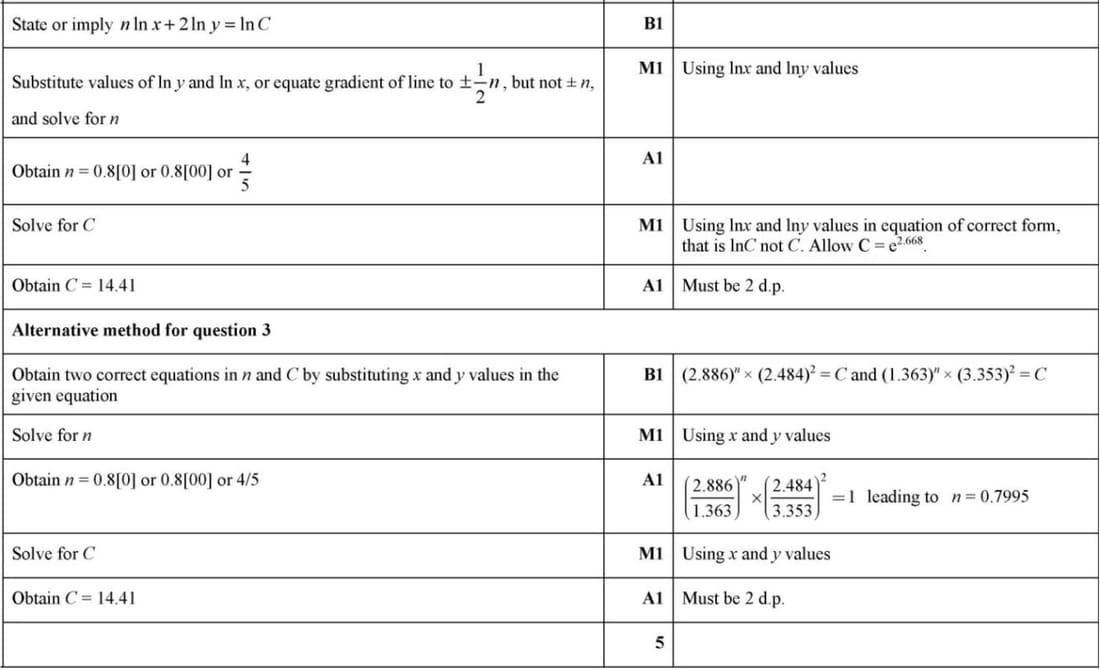
The variables x and y satisfy the equation xny2 = C, where n and C are constants. The graph of ln y against ln x is a straight line passing through the points (0.31, 1.21) and (1.06, 0.91), as shown in the diagram.
Find the value of n and find the value of C correct to 2 decimal places.
9709 P32 - Jun 2021 - Q3
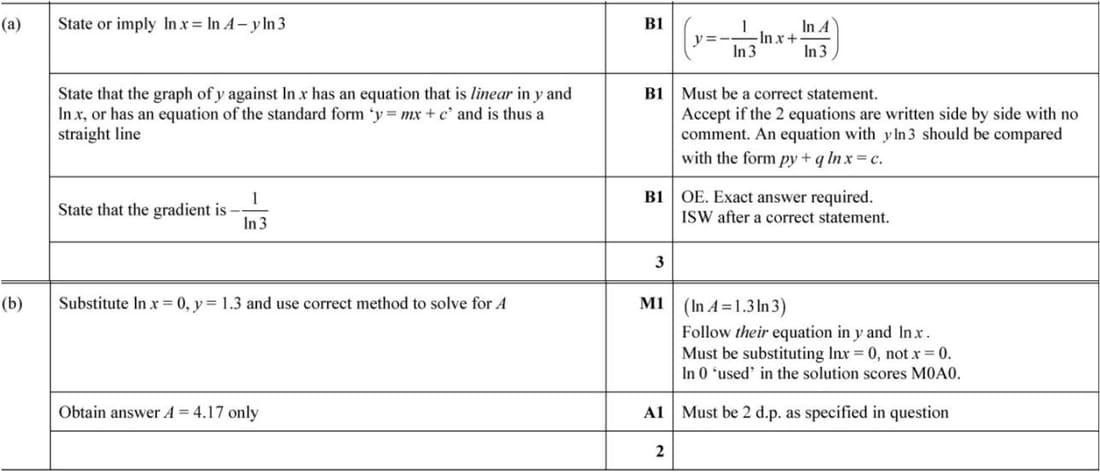
\(The variables x and y satisfy the equation x = A(3^{-y}), where A is a constant.\)
(a) Explain why the graph of y against ln x is a straight line and state the exact value of the gradient of the line.
\(It is given that the line intersects the y-axis at the point where y = 1.3.\)
(b) Calculate the value of A, giving your answer correct to 2 decimal places.
9709 P32 - Nov 2020 - Q3
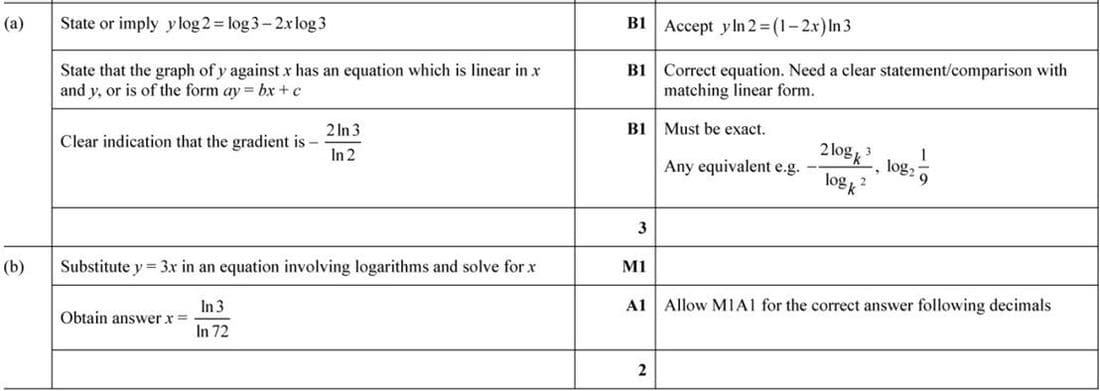
The variables x and y satisfy the relation \(2^y = 3^{1-2x}\).
(a) By taking logarithms, show that the graph of y against x is a straight line. State the exact value of the gradient of this line. [3]
(b) Find the exact x-coordinate of the point of intersection of this line with the line y = 3x. Give your answer in the form \(\frac{\ln a}{\ln b}\), where a and b are integers. [2]
9709 P32 - Jun 2020 - Q2
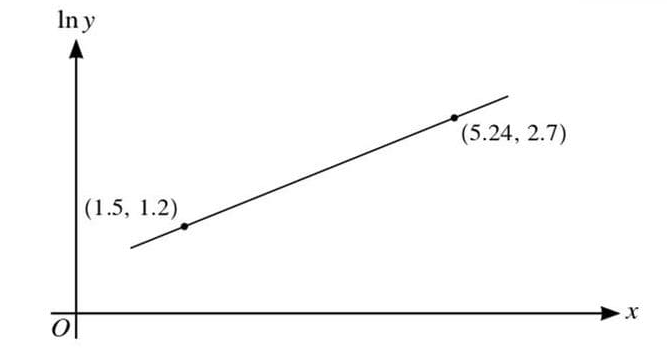
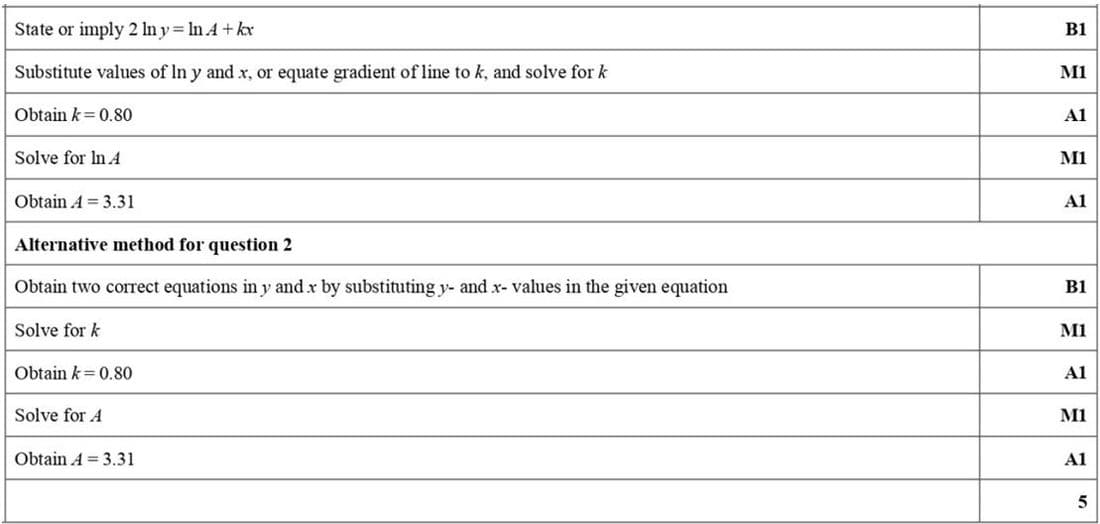
The variables x and y satisfy the equation y2 = Aekx, where A and k are constants. The graph of ln y against x is a straight line passing through the points (1.5, 1.2) and (5.24, 2.7) as shown in the diagram.
Find the values of A and k correct to 2 decimal places.
9709 P32 - Mar 2018 - Q4
The variables x and y satisfy the equation yn = Ax3, where n and A are constants. It is given that y = 2.58 when x = 1.20, and y = 9.49 when x = 2.51.
- Explain why the graph of ln y against ln x is a straight line.
- Find the values of n and A, giving your answers correct to 2 decimal places.
9709 P31 - Nov 2017 - Q2
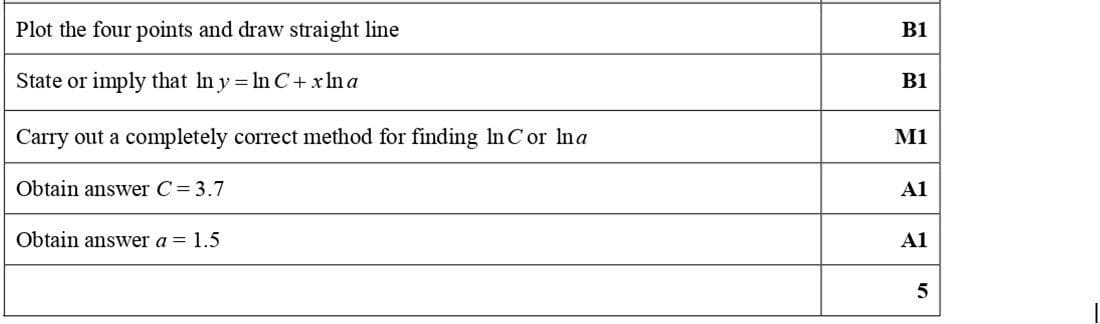
Two variable quantities x and y are believed to satisfy an equation of the form \(y = C(a^x)\), where \(C\) and \(a\) are constants. An experiment produced four pairs of values of x and y. The table below gives the corresponding values of x and \(\\ln y\).
\(\begin{array}{c|cccc} x & 0.9 & 1.6 & 2.4 & 3.2 \\ \hline \\ln y & 1.7 & 1.9 & 2.3 & 2.6 \end{array}\)
By plotting \(\\ln y\) against x for these four pairs of values and drawing a suitable straight line, estimate the values of \(C\) and \(a\). Give your answers correct to 2 significant figures.
9709 P33 - Jun 2016 - Q2
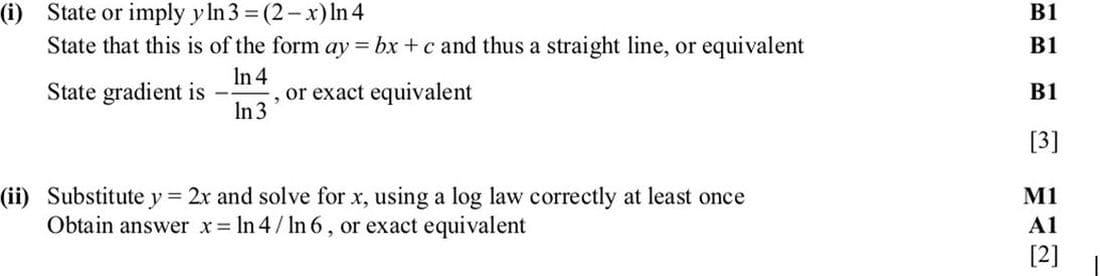
The variables x and y satisfy the relation \(3^y = 4^{2-x}\).
- By taking logarithms, show that the graph of y against x is a straight line. State the exact value of the gradient of this line. [3]
- Calculate the exact x-coordinate of the point of intersection of this line with the line with equation y = 2x, simplifying your answer. [2]
9709 P32 - Jun 2013 - Q3
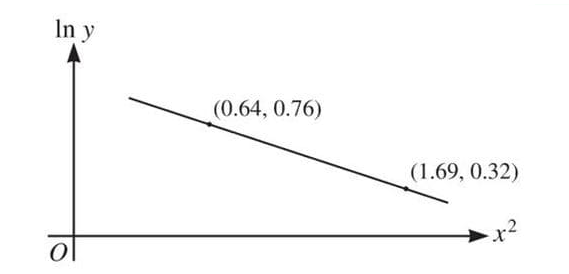
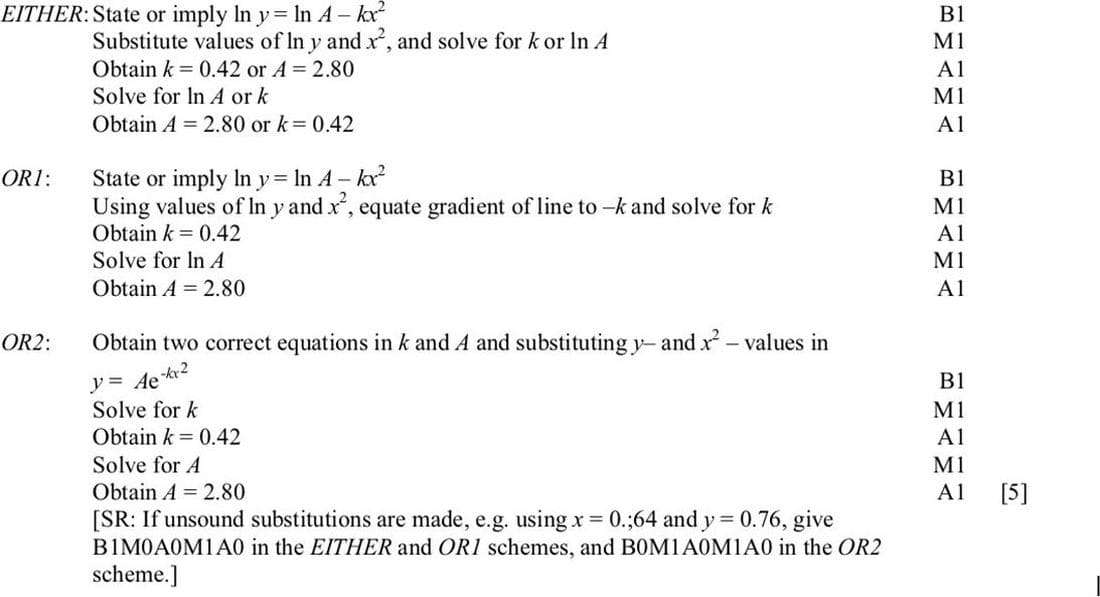
The variables x and y satisfy the equation y = Ae-kx2, where A and k are constants. The graph of ln y against x2 is a straight line passing through the points (0.64, 0.76) and (1.69, 0.32), as shown in the diagram. Find the values of A and k correct to 2 decimal places.
9709 P43 - Nov 2023 - Q1
A particle is projected vertically upwards from horizontal ground with a speed of \(u \text{ m s}^{-1}\). The particle has height \(s\) m above the ground at times 3 seconds and 4 seconds after projection.
Find the value of \(u\) and the value of \(s\).

9709 P42 - Nov 2019 - Q5
Two particles A and B move in the same vertical line. Particle A is projected vertically upwards from the ground with speed 20 m s-1. One second later particle B is dropped from rest from a height of 40 m.
- Find the height above the ground at which the two particles collide.
- Find the difference in the speeds of the two particles at the instant when the collision occurs.

9709 P41 - Jun 2019 - Q2
A particle P is projected vertically upwards with speed 25 m s-1 from a point 3 m above horizontal ground.
- Find the time taken for P to reach its greatest height.
- Find the length of time for which P is higher than 23 m above the ground.
- P is higher than h m above the ground for 1 second. Find h.

9709 P42 - Mar 2019 - Q2
A particle is projected vertically upwards with speed 30 m s-1 from a point on horizontal ground.
- Show that the maximum height above the ground reached by the particle is 45 m.
- Find the time that it takes for the particle to reach a height of 33.75 m above the ground for the first time. Find also the speed of the particle at this time.

9709 P43 - Jun 2018 - Q2
A small ball is projected vertically downwards with speed 5 m s-1 from a point A at a height of 7.2 m above horizontal ground. The ball hits the ground with speed V m s-1 and rebounds vertically upwards with speed \(\frac{1}{2} V\) m s-1. The highest point the ball reaches after rebounding is B. Find V and hence find the total time taken for the ball to reach the ground from A and rebound to B.

9709 P41 - Jun 2018 - Q1
A particle P is projected vertically upwards with speed 24 m s-1 from a point 5 m above ground level. Find the time from projection until P reaches the ground.

9709 P42 - Mar 2018 - Q5
A small rocket is fired vertically upwards, starting from rest at ground level, and moves with constant acceleration. The rocket reaches a height of 200 m after 10 s.
- Show that the speed of the rocket after 10 s is 40 m s-1 and find the acceleration of the rocket during the first 10 s. [4]
- After 10 s, the rocket’s fuel stops burning and there is no upward force acting on the rocket. Find the maximum height above ground level reached by the rocket. [2]
- Find the total time from the instant the rocket is fired until it returns to the ground. [4]

9709 P42 - Nov 2017 - Q4
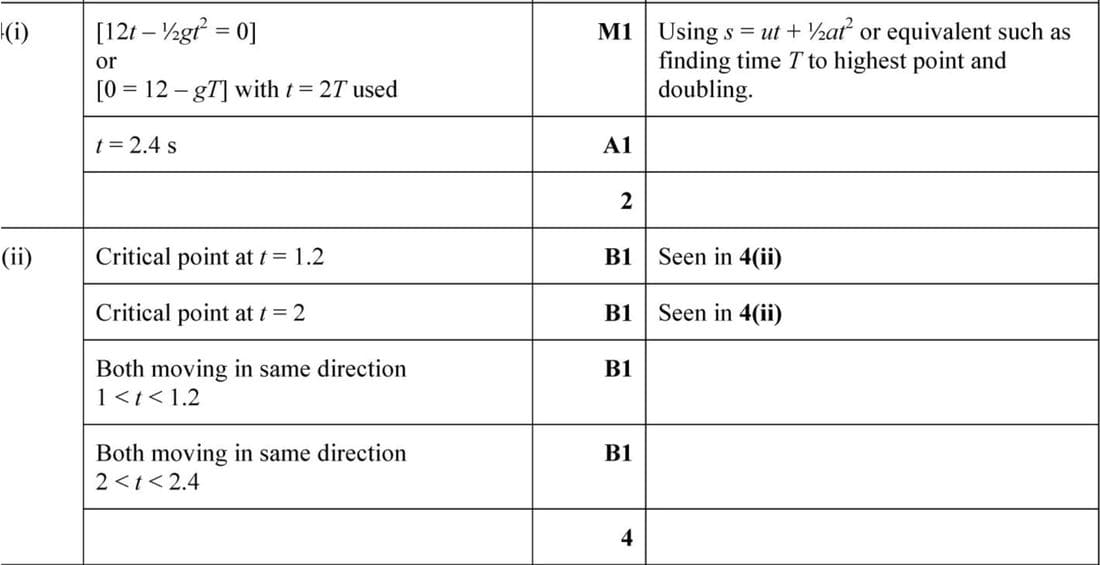
A particle P is projected vertically upwards from horizontal ground with speed 12 m s-1.
- Find the time taken for P to return to the ground.
The time in seconds after P is projected is denoted by t. When t = 1, a second particle Q is projected vertically upwards with speed 10 m s-1 from a point which is 5 m above the ground. Particles P and Q move in different vertical lines.
- Find the set of values of t for which the two particles are moving in the same direction.
9709 P43 - Jun 2017 - Q5
A particle is projected vertically upwards from a point O with a speed of 12 m s-1. Two seconds later a second particle is projected vertically upwards from O with a speed of 20 m s-1. At time t s after the second particle is projected, the two particles collide.
(i) Find t.
(ii) Hence find the height above O at which the particles collide.

9709 P43 - Nov 2016 - Q4
A ball A is released from rest at the top of a tall tower. One second later, another ball B is projected vertically upwards from ground level near the bottom of the tower with a speed of 20 m s-1. The two balls are at the same height 1.5 s after ball B is projected.
(i) Show that the height of the tower is 50 m.
(ii) Find the length of time for which ball B has been in motion when ball A reaches the ground. Hence find the total distance travelled by ball B up to the instant when ball A reaches the ground.
