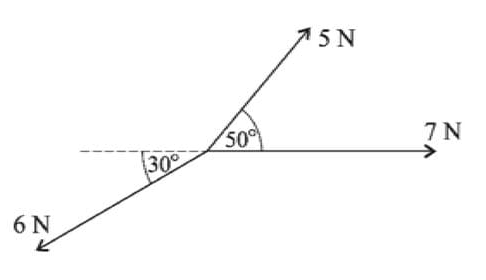
To find the resultant of the three forces, we resolve each force into its horizontal (
X
) and vertical (
Y
) components.
For the 7 N force (acting horizontally):
\(X_1 = 7, \quad Y_1 = 0\)
For the 5 N force (at 50° to the horizontal):
\(X_2 = 5 \cos 50°, \quad Y_2 = 5 \sin 50°\)
For the 6 N force (at 30° below the horizontal):
\(X_3 = -6 \cos 30°, \quad Y_3 = -6 \sin 30°\)
Summing the components:
\(X = X_1 + X_2 + X_3 = 7 + 5 \cos 50° - 6 \cos 30°\)
\(Y = Y_1 + Y_2 + Y_3 = 5 \sin 50° - 6 \sin 30°\)
Calculating these values:
X \approx 5.02, \quad Y \approx 0.83
The magnitude of the resultant force is given by:
\(R = \sqrt{X^2 + Y^2} \approx \sqrt{5.02^2 + 0.83^2} \approx 5.09 \text{ N}\)
The direction of the resultant force relative to the 7 N force is given by:
\(\theta = \tan^{-1} \left(\frac{Y}{X}\right) \approx \tan^{-1} \left(\frac{0.83}{5.02}\right) \approx 9.4°\)
Thus, the magnitude of the resultant force is 5.09 N, and its direction is 9.4° anti-clockwise from the force of magnitude 7 N.