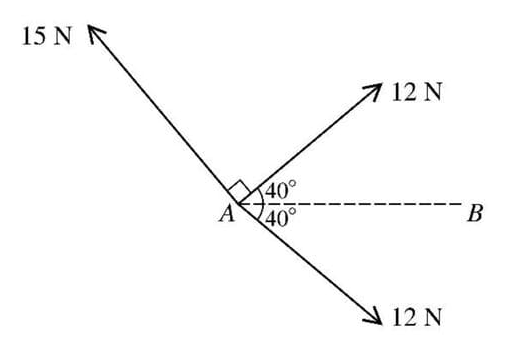
Three coplanar forces of magnitudes 15 N, 12 N, and 12 N act at a point A in directions as shown in the diagram.
(i) Find the component of the resultant of the three forces
- in the direction of AB,
- perpendicular to AB.
(ii) Hence find the magnitude and direction of the resultant of the three forces.
Solution
(i) To find the component of the resultant in the direction of AB:
The forces are resolved along AB using the cosine of the angles given:
\(2 \times 12 \cos 40^\circ - 15 \cos 50^\circ = 8.74 \text{ N}\)
(ii) To find the component perpendicular to AB:
The forces are resolved perpendicular to AB using the sine of the angles:
\(12 \sin 40^\circ + 12 \sin 40^\circ - 15 \sin 50^\circ = 11.5 \text{ N}\)
(ii) To find the magnitude and direction of the resultant:
The magnitude of the resultant force is given by:
\(R = \sqrt{(8.74)^2 + (11.5)^2} = 14.4 \text{ N}\)
The direction \(\theta\) is given by:
\(\tan \theta = \frac{11.5}{8.74}\)
Thus, \(\theta = 52.7^\circ\) anticlockwise from the i direction.
Log in to record attempts.