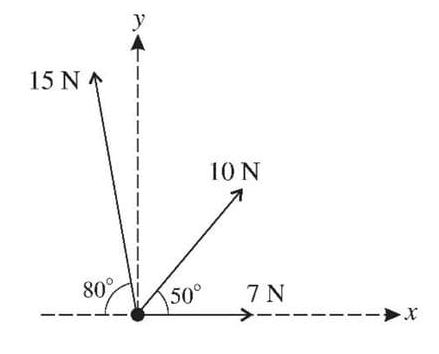
To find the components of the resultant force, we resolve each force into its x and y components.
For the 7 N force along the x-axis:
\(F_{x1} = 7 \text{ N}\)
For the 10 N force at 50° to the x-axis:
\(F_{x2} = 10 \cos 50^{\circ}\)
\(F_{y2} = 10 \sin 50^{\circ}\)
For the 15 N force at 80° to the x-axis:
\(F_{x3} = -15 \cos 80^{\circ}\)
\(F_{y3} = 15 \sin 80^{\circ}\)
The negative sign for \(F_{x3}\) is because the force is acting in the negative x-direction.
Summing the x-components:
\(X = F_{x1} + F_{x2} + F_{x3} = 7 + 10 \cos 50^{\circ} - 15 \cos 80^{\circ}\)
Summing the y-components:
\(Y = F_{y2} + F_{y3} = 10 \sin 50^{\circ} + 15 \sin 80^{\circ}\)
Calculating these gives:
\(X = 10.8 \text{ N}\)
\(Y = 22.4 \text{ N}\)
To find the direction of the resultant force, we use:
\(\theta = \arctan \left( \frac{Y}{X} \right) = \arctan \left( \frac{22.4}{10.8} \right)\)
Calculating this gives:
\(\theta = 64.2^{\circ}\)
The direction is 64.2° anticlockwise from the x-axis.