9709 P4 - Nov 2006 - Q6
3707
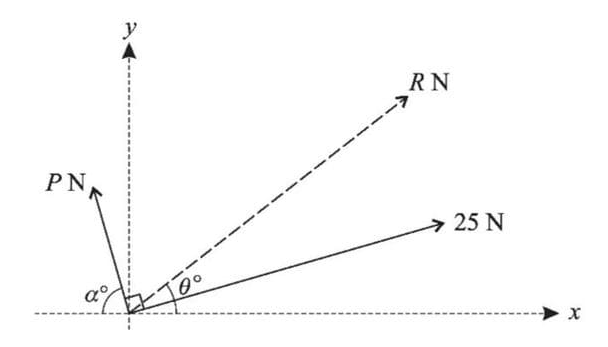
Forces of magnitudes PN and 25N act at right angles to each other. The resultant of the two forces has magnitude RN and makes an angle of θ° with the x-axis (see diagram). The force of magnitude PN has components -2.8N in the x-direction and 9.6N in the y-direction respectively, and makes an angle of α° with the negative x-axis.
- Find the values of P and R.
- Find the value of α, and hence find the components of the force of magnitude 25N in
- the x-direction,
- the y-direction.
- Find the value of θ.
Solutions locked. Please sign in with access to view them.