Past Exam Questions
← Back9709 P31 - Jun 2022 - Q1
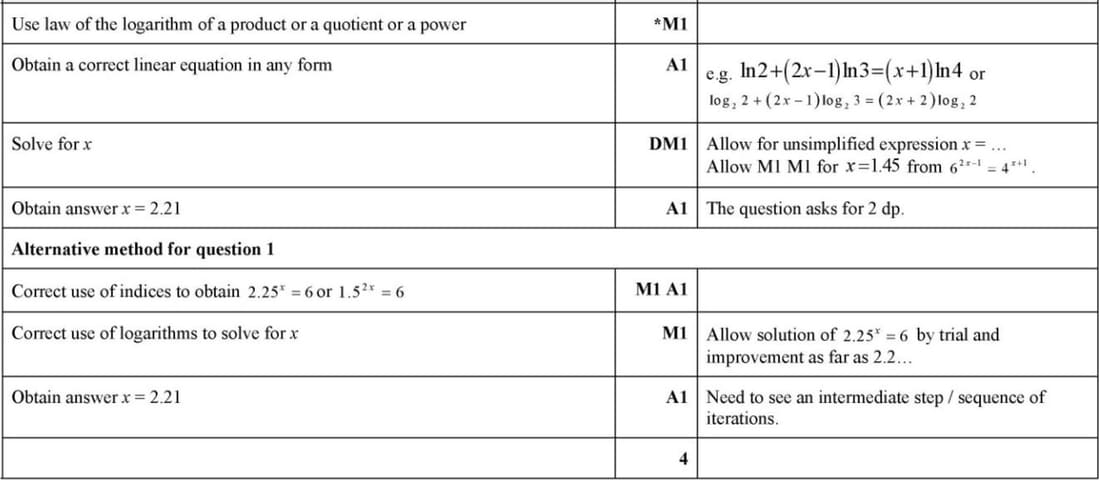
Solve the equation \(2(3^{2x-1}) = 4^{x+1}\), giving your answer correct to 2 decimal places.
9709 P32 - Nov 2021 - Q1
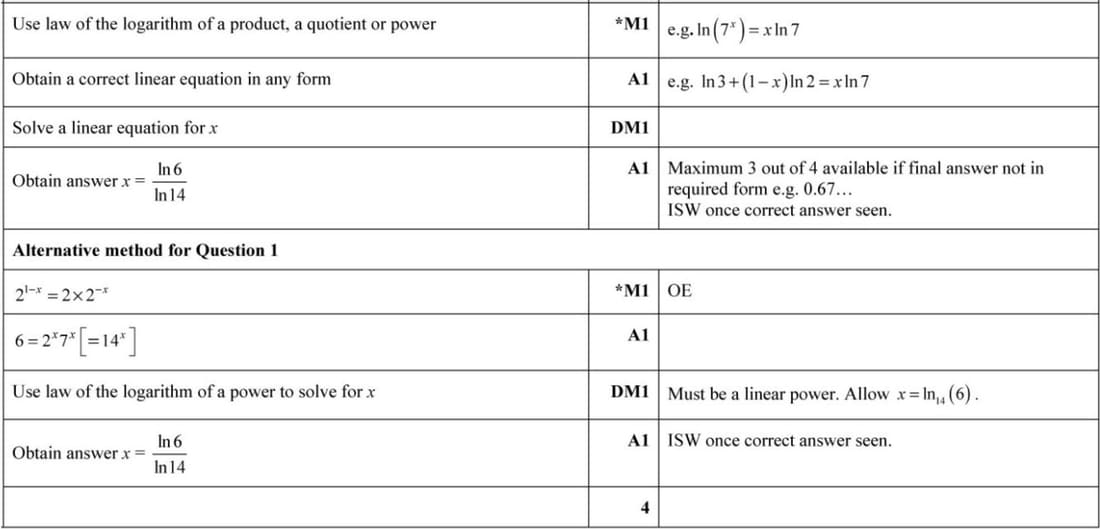
Find the value of \(x\) for which \(3(2^{1-x}) = 7^x\). Give your answer in the form \(\frac{\ln a}{\ln b}\), where \(a\) and \(b\) are integers.
9709 P32 - Mar 2021 - Q1
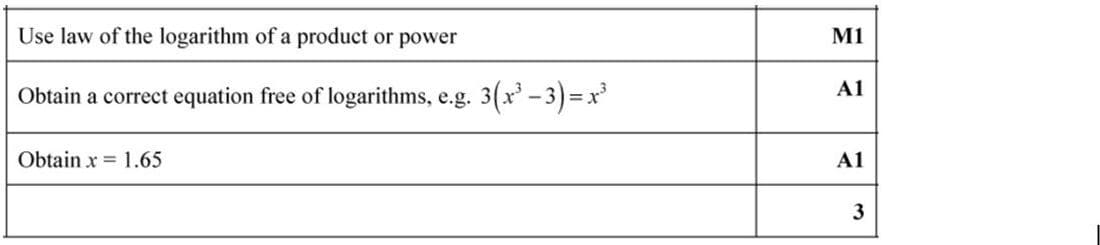
Solve the equation \(\ln(x^3 - 3) = 3 \ln x - \ln 3\). Give your answer correct to 3 significant figures.
9709 P31 - Jun 2023 - Q1
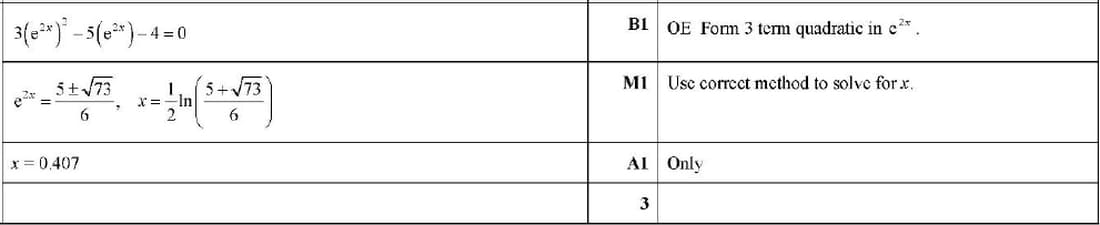
Solve the equation
\(3e^{2x} - 4e^{-2x} = 5\).
Give the answer correct to 3 decimal places.
9709 P31 - Jun 2021 - Q2
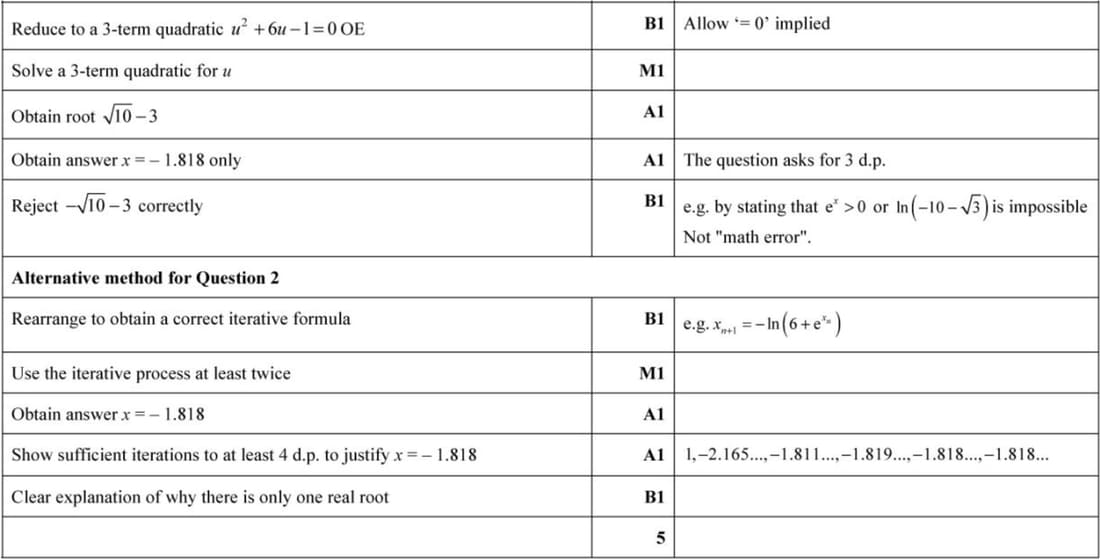
Find the real root of the equation \(\frac{2e^x + e^{-x}}{2 + e^x} = 3\), giving your answer correct to 3 decimal places. Your working should show clearly that the equation has only one real root.
9709 P33 - Jun 2020 - Q3
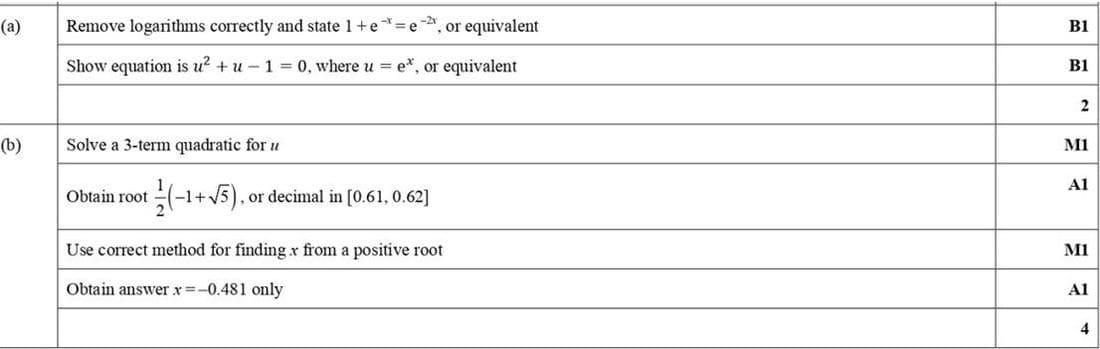
(a) Show that the equation \(\ln(1 + e^{-x}) + 2x = 0\) can be expressed as a quadratic equation in \(e^x\).
(b) Hence solve the equation \(\ln(1 + e^{-x}) + 2x = 0\), giving your answer correct to 3 decimal places.
9709 P32 - Nov 2018 - Q4
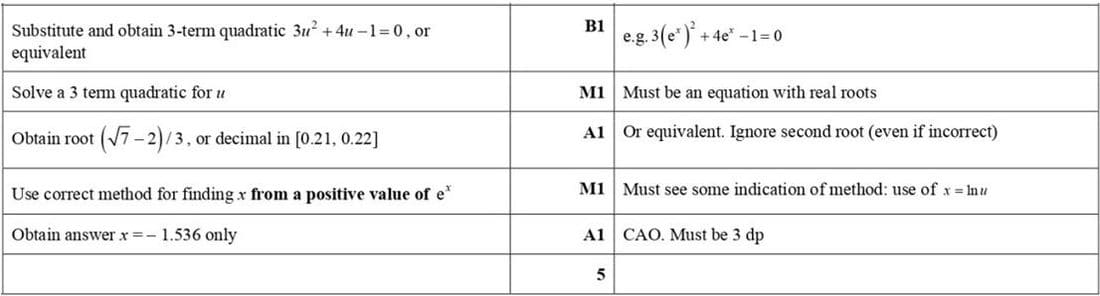
Showing all necessary working, solve the equation
\(\frac{e^x + e^{-x}}{e^x + 1} = 4\),
giving your answer correct to 3 decimal places.
9709 P31 - Nov 2018 - Q2
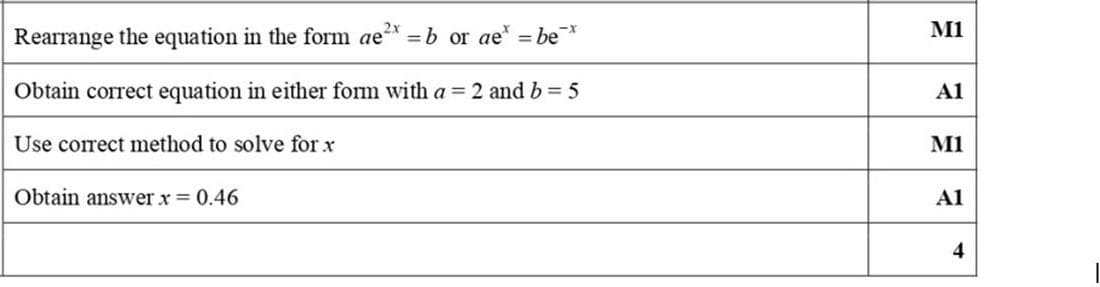
Showing all necessary working, solve the equation \(\frac{2e^x + e^{-x}}{e^x - e^{-x}} = 4\), giving your answer correct to 2 decimal places.
9709 P33 - Jun 2017 - Q3
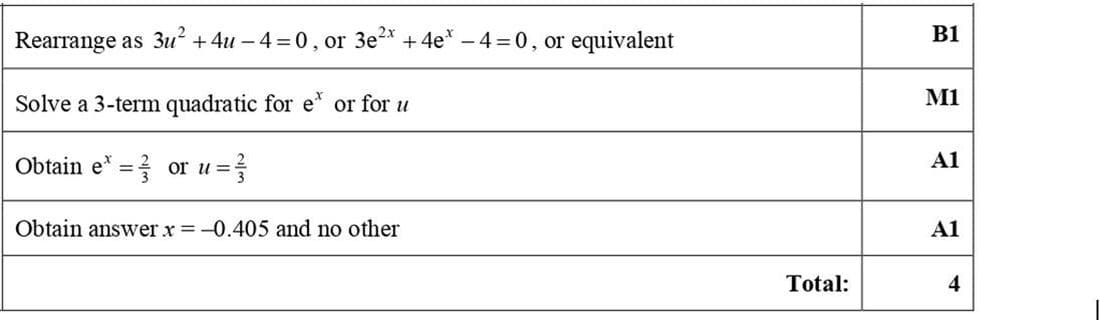
Using the substitution \(u = e^x\), solve the equation \(4e^{-x} = 3e^x + 4\). Give your answer correct to 3 significant figures.
9709 P31 - Nov 2011 - Q1
Using the substitution \(u = e^x\), or otherwise, solve the equation
\(e^x = 1 + 6e^{-x}\),
giving your answer correct to 3 significant figures.

9709 P3 - Jun 2008 - Q2
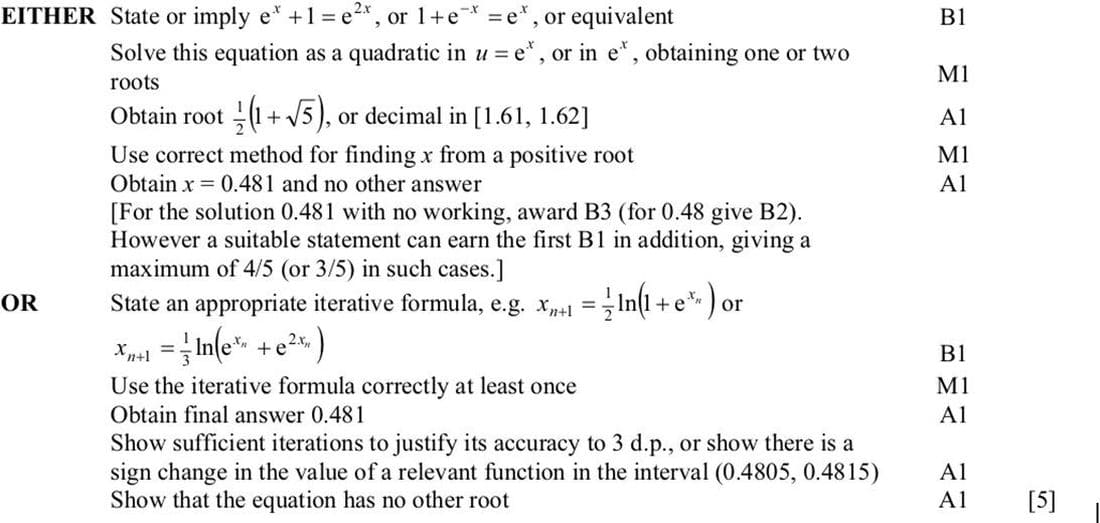
Solve, correct to 3 significant figures, the equation
\(e^x + e^{2x} = e^{3x}\).
9709 P32 - Mar 2023 - Q1
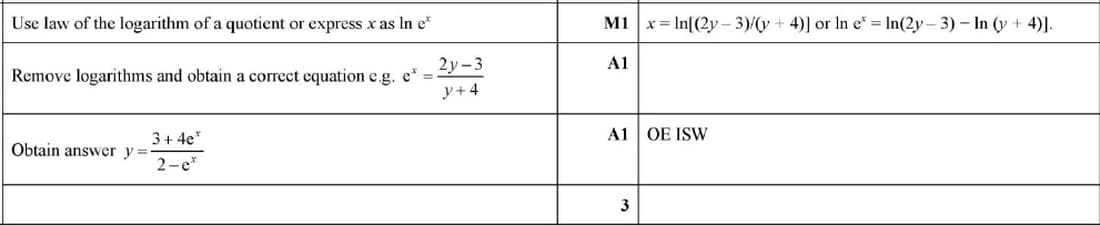
It is given that \(x = \ln(2y - 3) - \ln(y + 4)\).
Express \(y\) in terms of \(x\).
9709 P31 - Nov 2019 - Q1
Given that \(\ln(1 + e^{2y}) = x\), express \(y\) in terms of \(x\).

9709 P33 - Nov 2016 - Q1
It is given that \(z = \ln(y+2) - \ln(y+1)\). Express \(y\) in terms of \(z\).

9709 P33 - Nov 2013 - Q1
Given that \(2 \ln(x + 4) - \ln x = \ln(x + a)\), express \(x\) in terms of \(a\).

9709 P33 - Jun 2013 - Q2
It is given that \(\ln(y + 1) - \ln y = 1 + 3 \ln x\). Express \(y\) in terms of \(x\), in a form not involving logarithms.

9709 P3 - Jun 2006 - Q1
Given that \(x = 4(3^{-y})\), express \(y\) in terms of \(x\).

9709 P31 - Nov 2023 - Q3
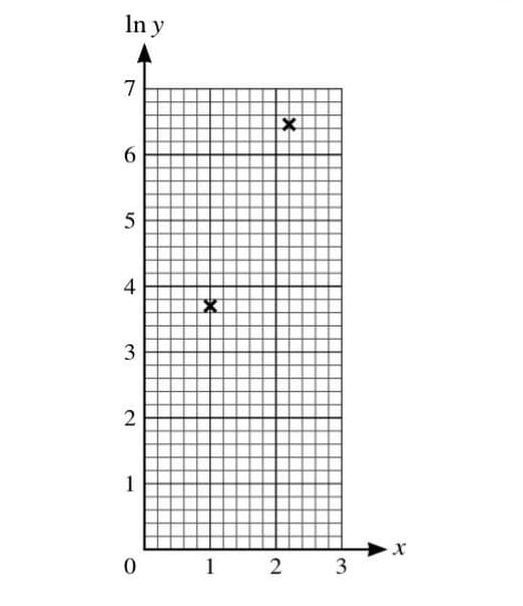
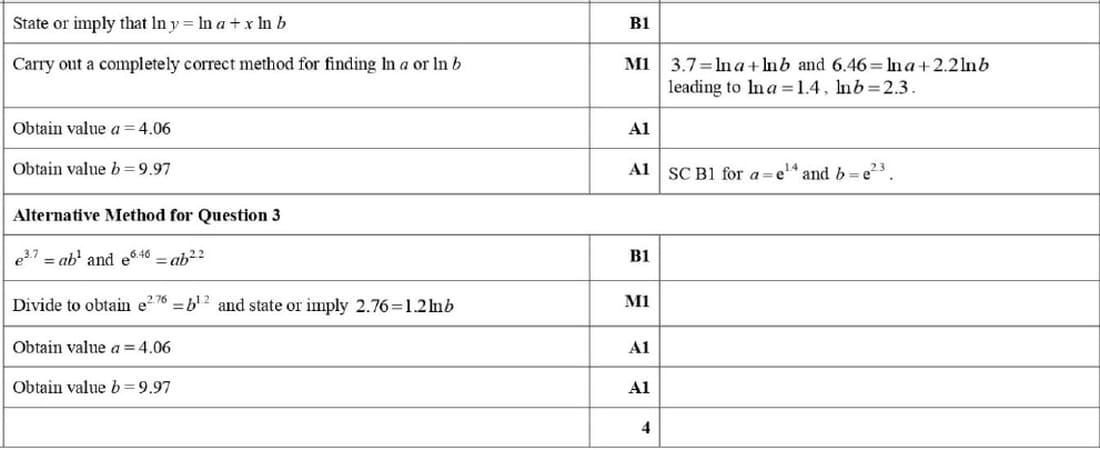
The variables x and y are related by the equation \(y = ab^x\), where \(a\) and \(b\) are constants. The diagram shows the result of plotting \(\ln y\) against \(x\) for two pairs of values of \(x\) and \(y\). The coordinates of these points are (1, 3.7) and (2.2, 6.46).
Use this information to find the values of \(a\) and \(b\).
9709 P31 - Jun 2011 - Q5
The curve with equation
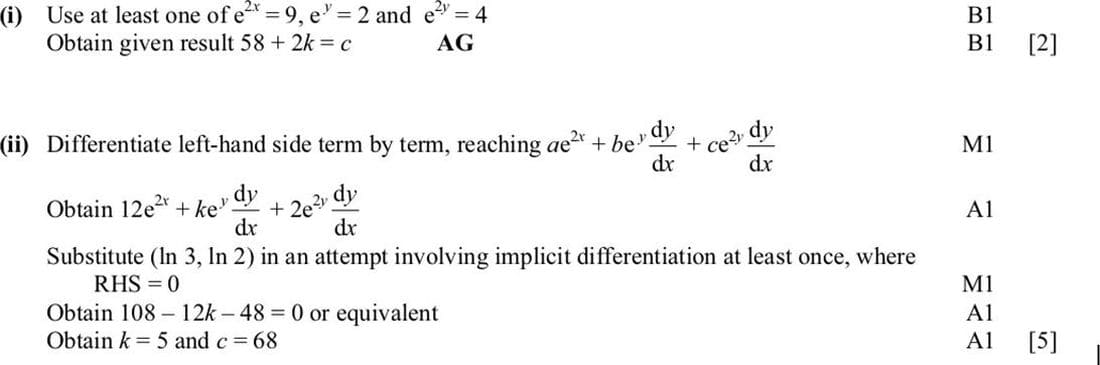
\(6e^{2x} + ke^y + e^{2y} = c\),
where \(k\) and \(c\) are constants, passes through the point \(P\) with coordinates \((\ln 3, \ln 2)\).
- Show that \(58 + 2k = c\).
- Given also that the gradient of the curve at \(P\) is \(-6\), find the values of \(k\) and \(c\).
9709 P33 - Jun 2010 - Q2
The variables x and y satisfy the equation y3 = Ae2x, where A is a constant. The graph of ln y against x is a straight line.
(i) Find the gradient of this line.
(ii) Given that the line intersects the axis of ln y at the point where ln y = 0.5, find the value of A correct to 2 decimal places.
