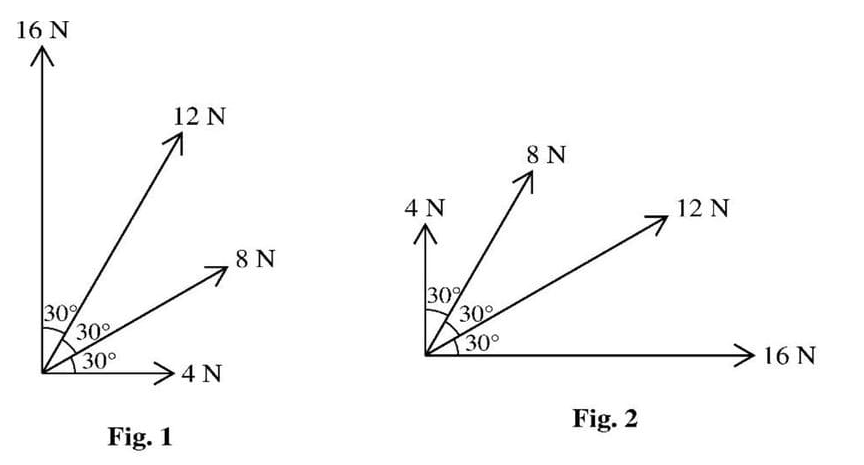
Four coplanar forces of magnitudes 4 N, 8 N, 12 N, and 16 N act at a point. The directions in which the forces act are shown in Fig. 1.
(i) Find the magnitude and direction of the resultant of the four forces.
The forces of magnitudes 4 N and 16 N exchange their directions and the forces of magnitudes 8 N and 12 N also exchange their directions (see Fig. 2).
(ii) State the magnitude and direction of the resultant of the four forces in Fig. 2.
Solution
(i) To find the resultant of the forces in Fig. 1, we calculate the components:
The x-component is given by:
\(x = 4 + 8 \cos 30^\circ + 12 \cos 60^\circ = 10 + 4\sqrt{3} \approx 16.928\)
The y-component is given by:
\(y = 8 \sin 30^\circ + 12 \sin 60^\circ + 16 = 20 + 6\sqrt{3} \approx 30.392\)
The magnitude of the resultant force is:
\(R = \sqrt{x^2 + y^2} = \sqrt{16.928^2 + 30.392^2} \approx 34.8 \text{ N}\)
The direction \(\theta\) with the 4 N force is:
\(\theta = \arctan \left( \frac{y}{x} \right) = \arctan \left( \frac{30.392}{16.928} \right) \approx 60.9^\circ\)
(ii) For Fig. 2, the forces exchange directions. The magnitude remains the same:
\(R = 34.8 \text{ N}\)
The direction \(\theta\) with the 16 N force is:
\(\theta = 90^\circ - 60.9^\circ = 29.1^\circ\)
Log in to record attempts.