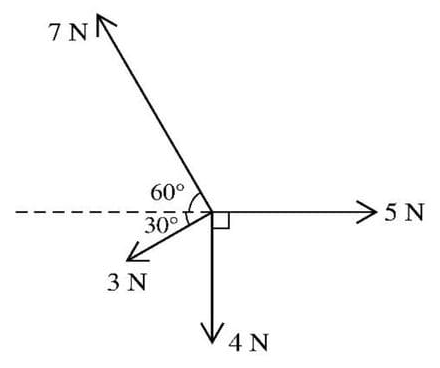
To find the resultant of the forces, we resolve each force into its x and y components.
For the x-direction:
\(X = 5 - 7\cos 60^\circ - 3\cos 30^\circ\)
\(X = 5 - 7 \times 0.5 - 3 \times \frac{\sqrt{3}}{2}\)
\(X = 5 - 3.5 - 2.598 \approx -1.098\)
For the y-direction:
\(Y = 7\sin 60^\circ - 3\sin 30^\circ - 4\)
\(Y = 7 \times \frac{\sqrt{3}}{2} - 3 \times 0.5 - 4\)
\(Y = 6.062 - 1.5 - 4 \approx 0.562\)
The magnitude of the resultant force \(R\) is given by:
\(R = \sqrt{X^2 + Y^2}\)
\(R = \sqrt{(-1.098)^2 + (0.562)^2}\)
\(R = \sqrt{1.206 + 0.316} \approx 1.23 \text{ N}\)
The direction \(\theta\) of the resultant force is given by:
\(\tan \theta = \frac{Y}{X}\)
\(\theta = \arctan\left(\frac{0.562}{-1.098}\right)\)
\(\theta \approx 152.9^\circ \text{ anticlockwise from the positive x-axis}\)