Past Exam Questions
← Back9709 P32 - Jun 2017 - Q1
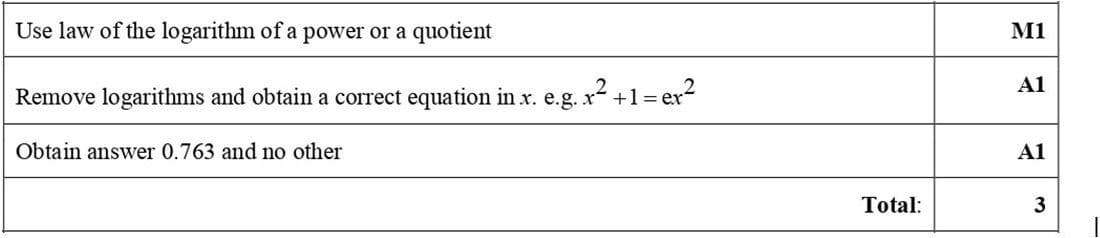
Solve the equation \(\ln(x^2 + 1) = 1 + 2 \ln x\), giving your answer correct to 3 significant figures.
9709 P2 - Mar 2023 - Q1
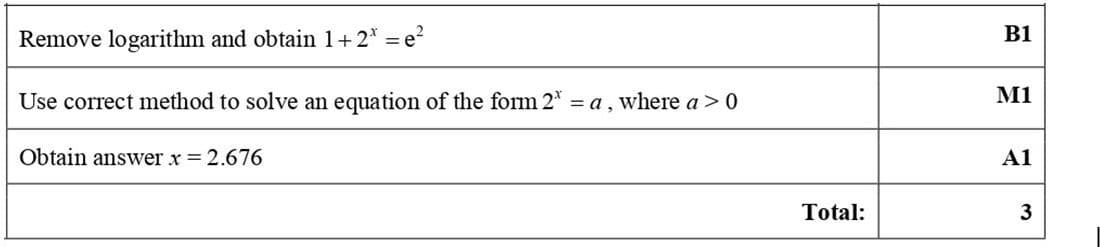
Solve the equation \(\ln(1 + 2^x) = 2\), giving your answer correct to 3 decimal places.
9709 P32 - Mar 2016 - Q1
Solve the equation \(\ln(x^2 + 4) = 2 \ln x + \ln 4\), giving your answer in an exact form.

9709 P33 - Jun 2015 - Q1
Solve the equation \(\ln(x + 4) = 2 \ln x + \ln 4\), giving your answer correct to 3 significant figures.

9709 P31 - Nov 2014 - Q1
Use logarithms to solve the equation \(e^x = 3^{x-2}\), giving your answer correct to 3 decimal places.

9709 P32 - Jun 2023 - Q2
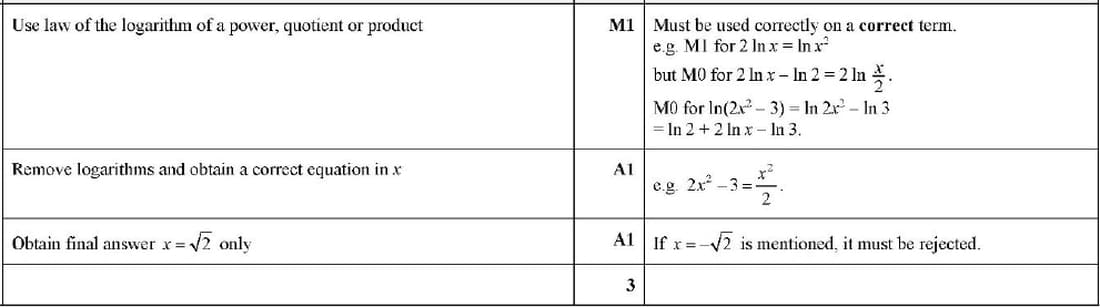
Solve the equation \(\ln(2x^2 - 3) = 2 \ln x - \ln 2\), giving your answer in an exact form.
9709 P32 - Jun 2014 - Q2
Solve the equation
\(2 \ln(5 - e^{-2x}) = 1\),
giving your answer correct to 3 significant figures.

9709 P31 - Jun 2014 - Q6
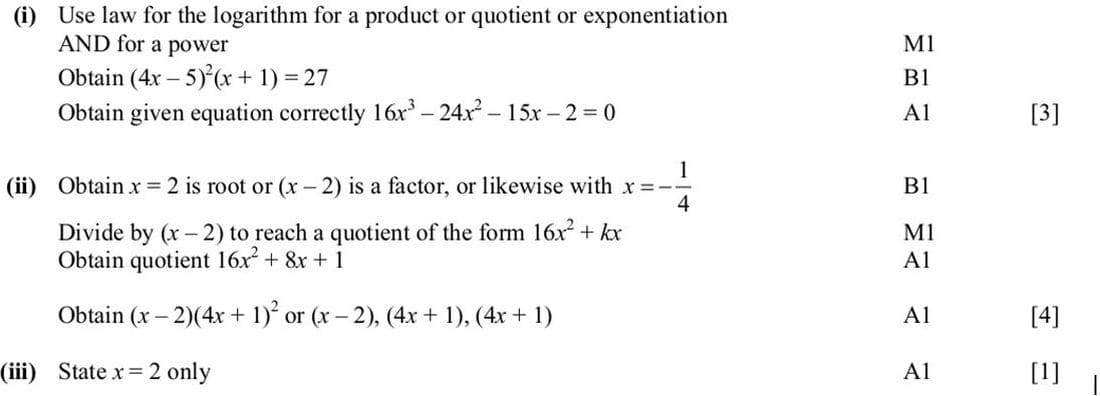
It is given that \(2\ln(4x - 5) + \ln(x + 1) = 3\ln 3\).
- Show that \(16x^3 - 24x^2 - 15x - 2 = 0\).
- By first using the factor theorem, factorise \(16x^3 - 24x^2 - 15x - 2\) completely.
- Hence solve the equation \(2\ln(4x - 5) + \ln(x + 1) = 3\ln 3\).
9709 P33 - Nov 2012 - Q1
Solve the equation \(\ln(x+5) = 1 + \ln x\), giving your answer in terms of \(e\).

9709 P33 - Jun 2012 - Q2
Solve the equation \(\ln(2x + 3) = 2 \ln x + \ln 3\), giving your answer correct to 3 significant figures.

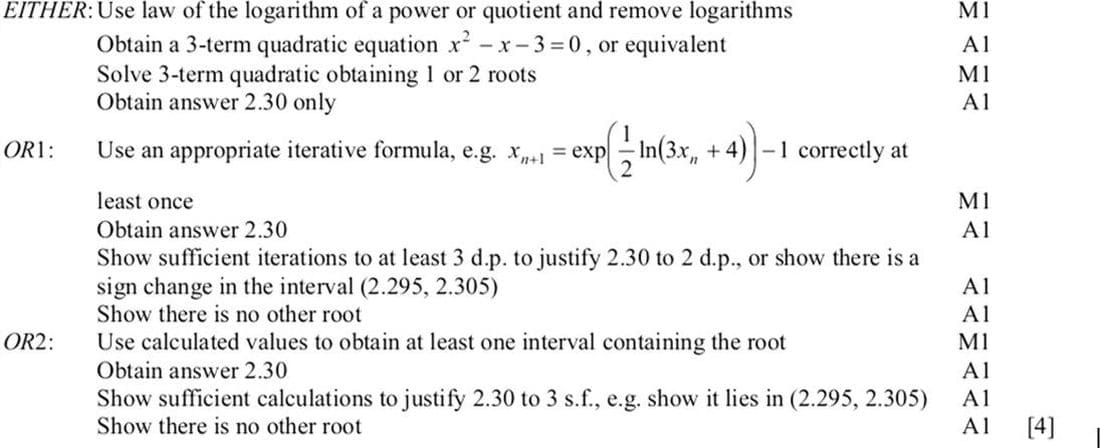
9709 P32 - Jun 2012 - Q1
Solve the equation
\(\ln(3x + 4) = 2 \ln(x + 1)\),
giving your answer correct to 3 significant figures.
9709 P31 - Nov 2010 - Q2
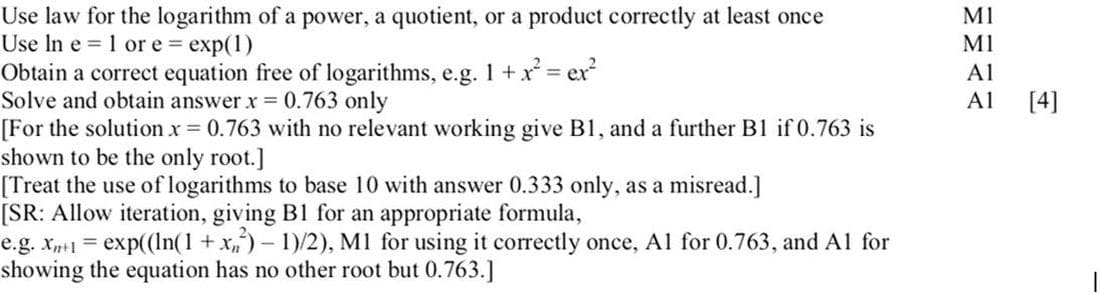
Solve the equation \(\ln(1 + x^2) = 1 + 2 \ln x\), giving your answer correct to 3 significant figures.
9709 P32 - Nov 2009 - Q1
Solve the equation \(\ln(5-x) = \ln 5 - \ln x\), giving your answers correct to 3 significant figures.

9709 P3 - Jun 2009 - Q1
Solve the equation \(\ln(2 + e^{-x}) = 2\), giving your answer correct to 2 decimal places.

9709 P3 - Nov 2008 - Q1
Solve the equation
\(\ln(x+2) = 2 + \ln x\),
giving your answer correct to 3 decimal places.

9709 P3 - Nov 2004 - Q2
Solve the equation \(\ln(1 + x) = 1 + \ln x\), giving your answer correct to 2 significant figures.

9709 P33 - Nov 2022 - Q1
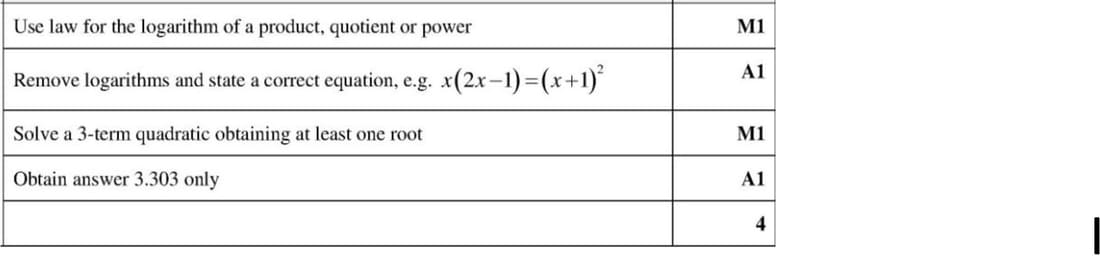
Solve the equation \(\ln(2x - 1) = 2 \ln(x + 1) - \ln x\). Give your answer correct to 3 decimal places.
9709 P32 - Nov 2022 - Q1
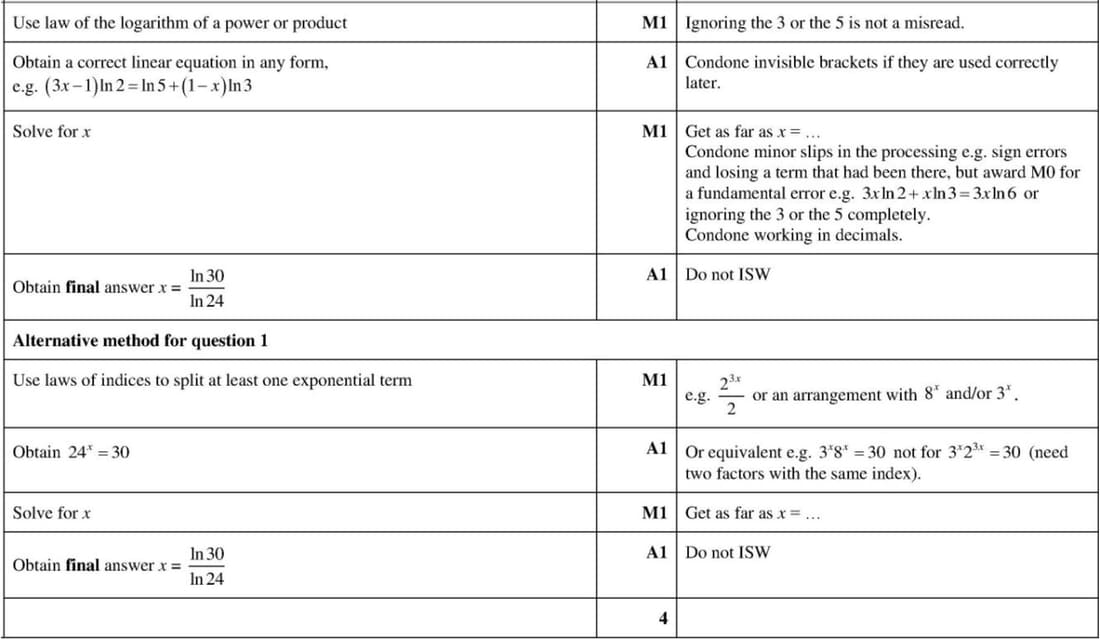
Solve the equation \(2^{3x-1} = 5(3^{1-x})\). Give your answer in the form \(\frac{\ln a}{\ln b}\) where \(a\) and \(b\) are integers.
9709 P31 - Nov 2022 - Q3
Solve the equation \(2^{3x-1} = 5(3^{-x})\). Give your answer in the form \(\frac{\ln a}{\ln b}\), where \(a\) and \(b\) are integers.

9709 P32 - Jun 2022 - Q1
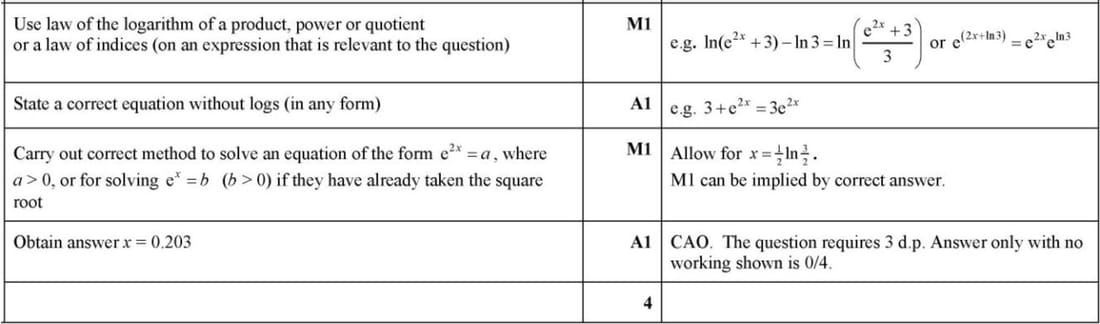
Solve the equation \(\ln(e^{2x} + 3) = 2x + \ln 3\), giving your answer correct to 3 decimal places.