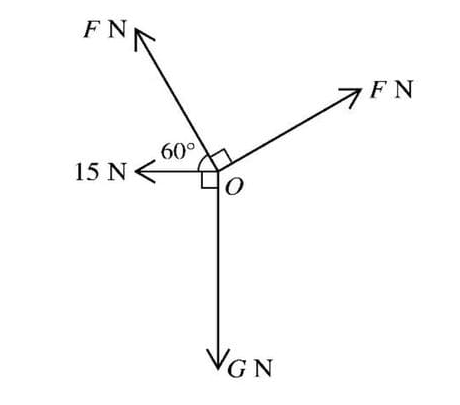
(i) To find F, resolve the forces in the horizontal direction. The equilibrium condition gives:
\(15 + F \cos 60^\circ = F \cos 30^\circ\)
Using \(\cos 60^\circ = \frac{1}{2}\) and \(\cos 30^\circ = \frac{\sqrt{3}}{2}\), the equation becomes:
\(15 + \frac{F}{2} = \frac{F\sqrt{3}}{2}\)
Rearranging gives:
\(15 = \frac{F\sqrt{3}}{2} - \frac{F}{2}\)
\(15 = \frac{F(\sqrt{3} - 1)}{2}\)
Solving for \(F\):
\(F = \frac{30}{\sqrt{3} - 1}\)
Rationalizing the denominator:
\(F = \frac{30(\sqrt{3} + 1)}{2} = 15(\sqrt{3} + 1)\)
Calculating gives \(F \approx 41.0\).
(ii) To find G, resolve the forces in the vertical direction. The equilibrium condition gives:
\(G = F(\sin 30^\circ + \sin 60^\circ)\)
Using \(\sin 30^\circ = \frac{1}{2}\) and \(\sin 60^\circ = \frac{\sqrt{3}}{2}\), the equation becomes:
\(G = F\left(\frac{1}{2} + \frac{\sqrt{3}}{2}\right)\)
\(G = F\left(\frac{1 + \sqrt{3}}{2}\right)\)
Substituting \(F = 41.0\):
\(G = 41.0 \times \frac{1 + \sqrt{3}}{2}\)
Calculating gives \(G \approx 56.0\).