Past Exam Questions
← Back9709 P41 - Nov 2016 - Q3
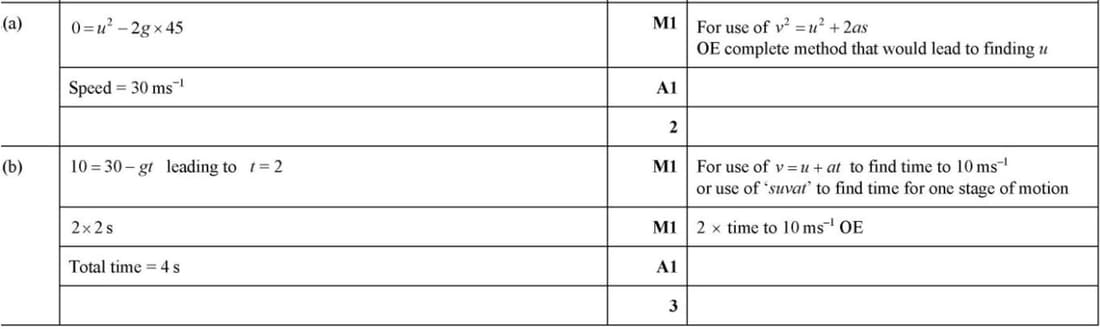
A particle P is projected vertically upwards from a point O. When the particle is at a height of 0.5 m, its speed is 6 m s-1. Find
- the greatest height reached by the particle above O,
- the time after projection at which the particle returns to O.
9709 P42 - Mar 2023 - Q2
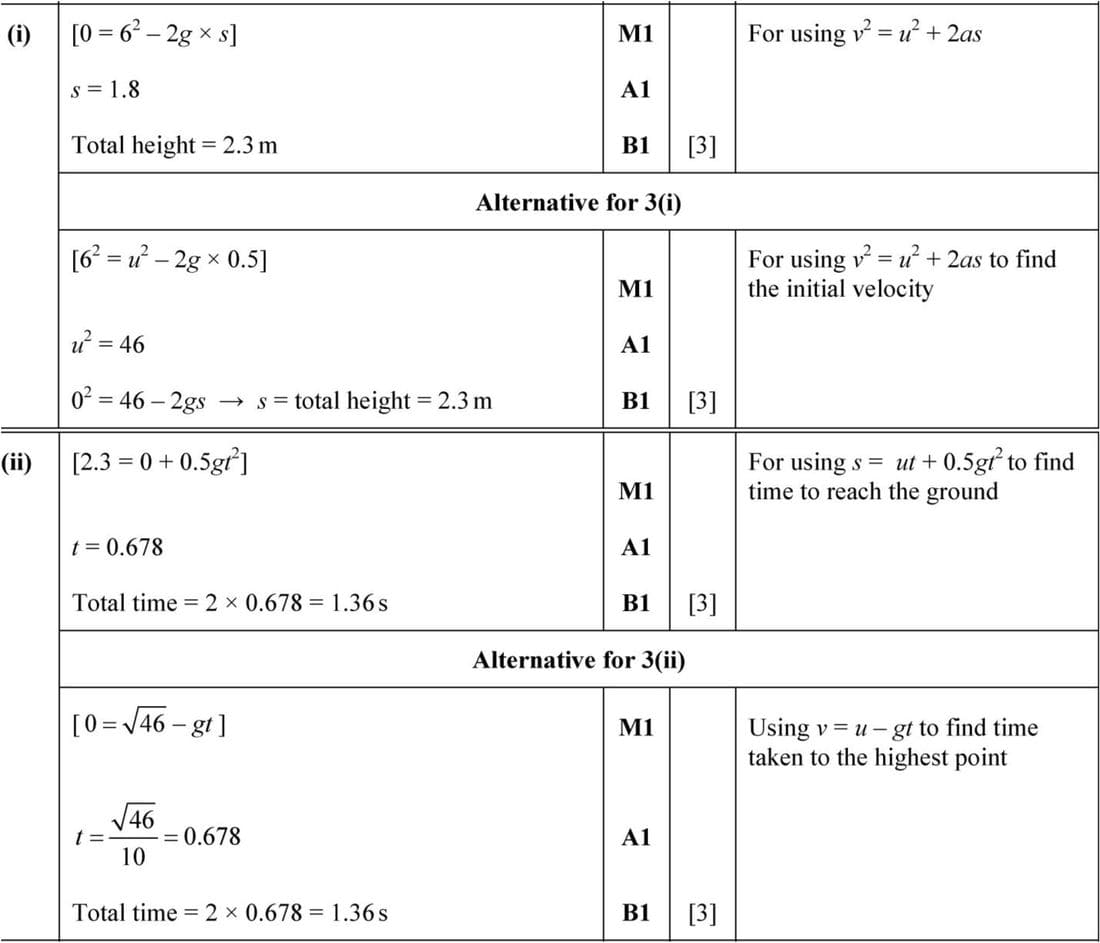
A particle P is projected vertically upwards from horizontal ground with speed 15 m s-1.
(a) Find the speed of P when it is 10 m above the ground.
At the same instant that P is projected, a second particle Q is dropped from a height of 18 m above the ground in the same vertical line as P.
(b) Find the height above the ground at which the two particles collide.
9709 P42 - Nov 2015 - Q2
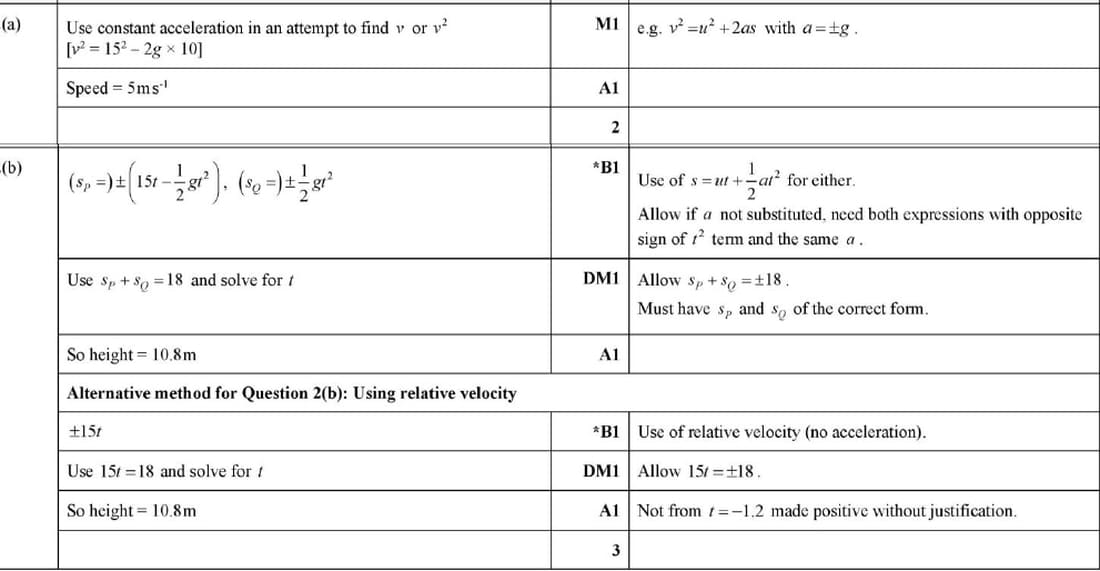
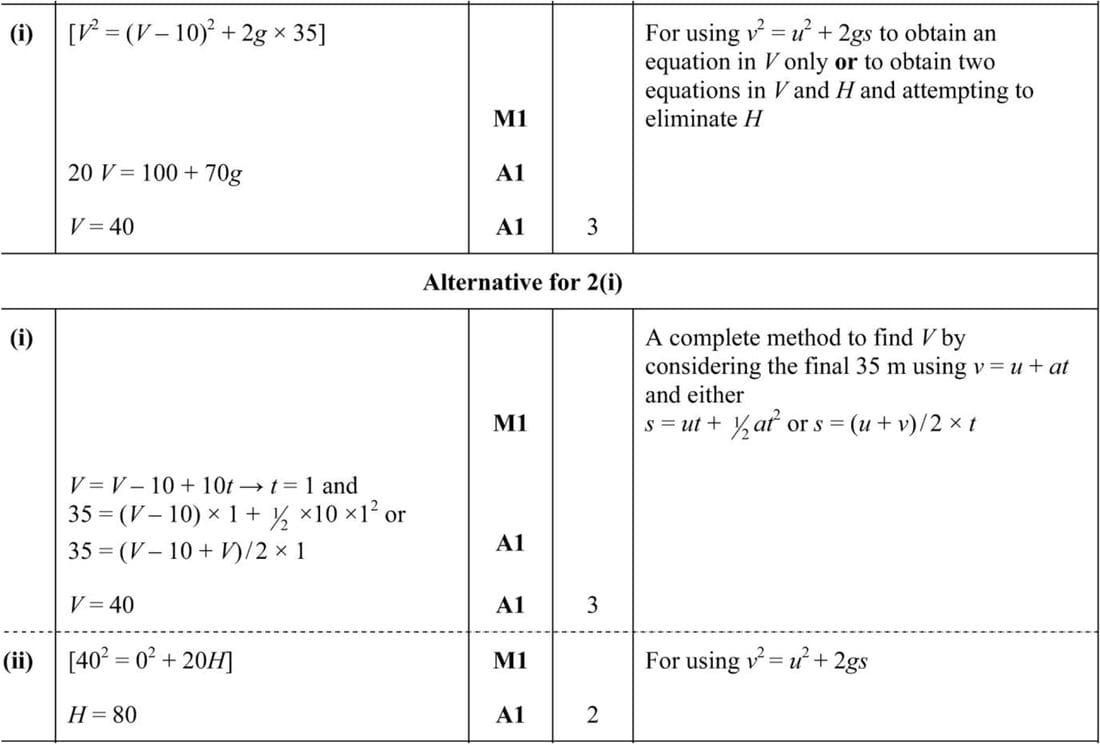
A particle is released from rest at a point H m above horizontal ground and falls vertically. The particle passes through a point 35 m above the ground with a speed of (V - 10) \text{ m s}^{-1} and reaches the ground with a speed of V \text{ m s}^{-1}. Find
- the value of V,
- the value of H.
9709 P42 - Nov 2014 - Q1
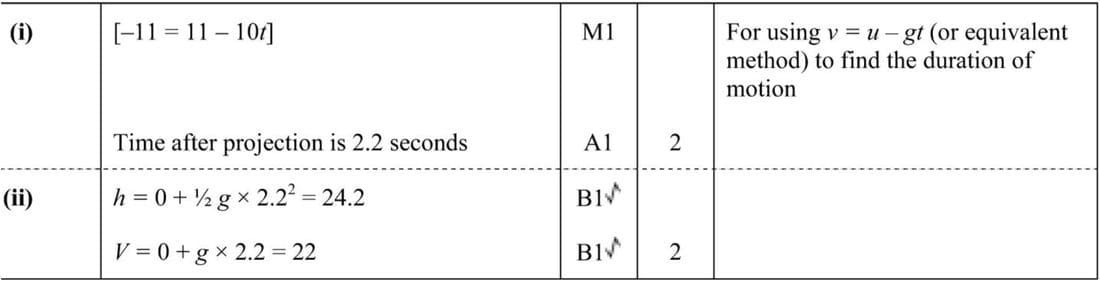
A particle P is projected vertically upwards with speed 11 m s-1 from a point on horizontal ground. At the same instant a particle Q is released from rest at a point h m above the ground. P and Q hit the ground at the same instant, when Q has speed V m s-1.
- Find the time after projection at which P hits the ground.
- Hence find the values of h and V.
9709 P42 - Jun 2014 - Q6
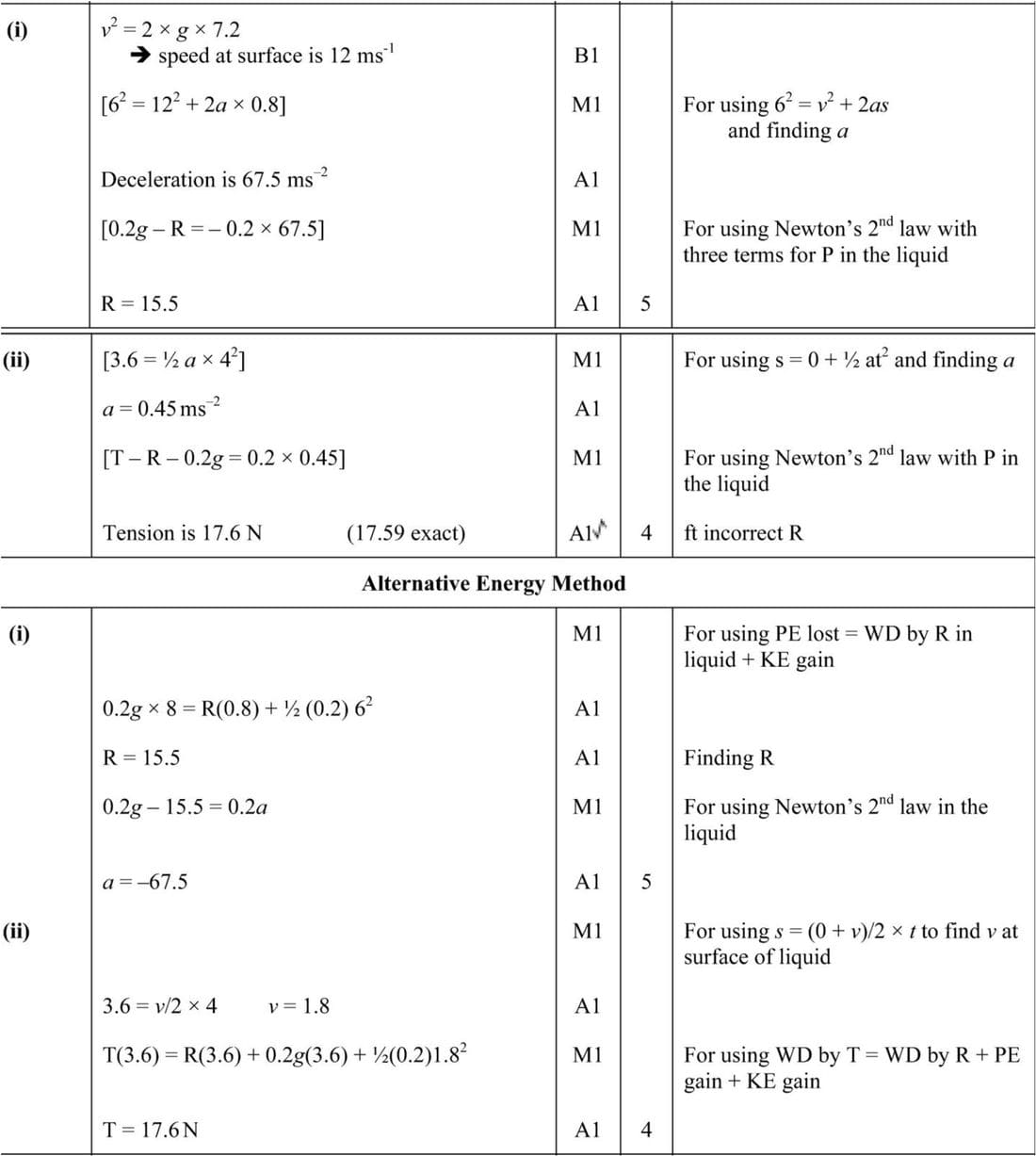
A particle P of mass 0.2 kg is released from rest at a point 7.2 m above the surface of the liquid in a container. P falls through the air and into the liquid. There is no air resistance and there is no instantaneous change of speed as P enters the liquid. When P is at a distance of 0.8 m below the surface of the liquid, P's speed is 6 m s-1. The only force on P due to the liquid is a constant resistance to motion of magnitude RN.
- Find the deceleration of P while it is falling through the liquid, and hence find the value of R.
The depth of the liquid in the container is 3.6 m. P is taken from the container and attached to one end of a light inextensible string. P is placed at the bottom of the container and then pulled vertically upwards with constant acceleration. The resistance to motion of RN continues to act. The particle reaches the surface 4 s after leaving the bottom of the container.
- Find the tension in the string.
9709 P41 - Jun 2014 - Q4
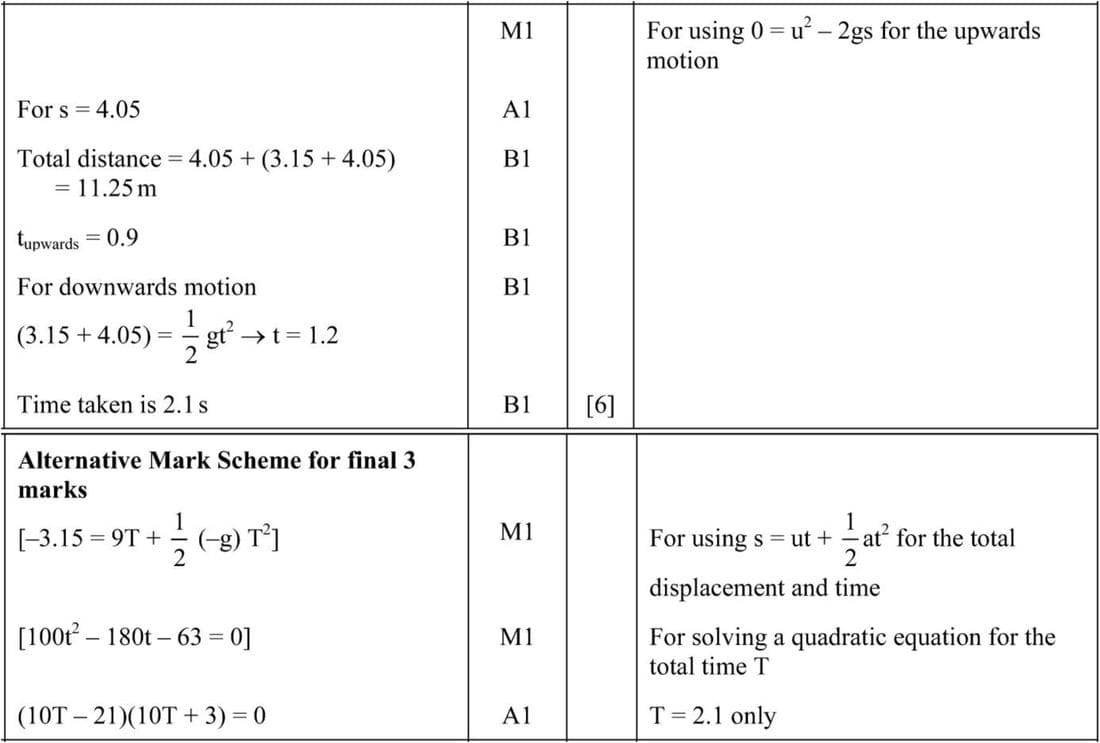
A particle is projected vertically upwards with speed 9 m s-1 from a point 3.15 m above horizontal ground. The particle moves freely under gravity until it hits the ground. For the particle’s motion from the instant of projection until the particle hits the ground, find the total distance travelled and the total time taken.
9709 P43 - Jun 2013 - Q5
A particle P is projected vertically upwards from a point on the ground with speed 17 m s-1. Another particle Q is projected vertically upwards from the same point with speed 7 m s-1. Particle Q is projected T seconds later than particle P.
- Given that the particles reach the ground at the same instant, find the value of T.
- At a certain instant when both P and Q are in motion, P is 5 m higher than Q. Find the magnitude and direction of the velocity of each of the particles at this instant.

9709 P41 - Jun 2013 - Q3
The top of a cliff is 40 metres above the level of the sea. A man in a boat, close to the bottom of the cliff, is in difficulty and fires a distress signal vertically upwards from sea level. Find
- the speed of projection of the signal given that it reaches a height of 5 m above the top of the cliff,
- the length of time for which the signal is above the level of the top of the cliff.
The man fires another distress signal vertically upwards from sea level. This signal is above the level of the top of the cliff for \(\sqrt{17}\) s.
- Find the speed of projection of the second signal.

9709 P43 - Nov 2012 - Q3
A particle P is projected vertically upwards, from a point O, with a velocity of 8 m s-1. The point A is the highest point reached by P. Find
- the speed of P when it is at the mid-point of OA,
- the time taken for P to reach the mid-point of OA while moving upwards.

9709 P41 - Nov 2012 - Q1
An object is released from rest at a height of 125 m above horizontal ground and falls freely under gravity, hitting a moving target \(P\). The target \(P\) is moving on the ground in a straight line, with constant acceleration \(0.8 \, \text{m/s}^2\). At the instant the object is released \(P\) passes through a point \(O\) with speed \(5 \, \text{m/s}\). Find the distance from \(O\) to the point where \(P\) is hit by the object.

9709 P42 - Jun 2011 - Q5
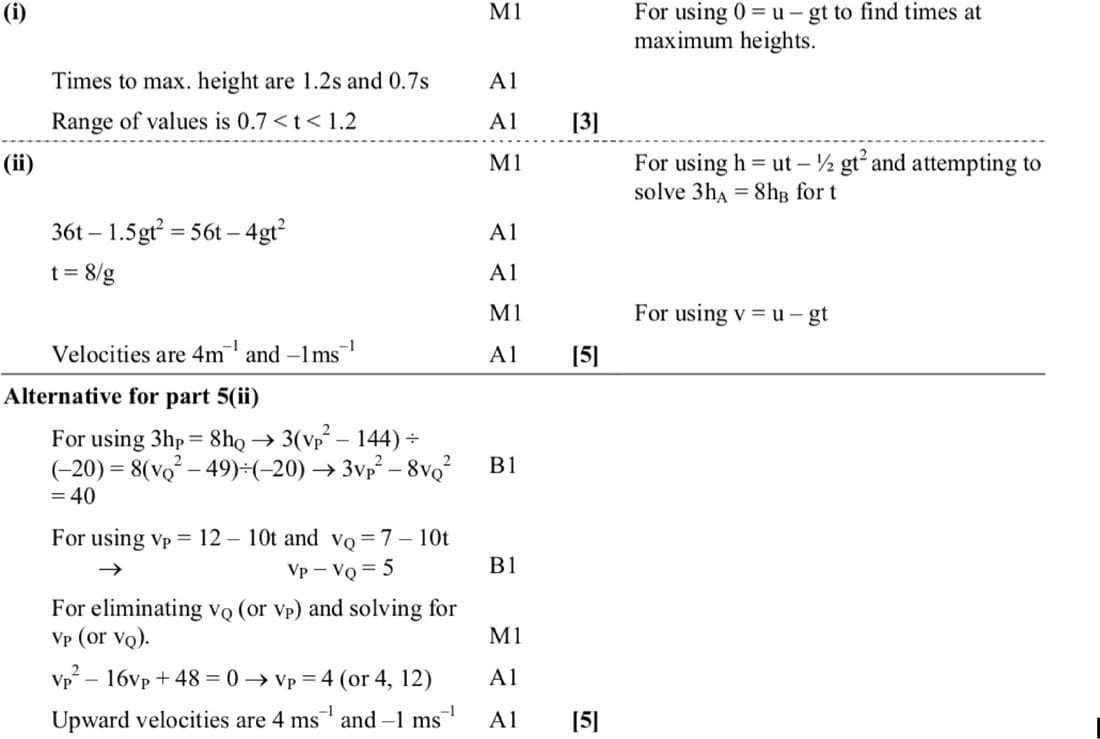
Two particles P and Q are projected vertically upwards from horizontal ground at the same instant. The speeds of projection of P and Q are 12 m s-1 and 7 m s-1 respectively and the heights of P and Q above the ground, t seconds after projection, are hP m and hQ m respectively. Each particle comes to rest on returning to the ground.
- Find the set of values of t for which the particles are travelling in opposite directions. [3]
- At a certain instant, P and Q are above the ground and 3hP = 8hQ. Find the velocities of P and Q at this instant. [5]
9709 P42 - Nov 2010 - Q5
Particles P and Q are projected vertically upwards, from different points on horizontal ground, with velocities of 20 m s-1 and 25 m s-1 respectively. Q is projected 0.4 s later than P. Find
- the time for which P's height above the ground is greater than 15 m,
- the velocities of P and Q at the instant when the particles are at the same height.

9709 P43 - Nov 2022 - Q1
A particle P is projected vertically upwards with speed u m s-1 from a point on the ground. P reaches its greatest height after 3 s.
(a) Find u.
(b) Find the greatest height of P above the ground.

9709 P41 - Nov 2010 - Q1
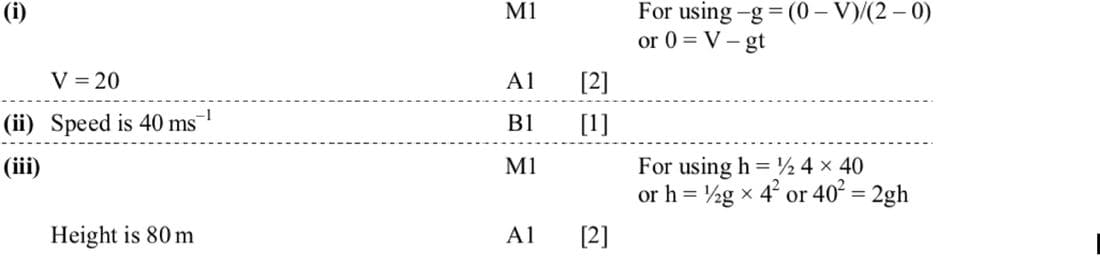
Two particles P and Q move vertically under gravity. The graphs show the upward velocity v m s-1 of the particles at time t s, for 0 ≤ t ≤ 4. P starts with velocity V m s-1 and Q starts from rest.
- Find the value of V.
\(Given that Q reaches the horizontal ground when t = 4, find\)
- the speed with which Q reaches the ground,
- the height of Q above the ground when t = 0.

9709 P4 - Nov 2008 - Q7
A particle P is held at rest at a fixed point O and then released. P falls freely under gravity until it reaches the point A which is 1.25 m below O.
- Find the speed of P at A and the time taken for P to reach A.
The particle continues to fall, but now its downward acceleration t seconds after passing through A is \((10 - 0.3t) \text{ m s}^{-2}\).
- Find the total distance P has fallen, 3 s after being released from O.

9709 P4 - Nov 2007 - Q2
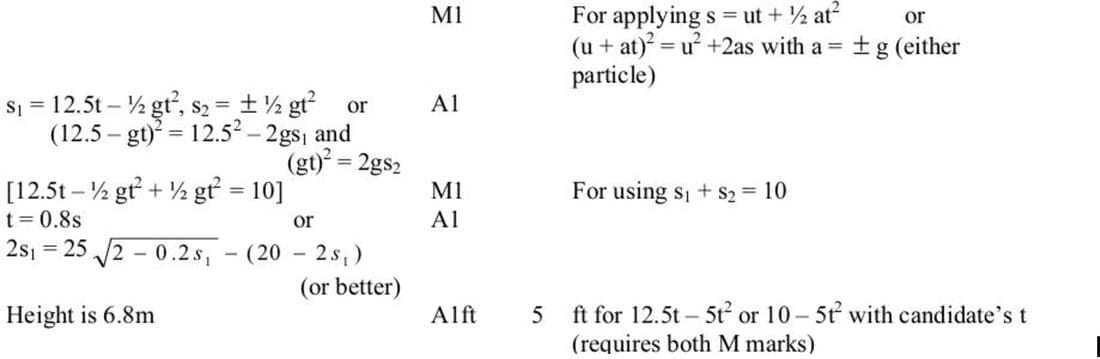
A particle is projected vertically upwards from a point O with initial speed 12.5 m s-1. At the same instant another particle is released from rest at a point 10 m vertically above O. Find the height above O at which the particles meet.
9709 P4 - Jun 2004 - Q7
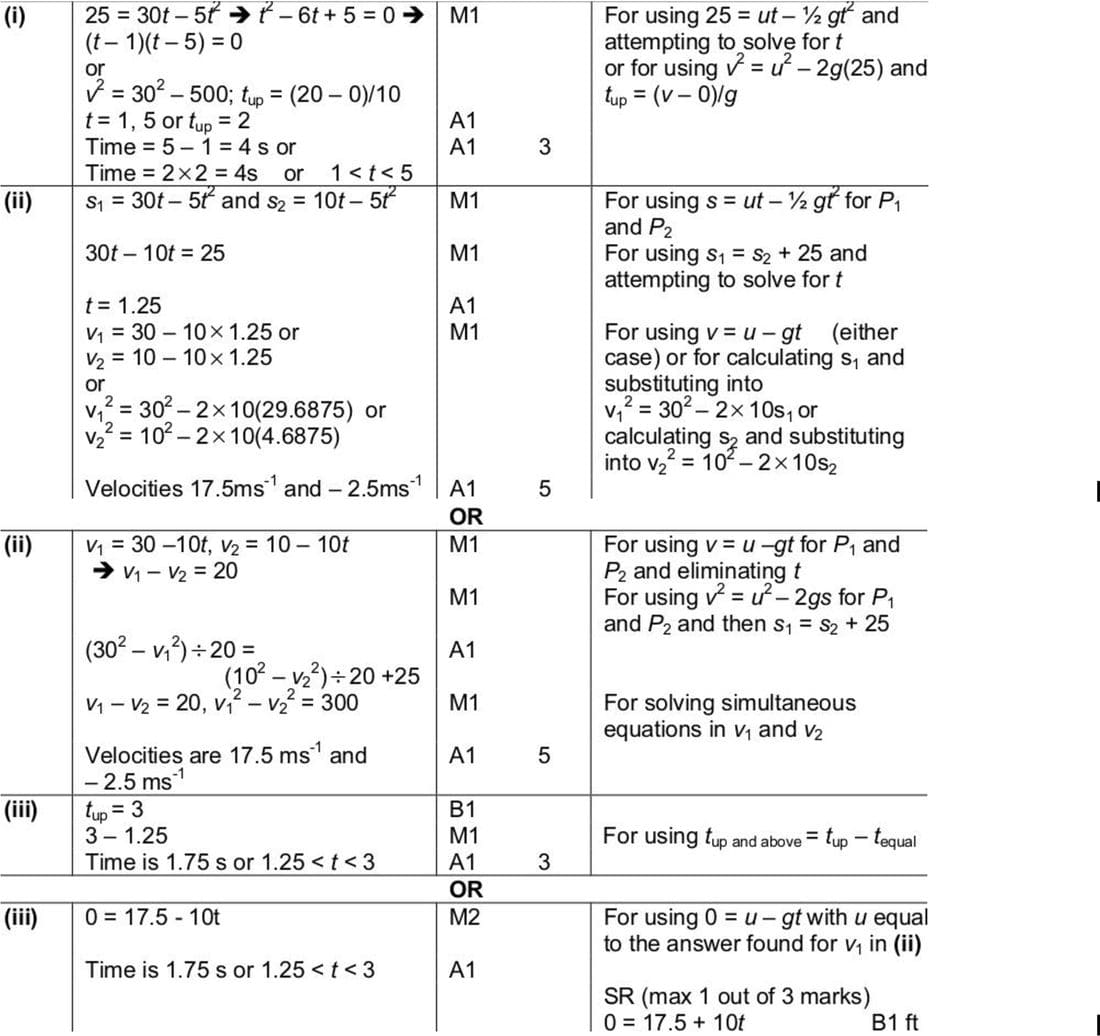
A particle \(P_1\) is projected vertically upwards, from horizontal ground, with a speed of 30 m s\(^{-1}\). At the same instant another particle \(P_2\) is projected vertically upwards from the top of a tower of height 25 m, with a speed of 10 m s\(^{-1}\). Find
- the time for which \(P_1\) is higher than the top of the tower,
- the velocities of the particles at the instant when the particles are at the same height,
- the time for which \(P_1\) is higher than \(P_2\) and is moving upwards.
9709 P4 - Nov 2003 - Q2
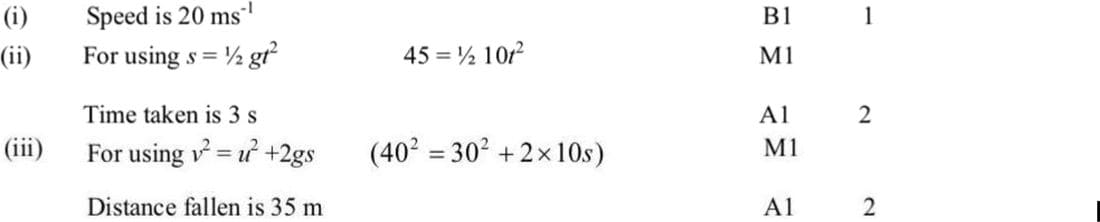
A stone is released from rest and falls freely under gravity. Find
- the speed of the stone after 2 s,
- the time taken for the stone to fall a distance of 45 m from its initial position,
- the distance fallen by the stone from the instant when its speed is 30 m s-1 to the instant when its speed is 40 m s-1.
9709 P4 - Nov 2002 - Q4
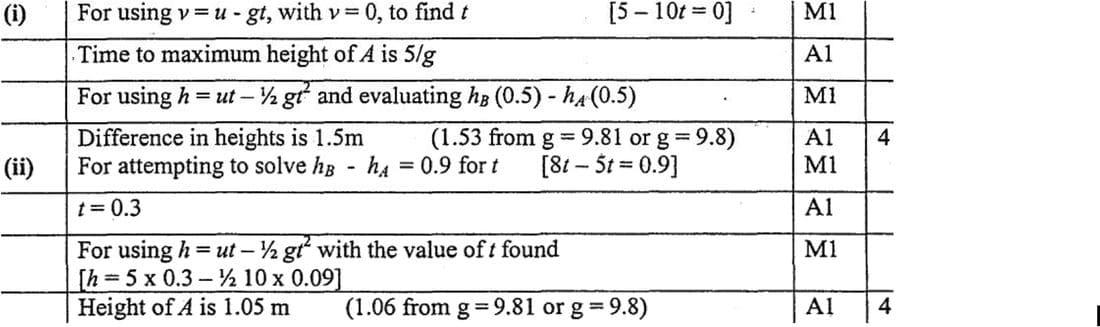
Two particles A and B are projected vertically upwards from horizontal ground at the same instant. The speeds of projection of A and B are 5 m s-1 and 8 m s-1 respectively. Find
- the difference in the heights of A and B when A is at its maximum height,
- the height of A above the ground when B is 0.9 m above A.
9709 P43 - Jun 2022 - Q2
A particle P is projected vertically upwards from horizontal ground. P reaches a maximum height of 45 m. After reaching the ground, P comes to rest without rebounding.
(a) Find the speed at which P was projected.
(b) Find the total time for which the speed of P is at least 10 m s-1.