Answer: (i) The asymptotes are \(x=-b\) and \(y=x-b\).
(ii) The curve does not intersect the \(x\)-axis because \(x^2+b=0\) has no real solution when \(b>0\).
(iii) There are \(2\) stationary points on \(C\).
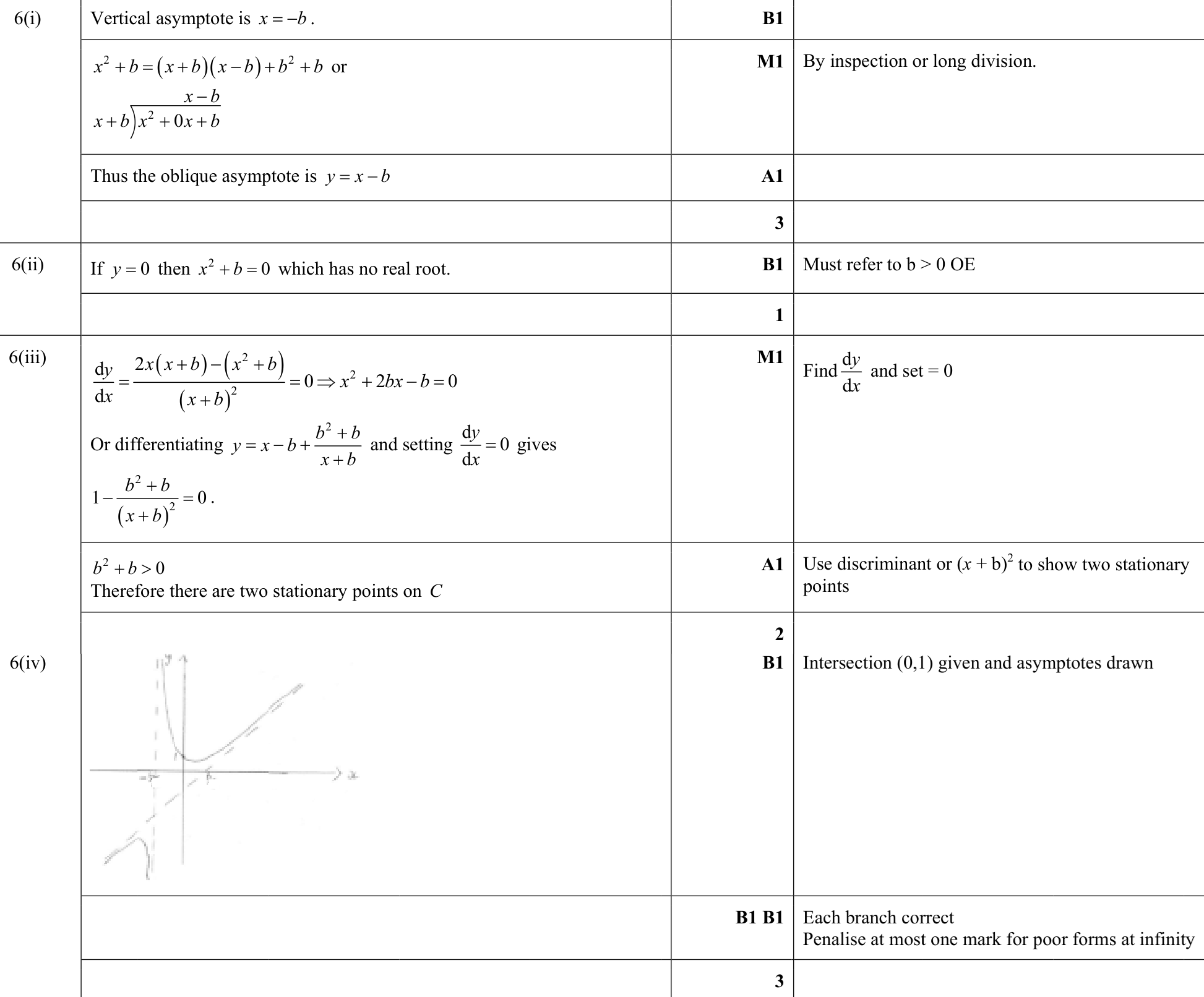
(iv) The curve crosses the \(y\)-axis at \((0,1)\). It has a vertical asymptote \(x=-b\) and an oblique asymptote \(y=x-b\), does not meet the \(x\)-axis, and has two stationary points.
We first rewrite the function by division:
\(y=\dfrac{x^2+b}{x+b}=x-b+\dfrac{b(1+b)}{x+b}\).
This form is very useful for the asymptotes and for differentiation.
(i) As \(x\to -b\), the denominator of the last term tends to \(0\), so there is a vertical asymptote at \(x=-b\).
As \(|x|\to\infty\), the term \(\dfrac{b(1+b)}{x+b}\to 0\), so the curve approaches the straight line \(y=x-b\). Hence the oblique asymptote is \(y=x-b\).
(ii) To find any \(x\)-axis intersections, set \(y=0\):
\(\dfrac{x^2+b}{x+b}=0\).
This requires \(x^2+b=0\), so \(x^2=-b\). But \(b>0\), so the right-hand side is negative and there are no real solutions. Therefore \(C\) does not intersect the \(x\)-axis.
(iii) Differentiate the rewritten form:
\(y=x-b+\dfrac{b(1+b)}{x+b}\).
So
\(\dfrac{dy}{dx}=1-\dfrac{b(1+b)}{(x+b)^2}.\)
Stationary points occur when \(\dfrac{dy}{dx}=0\):
\(1-\dfrac{b(1+b)}{(x+b)^2}=0\)
\(\Rightarrow (x+b)^2=b(1+b).\)
Since \(b>0\), \(b(1+b)>0\), so this equation has two distinct real solutions:
\(x=-b\pm \sqrt{b(1+b)}\).
Hence the curve has \(2\) stationary points.
(iv) For the sketch, note:
- vertical asymptote \(x=-b\),
- slant asymptote \(y=x-b\),
- no \(x\)-axis intercepts,
- \(y\)-axis intercept found by setting \(x=0\): \(y=\dfrac{b}{b}=1\), so the point is \((0,1)\),
- two stationary points, one on each side of the vertical asymptote.
A correct sketch should show two branches separated by \(x=-b\), approaching the line \(y=x-b\) for large \(|x|\), passing through \((0,1)\), and never crossing the \(x\)-axis.