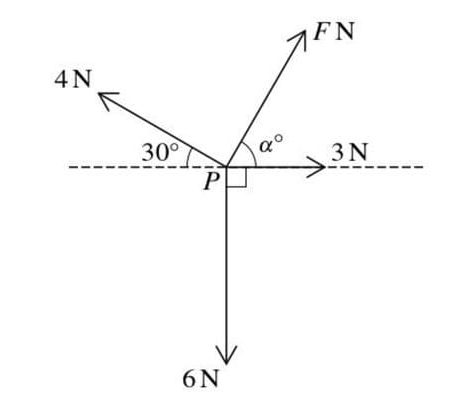
Coplanar forces, of magnitudes F N, 3 N, 6 N, and 4 N, act at a point P, as shown in the diagram.
(a) Given that \(\alpha = 60\), and that the resultant of the four forces is in the direction of the 3 N force, find \(F\).
(b) Given instead that the four forces are in equilibrium, find the values of \(F\) and \(\alpha\).
Solution
(a) Resolve the forces vertically and equate to zero:
\(4 \sin 30^\circ + F \sin 60^\circ - 6 = 0\)
Substitute \(\sin 30^\circ = 0.5\) and \(\sin 60^\circ = \frac{\sqrt{3}}{2}\):
\(2 + \frac{F \sqrt{3}}{2} - 6 = 0\)
\(\frac{F \sqrt{3}}{2} = 4\)
\(F = \frac{8}{\sqrt{3}} \approx 4.62\)
(b) Resolve forces either vertically or horizontally:
Vertically: \(F \sin \alpha + 4 \sin 30^\circ - 6 = 0\)
Horizontally: \(F \cos \alpha + 3 - 4 \cos 30^\circ = 0\)
\(F \sin \alpha = 4\)
\(F \cos \alpha = 0.464\)
Using Pythagoras:
\(F^2 = 4^2 + 0.464^2\)
\(F = \sqrt{16 + 0.215296} \approx 4.03\)
Using trigonometry:
\(\alpha = \arctan \left( \frac{4}{0.464} \right) \approx 83.4\)
Log in to record attempts.