Answer:
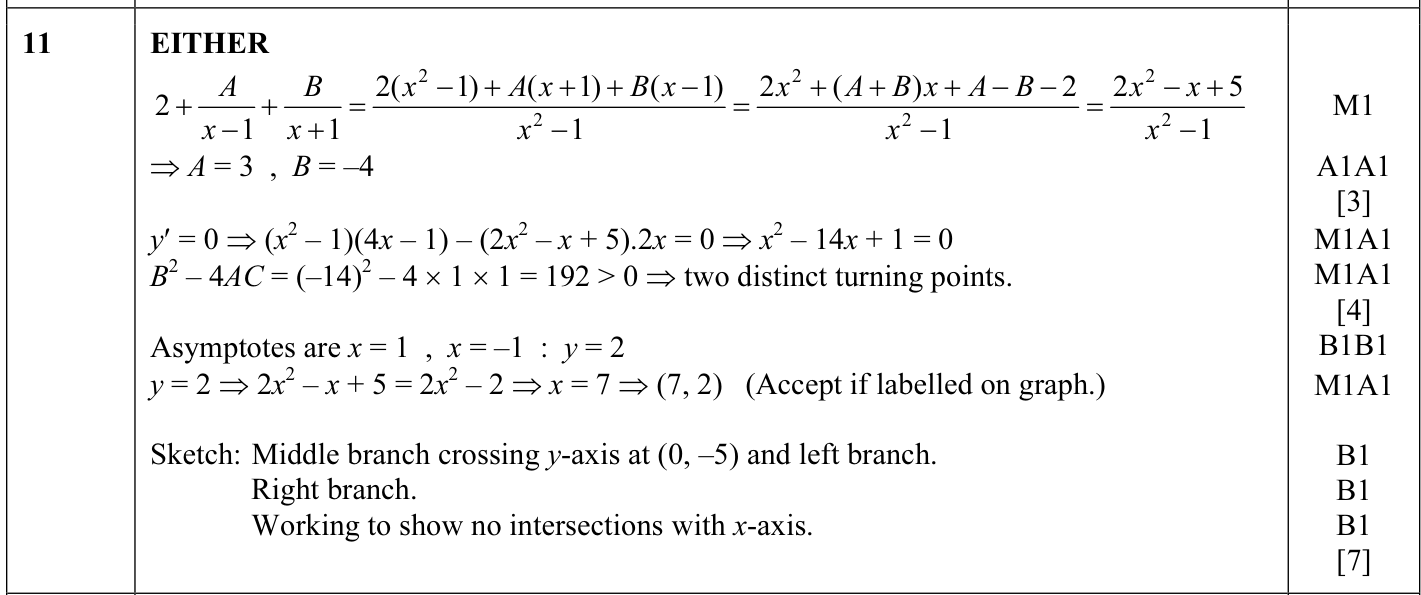
\(\frac{2x^{2}-x+5}{x^{2}-1}=2+\frac{3}{x-1}-\frac{4}{x+1}.\)
The stationary points satisfy \(x^2-14x+1=0\), so there are two distinct stationary points.
The asymptotes are \(x=1\), \(x=-1\) and \(y=2\). The curve crosses the \(y\)-axis at \((0,-5)\), meets the asymptote \(y=2\) at \((7,2)\), and has no \(x\)-intercepts.
Write
\(\frac{2x^2-x+5}{x^2-1}=2+\frac{A}{x-1}+\frac{B}{x+1}.\)
Then
\(2+\frac{A}{x-1}+\frac{B}{x+1}=\frac{2(x^2-1)+A(x+1)+B(x-1)}{x^2-1}.\)
The numerator is
\(2x^2+(A+B)x+(A-B-2).\)
Equating coefficients with \(2x^2-x+5\) gives
\(A+B=-1,\qquad A-B=7.\)
So \(A=3\) and \(B=-4\), hence
\(\frac{2x^2-x+5}{x^2-1}=2+\frac{3}{x-1}-\frac{4}{x+1}.\)
Differentiate this form:
\(\frac{dy}{dx}=-\frac{3}{(x-1)^2}+\frac{4}{(x+1)^2}.\)
For stationary points, set \(\frac{dy}{dx}=0\):
\(\frac{4}{(x+1)^2}=\frac{3}{(x-1)^2}.\)
So
\(4(x-1)^2=3(x+1)^2,\)
which simplifies to
\(x^2-14x+1=0.\)
The discriminant is
\((-14)^2-4(1)(1)=192\gt 0,\)
so there are two distinct real values of \(x\) for which \(\frac{dy}{dx}=0\).
The vertical asymptotes are \(x=1\) and \(x=-1\), and the horizontal asymptote is \(y=2\).
At \(x=0\),
\(y=\frac{5}{-1}=-5,\)
so the curve crosses the \(y\)-axis at \((0,-5)\).
To find where the curve meets \(y=2\), solve
\(\frac{2x^2-x+5}{x^2-1}=2.\)
This gives \(2x^2-x+5=2x^2-2\), so \(x=7\). Hence the point is \((7,2)\).
For \(x\)-axis intersections, set \(y=0\):
\(2x^2-x+5=0.\)
The discriminant is \(1-40=-39\lt 0\), so there are no real \(x\)-intercepts.
The sketch should therefore show three branches with asymptotes \(x=\pm1\) and \(y=2\), crossing the \(y\)-axis at \((0,-5)\), meeting \(y=2\) at \((7,2)\), and no \(x\)-axis intersections.