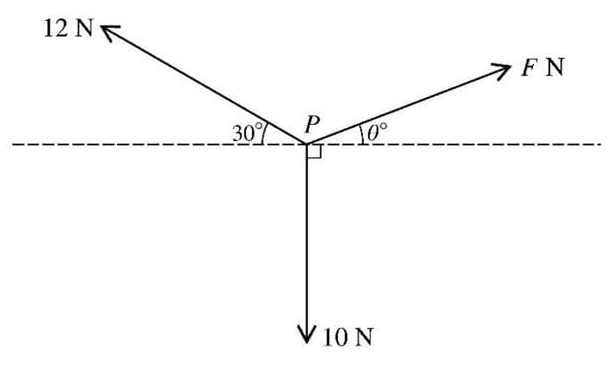
The three coplanar forces shown in the diagram act at a point P and are in equilibrium.
- Find the values of F and \(\theta\).
- State the magnitude and direction of the resultant force at P when the force of magnitude 12 N is removed.
Solution
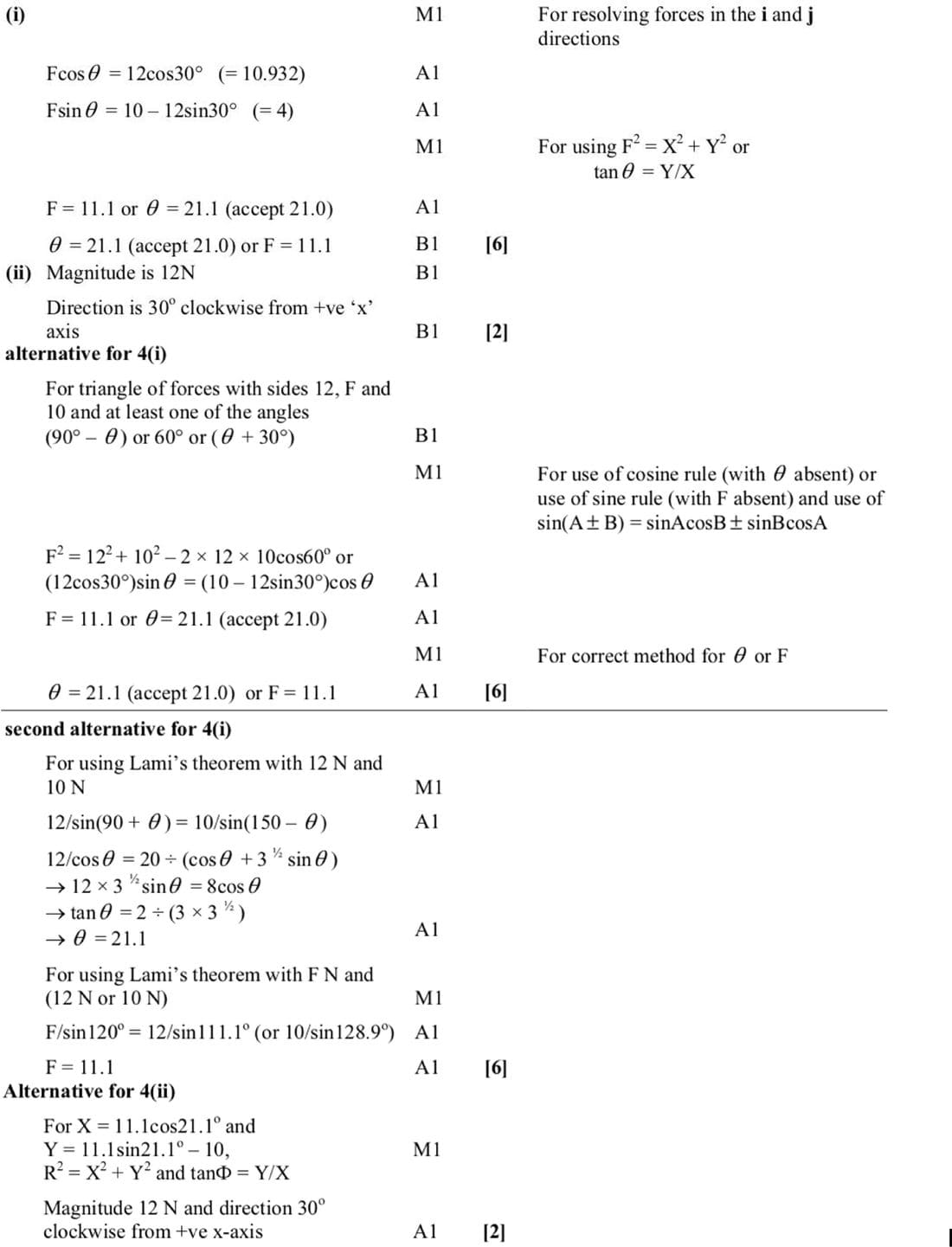
To solve for \(F\) and \(\theta\), resolve the forces into horizontal and vertical components:
Horizontal: \(F \cos \theta = 12 \cos 30^\circ\)
Vertical: \(F \sin \theta = 10 - 12 \sin 30^\circ\)
Calculate \(F\) and \(\theta\):
\(F \cos \theta = 10.932\)
\(F \sin \theta = 4\)
Using \(F^2 = X^2 + Y^2\):
\(F = \sqrt{10.932^2 + 4^2} = 11.1 \text{ N}\)
Using \(\tan \theta = \frac{Y}{X}\):
\(\theta = \arctan \left( \frac{4}{10.932} \right) = 21.1^\circ\)
For part (ii), when the 12 N force is removed, the resultant force is the vector sum of the remaining forces:
Magnitude is 12 N, direction is 30° clockwise from the positive x-axis.
Log in to record attempts.