9709 P4 - Jun 2003 - Q2
3710
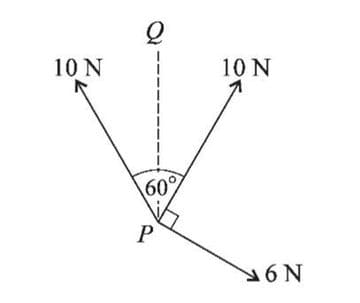
Three coplanar forces of magnitudes 10 N, 10 N, and 6 N act at a point P in the directions shown in the diagram. PQ is the bisector of the angle between the two forces of magnitude 10 N.
(i) Find the component of the resultant of the three forces
- in the direction of PQ,
- in the direction perpendicular to PQ.
(ii) Find the magnitude of the resultant of the three forces.
Solutions locked. Please sign in with access to view them.