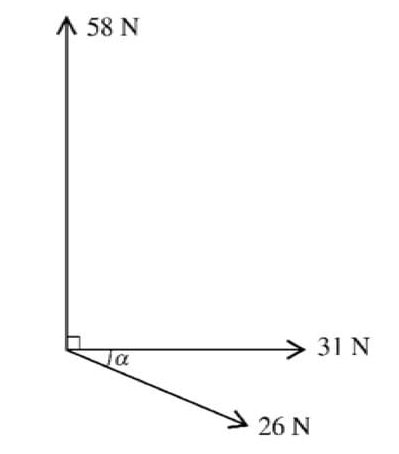
First, resolve the forces into their components along the i and j directions.
For the 31 N force, it acts entirely in the i direction: \(X_1 = 31\).
For the 26 N force, resolve using \(\tan \alpha = \frac{5}{12}\):
\(\cos \alpha = \frac{12}{13}\) and \(\sin \alpha = \frac{5}{13}\).
Thus, \(X_2 = 26 \cos \alpha = 26 \times \frac{12}{13} = 24\).
\(Y_2 = 26 \sin \alpha = 26 \times \frac{5}{13} = 10\).
For the 58 N force, it acts entirely in the j direction: \(Y_1 = 58\).
Sum the components:
\(X = 31 + 24 = 55\).
\(Y = 58 - 10 = 48\).
Calculate the magnitude of the resultant force:
\(R = \sqrt{X^2 + Y^2} = \sqrt{55^2 + 48^2} = 73 \text{ N}\).
Calculate the direction of the resultant force:
\(\tan \theta = \frac{Y}{X} = \frac{48}{55}\).
\(\theta = \arctan \left( \frac{48}{55} \right) \approx 41.1^\circ\).
Thus, the resultant is 73 N and the direction is 41.1° to the i direction.