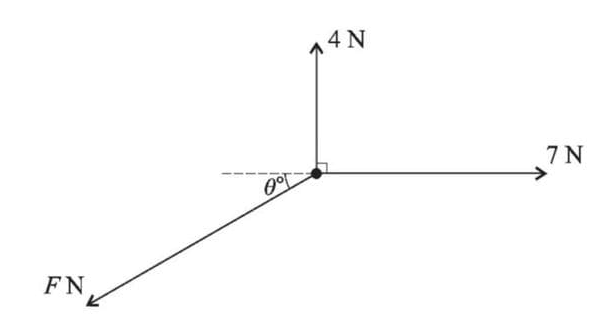
A particle is in equilibrium on a smooth horizontal table when acted on by the three horizontal forces shown in the diagram.
(i) Find the values of \(F\) and \(\theta\).
(ii) The force of magnitude 7 N is now removed. State the magnitude and direction of the resultant of the remaining two forces.
Solution
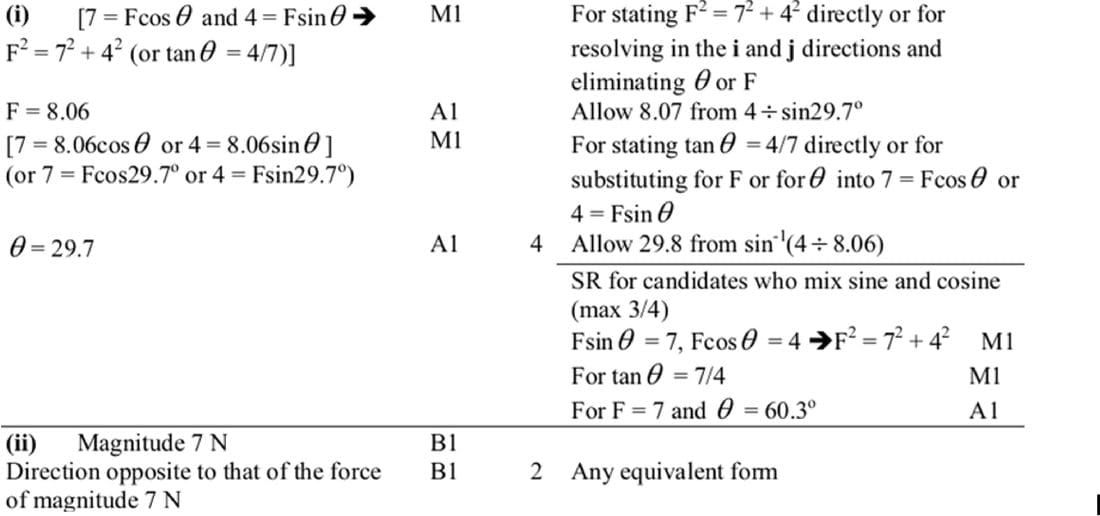
(i) Since the particle is in equilibrium, the sum of the forces in both the horizontal and vertical directions must be zero.
Resolve the forces horizontally and vertically:
Horizontal: \(7 = F \cos \theta\)
Vertical: \(4 = F \sin \theta\)
Using \(F^2 = 7^2 + 4^2\), we find:
\(F = \sqrt{49 + 16} = \sqrt{65} \approx 8.06\)
Using \(\tan \theta = \frac{4}{7}\), we find:
\(\theta = \arctan\left(\frac{4}{7}\right) \approx 29.7^\circ\)
(ii) When the 7 N force is removed, the resultant force is the vector sum of the remaining forces:
The magnitude is 7 N, and the direction is opposite to the original 7 N force.
Log in to record attempts.