Past Exam Questions
← Back9709 P43 - Jun 2020 - Q5
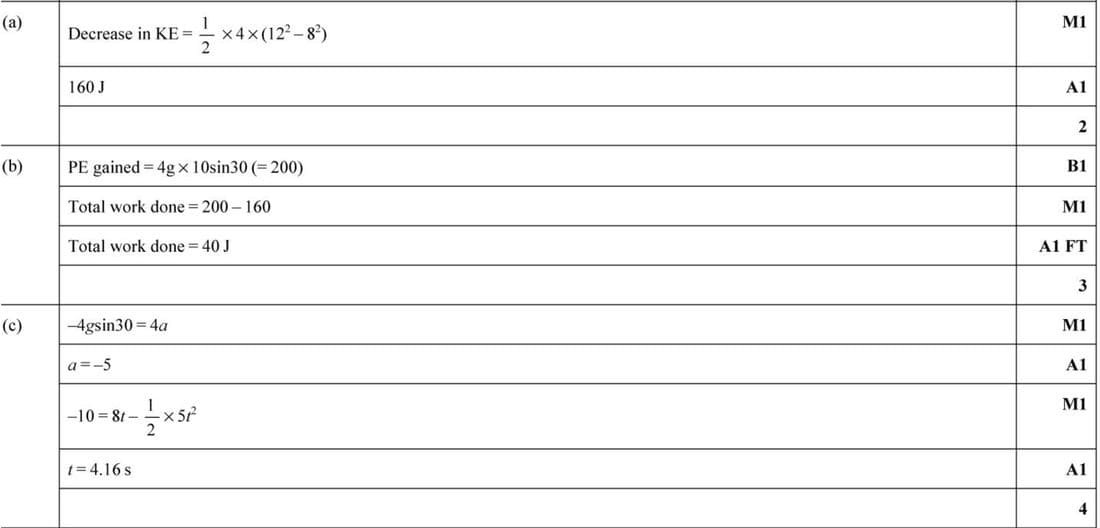
A block B of mass 4 kg is pushed up a line of greatest slope of a smooth plane inclined at 30° to the horizontal by a force applied to B, acting in the direction of motion of B. The block passes through points P and Q with speeds 12 m s-1 and 8 m s-1 respectively. P and Q are 10 m apart with P below the level of Q.
(a) Find the decrease in kinetic energy of the block as it moves from P to Q.
(b) Hence find the work done by the force pushing the block up the slope as the block moves from P to Q.
(c) At the instant the block reaches Q, the force pushing the block up the slope is removed.
Find the time taken, after this instant, for the block to return to P.
9709 P41 - Jun 2020 - Q5
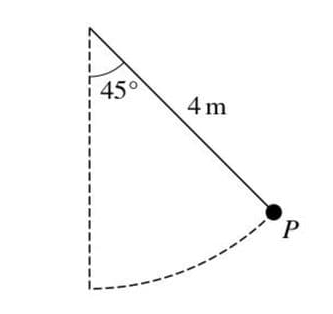
A child of mass 35 kg is swinging on a rope. The child is modelled as a particle P and the rope is modelled as a light inextensible string of length 4 m. Initially P is held at an angle of 45° to the vertical (see diagram).
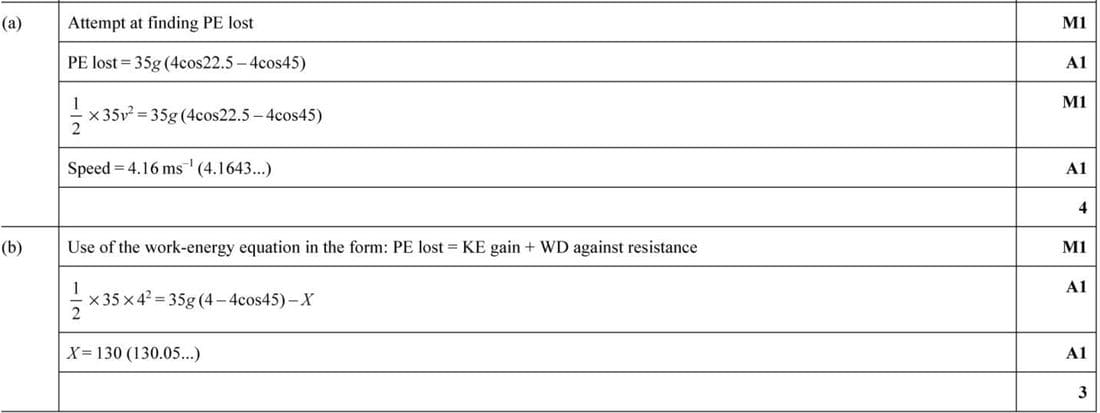
(a) Given that there is no resistance force, find the speed of P when it has travelled half way along the circular arc from its initial position to its lowest point.
(b) It is given instead that there is a resistance force. The work done against the resistance force as P travels from its initial position to its lowest point is X J. The speed of P at its lowest point is 4 m s-1.
Find X.
9709 P42 - Mar 2020 - Q3
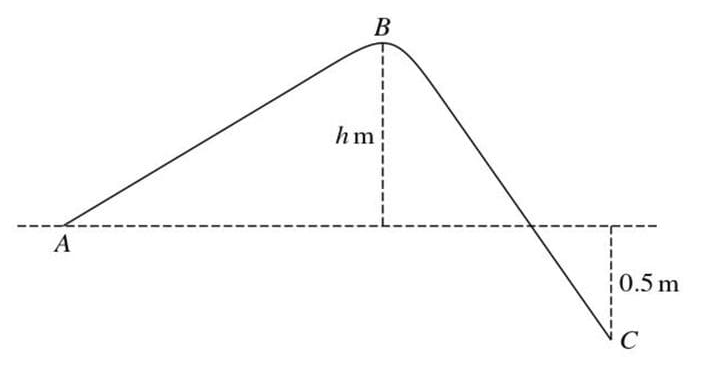
The diagram shows the vertical cross-section of a surface. A, B, and C are three points on the cross-section. The level of B is h m above the level of A. The level of C is 0.5 m below the level of A. A particle of mass 0.2 kg is projected up the slope from A with initial speed 5 m/s. The particle remains in contact with the surface as it travels from A to C.
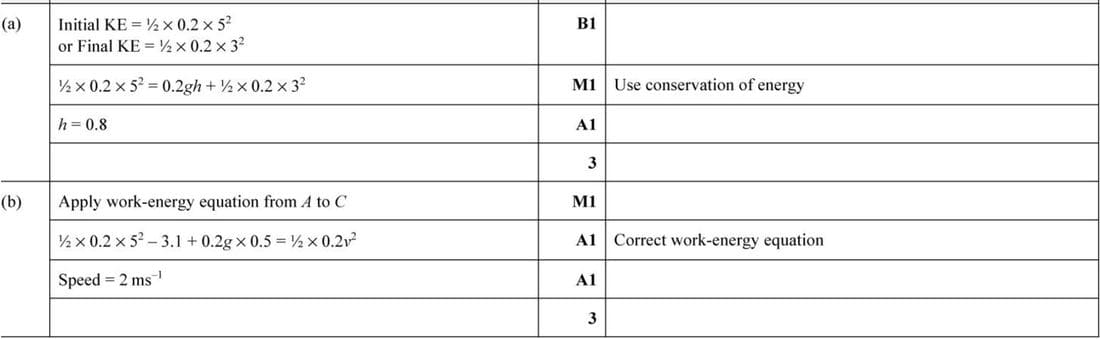
(a) Given that the particle reaches B with a speed of 3 m/s and that there is no resistance force, find h.
(b) It is given instead that there is a resistance force and that the particle does 3.1 J of work against the resistance force as it travels from A to C. Find the speed of the particle when it reaches C.
9709 P43 - Nov 2019 - Q2
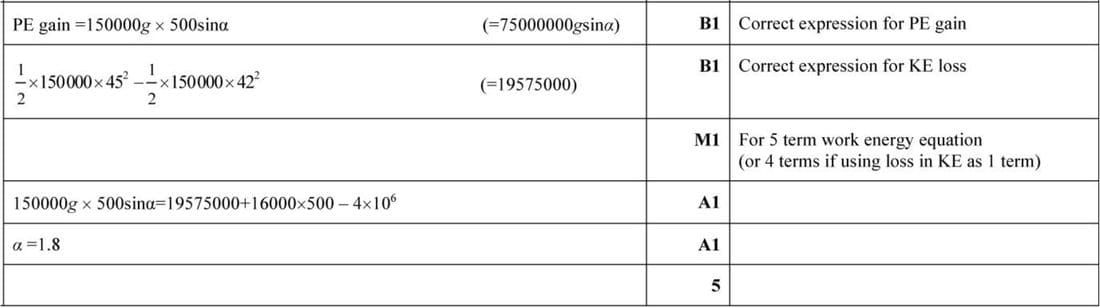
A train of mass 150,000 kg ascends a straight slope inclined at \(\alpha^\circ\) to the horizontal with a constant driving force of 16,000 N. At a point \(A\) on the slope the speed of the train is 45 m s\(^{-1}\). Point \(B\) on the slope is 500 m beyond \(A\). At \(B\) the speed of the train is 42 m s\(^{-1}\). There is a resistance force acting on the train and the train does \(4 \times 10^6\) J of work against this resistance force between \(A\) and \(B\). Find the value of \(\alpha\).
9709 P43 - Jun 2023 - Q7
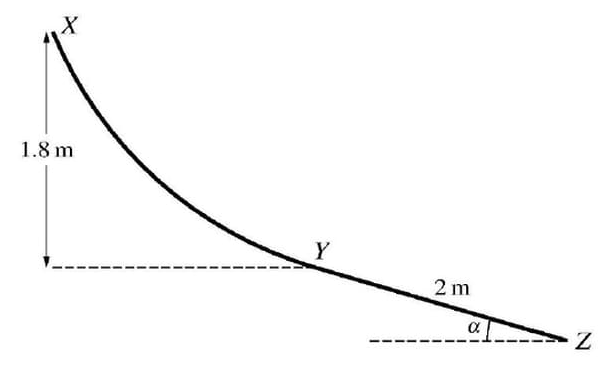
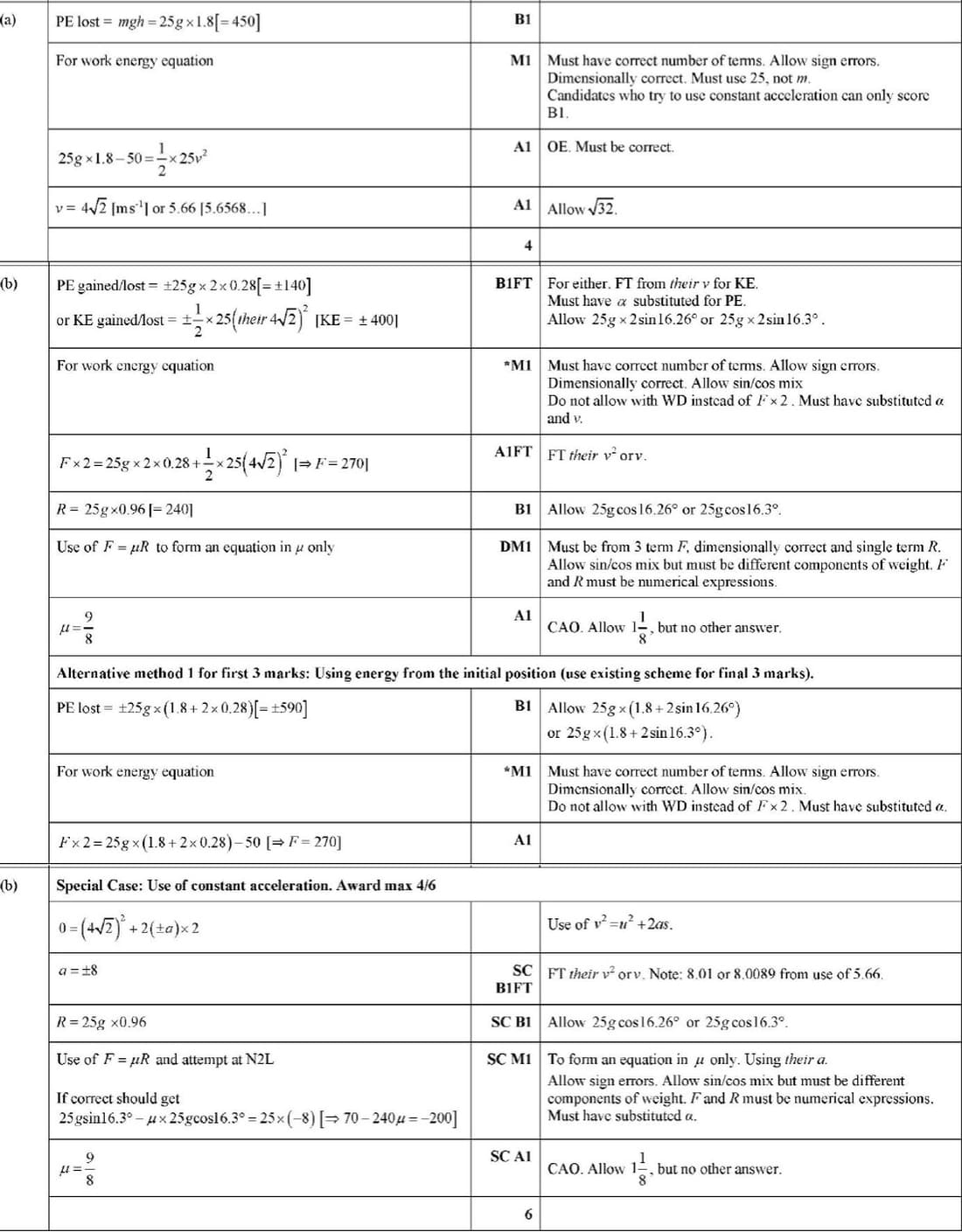
The diagram shows the vertical cross-section XYZ of a rough slide. The section YZ is a straight line of length 2 m inclined at an angle of \(\alpha\) to the horizontal, where \(\sin \alpha = 0.28\). The section YZ is tangential to the curved section XY at Y, and X is 1.8 m above the level of Y. A child of mass 25 kg slides down the slide, starting from rest at X. The work done by the child against the resistance force in moving from X to Y is 50 J.
(a) Find the speed of the child at Y.
It is given that the child comes to rest at Z.
(b) Use an energy method to find the coefficient of friction between the child and YZ, giving your answer as a fraction in its simplest form.
9709 P42 - Nov 2019 - Q4
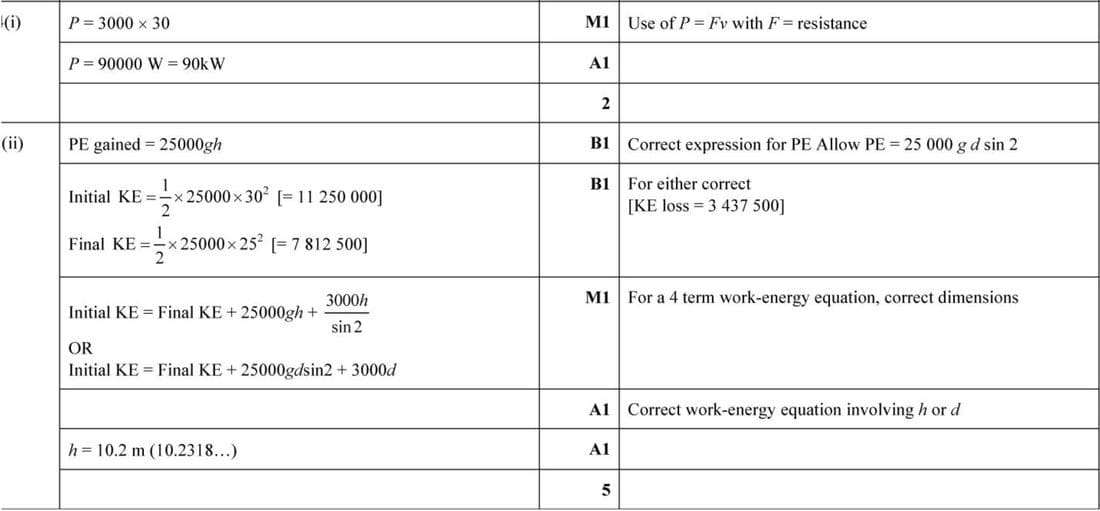
A lorry of mass 25,000 kg travels along a straight horizontal road. There is a constant force of 3000 N resisting the motion.
- Find the power required to maintain a constant speed of 30 m s-1.
The lorry comes to a straight hill inclined at 2° to the horizontal. The driver switches off the engine of the lorry at the point A which is at the foot of the hill. Point B is further up the hill. The speeds of the lorry at A and B are 30 m s-1 and 25 m s-1 respectively. The resistance force is still 3000 N.
- Use an energy method to find the height of B above the level of A.
9709 P41 - Nov 2019 - Q2
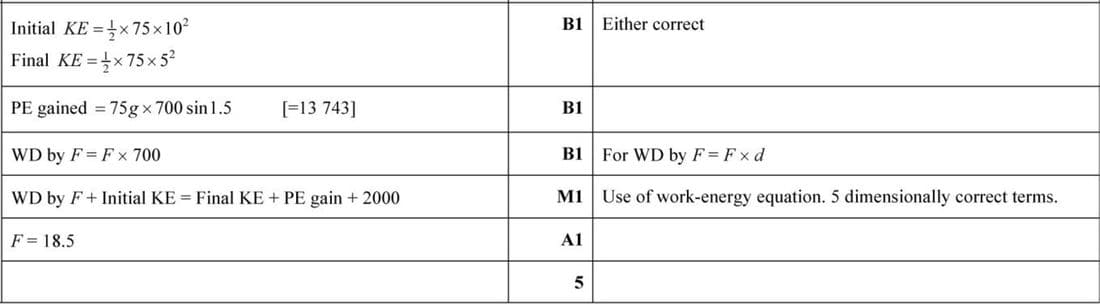
The total mass of a cyclist and her bicycle is 75 kg. The cyclist ascends a straight hill of length 0.7 km inclined at 1.5° to the horizontal. Her speed at the bottom of the hill is 10 m/s and at the top it is 5 m/s. There is a resistance to motion, and the work done against this resistance as the cyclist ascends the hill is 2000 J. The cyclist exerts a constant force of magnitude \(F\) N in the direction of motion. Find \(F\).
9709 P43 - Jun 2019 - Q5
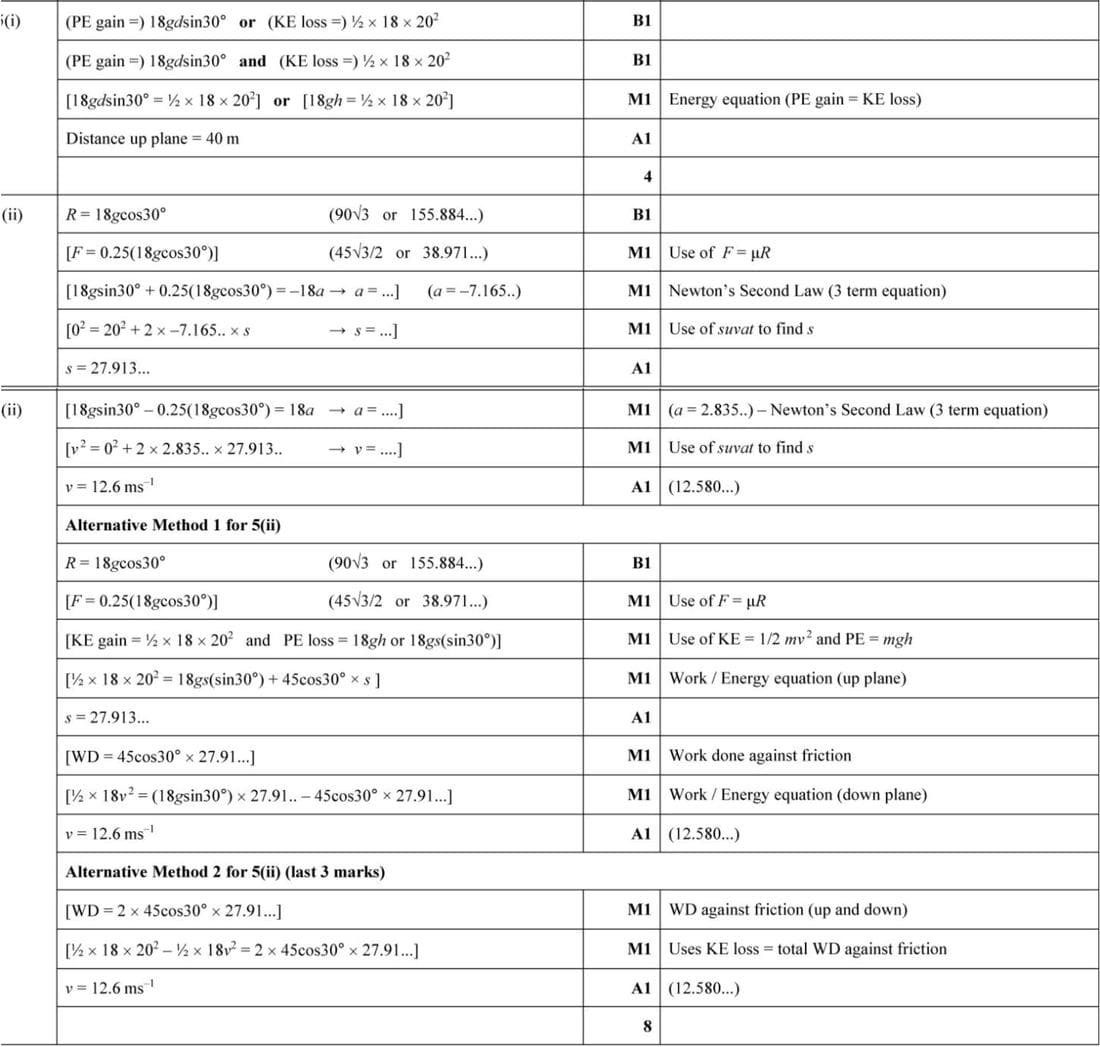
A particle of mass 18 kg is on a plane inclined at an angle of 30° to the horizontal. The particle is projected up a line of greatest slope of the plane with a speed of 20 m/s-1.
- Given that the plane is smooth, use an energy method to find the distance the particle moves up the plane before coming to instantaneous rest.
- Given instead that the plane is rough and the coefficient of friction between the particle and the plane is 0.25, find the speed of the particle as it returns to its starting point.
9709 P41 - Jun 2019 - Q6
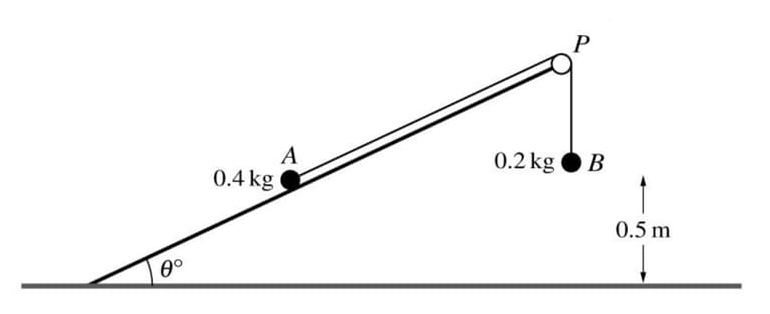
Two particles A and B, of masses 0.4 kg and 0.2 kg respectively, are connected by a light inextensible string. Particle A is held on a smooth plane inclined at an angle of \(\theta^\circ\) to the horizontal. The string passes over a small smooth pulley P fixed at the top of the plane, and B hangs freely 0.5 m above horizontal ground (see diagram). The particles are released from rest with both sections of the string taut.
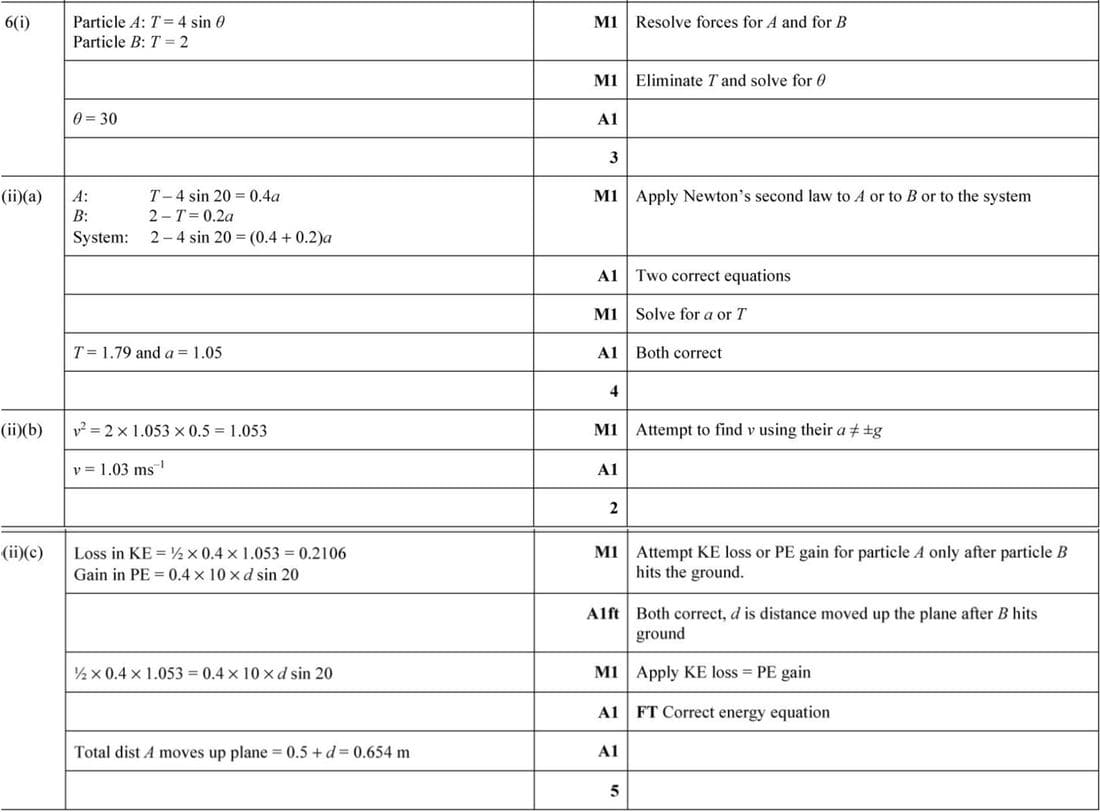
- Given that the system is in equilibrium, find \(\theta\).
- It is given instead that \(\theta = 20\). In the subsequent motion particle A does not reach P and B remains at rest after reaching the ground.
- Find the tension in the string and the acceleration of the system.
- Find the speed of A at the instant B reaches the ground.
- Use an energy method to find the total distance A moves up the plane before coming to instantaneous rest.
9709 P42 - Mar 2019 - Q7
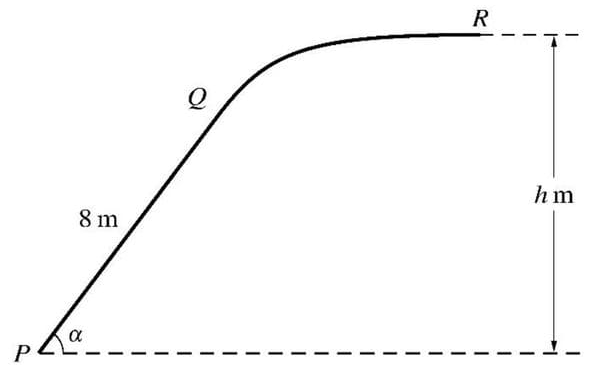
The diagram shows the vertical cross-section PQR of a slide. The part PQ is a straight line of length 8 m inclined at angle \(\alpha\) to the horizontal, where \(\sin \alpha = 0.8\). The straight part PQ is tangential to the curved part QR, and R is h m above the level of P. The straight part PQ of the slide is rough and the curved part QR is smooth. A particle of mass 0.25 kg is projected with speed 15 m s-1 from P towards Q and comes to rest at R. The coefficient of friction between the particle and PQ is 0.5.
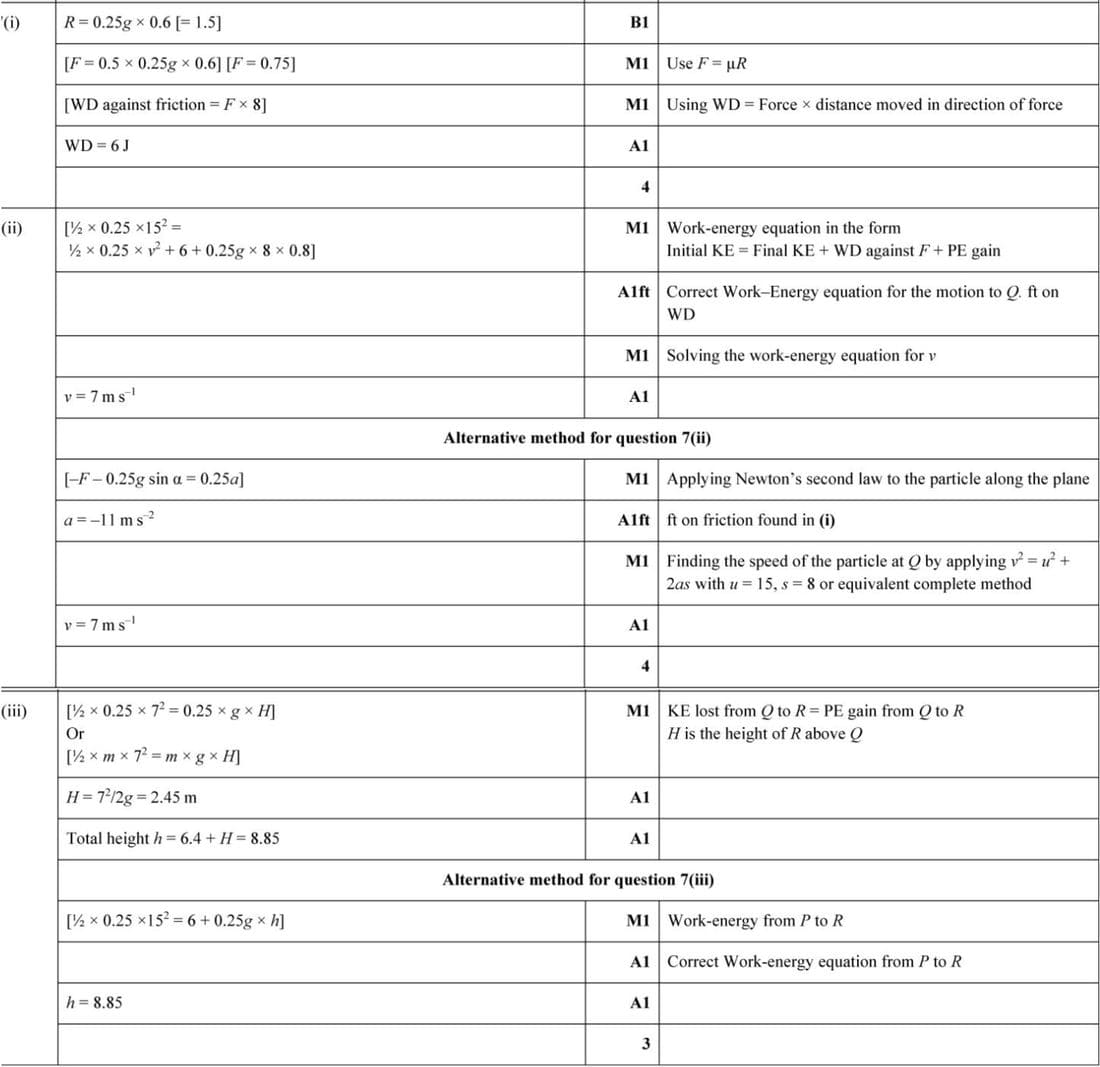
- Find the work done by the friction force during the motion of the particle from P to Q. [4]
- Hence find the speed of the particle at Q. [4]
- Find the value of h. [3]
9709 P42 - Nov 2018 - Q7
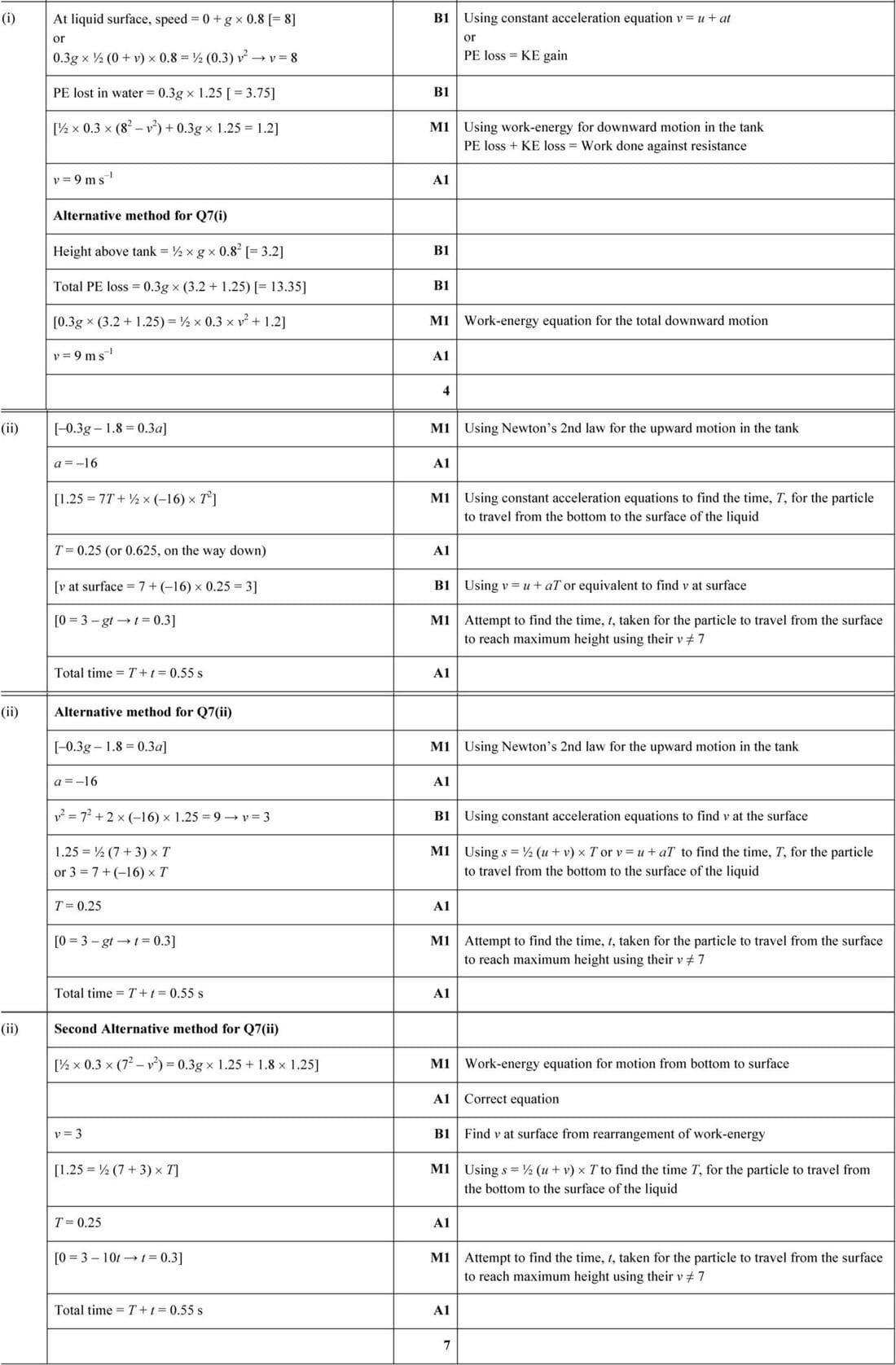
A particle of mass 0.3 kg is released from rest above a tank containing water. The particle falls vertically, taking 0.8 s to reach the water surface. There is no instantaneous change of speed when the particle enters the water. The depth of water in the tank is 1.25 m. The water exerts a force on the particle resisting its motion. The work done against this resistance force from the instant that the particle enters the water until it reaches the bottom of the tank is 1.2 J.
(i) Use an energy method to find the speed of the particle when it reaches the bottom of the tank. [4]
When the particle reaches the bottom of the tank, it bounces back vertically upwards with initial speed 7 m s−1. As the particle rises through the water, it experiences a constant resistance force of 1.8 N. The particle comes to instantaneous rest t seconds after it bounces on the bottom of the tank.
(ii) Find the value of t. [7]
9709 P43 - Jun 2018 - Q4
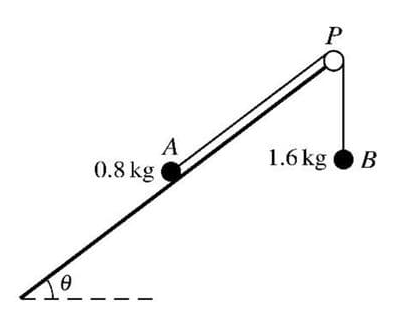
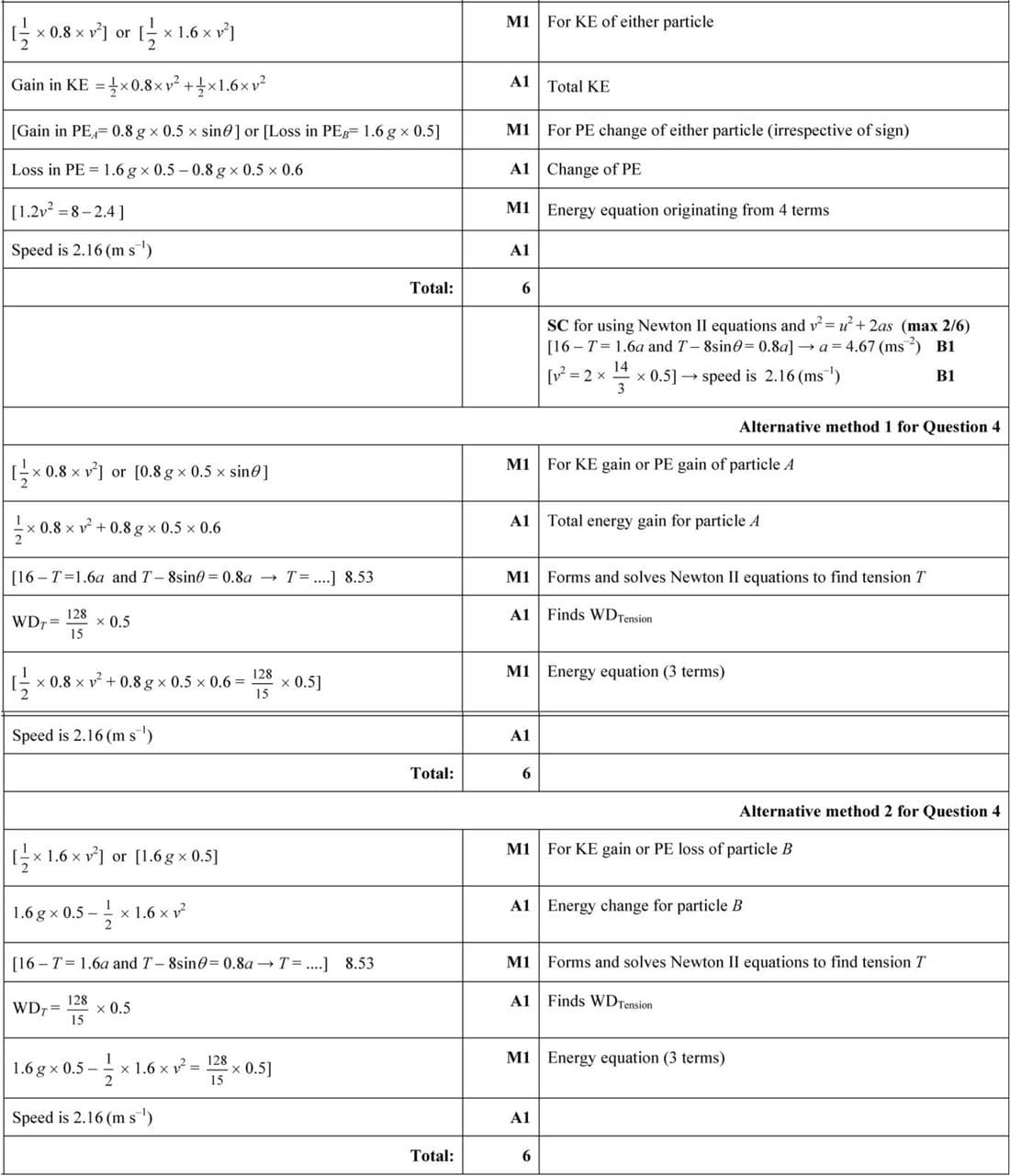
Two particles A and B, of masses 0.8 kg and 1.6 kg respectively, are connected by a light inextensible string. Particle A is placed on a smooth plane inclined at an angle \(\theta\) to the horizontal, where \(\sin \theta = \frac{3}{5}\). The string passes over a small smooth pulley P fixed at the top of the plane, and B hangs freely (see diagram). The section AP of the string is parallel to a line of greatest slope of the plane. The particles are released from rest with both sections of the string taut. Use an energy method to find the speed of the particles after each particle has moved a distance of 0.5 m, assuming that A has not yet reached the pulley.
9709 P41 - Jun 2018 - Q6
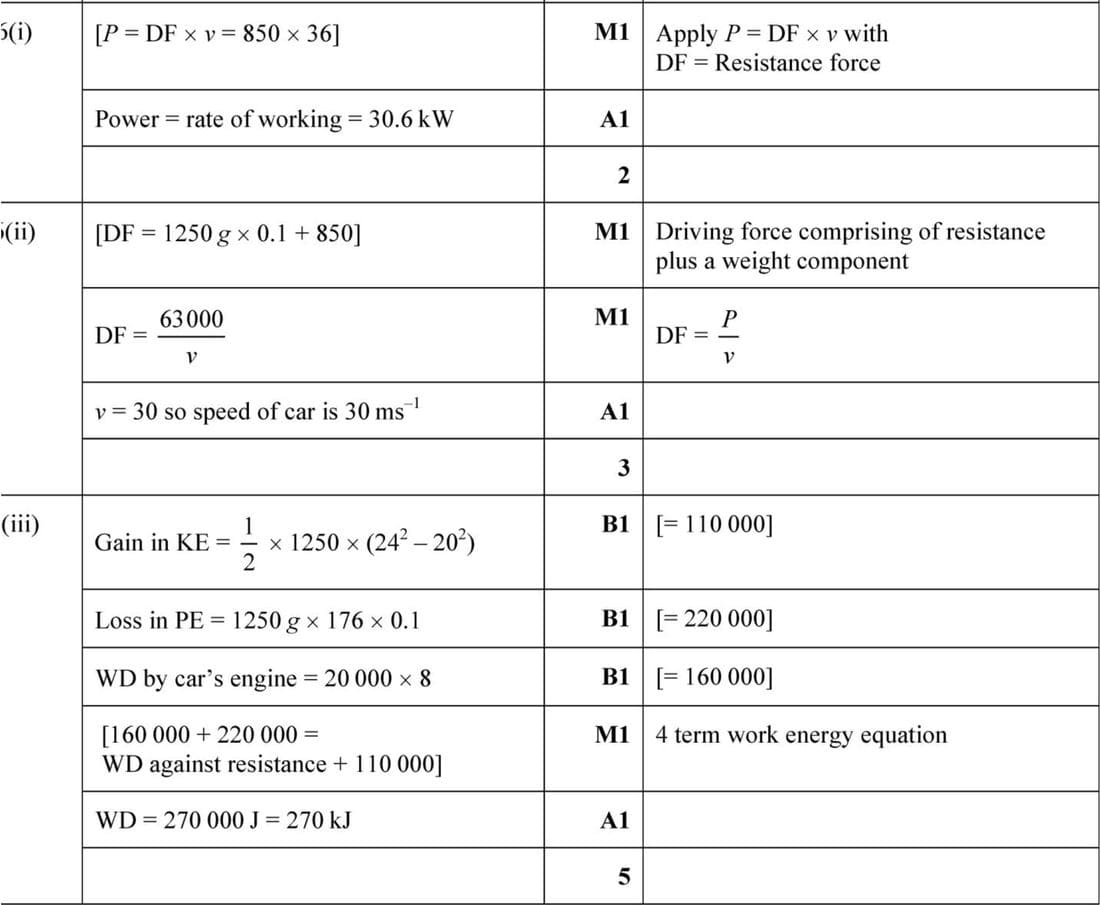
A car has mass 1250 kg.
- The car is moving along a straight level road at a constant speed of 36 m s-1 and is subject to a constant resistance of magnitude 850 N. Find, in kW, the rate at which the engine of the car is working.
- The car travels at a constant speed up a hill and is subject to the same resistance as in part (i). The hill is inclined at an angle of θ° to the horizontal, where sin θ° = 0.1, and the engine is working at 63 kW. Find the speed of the car.
- The car descends the same hill with the engine of the car working at a constant rate of 20 kW. The resistance is not constant. The initial speed of the car is 20 m s-1. Eight seconds later the car has speed 24 m s-1 and has moved 176 m down the hill. Use an energy method to find the total work done against the resistance during the eight seconds.
9709 P42 - Mar 2018 - Q3
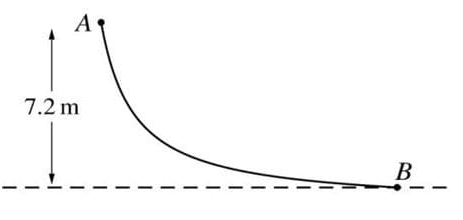
A girl, of mass 40 kg, slides down a slide in a water park. The girl starts at the point A and slides to the point B which is 7.2 metres vertically below the level of A, as shown in the diagram.
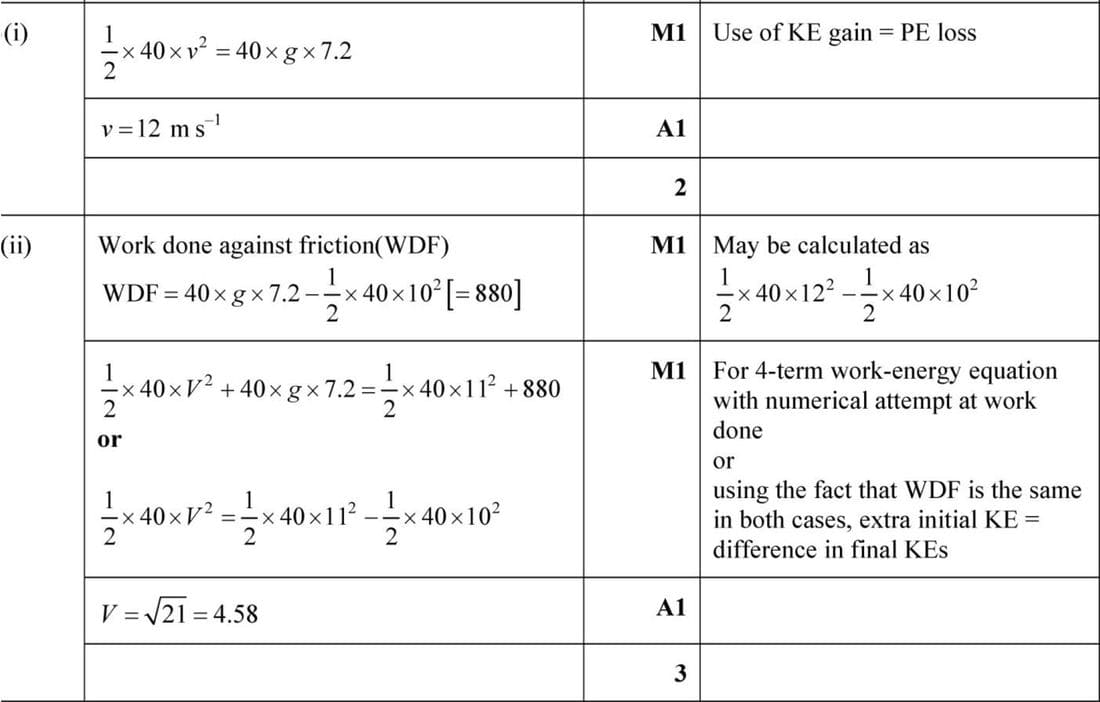
(i) Given that the slide is smooth and that the girl starts from rest at A, find the speed of the girl at B. [2]
(ii) It is given instead that the slide is rough. On one occasion the girl starts from rest at A and reaches B with a speed of 10 m s-1. On another occasion the girl is pushed from A with an initial speed V m s-1 and reaches B with speed 11 m s-1. Given that the work done against friction is the same on both occasions, find V. [3]
9709 P43 - Nov 2017 - Q7
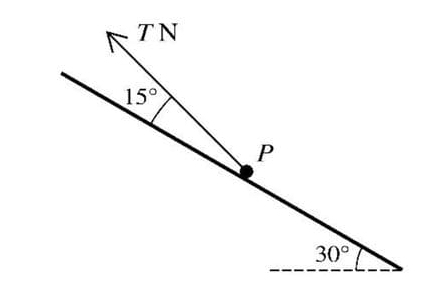
A particle P of mass 0.2 kg rests on a rough plane inclined at 30° to the horizontal. The coefficient of friction between the particle and the plane is 0.3. A force of magnitude T N acts upwards on P at 15° above a line of greatest slope of the plane (see diagram).
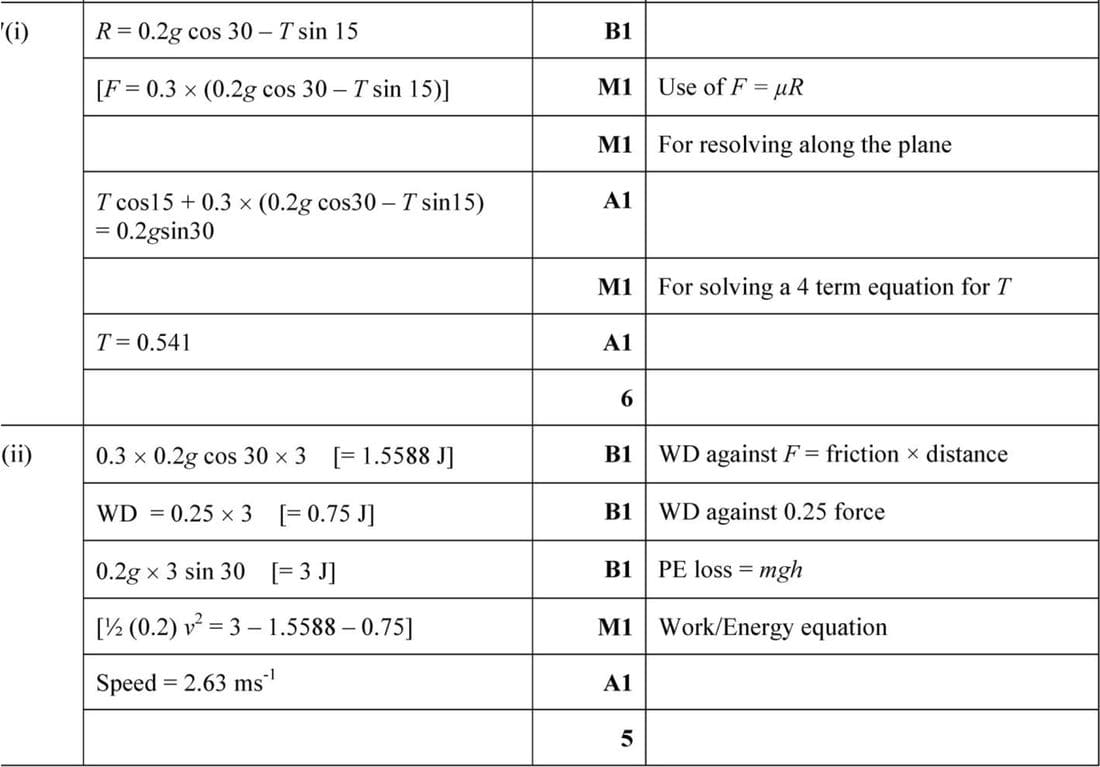
- Find the least value of T for which the particle remains at rest.
The force of magnitude T N is now removed. A new force of magnitude 0.25 N acts on P up the plane, parallel to a line of greatest slope of the plane. Starting from rest, P slides down the plane. After moving a distance of 3 m, P passes through the point A.
- Use an energy method to find the speed of P at A.
9709 P42 - Jun 2023 - Q4
An athlete of mass 84 kg is running along a straight road.
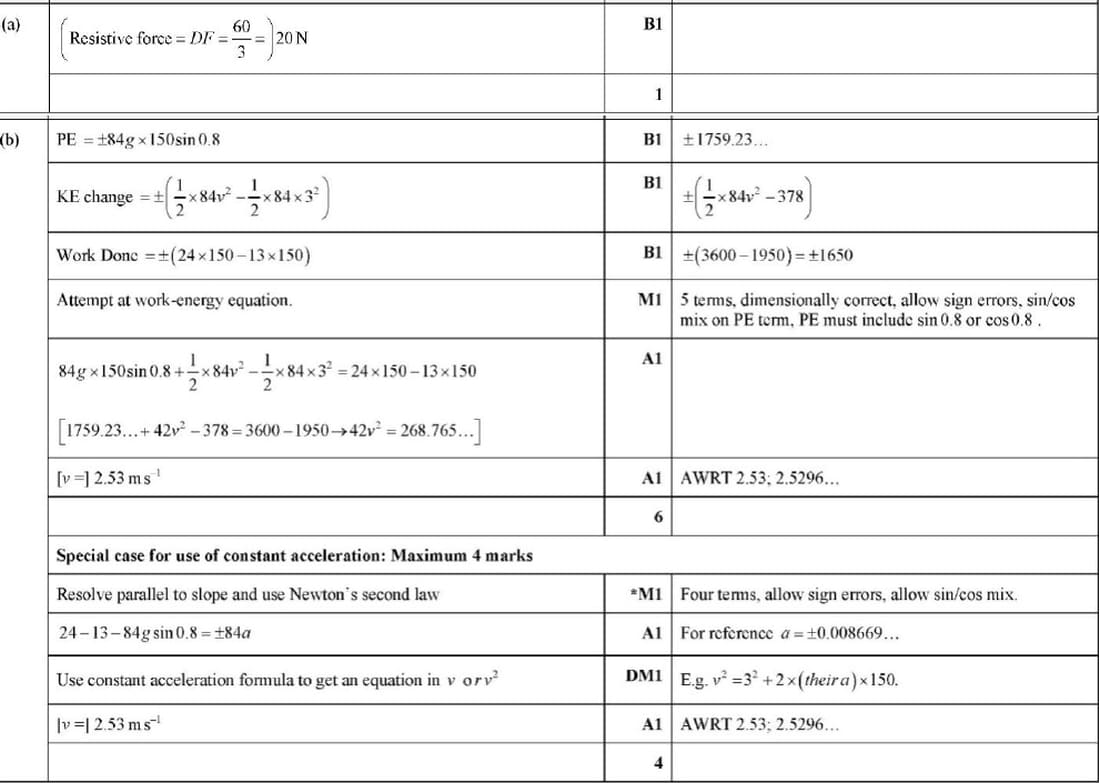
(a) Initially the road is horizontal and he runs at a constant speed of 3 m s-1. The athlete produces a constant power of 60 W.
Find the resistive force which acts on the athlete.
(b) The athlete then runs up a 150 m section of the road which is inclined at 0.8° to the horizontal. The speed of the athlete at the start of this section of road is 3 m s-1 and he now produces a constant driving force of 24 N. The total resistive force which acts on the athlete along this section of road has constant magnitude 13 N.
Use an energy method to find the speed of the athlete at the end of the 150 m section of road.
9709 P41 - Nov 2017 - Q3
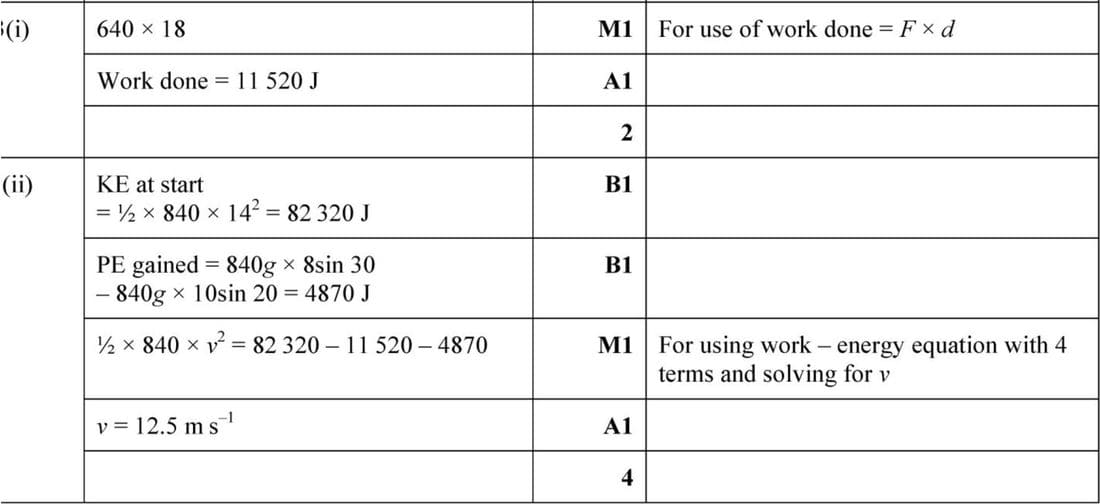
A roller-coaster car (including passengers) has a mass of 840 kg. The roller-coaster ride includes a section where the car climbs a straight ramp of length 8 m inclined at 30° above the horizontal. The car then immediately descends another ramp of length 10 m inclined at 20° below the horizontal. The resistance to motion acting on the car is 640 N throughout the motion.
- Find the total work done against the resistance force as the car ascends the first ramp and descends the second ramp.
- The speed of the car at the bottom of the first ramp is 14 m s-1. Use an energy method to find the speed of the car when it reaches the bottom of the second ramp.
9709 P42 - Jun 2017 - Q2
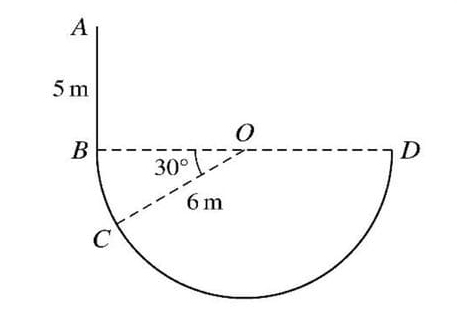
The diagram shows a wire ABCD consisting of a straight part AB of length 5 m and a part BCD in the shape of a semicircle of radius 6 m and centre O. The diameter BD of the semicircle is horizontal and AB is vertical. A small ring is threaded onto the wire and slides along the wire. The ring starts from rest at A. The part AB of the wire is rough, and the ring accelerates at a constant rate of 2.5 m/s2 between A and B.
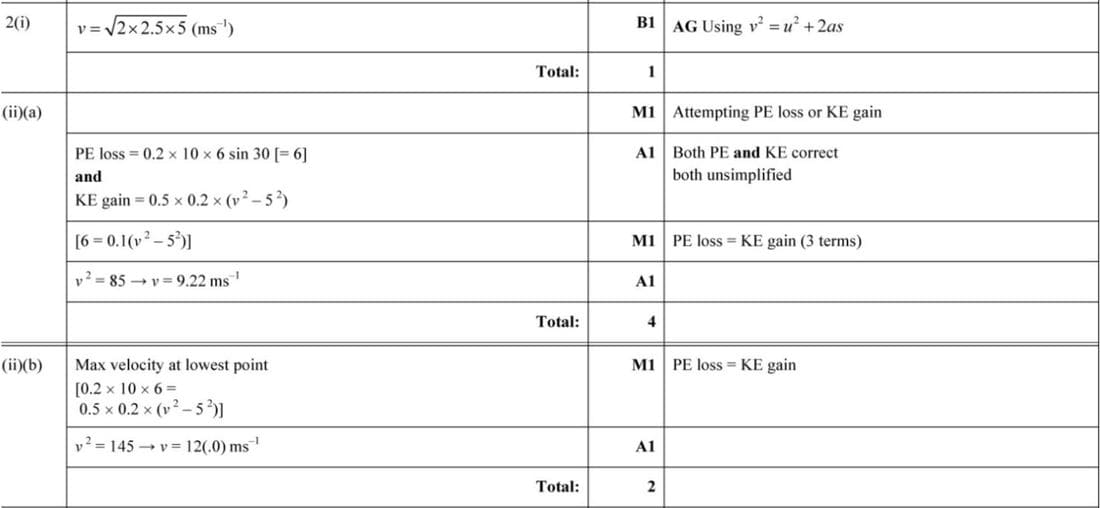
- Show that the speed of the ring as it reaches B is 5 m/s-1. [1]
The part BCD of the wire is smooth. The mass of the ring is 0.2 kg.
- (a) Find the speed of the ring at C, where angle BOC = 30°. [4]
- (b) Find the greatest speed of the ring. [2]
9709 P41 - Jun 2017 - Q4
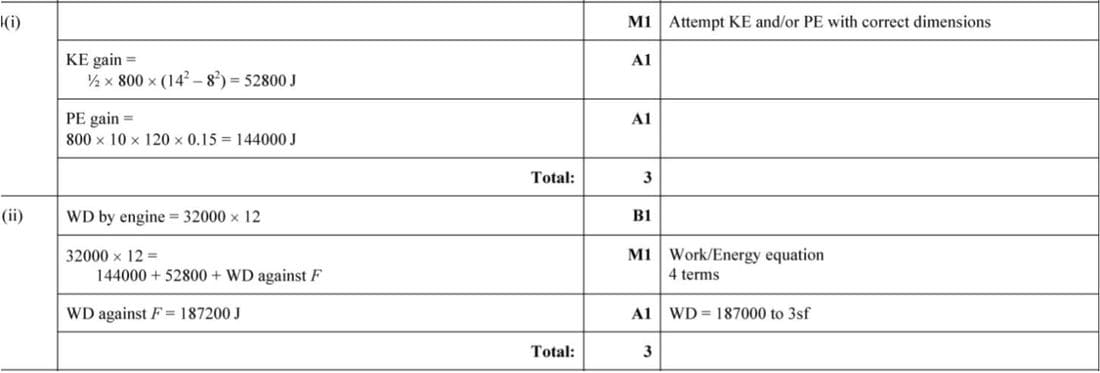
A car of mass 800 kg is moving up a hill inclined at \(\theta\) to the horizontal, where \(\sin \theta = 0.15\). The initial speed of the car is 8 m s\(^{-1}\). Twelve seconds later the car has travelled 120 m up the hill and has speed 14 m s\(^{-1}\).
(i) Find the change in the kinetic energy and the change in gravitational potential energy of the car. [3]
(ii) The engine of the car is working at a constant rate of 32 kW. Find the total work done against the resistive forces during the twelve seconds. [3]
9709 P42 - Mar 2017 - Q1
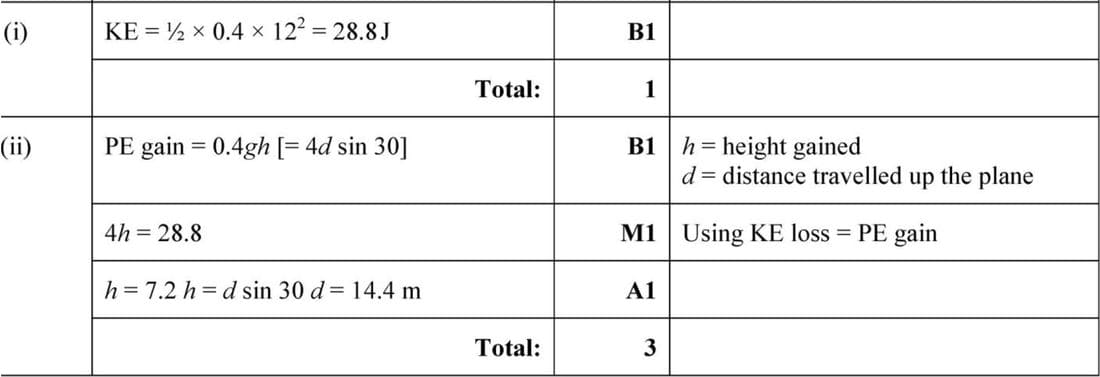
A particle of mass 0.4 kg is projected with a speed of 12 m s-1 up a line of greatest slope of a smooth plane inclined at 30° to the horizontal.
- Find the initial kinetic energy of the particle.
- Use an energy method to find the distance the particle moves up the plane before coming to instantaneous rest.