9709 P42 - Nov 2009 - Q2
3573
A lorry of mass 15,000 kg moves with constant speed 14 m/s from the top to the bottom of a straight hill of length 900 m. The top of the hill is 18 m above the level of the bottom of the hill. The total work done by the resistive forces acting on the lorry, including the braking force, is \(4.8 \times 10^6\) J. Find
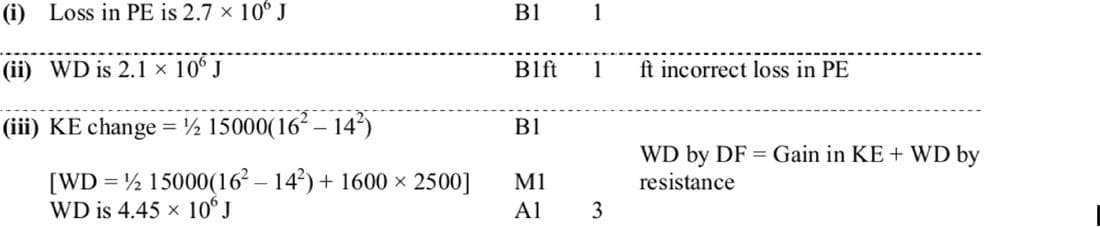
- the loss in gravitational potential energy of the lorry,
- the work done by the driving force.
On reaching the bottom of the hill the lorry continues along a straight horizontal road against a constant resistance of 1600 N. There is no braking force acting. The speed of the lorry increases from 14 m/s at the bottom of the hill to 16 m/s at the point X, where X is 2500 m from the bottom of the hill.
- By considering energy, find the work done by the driving force of the lorry while it travels from the bottom of the hill to X.