Past Exam Questions
← Back9709 P43 - Nov 2016 - Q7
A box of mass 50 kg is at rest on a plane inclined at 10° to the horizontal.
- Find an inequality for the coefficient of friction between the box and the plane. [2]
In fact the coefficient of friction between the box and the plane is 0.19.
- A girl pushes the box with a force of 50 N, acting down a line of greatest slope of the plane, for a distance of 5 m. She then stops pushing. Use an energy method to find the speed of the box when it has travelled a further 5 m. [5]
The box then comes to a plane inclined at 20° below the horizontal. The box moves down a line of greatest slope of this plane. The coefficient of friction is still 0.19 and the girl is not pushing the box.
- Find the acceleration of the box. [2]
9709 P41 - Nov 2016 - Q6
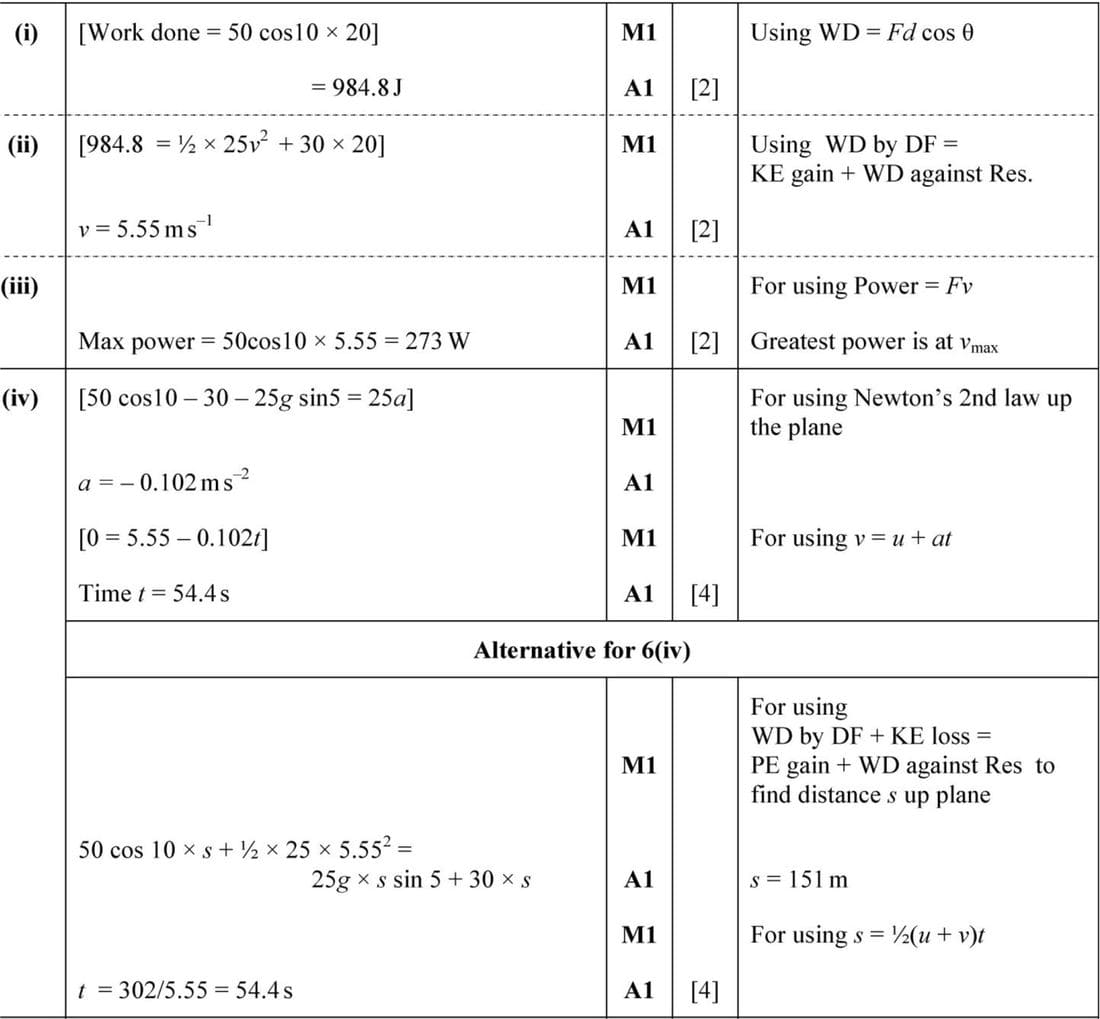
A block of mass 25 kg is pulled along horizontal ground by a force of magnitude 50 N inclined at 10° above the horizontal. The block starts from rest and travels a distance of 20 m. There is a constant resistance force of magnitude 30 N opposing motion.
- Find the work done by the pulling force.
- Use an energy method to find the speed of the block when it has moved a distance of 20 m.
- Find the greatest power exerted by the 50 N force.
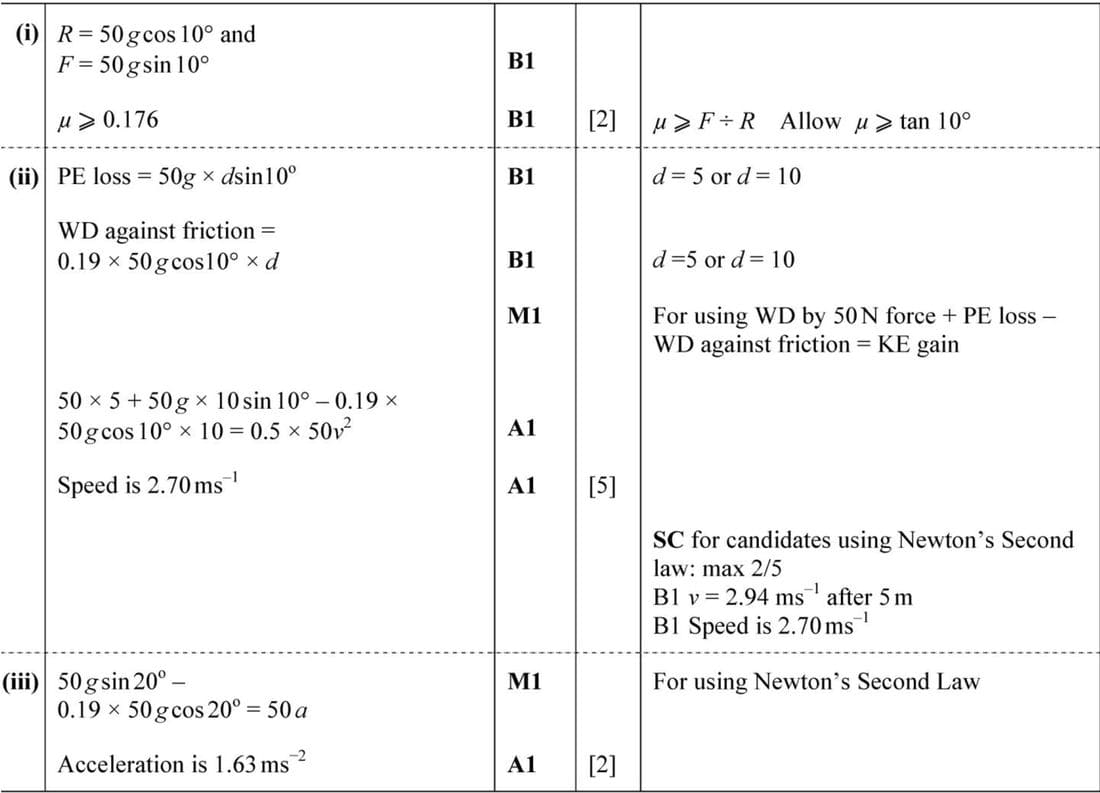
After the block has travelled the 20 m, it comes to a plane inclined at 5° to the horizontal. The force of 50 N is now inclined at an angle of 10° to the plane and pulls the block directly up the plane (see diagram). The resistance force remains 30 N.
- Find the time it takes for the block to come to rest from the instant when it reaches the foot of the inclined plane.
9709 P41 - Nov 2016 - Q5
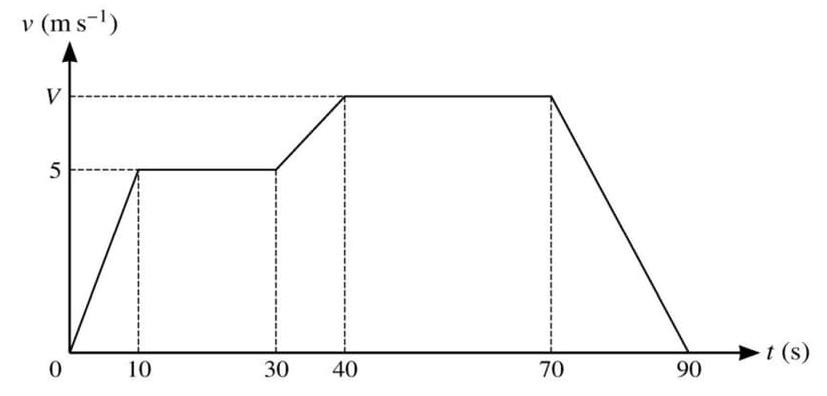
The diagram shows a velocity-time graph which models the motion of a cyclist. The graph consists of five straight line segments. The cyclist accelerates from rest to a speed of 5 m s-1 over a period of 10 s, and then travels at this speed for a further 20 s. The cyclist then descends a hill, accelerating to speed V m s-1 over a period of 10 s. This speed is maintained for a further 30 s. The cyclist then decelerates to rest over a period of 20 s.
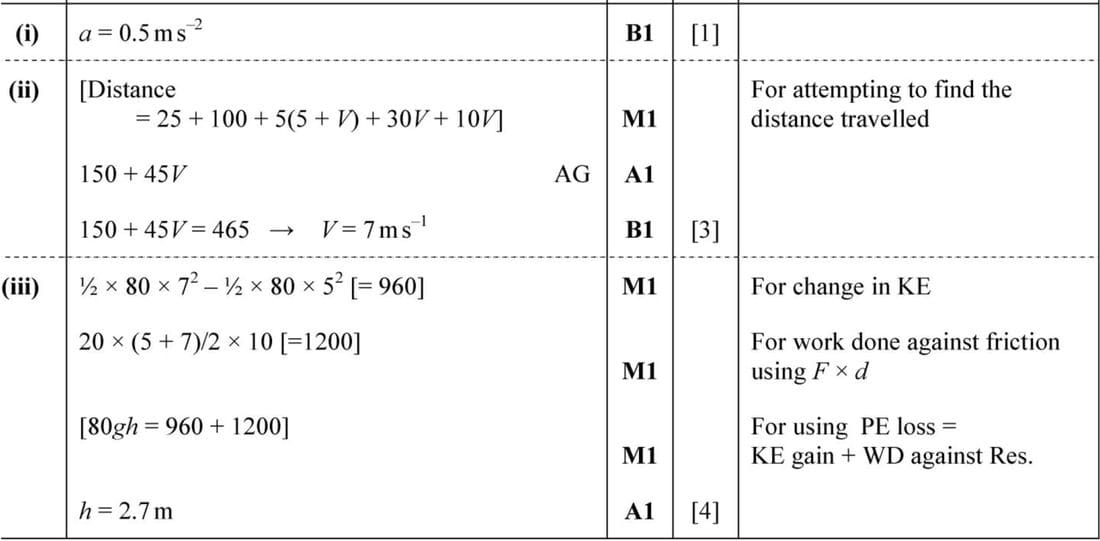
(i) Find the acceleration of the cyclist during the first 10 seconds.
(ii) Show that the total distance travelled by the cyclist in the 90 seconds of motion may be expressed as (45V + 150) m. Hence find V, given that the total distance travelled by the cyclist is 465 m.
(iii) The combined mass of the cyclist and the bicycle is 80 kg. The cyclist experiences a constant resistance to motion of 20 N. Use an energy method to find the vertical distance which the cyclist descends during the downhill section from t = 30 to t = 40, assuming that the cyclist does no work during this time.
9709 P43 - Jun 2016 - Q1
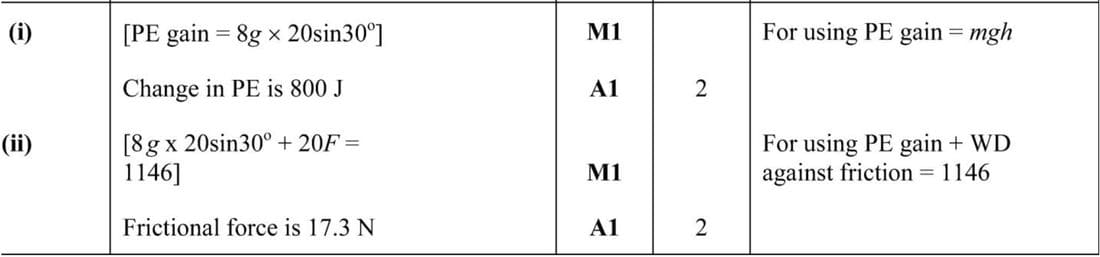
A particle of mass 8 kg is pulled at a constant speed a distance of 20 m up a rough plane inclined at an angle of 30° to the horizontal by a force acting along a line of greatest slope.
- Find the change in gravitational potential energy of the particle.
- The total work done against gravity and friction is 1146 J. Find the frictional force acting on the particle.
9709 P42 - Jun 2016 - Q3
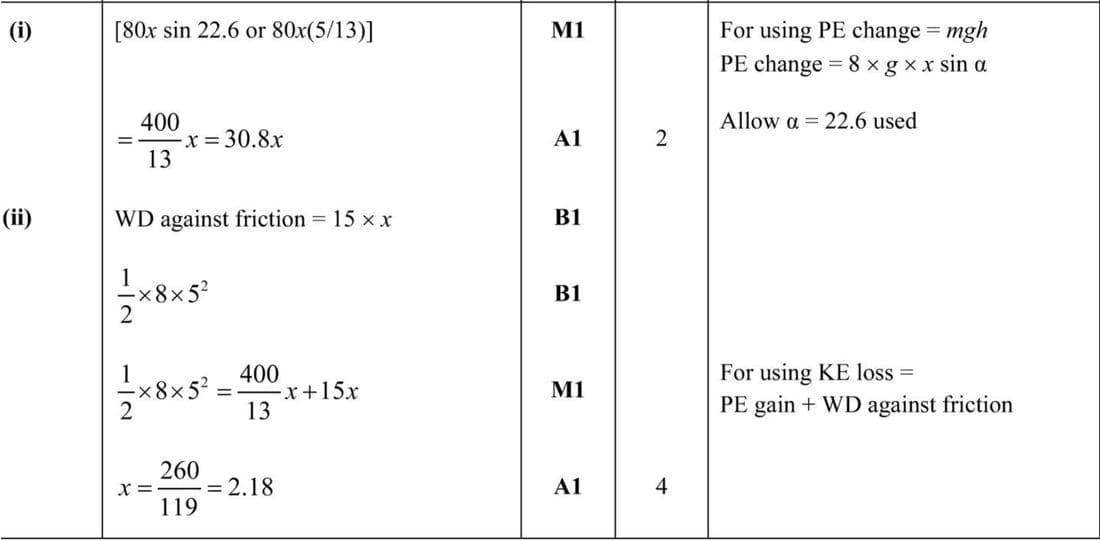
A particle of mass 8 kg is projected with a speed of 5 m s-1 up a line of greatest slope of a rough plane inclined at an angle α to the horizontal, where sin α = 5/13. The motion of the particle is resisted by a constant frictional force of magnitude 15 N. The particle comes to instantaneous rest after travelling a distance x m up the plane.
(i) Express the change in gravitational potential energy of the particle in terms of x.
(ii) Use an energy method to find x.
9709 P41 - Jun 2016 - Q7
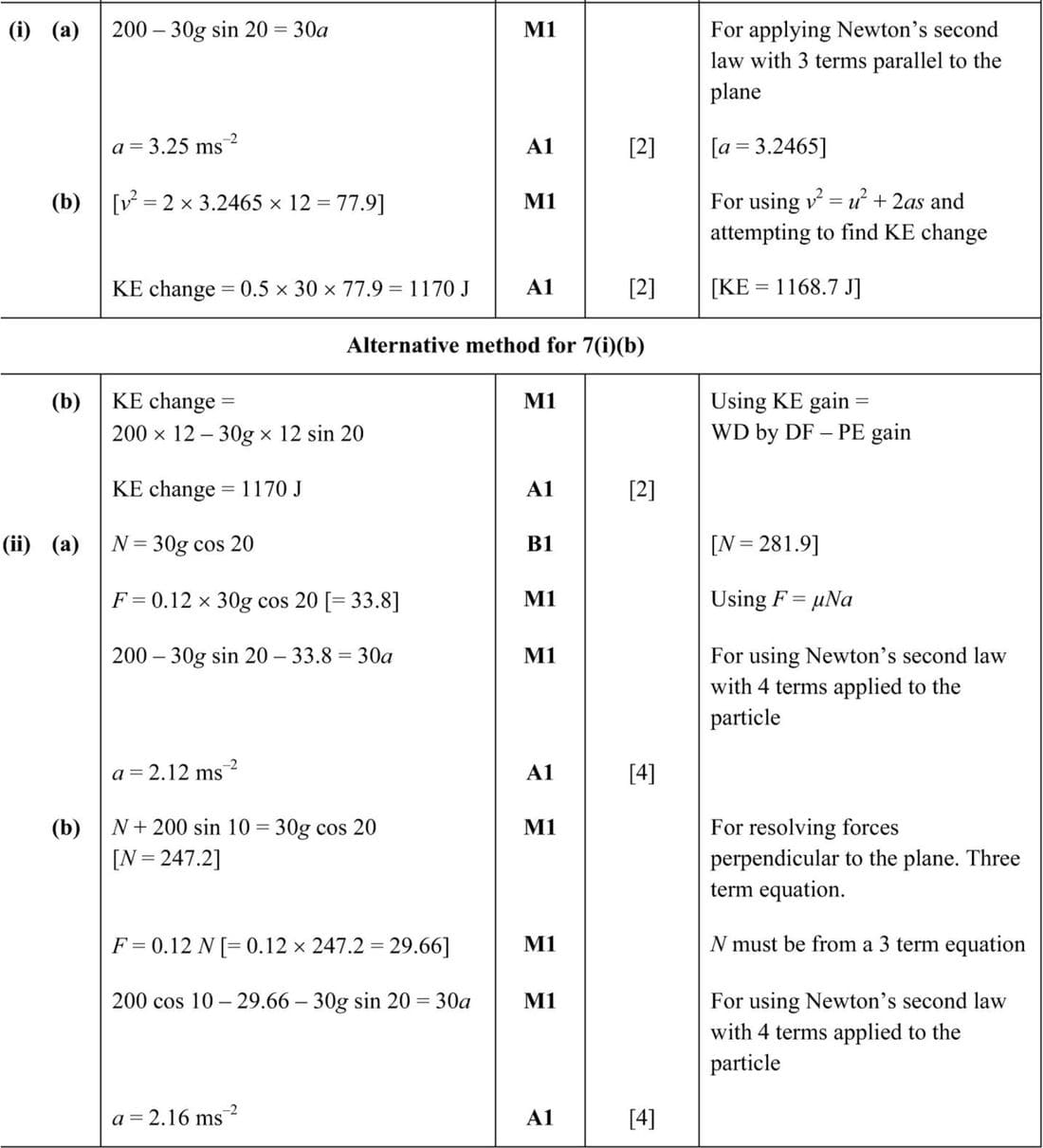
A particle of mass 30 kg is on a plane inclined at an angle of 20° to the horizontal. Starting from rest, the particle is pulled up the plane by a force of magnitude 200 N acting parallel to a line of greatest slope.
- Given that the plane is smooth, find
- the acceleration of the particle,
- the change in kinetic energy after the particle has moved 12 m up the plane.
- It is given instead that the plane is rough and the coefficient of friction between the particle and the plane is 0.12.
- Find the acceleration of the particle.
- The direction of the force of magnitude 200 N is changed, and the force now acts at an angle of 10° above the line of greatest slope. Find the acceleration of the particle.
9709 P41 - Jun 2023 - Q7 - 11 marks
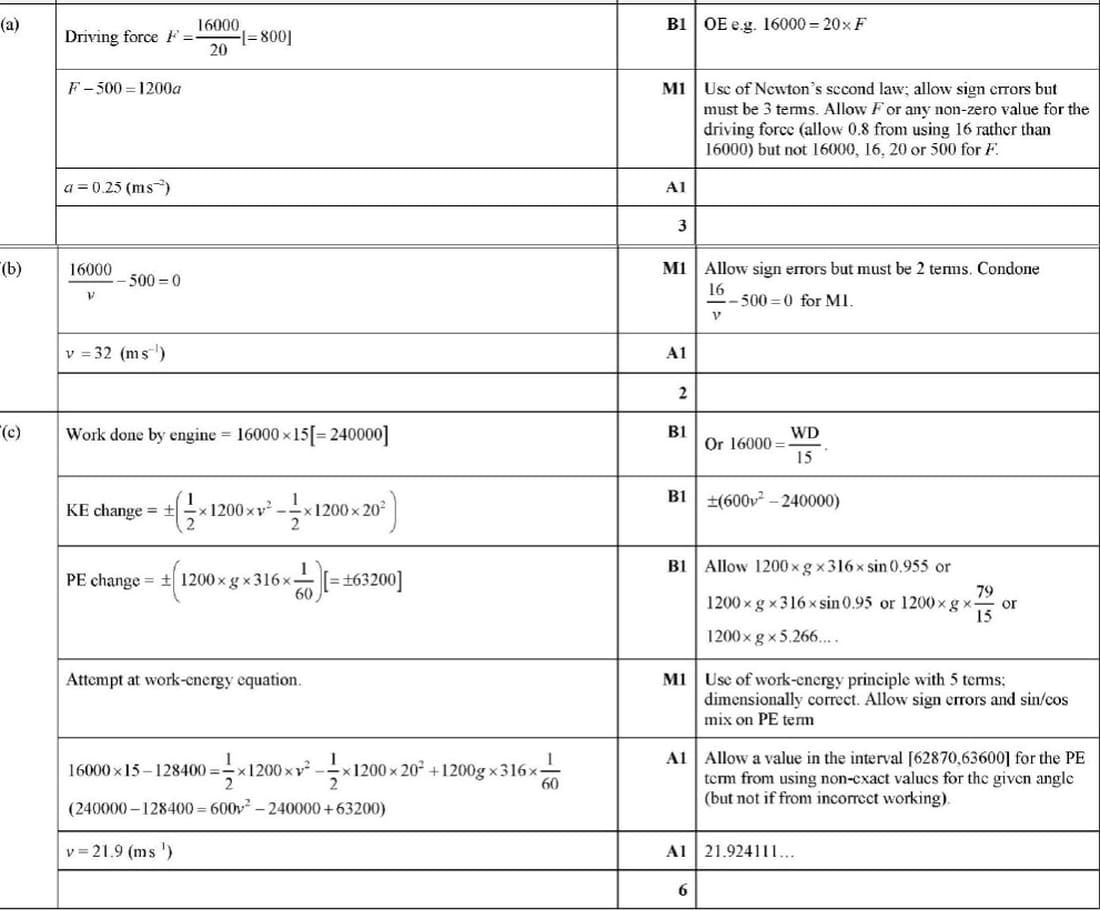
A car of mass 1200 kg is travelling along a straight horizontal road. The power of the car's engine is constant and is equal to 16 kW. There is a constant resistance to motion of magnitude 500 N.
(a) Find the acceleration of the car at an instant when its speed is 20 m/s.
(b) Assuming that the power and the resistance forces remain unchanged, find the steady speed at which the car can travel.
The car comes to the bottom of a straight hill of length 316 m, inclined at an angle to the horizontal of \(\sin^{-1}\left(\frac{1}{60}\right)\). The power remains constant at 16 kW, but the magnitude of the resistance force is no longer constant and changes such that the work done against the resistance force in ascending the hill is 128400 J. The time taken to ascend the hill is 15 s.
(c) Given that the car is travelling at a speed of 20 m/s at the bottom of the hill, find its speed at the top of the hill.
9709 P41 - Jun 2016 - Q2
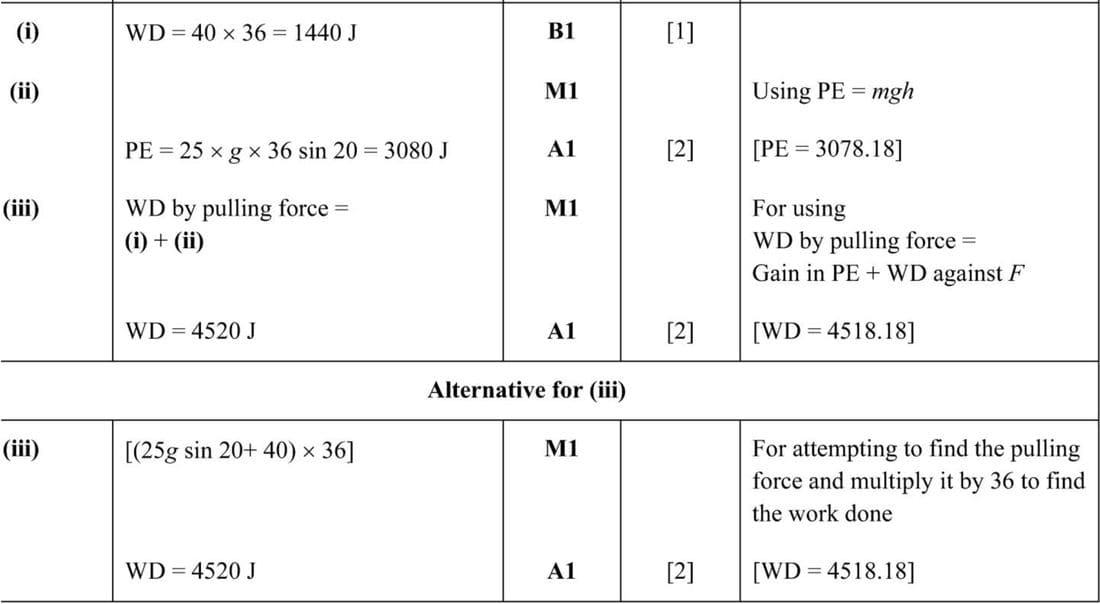
A box of mass 25 kg is pulled, at a constant speed, a distance of 36 m up a rough plane inclined at an angle of 20° to the horizontal. The box moves up a line of greatest slope against a constant frictional force of 40 N. The force pulling the box is parallel to the line of greatest slope. Find
- the work done against friction,
- the change in gravitational potential energy of the box,
- the work done by the pulling force.
9709 P43 - Nov 2015 - Q7
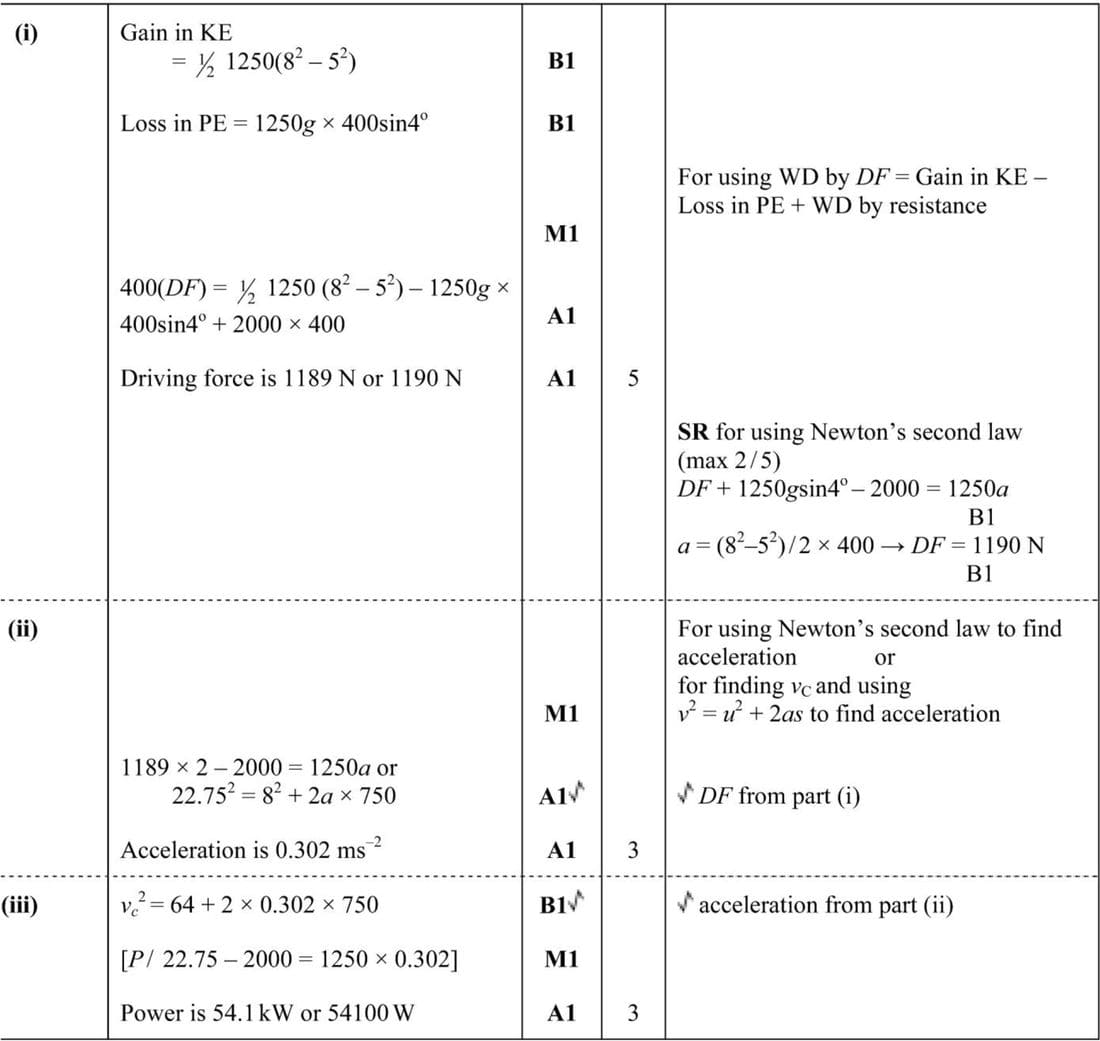
A straight hill AB has length 400 m with A at the top and B at the bottom and is inclined at an angle of 4° to the horizontal. A straight horizontal road BC has length 750 m. A car of mass 1250 kg has a speed of 5 m s-1 at A when starting to move down the hill. While moving down the hill the resistance to the motion of the car is 2000 N and the driving force is constant. The speed of the car on reaching B is 8 m s-1.
- By using work and energy, find the driving force of the car.
- On reaching B the car moves along the road BC. The driving force is constant and twice that when the car was on the hill. The resistance to the motion of the car continues to be 2000 N. Find
- the acceleration of the car while moving from B to C,
- the power of the car’s engine as the car reaches C.
9709 P42 - Nov 2015 - Q7
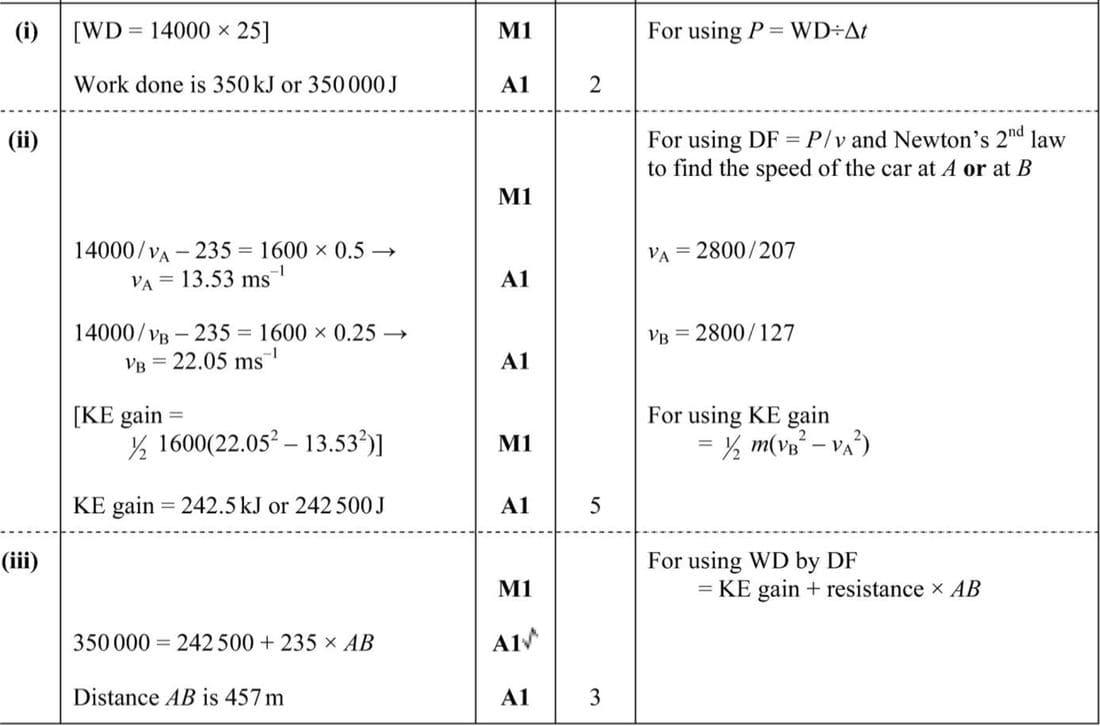
A car of mass 1600 kg moves with constant power 14 kW as it travels along a straight horizontal road. The car takes 25 s to travel between two points A and B on the road.
(i) Find the work done by the car’s engine while the car travels from A to B.
The resistance to the car’s motion is constant and equal to 235 N. The car has accelerations at A and B of 0.5 m/s2 and 0.25 m/s2 respectively. Find
(ii) the gain in kinetic energy by the car in moving from A to B,
(iii) the distance AB.
9709 P42 - Nov 2015 - Q4
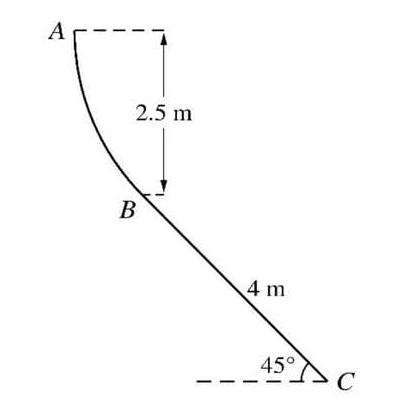
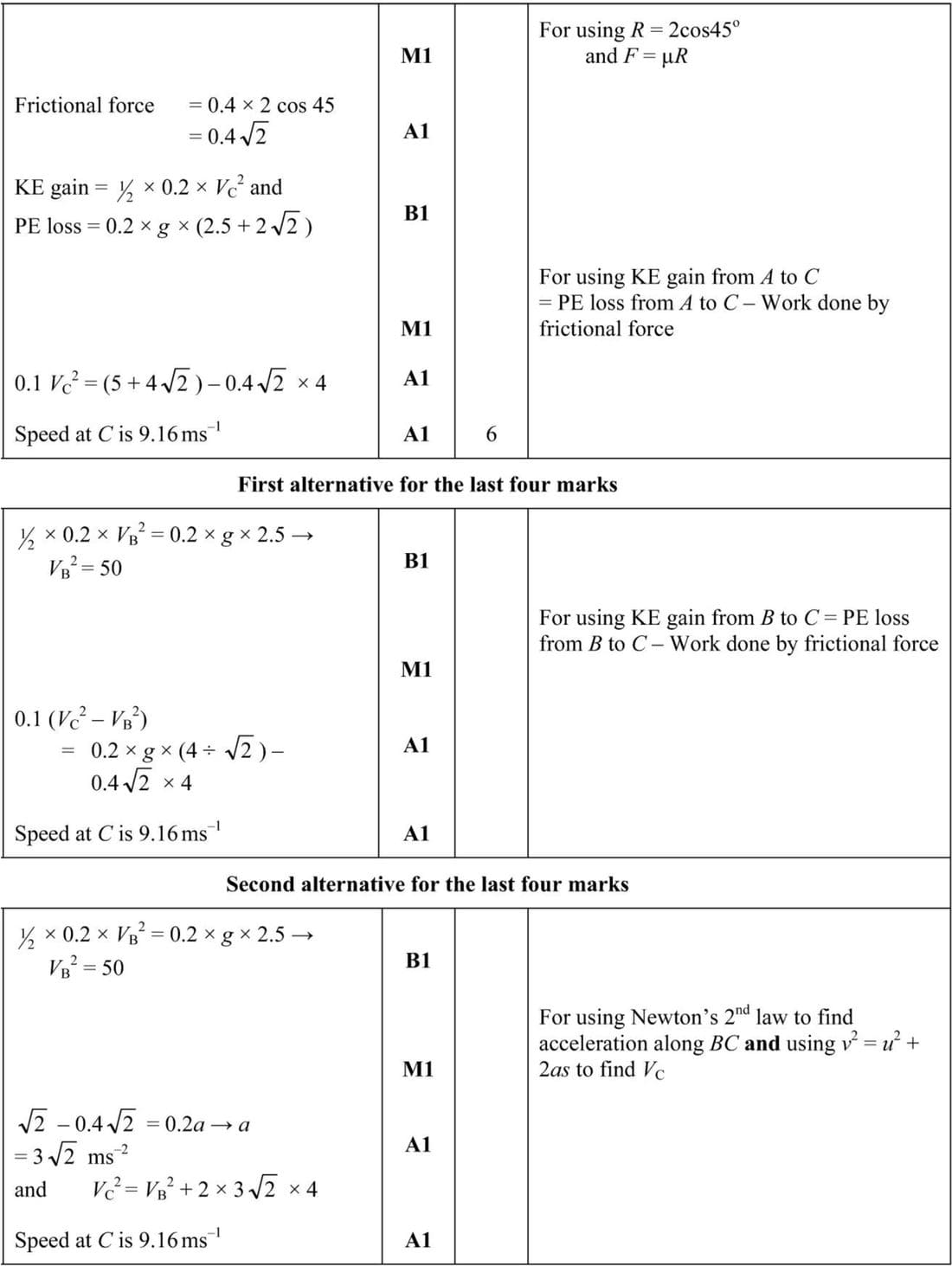
The diagram shows a vertical cross-section ABC of a surface. The part of the surface containing AB is smooth and A is 2.5 m above the level of B. The part of the surface containing BC is rough and is at 45° to the horizontal. The distance BC is 4 m (see diagram). A particle P of mass 0.2 kg is released from rest at A and moves in contact with the curve AB and then with the straight line BC. The coefficient of friction between P and the part of the surface containing BC is 0.4. Find the speed with which P reaches C.
9709 P42 - Jun 2015 - Q3
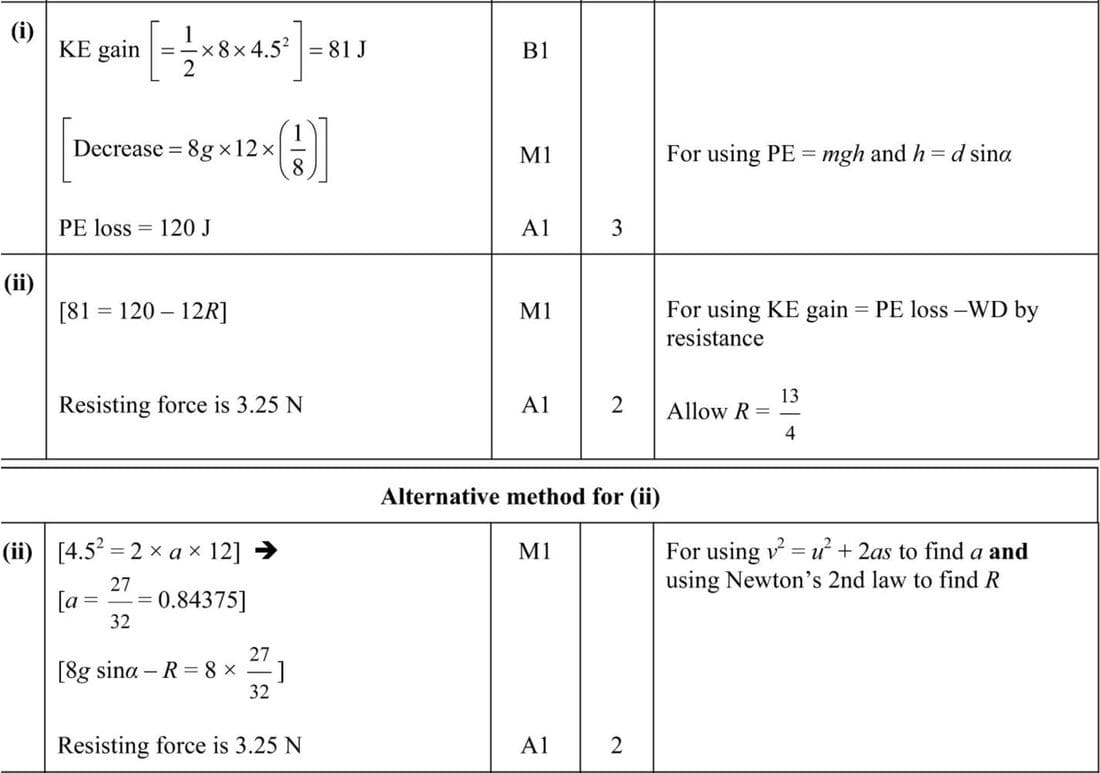
A plane is inclined at an angle of \(\sin^{-1}\left(\frac{1}{8}\right)\) to the horizontal. \(A\) and \(B\) are two points on the same line of greatest slope with \(A\) higher than \(B\). The distance \(AB\) is 12 m. A small object \(P\) of mass 8 kg is released from rest at \(A\) and slides down the plane, passing through \(B\) with speed 4.5 m s\(^{-1}\). For the motion of \(P\) from \(A\) to \(B\), find
- the increase in kinetic energy of \(P\) and the decrease in potential energy of \(P\),
- the magnitude of the constant resisting force that opposes the motion of \(P\).
9709 P41 - Jun 2015 - Q4
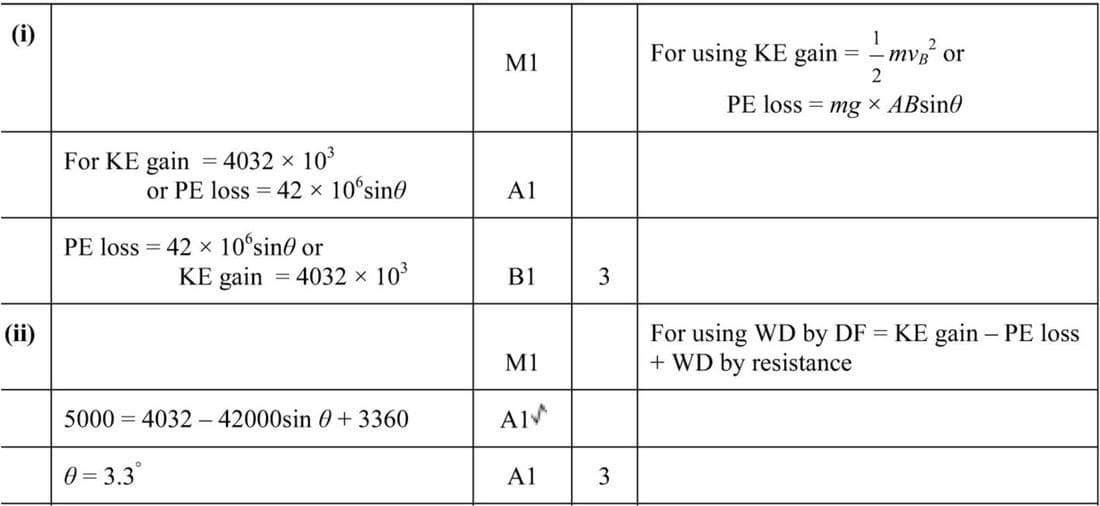
A lorry of mass 14,000 kg moves along a road starting from rest at a point O. It reaches a point A, and then continues to a point B which it reaches with a speed of 24 m s-1. The part OA of the road is straight and horizontal and has length 400 m. The part AB of the road is straight and is inclined downwards at an angle of θ° to the horizontal and has length 300 m.
(i) For the motion from O to B, find the gain in kinetic energy of the lorry and express its loss in potential energy in terms of θ.
The resistance to the motion of the lorry is 4800 N and the work done by the driving force of the lorry from O to B is 5000 kJ.
(ii) Find the value of θ.
9709 P42 - Nov 2014 - Q5
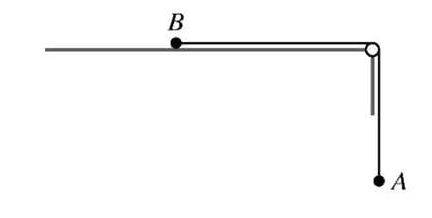
Particles A and B, each of mass 0.3 kg, are connected by a light inextensible string. The string passes over a small smooth pulley fixed at the edge of a rough horizontal surface. Particle A hangs freely and particle B is held at rest in contact with the surface (see diagram). The coefficient of friction between B and the surface is 0.7. Particle B is released and moves on the surface without reaching the pulley.
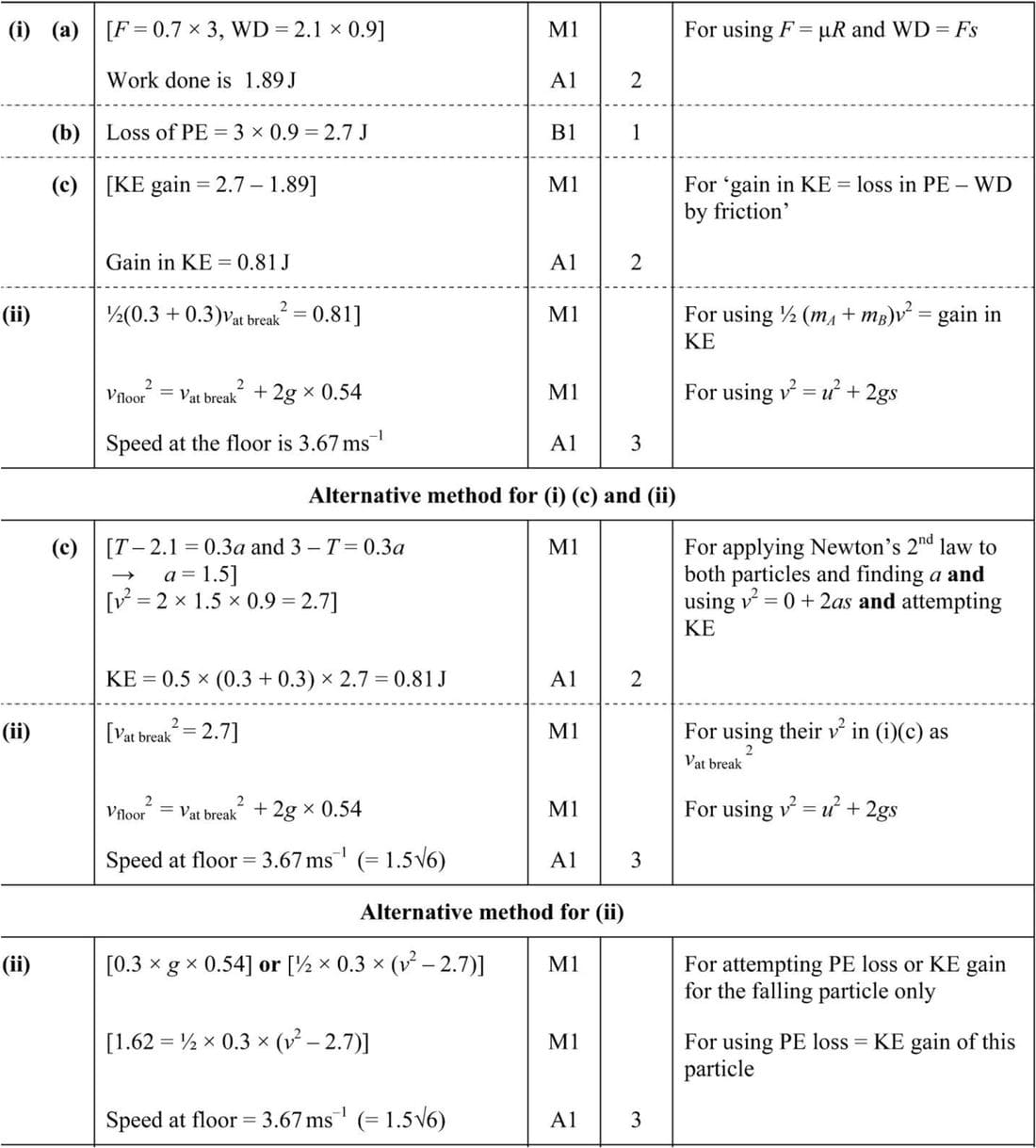
(i) Find, for the first 0.9 m of B's motion,
- the work done against the frictional force acting on B,
- the loss of potential energy of the system,
- the gain in kinetic energy of the system.
At the instant when B has moved 0.9 m the string breaks. A is at a height of 0.54 m above a horizontal floor at this instant.
(ii) Find the speed with which A reaches the floor.
9709 P43 - Jun 2014 - Q5
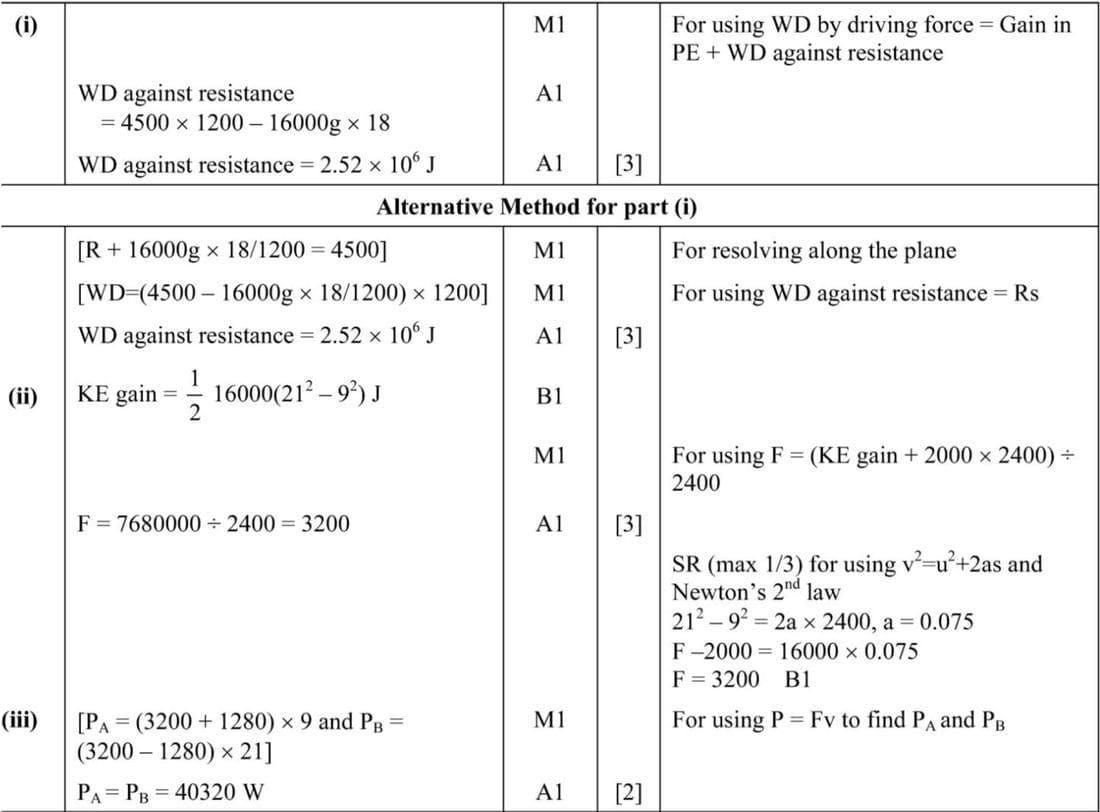
A lorry of mass 16000 kg travels at constant speed from the bottom, O, to the top, A, of a straight hill. The distance OA is 1200 m and A is 18 m above the level of O. The driving force of the lorry is constant and equal to 4500 N.
- Find the work done against the resistance to the motion of the lorry.
On reaching A the lorry continues along a straight horizontal road against a constant resistance of 2000 N. The driving force of the lorry is not now constant, and the speed of the lorry increases from 9 m/s at A to 21 m/s at the point B on the road. The distance AB is 2400 m.
- Use an energy method to find F, where F N is the average value of the driving force of the lorry while moving from A to B.
- Given that the driving force at A is 1280 N greater than F N and that the driving force at B is 1280 N less than F N, show that the power developed by the lorry’s engine is the same at B as it is at A.
9709 P43 - Jun 2014 - Q4
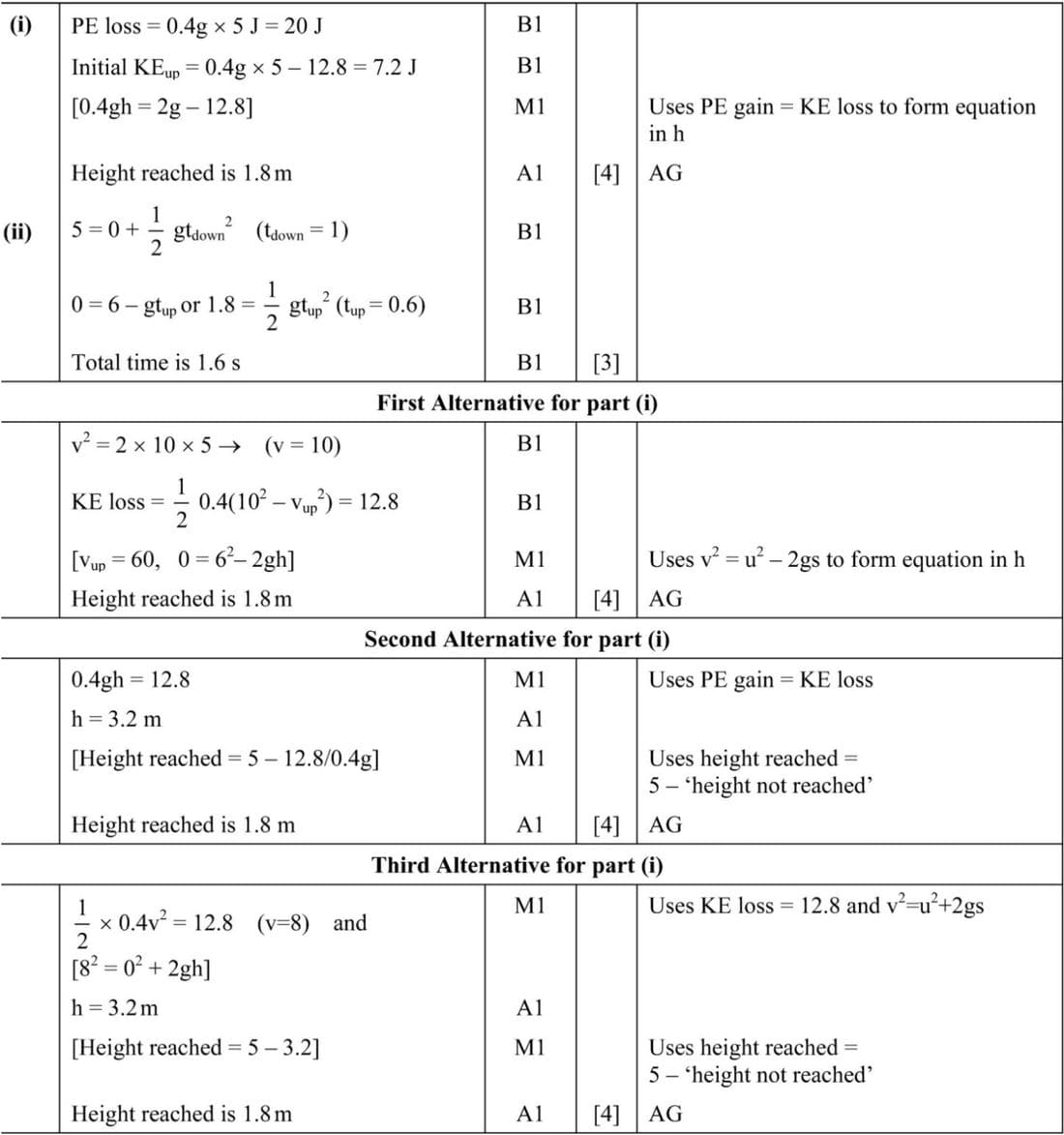
A small ball of mass 0.4 kg is released from rest at a point 5 m above horizontal ground. At the instant the ball hits the ground it loses 12.8 J of kinetic energy and starts to move upwards.
- Show that the greatest height above the ground that the ball reaches after hitting the ground is 1.8 m. [4]
- Find the time taken for the ball’s motion from its release until reaching this greatest height. [3]
9709 P42 - Jun 2014 - Q5
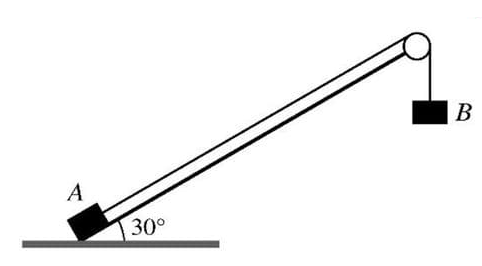
A light inextensible rope has a block A of mass 5 kg attached at one end, and a block B of mass 16 kg attached at the other end. The rope passes over a smooth pulley which is fixed at the top of a rough plane inclined at an angle of 30° to the horizontal. Block A is held at rest at the bottom of the plane and block B hangs below the pulley (see diagram). The coefficient of friction between A and the plane is \(\frac{1}{\sqrt{3}}\). Block A is released from rest and the system starts to move. When each of the blocks has moved a distance of \(x\) m each has speed \(v\) m s-1.
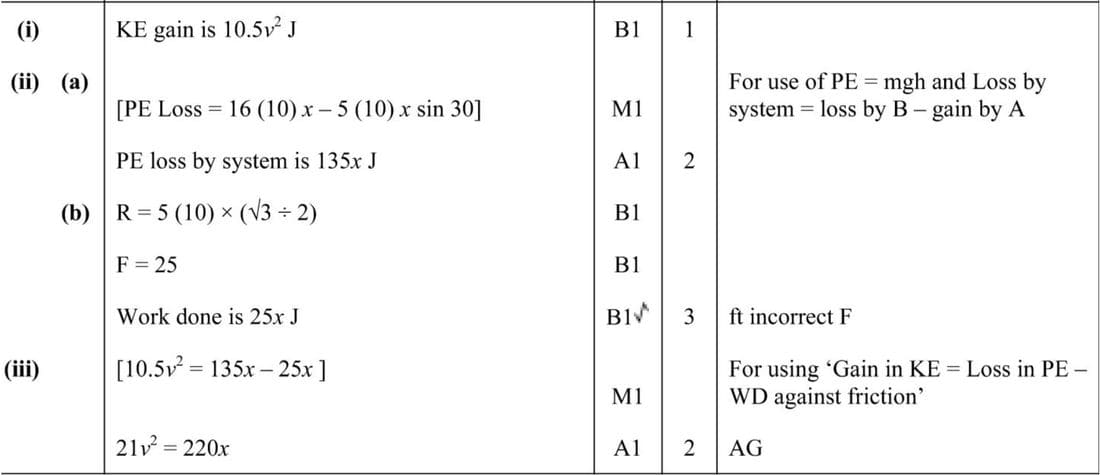
- Write down the gain in kinetic energy of the system in terms of \(v\).
- Find, in terms of \(x\),
- the loss of gravitational potential energy of the system,
- the work done against the frictional force.
- Show that \(21v^2 = 220x\).
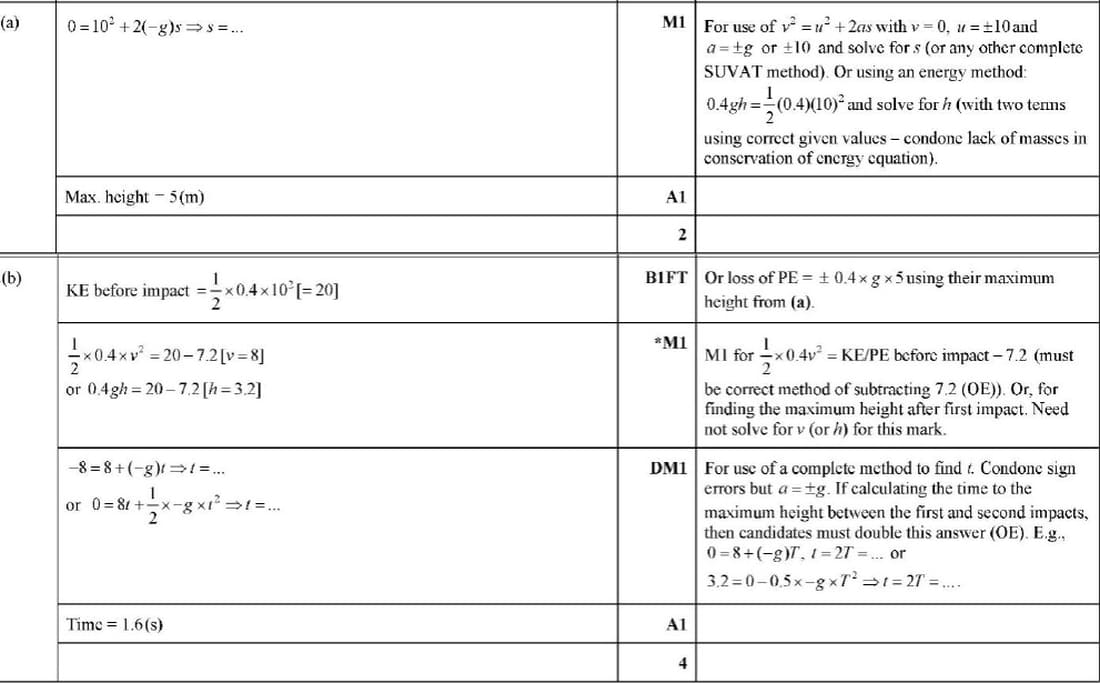
9709 P41 - Jun 2023 - Q2 - 6 marks
A particle P of mass 0.4 kg is projected vertically upwards from horizontal ground with speed 10 m s-1.
(a) Find the greatest height above the ground reached by P.
When P reaches the ground again, it bounces vertically upwards. At the first instant that it hits the ground, P loses 7.2 J of energy.
(b) Find the time between the first and second instants at which P hits the ground.
9709 P41 - Jun 2014 - Q5
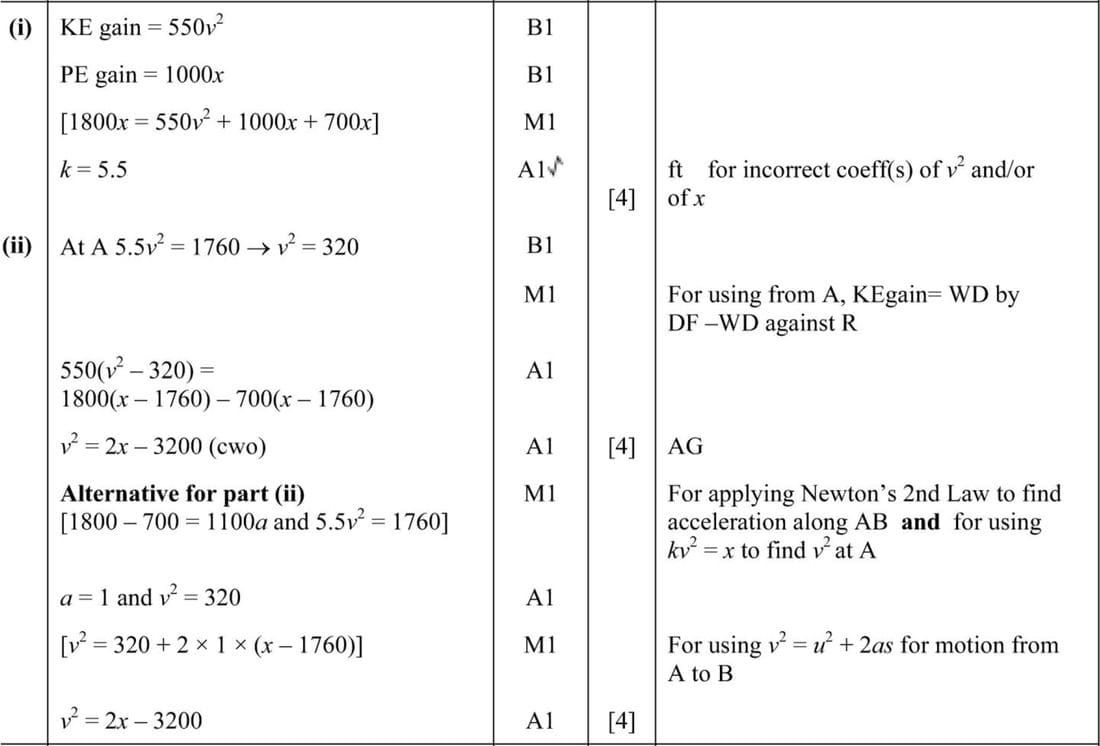
A car of mass 1100 kg starts from rest at O and travels along a road OAB. The section OA is straight, of length 1760 m, and inclined to the horizontal with A at a height of 160 m above the level of O. The section AB is straight and horizontal (see diagram). While the car is moving the driving force of the car is 1800 N and the resistance to the car’s motion is 700 N. The speed of the car is v m s-1 when the car has travelled a distance of x m from O.
- For the car’s motion from O to A, write down its increase in kinetic energy in terms of v and its increase in potential energy in terms of x. Hence find the value of k for which kv2 = x for 0 ≤ x ≤ 1760.
- Show that v2 = 2x − 3200 for x > 1760.

9709 P43 - Jun 2013 - Q2
Particle A of mass 1.6 kg and particle B of mass 2 kg are attached to opposite ends of a light inextensible string. The string passes over a small smooth pulley fixed at the top of a smooth plane, which is inclined at angle \(\theta\), where \(\sin \theta = 0.8\). Particle A is held at rest at the bottom of the plane and B hangs at a height of 3.24 m above the level of the bottom of the plane (see diagram). A is released from rest and the particles start to move.
(i) Show that the loss of potential energy of the system, when B reaches the level of the bottom of the plane, is 23.328 J.
(ii) Hence find the speed of the particles when B reaches the level of the bottom of the plane.