Browsing as Guest. Progress, bookmarks and attempts are disabled.
Log in to track your work.
Nov 2013 p41 q2
3606
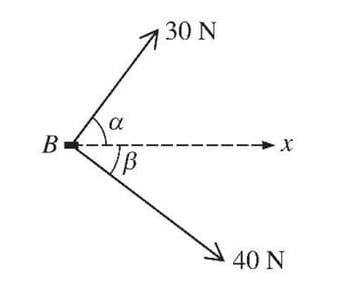
A block B lies on a rough horizontal plane. Horizontal forces of magnitudes 30 N and 40 N, making angles of \(\alpha\) and \(\beta\) respectively with the x-direction, act on B as shown in the diagram, and B is moving in the x-direction with constant speed. It is given that \(\cos \alpha = 0.6\) and \(\cos \beta = 0.8\).
(i) Find the total work done by the forces shown in the diagram when B has moved a distance of 20 m.
(ii) Given that the coefficient of friction between the block and the plane is \(\frac{5}{8}\), find the weight of the block.
Solution
(i) The work done by a force is given by \(W = Fd \cos \theta\), where \(F\) is the force, \(d\) is the distance moved, and \(\theta\) is the angle between the force and the direction of movement.
The work done by the 30 N force is \(30 \times 20 \times 0.6\).
The work done by the 40 N force is \(40 \times 20 \times 0.8\).
Total work done = \(30 \times 20 \times 0.6 + 40 \times 20 \times 0.8 = 1000 \text{ J}\).
(ii) Since the block is moving with constant speed, the net force in the x-direction is zero. The frictional force \(F_f = \mu W\), where \(\mu = \frac{5}{8}\) and \(W\) is the weight of the block.
The equation for equilibrium in the x-direction is: