Past Exam Questions
← Back9709 P43 - Jun 2010 - Q3
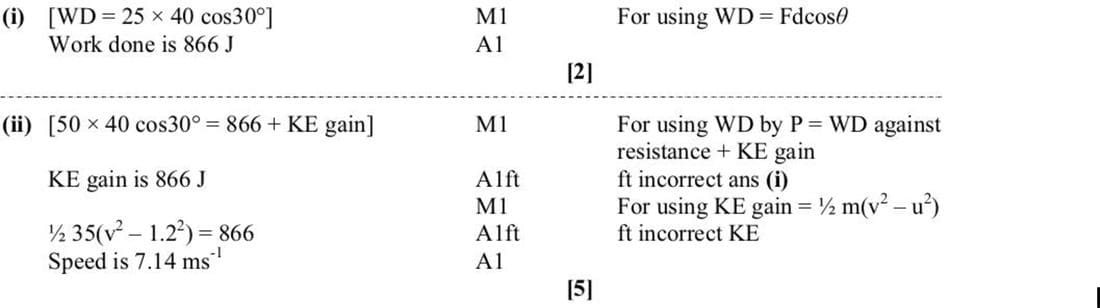
A load is pulled along a horizontal straight track, from A to B, by a force of magnitude P N which acts at an angle of 30° upwards from the horizontal. The distance AB is 80 m. The speed of the load is constant and equal to 1.2 m s-1 as it moves from A to the mid-point M of AB.
- For the motion from A to M the value of P is 25. Calculate the work done by the force as the load moves from A to M.
The speed of the load increases from 1.2 m s-1 as it moves from M towards B. For the motion from M to B the value of P is 50 and the work done against resistance is the same as that for the motion from A to M. The mass of the load is 35 kg.
- Find the gain in kinetic energy of the load as it moves from M to B and hence find the speed with which it reaches B.
9709 P41 - Jun 2010 - Q5
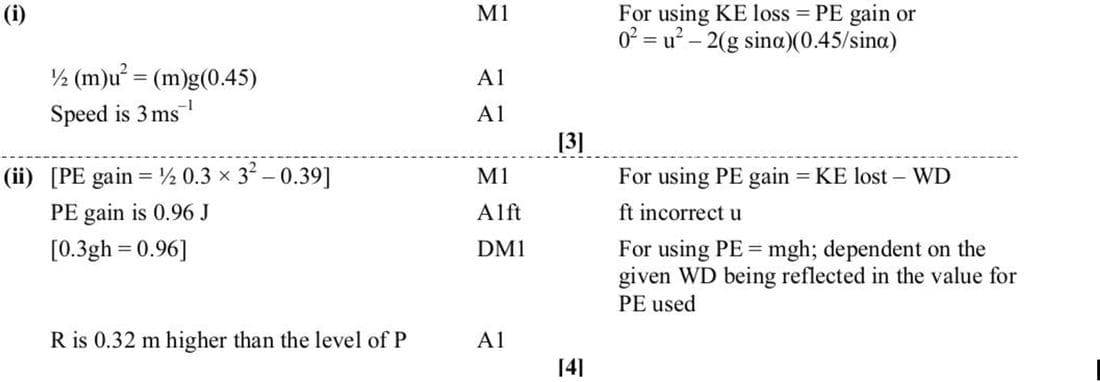
P and Q are fixed points on a line of greatest slope of an inclined plane. The point Q is at a height of 0.45 m above the level of P. A particle of mass 0.3 kg moves upwards along the line PQ.
- Given that the plane is smooth and that the particle just reaches Q, find the speed with which it passes through P.
- It is given instead that the plane is rough. The particle passes through P with the same speed as that found in part (i), and just reaches a point R which is between P and Q. The work done against the frictional force in moving from P to R is 0.39 J. Find the potential energy gained by the particle in moving from P to R and hence find the height of R above the level of P.
9709 P42 - Nov 2009 - Q2
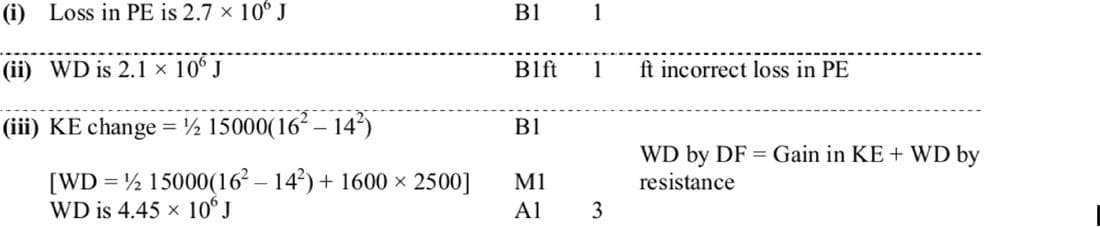
A lorry of mass 15,000 kg moves with constant speed 14 m/s from the top to the bottom of a straight hill of length 900 m. The top of the hill is 18 m above the level of the bottom of the hill. The total work done by the resistive forces acting on the lorry, including the braking force, is \(4.8 \times 10^6\) J. Find
- the loss in gravitational potential energy of the lorry,
- the work done by the driving force.
On reaching the bottom of the hill the lorry continues along a straight horizontal road against a constant resistance of 1600 N. There is no braking force acting. The speed of the lorry increases from 14 m/s at the bottom of the hill to 16 m/s at the point X, where X is 2500 m from the bottom of the hill.
- By considering energy, find the work done by the driving force of the lorry while it travels from the bottom of the hill to X.
9709 P41 - Nov 2009 - Q2
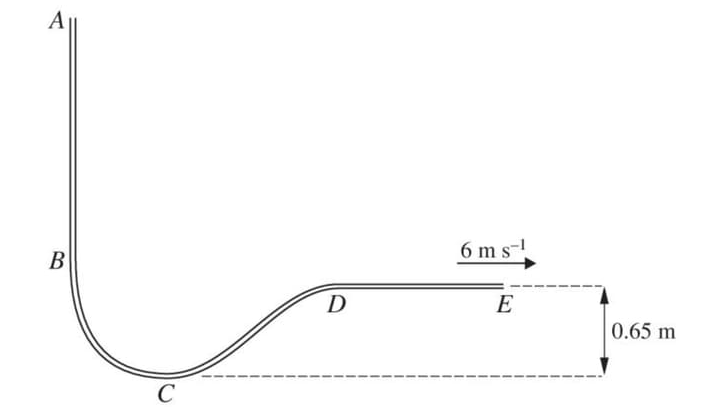
A smooth narrow tube AE has two straight parts, AB and DE, and a curved part BCD. The part AB is vertical with A above B, and DE is horizontal. C is the lowest point of the tube and is 0.65 m below the level of DE. A particle is released from rest at A and travels through the tube, leaving it at E with speed 6 m/s (see diagram). Find
- the height of A above the level of DE,
- the maximum speed of the particle.

9709 P41 - Nov 2009 - Q1
A car of mass 1000 kg moves along a horizontal straight road, passing through points A and B. The power of its engine is constant and equal to 15,000 W. The driving force exerted by the engine is 750 N at A and 500 N at B. Find the speed of the car at A and at B, and hence find the increase in the car’s kinetic energy as it moves from A to B.

9709 P4 - Jun 2009 - Q5
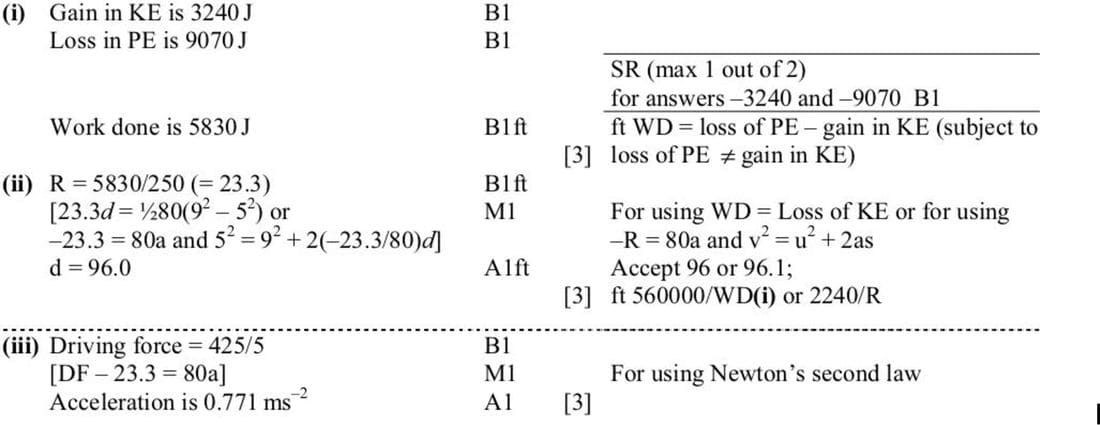
A cyclist and his machine have a total mass of 80 kg. The cyclist starts from rest at the top A of a straight path AB, and freewheels (moves without pedalling or braking) down the path to B. The path AB is inclined at 2.6° to the horizontal and is of length 250 m (see diagram).
(i) Given that the cyclist passes through B with speed 9 m s-1, find the gain in kinetic energy and the loss in potential energy of the cyclist and his machine. Hence find the work done against the resistance to motion of the cyclist and his machine.
The cyclist continues to freewheel along a horizontal straight path BD until he reaches the point C, where the distance BC is d m. His speed at C is 5 m s-1. The resistance to motion is constant, and is the same on BD as on AB.
(ii) Find the value of d.
The cyclist starts to pedal at C, generating 425 W of power.
(iii) Find the acceleration of the cyclist immediately after passing through C.

9709 P4 - Jun 2009 - Q2
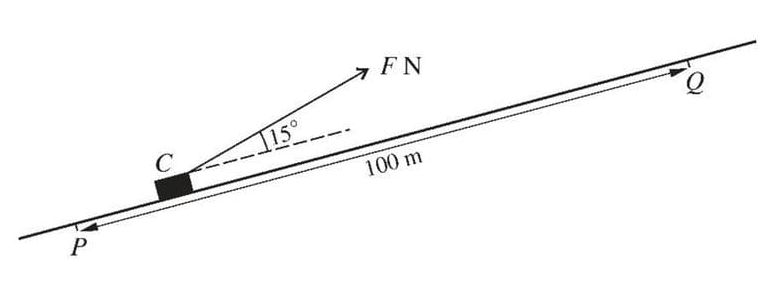
A crate C is pulled at constant speed up a straight inclined path by a constant force of magnitude F N, acting upwards at an angle of 15° to the path. C passes through points P and Q which are 100 m apart (see diagram). As C travels from P to Q the work done against the resistance to C's motion is 900 J, and the gain in C's potential energy is 2100 J. Write down the work done by the pulling force as C travels from P to Q, and hence find the value of F.

9709 P4 - Jun 2008 - Q4
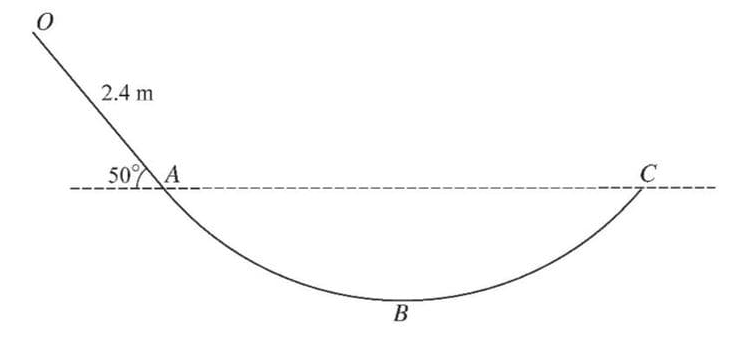
OABC is a vertical cross-section of a smooth surface. The straight part OA has length 2.4 m and makes an angle of 50° with the horizontal. A and C are at the same horizontal level and B is the lowest point of the cross-section (see diagram). A particle P of mass 0.8 kg is released from rest at O and moves on the surface. P remains in contact with the surface until it leaves the surface at C. Find
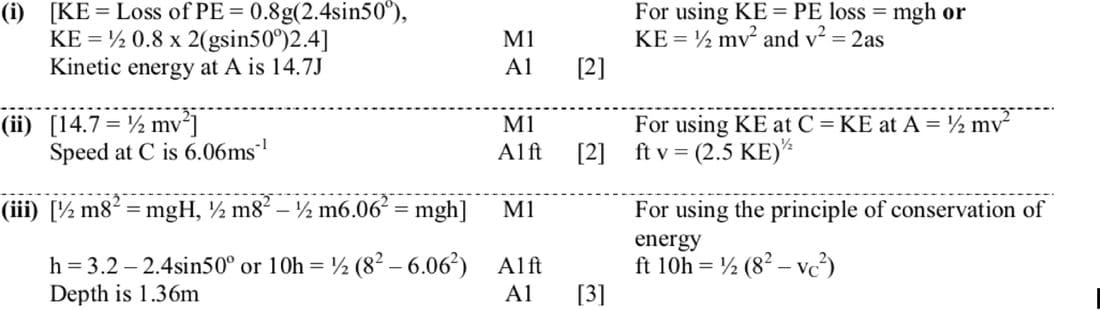
- the kinetic energy of P at A,
- the speed of P at C.
The greatest speed of P is 8 m s-1.
- Find the depth of B below the horizontal through A and C.
9709 P4 - Nov 2007 - Q4
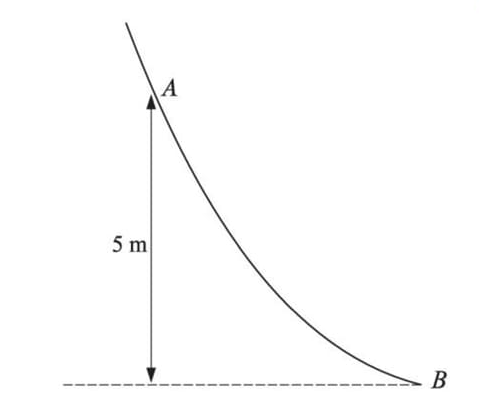
The diagram shows the vertical cross-section of a surface. A and B are two points on the cross-section, and A is 5 m higher than B. A particle of mass 0.35 kg passes through A with speed 7 m/s, moving on the surface towards B.
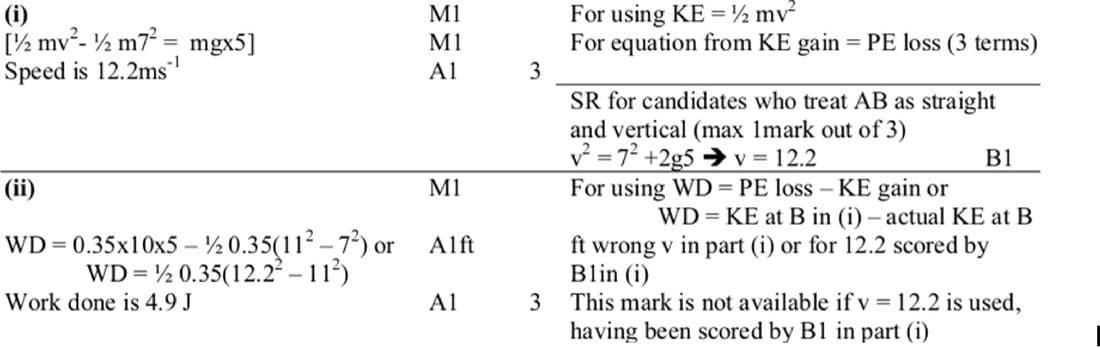
(i) Assuming that there is no resistance to motion, find the speed with which the particle reaches B.
(ii) Assuming instead that there is a resistance to motion, and that the particle reaches B with speed 11 m/s, find the work done against this resistance as the particle moves from A to B.
9709 P4 - Jun 2007 - Q5
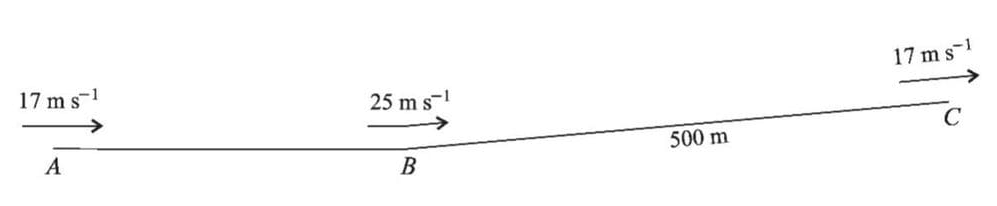
A lorry of mass 12,500 kg travels along a road that has a straight horizontal section AB and a straight inclined section BC. The length of BC is 500 m. The speeds of the lorry at A, B, and C are 17 m/s, 25 m/s, and 17 m/s respectively (see diagram).
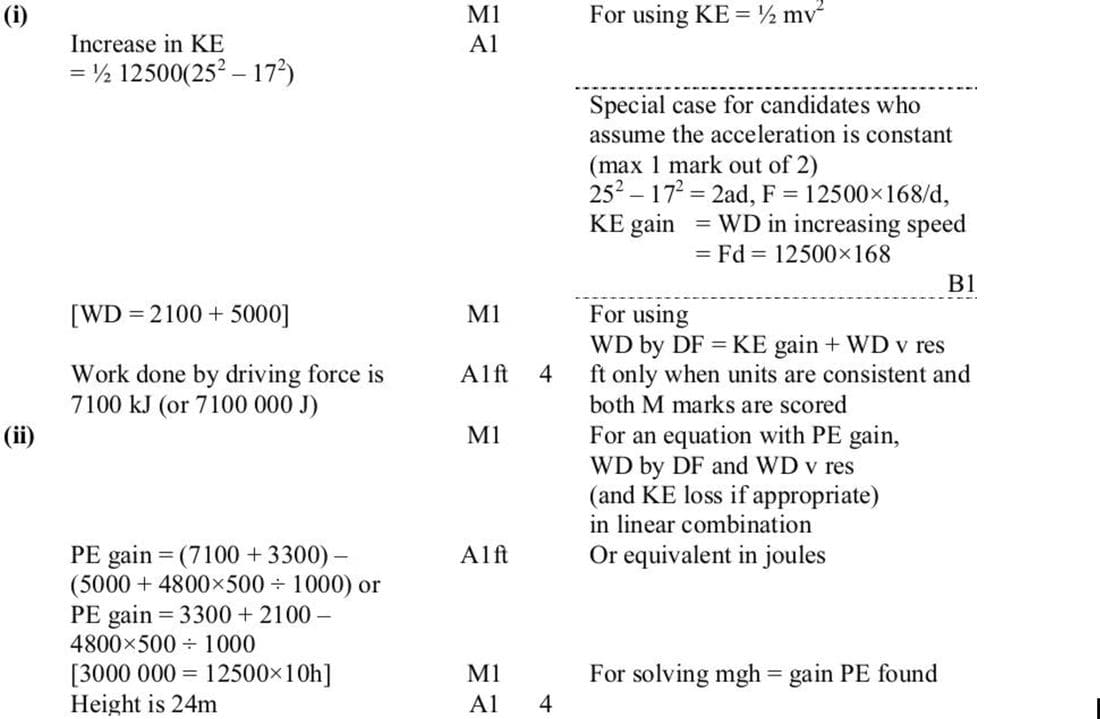
(i) The work done against the resistance to motion of the lorry, as it travels from A to B, is 5000 kJ. Find the work done by the driving force as the lorry travels from A to B.
(ii) As the lorry travels from B to C, the resistance to motion is 4800 N and the work done by the driving force is 3300 kJ. Find the height C above the level of AB.
9709 P43 - Jun 2022 - Q5
A cyclist is riding along a straight horizontal road. The total mass of the cyclist and her bicycle is 70 kg. At an instant when the cyclist’s speed is 4 m/s, her acceleration is 0.3 m/s². There is a constant resistance to motion of magnitude 30 N.
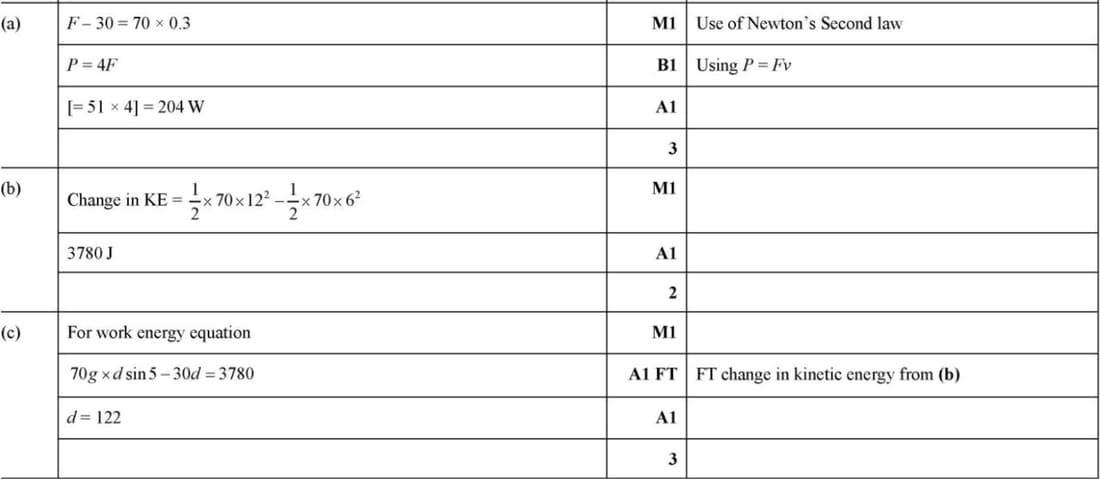
(a) Find the power developed by the cyclist.
The cyclist comes to the top of a hill inclined at 5° to the horizontal. The cyclist stops pedalling and freewheels down the hill (so that the cyclist is no longer supplying any power). The magnitude of the resistance force remains at 30 N. Over a distance of d m, the speed of the cyclist increases from 6 m/s to 12 m/s.
(b) Find the change in kinetic energy.
(c) Use an energy method to find d.
9709 P4 - Nov 2006 - Q5
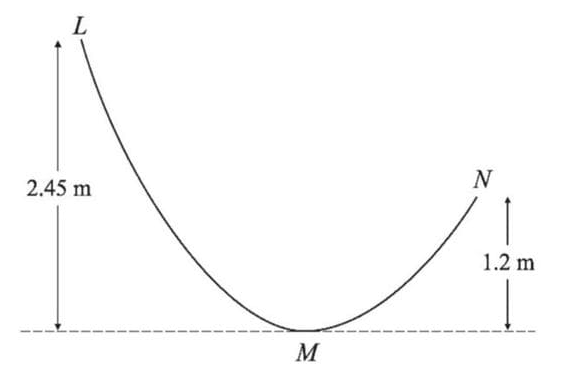
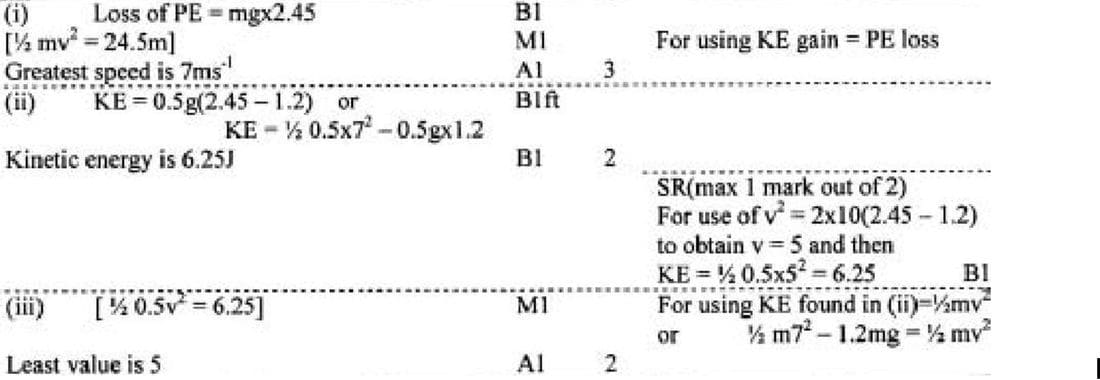
The diagram shows the vertical cross-section LMN of a fixed smooth surface. M is the lowest point of the cross-section. L is 2.45 m above the level of M, and N is 1.2 m above the level of M. A particle of mass 0.5 kg is released from rest at L and moves on the surface until it leaves it at N. Find
- the greatest speed of the particle,
- the kinetic energy of the particle at N.
The particle is now projected from N, with speed v m s-1, along the surface towards M.
- Find the least value of v for which the particle will reach L.
9709 P4 - Nov 2006 - Q1
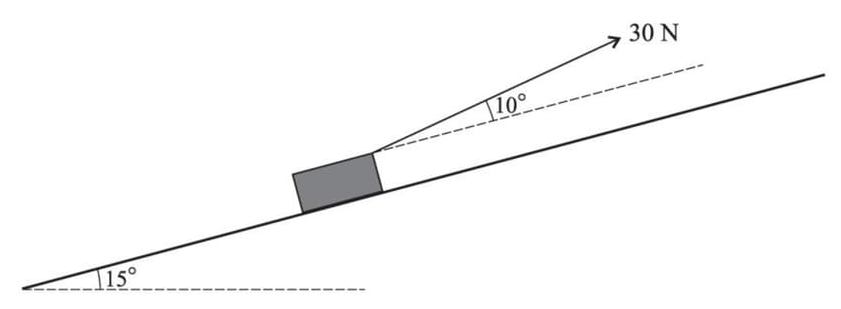
A box of mass 8 kg is pulled, at constant speed, up a straight path which is inclined at an angle of 15° to the horizontal. The pulling force is constant, of magnitude 30 N, and acts upwards at an angle of 10° from the path (see diagram). The box passes through the points A and B, where AB = 20 m and B is above the level of A. For the motion from A to B, find
- the work done by the pulling force,
- the gain in potential energy of the box,
- the work done against the resistance to motion of the box.

9709 P4 - Jun 2006 - Q6
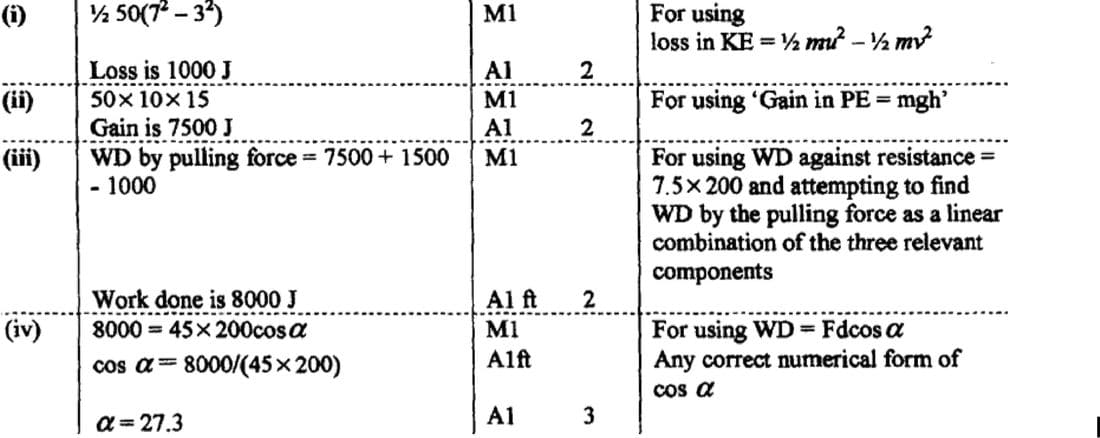
A block of mass 50 kg is pulled up a straight hill and passes through points A and B with speeds 7 m s-1 and 3 m s-1 respectively. The distance AB is 200 m and B is 15 m higher than A. For the motion of the block from A to B, find
- the loss in kinetic energy of the block,
- the gain in potential energy of the block.
The resistance to motion of the block has magnitude 7.5 N.
- Find the work done by the pulling force acting on the block.
The pulling force acting on the block has constant magnitude 45 N and acts at an angle \(\alpha \degree\) upwards from the hill.
- Find the value of \(\alpha\).
9709 P4 - Nov 2005 - Q7
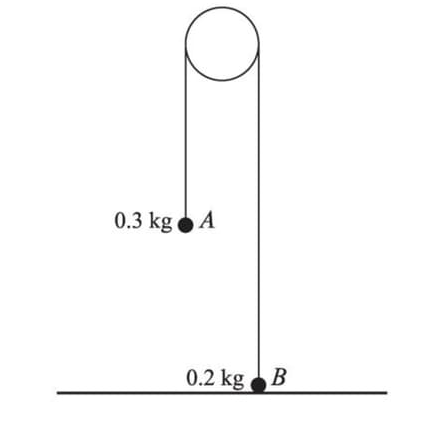
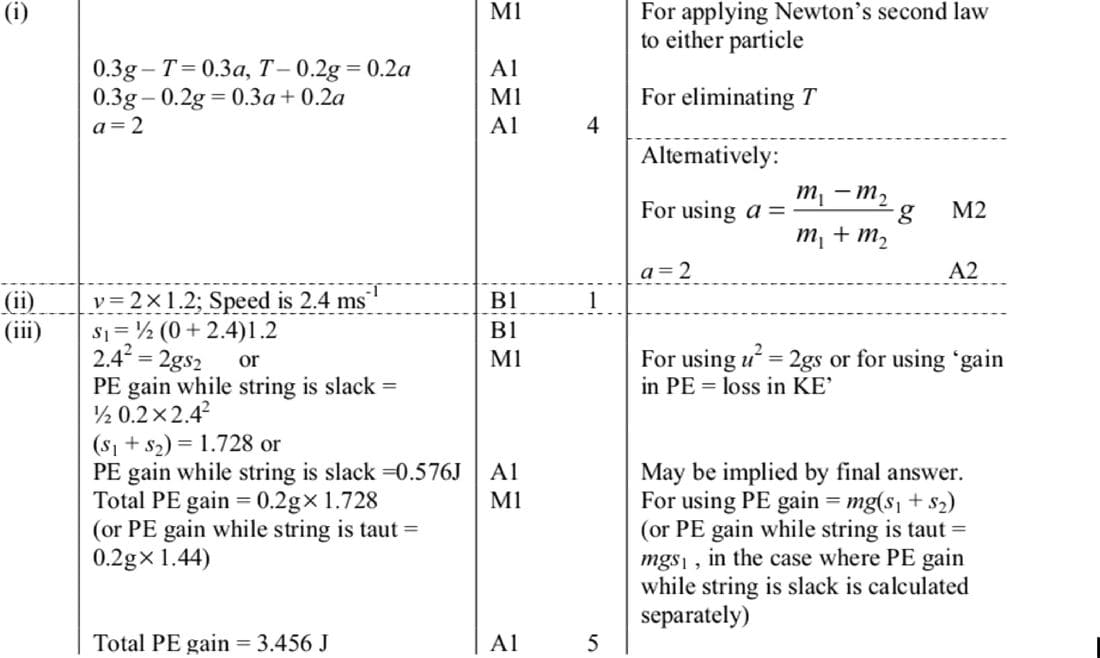
Two particles A and B, of masses 0.3 kg and 0.2 kg respectively, are attached to the ends of a light inextensible string which passes over a smooth fixed pulley. Particle B is held on the horizontal floor and particle A hangs in equilibrium. Particle B is released and each particle starts to move vertically with constant acceleration of magnitude a m s-2.
- Find the value of a.
- Show that A hits the floor with a speed of 2.4 m s-1.
- Find the gain in gravitational potential energy by B, from leaving the floor until reaching its greatest height.
Particle A hits the floor 1.2 s after it starts to move, and does not rebound upwards.
9709 P4 - Nov 2005 - Q2
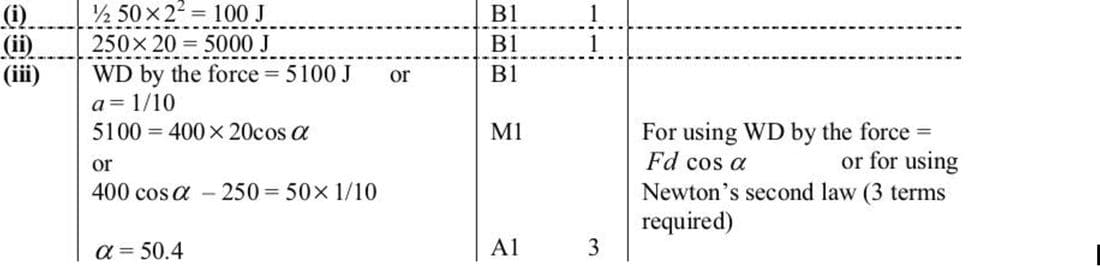
A crate of mass 50 kg is dragged along a horizontal floor by a constant force of magnitude 400 N acting at an angle \(\alpha^\circ\) upwards from the horizontal. The total resistance to motion of the crate has constant magnitude 250 N. The crate starts from rest at the point \(O\) and passes the point \(P\) with a speed of 2 m s\(^{-1}\). The distance \(OP\) is 20 m. For the crate’s motion from \(O\) to \(P\), find
- the increase in kinetic energy of the crate,
- the work done against the resistance to the motion of the crate,
- the value of \(\alpha\).
9709 P4 - Jun 2005 - Q7
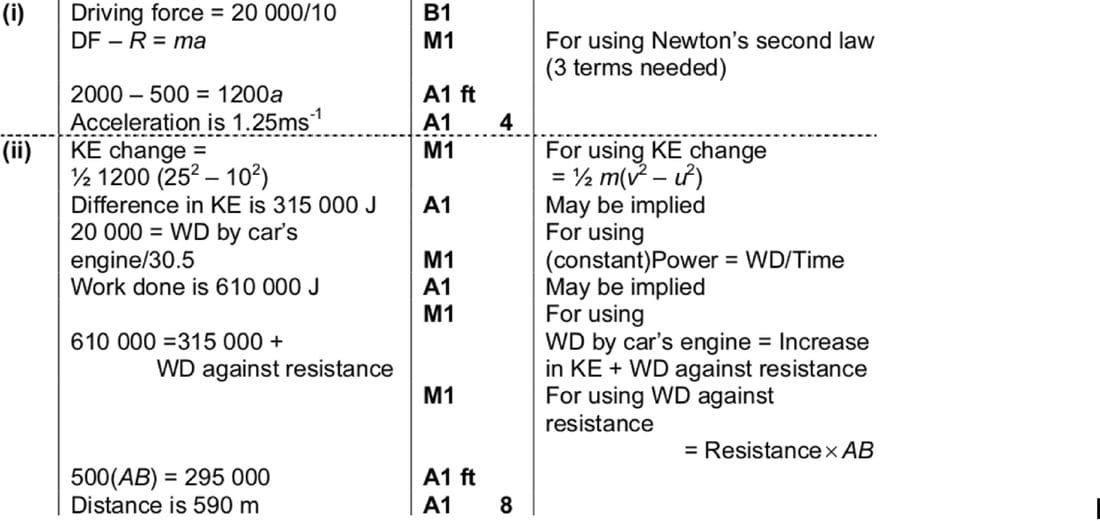
A car of mass 1200 kg travels along a horizontal straight road. The power provided by the car’s engine is constant and equal to 20 kW. The resistance to the car’s motion is constant and equal to 500 N. The car passes through the points A and B with speeds 10 m/s and 25 m/s respectively. The car takes 30.5 s to travel from A to B.
(i) Find the acceleration of the car at A.
(ii) By considering work and energy, find the distance AB.
9709 P4 - Nov 2004 - Q4
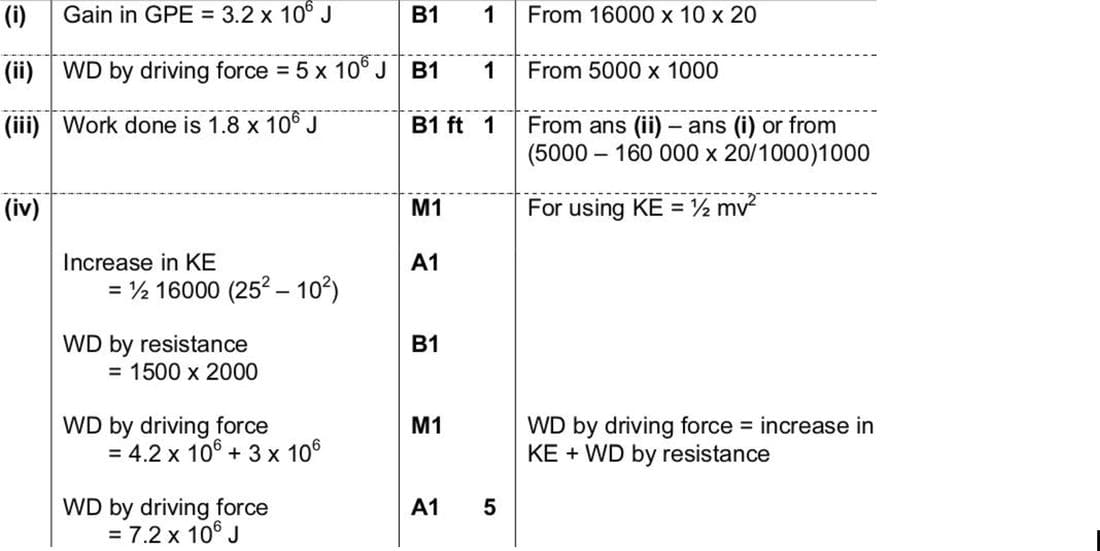
A lorry of mass 16000 kg climbs from the bottom to the top of a straight hill of length 1000 m at a constant speed of 10 m s-1. The top of the hill is 20 m above the level of the bottom of the hill. The driving force of the lorry is constant and equal to 5000 N. Find
- the gain in gravitational potential energy of the lorry,
- the work done by the driving force,
- the work done against the force resisting the motion of the lorry.
On reaching the top of the hill the lorry continues along a straight horizontal road against a constant resistance of 1500 N. The driving force of the lorry is not now constant, and the speed of the lorry increases from 10 m s-1 at the top of the hill to 25 m s-1 at the point P. The distance of P from the top of the hill is 2000 m.
- Find the work done by the driving force of the lorry while the lorry travels from the top of the hill to P.
9709 P4 - Jun 2004 - Q4
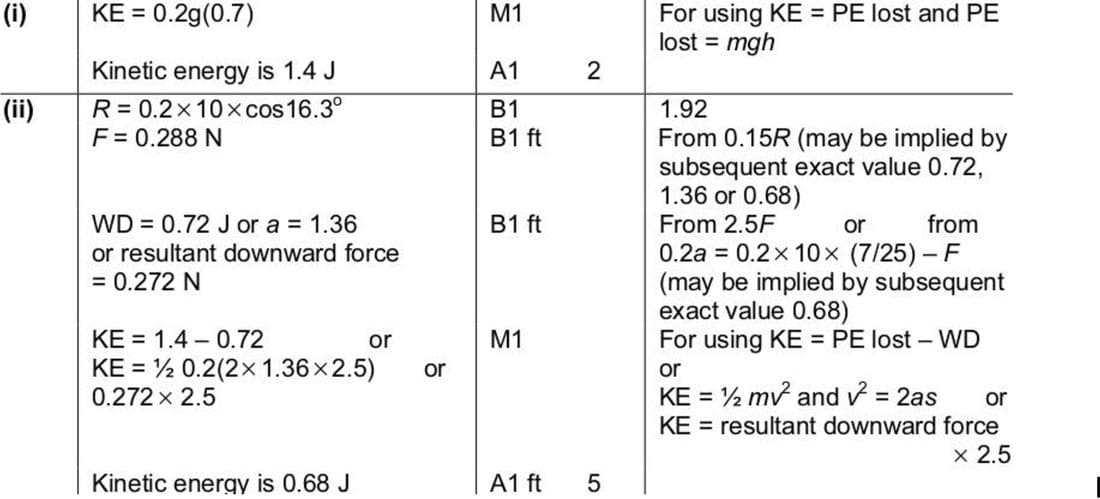
The top of an inclined plane is at a height of 0.7 m above the bottom. A block of mass 0.2 kg is released from rest at the top of the plane and slides a distance of 2.5 m to the bottom. Find the kinetic energy of the block when it reaches the bottom of the plane in each of the following cases:
- the plane is smooth,
- the coefficient of friction between the plane and the block is 0.15.
9709 P4 - Nov 2003 - Q4
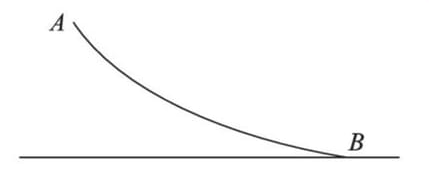
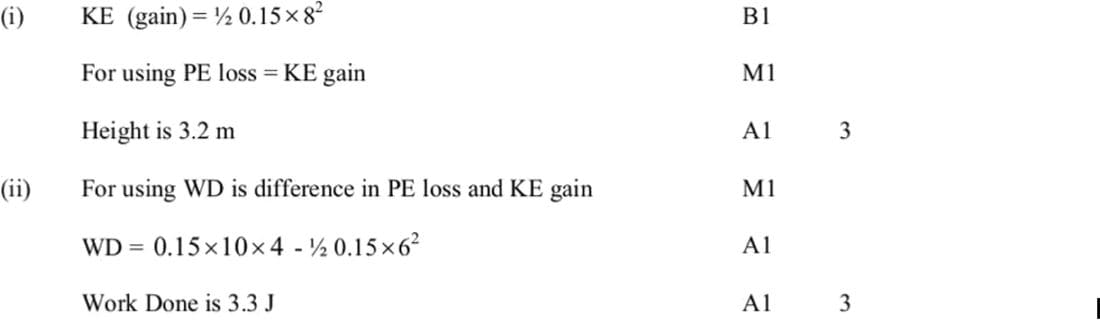
The diagram shows a vertical cross-section of a surface. A and B are two points on the cross-section. A particle of mass 0.15 kg is released from rest at A.
- Assuming that the particle reaches B with a speed of 8 m s-1 and that there are no resistances to motion, find the height of A above B.
- Assuming instead that the particle reaches B with a speed of 6 m s-1 and that the height of A above B is 4 m, find the work done against the resistances to motion.