Past Exam Questions
← Back9709 P42 - Jun 2012 - Q1
A block is pulled in a straight line along horizontal ground by a force of constant magnitude acting at an angle of 60° above the horizontal. The work done by the force in moving the block a distance of 5 m is 75 J. Find the magnitude of the force.

9709 P41 - Nov 2011 - Q1
One end of a light inextensible string is attached to a block. The string is used to pull the block along a horizontal surface with a speed of 2 m s-1. The string makes an angle of 20° with the horizontal and the tension in the string is 25 N. Find the work done by the tension in a period of 8 seconds.

9709 P43 - Jun 2011 - Q1
A block is pulled for a distance of 50 m along a horizontal floor, by a rope that is inclined at an angle of \(\alpha^\circ\) to the floor. The tension in the rope is 180 N and the work done by the tension is 8200 J. Find the value of \(\alpha\).

9709 P42 - Jun 2023 - Q1
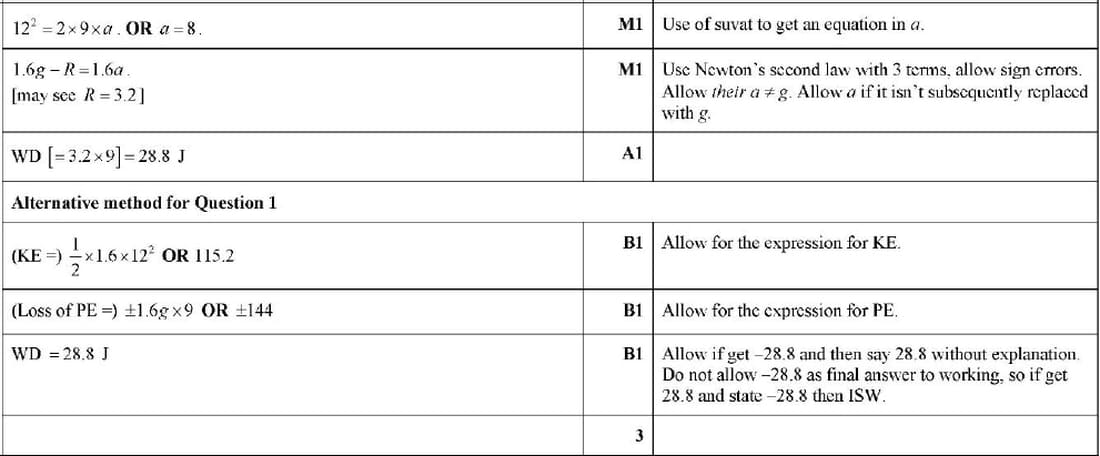
A particle of mass 1.6 kg is dropped from a height of 9 m above horizontal ground. The speed of the particle at the instant before hitting the ground is 12 m/s-1.
Find the work done against air resistance.
9709 P41 - Nov 2010 - Q5
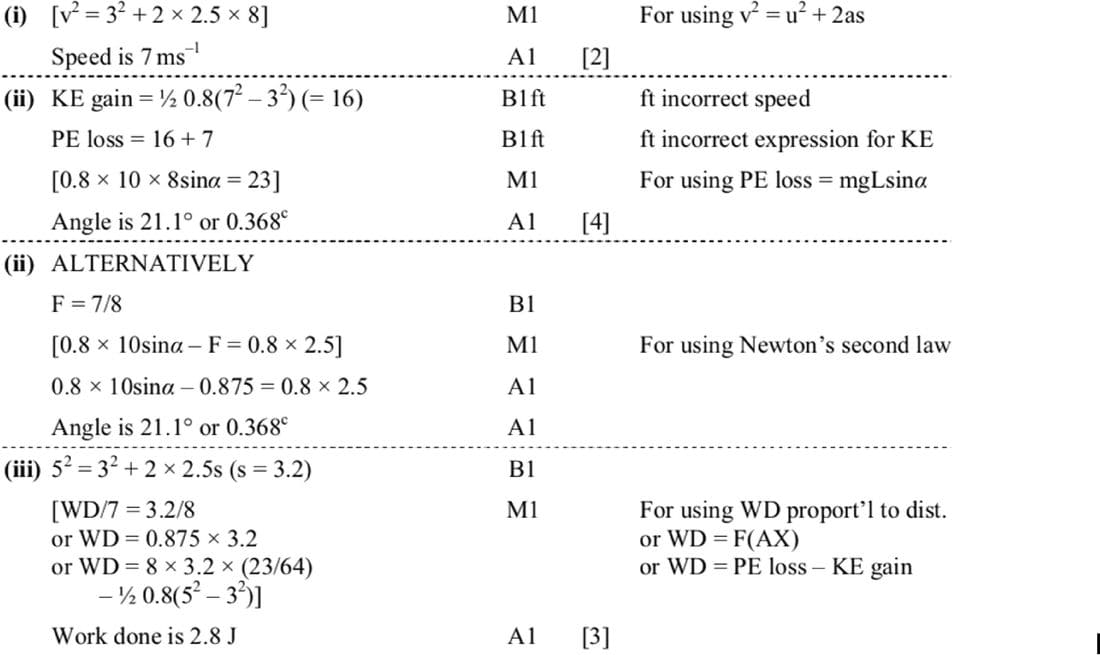
A particle of mass 0.8 kg slides down a rough inclined plane along a line of greatest slope AB. The distance AB is 8 m. The particle starts at A with speed 3 m/s and moves with constant acceleration 2.5 m/s2.
- Find the speed of the particle at the instant it reaches B.
- Given that the work done against the frictional force as the particle moves from A to B is 7 J, find the angle of inclination of the plane.
- When the particle is at the point X its speed is the same as the average speed for the motion from A to B. Find the work done by the frictional force for the particle’s motion from A to X.
9709 P4 - Nov 2008 - Q4
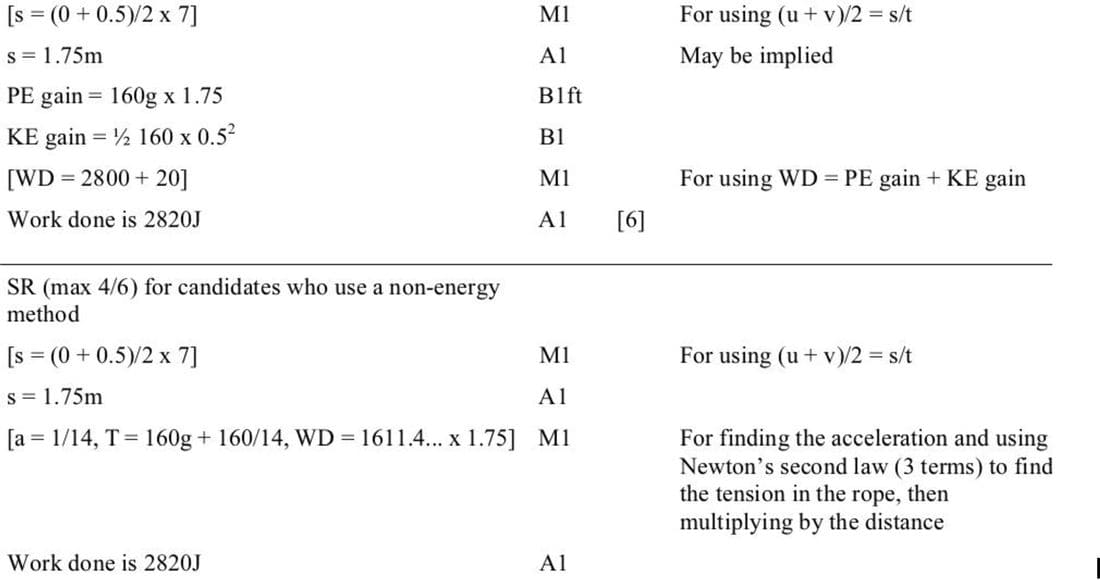
A load of mass 160 kg is lifted vertically by a crane, with constant acceleration. The load starts from rest at the point O. After 7 s, it passes through the point A with speed 0.5 m s-1. By considering energy, find the work done by the crane in moving the load from O to A.
9709 P4 - Jun 2008 - Q6
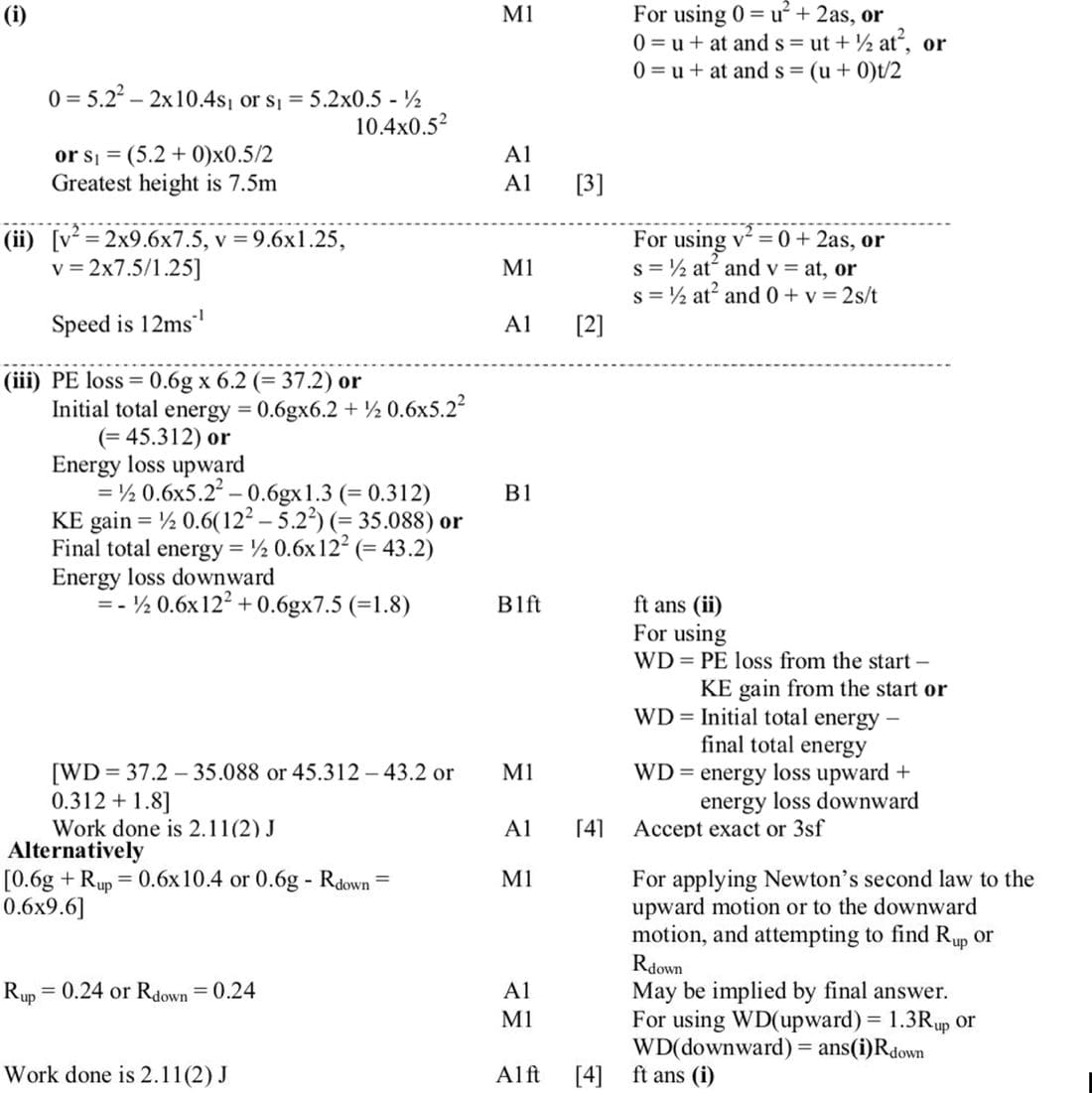
A particle P of mass 0.6 kg is projected vertically upwards with speed 5.2 m/s-1 from a point O which is 6.2 m above the ground. Air resistance acts on P so that its deceleration is 10.4 m/s-2 when P is moving upwards, and its acceleration is 9.6 m/s-2 when P is moving downwards. Find
- the greatest height above the ground reached by P,
- the speed with which P reaches the ground,
- the total work done on P by the air resistance.
9709 P4 - Jun 2005 - Q1
A small block is pulled along a rough horizontal floor at a constant speed of 1.5 m s-1 by a constant force of magnitude 30 N acting at an angle of \(\theta^\circ\) upwards from the horizontal. Given that the work done by the force in 20 s is 720 J, calculate the value of \(\theta\).

9709 P4 - Nov 2003 - Q3
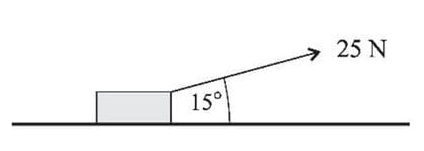
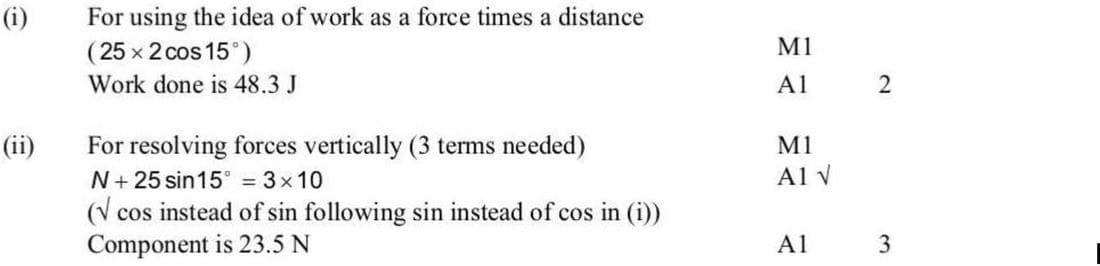
A crate of mass 3 kg is pulled at constant speed along a horizontal floor. The pulling force has magnitude 25 N and acts at an angle of 15° to the horizontal, as shown in the diagram. Find
- the work done by the pulling force in moving the crate a distance of 2 m,
- the normal component of the contact force on the crate.
9709 P42 - Nov 2022 - Q1
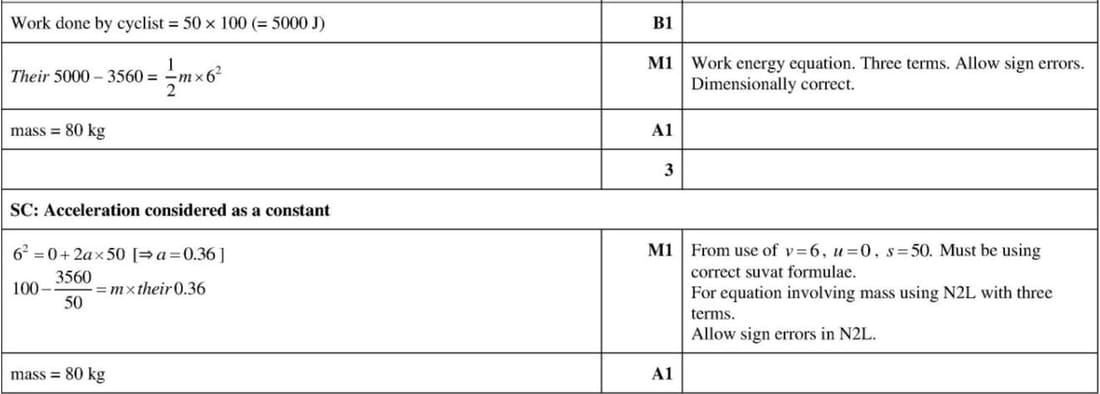
A cyclist is riding a bicycle along a straight horizontal road AB of length 50 m. The cyclist starts from rest at A and reaches a speed of 6 m s-1 at B. The cyclist produces a constant driving force of magnitude 100 N. There is a resistance force, and the work done against the resistance force from A to B is 3560 J.
Find the total mass of the cyclist and bicycle.
9709 P41 - Jun 2021 - Q1
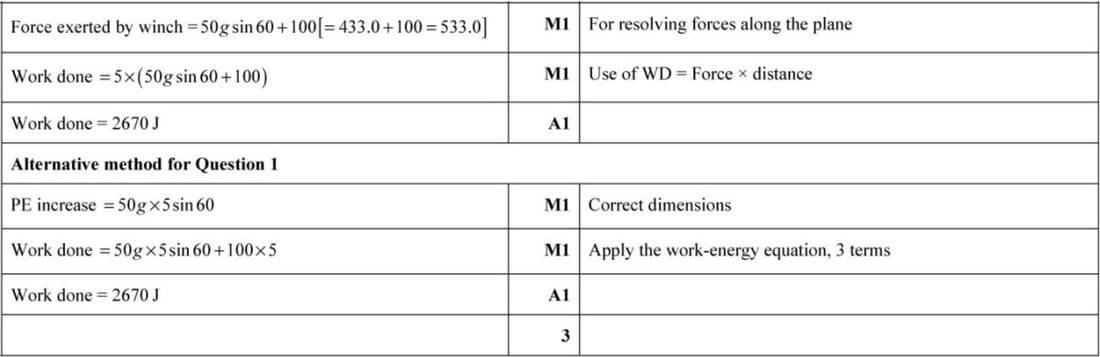
A winch operates by means of a force applied by a rope. The winch is used to pull a load of mass 50 kg up a line of greatest slope of a plane inclined at 60° to the horizontal. The winch pulls the load a distance of 5 m up the plane at constant speed. There is a constant resistance to motion of 100 N.
Find the work done by the winch.
9709 P42 - Jun 2019 - Q3
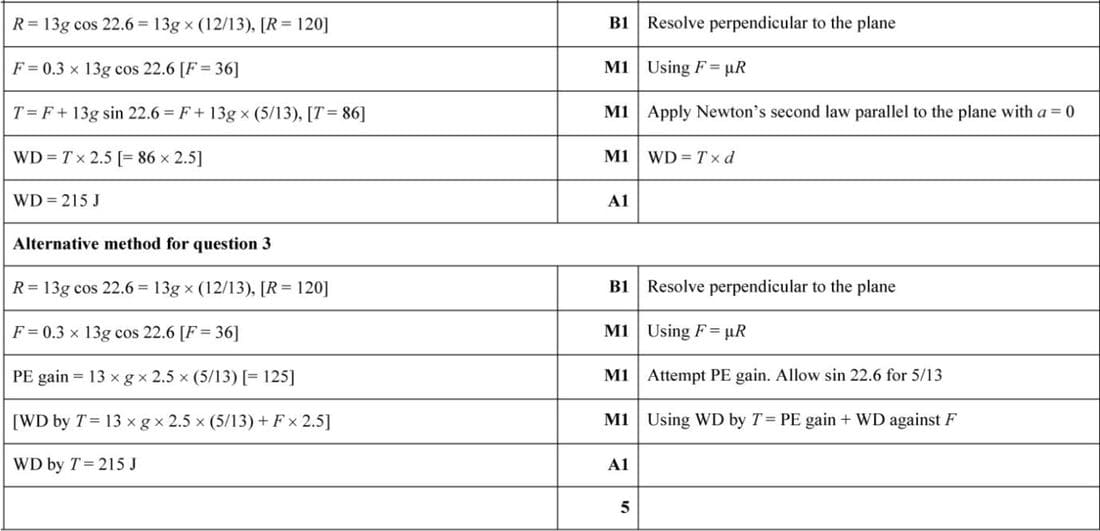
A particle of mass 13 kg is on a rough plane inclined at an angle of \(\theta\) to the horizontal, where \(\tan \theta = \frac{5}{12}\). The coefficient of friction between the particle and the plane is 0.3. A force of magnitude \(T\) N, acting parallel to a line of greatest slope, moves the particle a distance of 2.5 m up the plane at a constant speed. Find the work done by this force.
9709 P41 - Jun 2019 - Q4
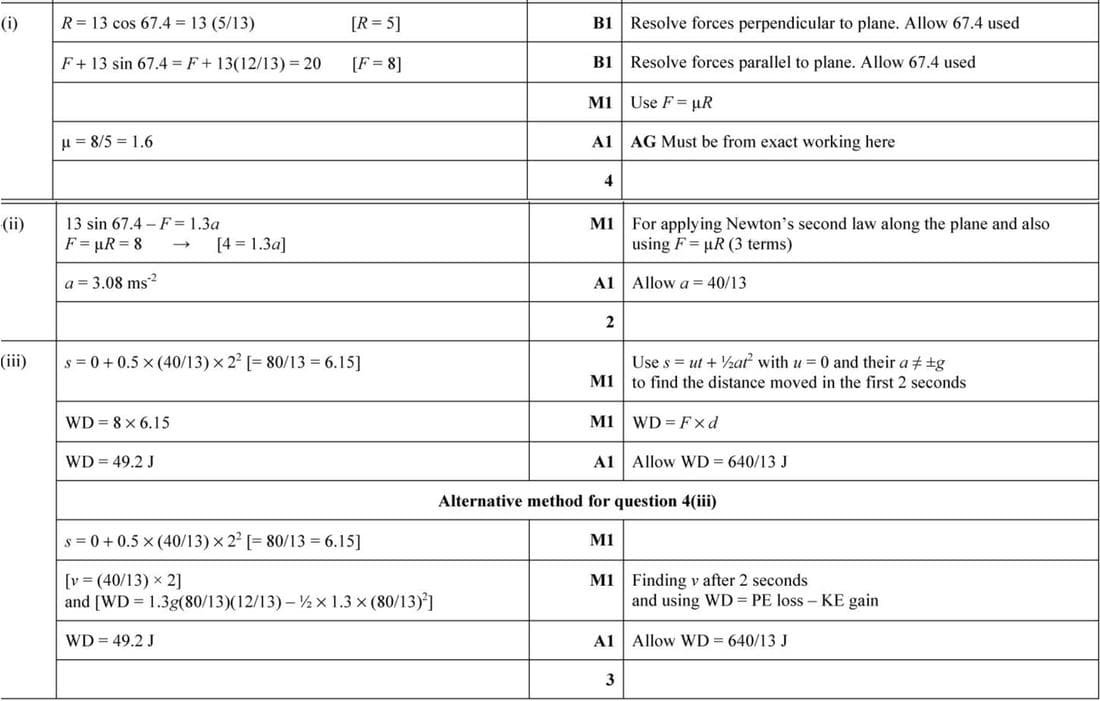
A particle of mass 1.3 kg rests on a rough plane inclined at an angle \(\theta\) to the horizontal, where \(\tan \theta = \frac{12}{5}\). The coefficient of friction between the particle and the plane is \(\mu\).
(i) A force of magnitude 20 N parallel to a line of greatest slope of the plane is applied to the particle and the particle is on the point of moving up the plane. Show that \(\mu = 1.6\). [4]
The force of magnitude 20 N is now removed.
(ii) Find the acceleration of the particle. [2]
(iii) Find the work done against friction during the first 2 s of motion. [3]
9709 P43 - Nov 2018 - Q3
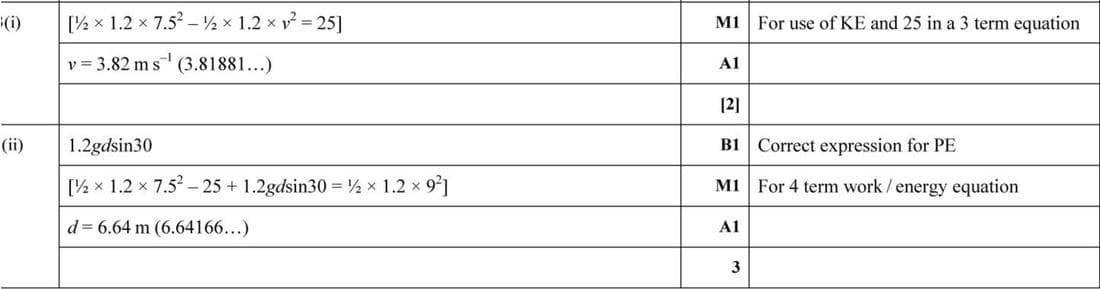
A particle of mass 1.2 kg moves in a straight line AB. It is projected with speed 7.5 m s-1 from A towards B and experiences a resistance force. The work done against this resistance force in moving from A to B is 25 J.
- Given that AB is horizontal, find the speed of the particle at B.
- It is given instead that AB is inclined at 30° below the horizontal and that the speed of the particle at B is 9 m s-1. The work done against the resistance force remains the same. Find the distance AB.
9709 P41 - Nov 2018 - Q3
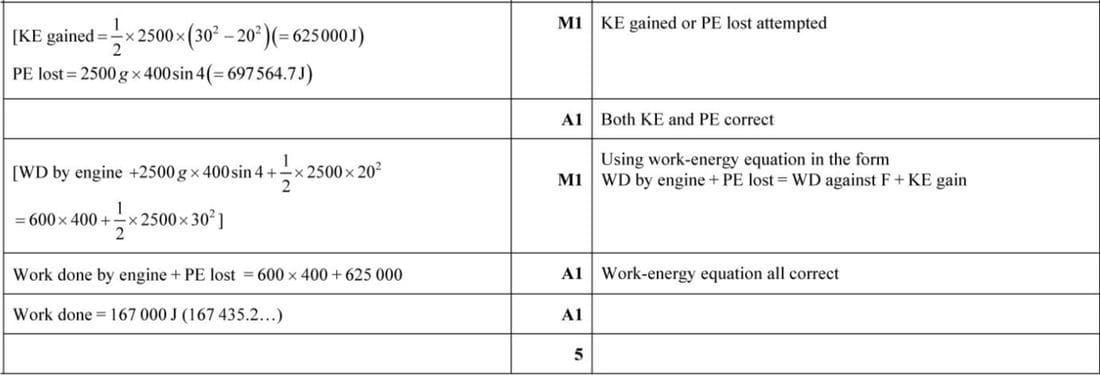
A van of mass 2500 kg descends a hill of length 0.4 km inclined at 4° to the horizontal. There is a constant resistance to motion of 600 N and the speed of the van increases from 20 m/s to 30 m/s as it descends the hill. Find the work done by the van’s engine as it descends the hill.
9709 P42 - Nov 2023 - Q6
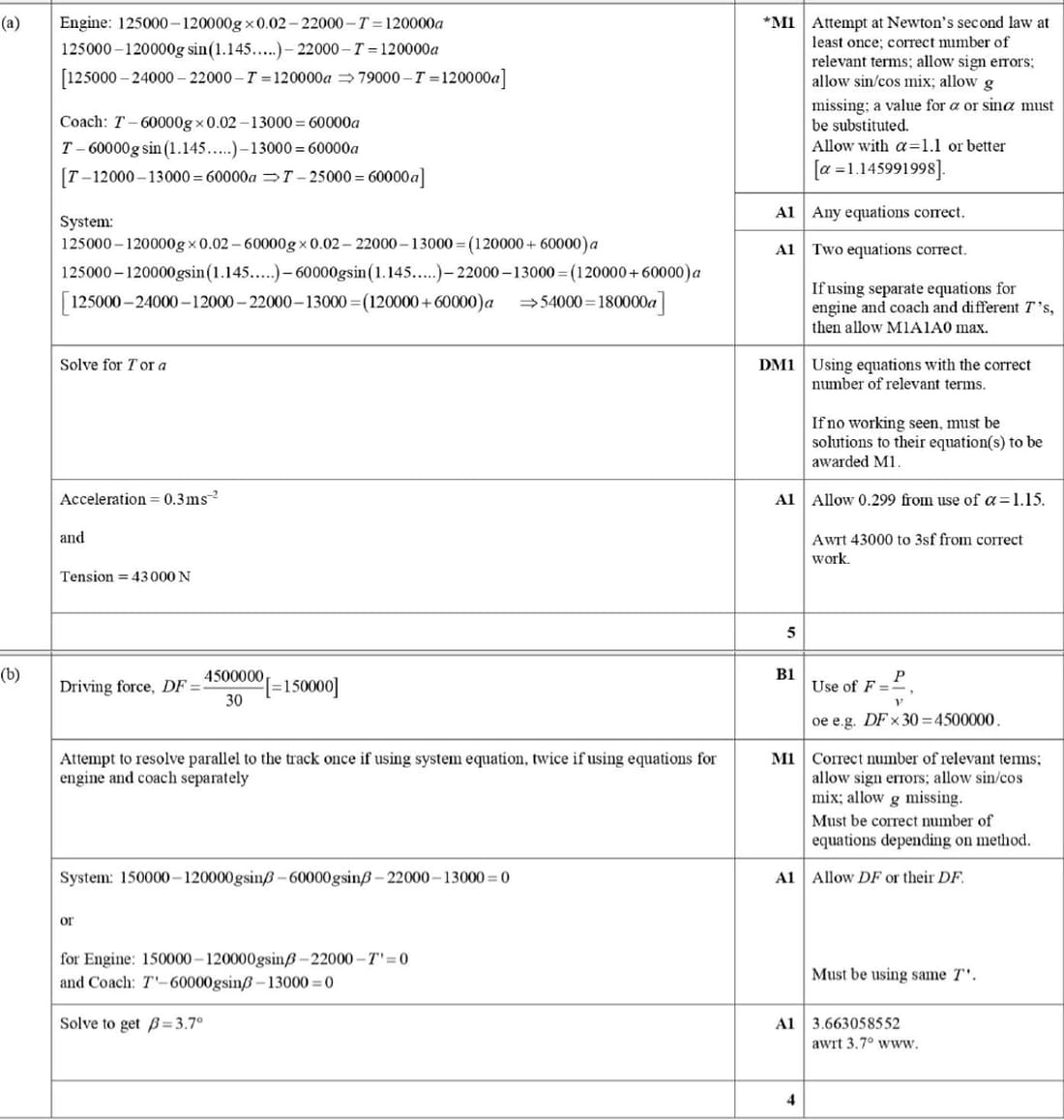
A railway engine of mass 120000 kg is towing a coach of mass 60000 kg up a straight track inclined at an angle of \(\alpha\) to the horizontal where \(\sin \alpha = 0.02\). There is a light rigid coupling, parallel to the track, connecting the engine and coach. The driving force produced by the engine is 125000 N and there are constant resistances to motion of 22000 N on the engine and 13000 N on the coach.
(a) Find the acceleration of the engine and find the tension in the coupling.
At an instant when the engine is travelling at 30 m/s, it comes to a section of track inclined upwards at an angle \(\beta\) to the horizontal. The power produced by the engine is now 4500000 W and, as a result, the engine maintains a constant speed.
(b) Assuming that the resistance forces remain unchanged, find the value of \(\beta\).
9709 P43 - Nov 2021 - Q4
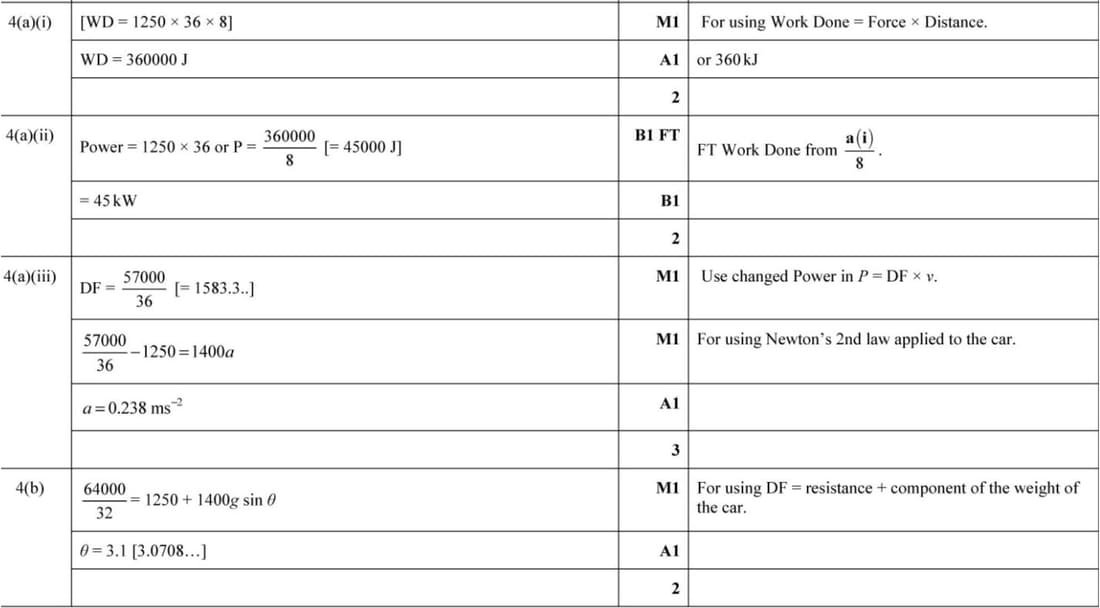
A car of mass 1400 kg is moving on a straight road against a constant force of 1250 N resisting the motion.
(a) The car moves along a horizontal section of the road at a constant speed of 36 m s-1.
- Calculate the work done against the resisting force during the first 8 seconds.
- Calculate, in kW, the power developed by the engine of the car.
- Given that this power is suddenly increased by 12 kW, find the instantaneous acceleration of the car.
(b) The car now travels at a constant speed of 32 m s-1 up a section of the road inclined at θ° to the horizontal, with the engine working at 64 kW.
Find the value of θ.
9709 P43 - Jun 2021 - Q2
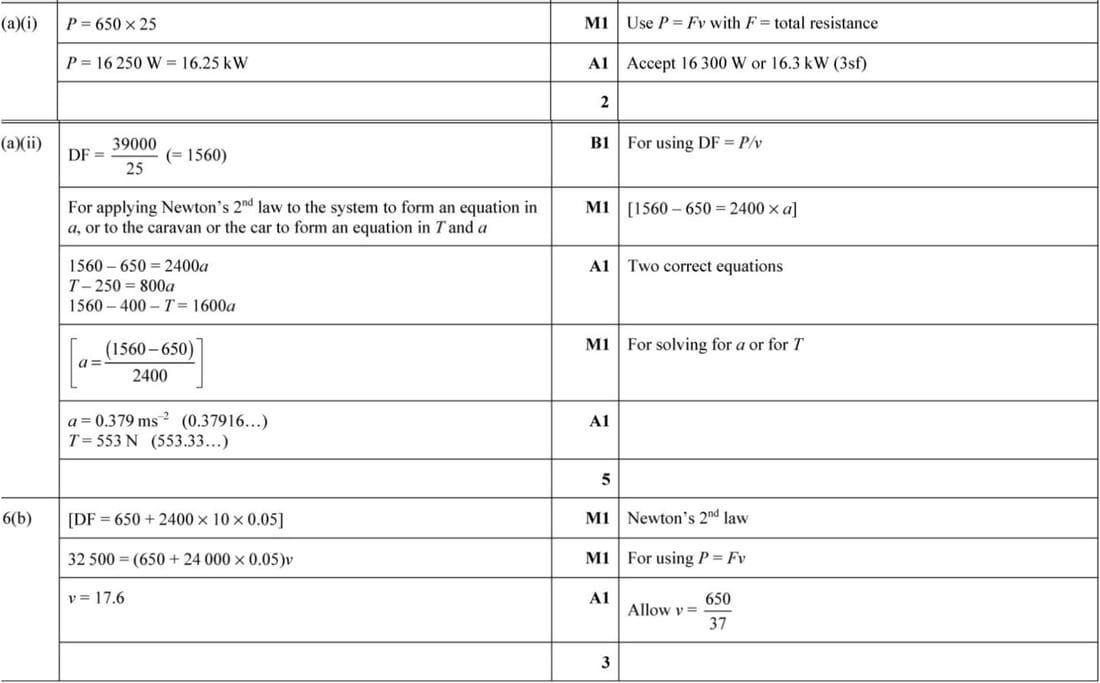
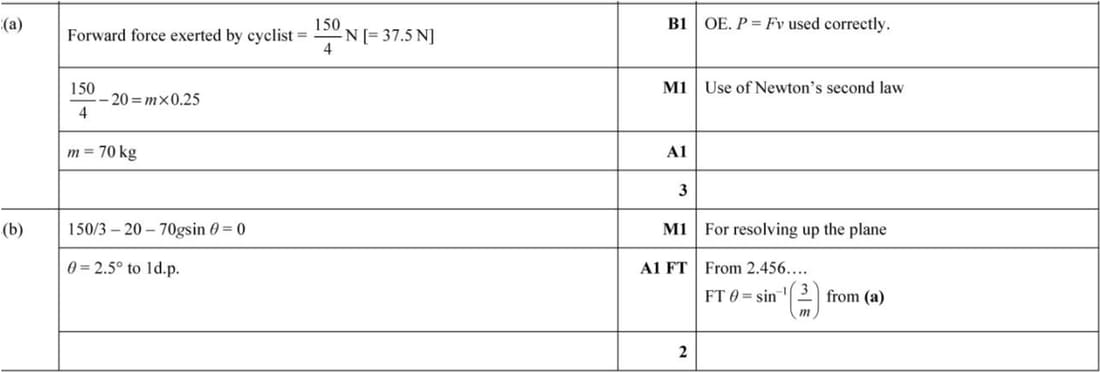
A cyclist is travelling along a straight horizontal road. She is working at a constant rate of 150 W. At an instant when her speed is 4 m s-1, her acceleration is 0.25 m s-2. The resistance to motion is 20 N.
(a) Find the total mass of the cyclist and her bicycle.
The cyclist comes to a straight hill inclined at an angle \(\theta\) above the horizontal. She ascends the hill at constant speed 3 m s-1. She continues to work at the same rate as before and the resistance force is unchanged.
(b) Find the value of \(\theta\).
9709 P42 - Mar 2021 - Q2
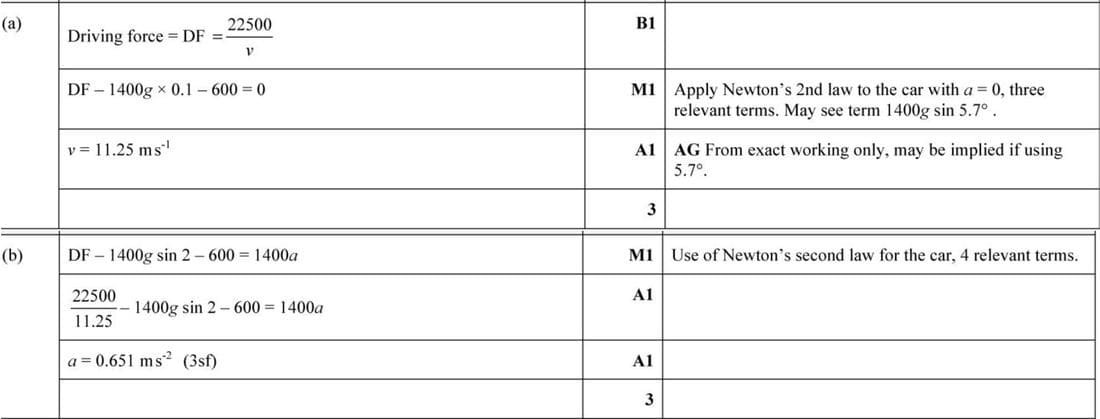
A car of mass 1400 kg is travelling at constant speed up a straight hill inclined at \(\alpha\) to the horizontal, where \(\sin \alpha = 0.1\). There is a constant resistance force of magnitude 600 N. The power of the car’s engine is 22 500 W.
(a) Show that the speed of the car is 11.25 m s\(^{-1}\).
The car, moving with speed 11.25 m s\(^{-1}\), comes to a section of the hill which is inclined at 2° to the horizontal.
(b) Given that the power and resistance force do not change, find the initial acceleration of the car up this section of the hill.
9709 P43 - Nov 2020 - Q6
A car of mass 1600 kg is pulling a caravan of mass 800 kg. The car and the caravan are connected by a light rigid tow-bar. The resistances to the motion of the car and caravan are 400 N and 250 N respectively.
(a) The car and caravan are travelling along a straight horizontal road.
- Given that the car and caravan have a constant speed of 25 m s-1, find the power of the car’s engine.
- The engine’s power is now suddenly increased to 39 kW. Find the instantaneous acceleration of the car and caravan and find the tension in the tow-bar.
(b) The car and caravan now travel up a straight hill, inclined at an angle of sin-1 0.05 to the horizontal, at a constant speed of v m s-1. The car’s engine is working at 32.5 kW.
Find v.