Browsing as Guest. Progress, bookmarks and attempts are disabled.
Log in to track your work.
June 2013 p42 q5
3464
A car of mass 1000 kg is travelling on a straight horizontal road. The power of its engine is constant and equal to \(P\) kW. The resistance to motion of the car is 600 N. At an instant when the car’s speed is 25 m s\(^{-1}\), its acceleration is 0.2 m s\(^{-2}\). Find
the value of \(P\),
the steady speed at which the car can travel.
Solution
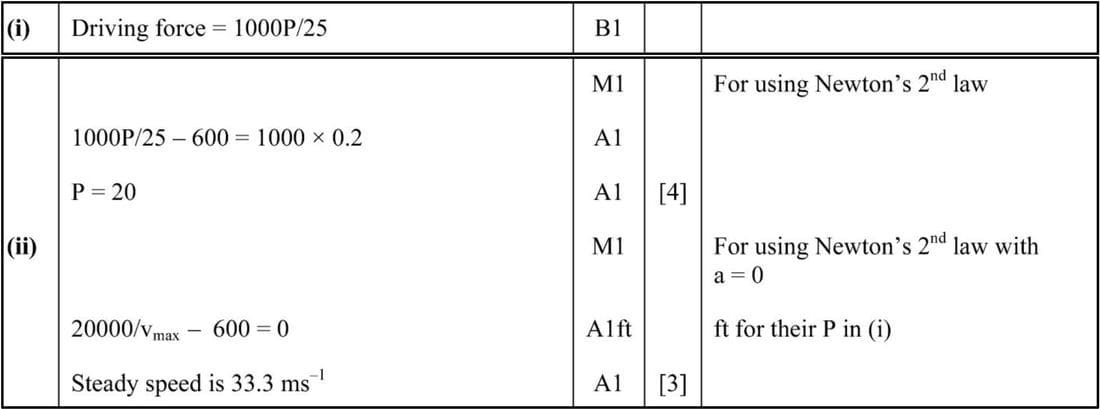
(i) The driving force \(F\) provided by the engine is given by \(F = \frac{1000P}{25}\).
Using Newton's second law, the net force is also given by \(F - 600 = 1000 \times 0.2\).
Substituting the expression for \(F\), we have:
\(\frac{1000P}{25} - 600 = 200\)
\(40P - 600 = 200\)
\(40P = 800\)
\(P = 20\)
(ii) For steady speed, the acceleration \(a = 0\). Therefore, the driving force equals the resistance: