Browsing as Guest. Progress, bookmarks and attempts are disabled.
Log in to track your work.
June 2011 p43 q2
3471
A car of mass 1250 kg is travelling along a straight horizontal road with its engine working at a constant rate of \(P\) W. The resistance to the car’s motion is constant and equal to \(R\) N. When the speed of the car is 19 m s\(^{-1}\) its acceleration is 0.6 m s\(^{-2}\), and when the speed of the car is 30 m s\(^{-1}\) its acceleration is 0.16 m s\(^{-2}\). Find the values of \(P\) and \(R\).
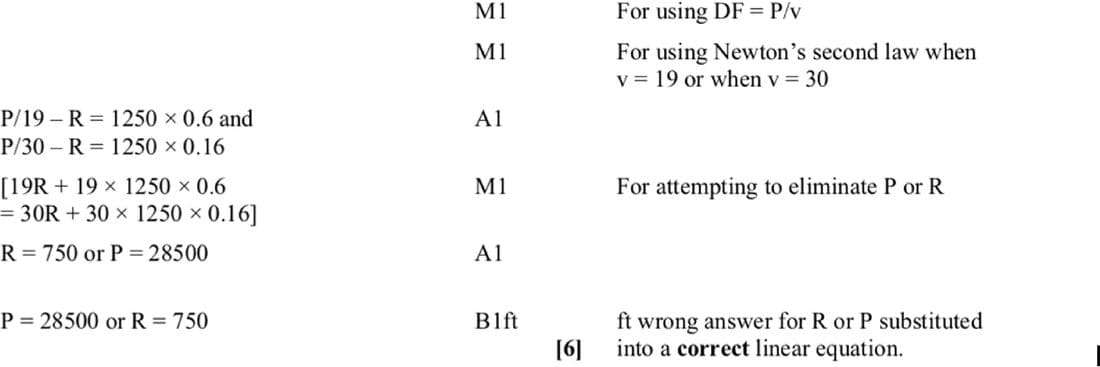
Solution
Using the formula for power, \(P = Fv\), where \(F\) is the force exerted by the engine, we have:
\(\frac{P}{v} - R = ma\)
For \(v = 19\) m/s and \(a = 0.6\) m/s\(^{-2}\):
\(\frac{P}{19} - R = 1250 \times 0.6\)
For \(v = 30\) m/s and \(a = 0.16\) m/s\(^{-2}\):
\(\frac{P}{30} - R = 1250 \times 0.16\)
We have two equations:
\(\frac{P}{19} - R = 750\)
\(\frac{P}{30} - R = 200\)
To eliminate \(R\), subtract the second equation from the first:
\(\frac{P}{19} - \frac{P}{30} = 750 - 200\)
\(\frac{30P - 19P}{570} = 550\)
\(11P = 550 \times 570\)
\(P = 28500\)
Substitute \(P = 28500\) back into the first equation: