Past Exam Questions
← Back9709 P42 - Nov 2020 - Q2
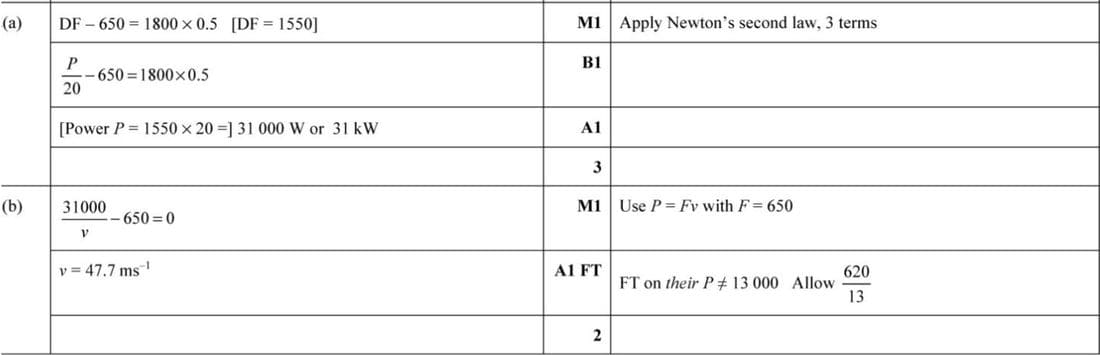
A car of mass 1800 kg is travelling along a straight horizontal road. The power of the car’s engine is constant. There is a constant resistance to motion of 650 N.
(a) Find the power of the car’s engine, given that the car’s acceleration is 0.5 m s-2 when its speed is 20 m s-1.
(b) Find the steady speed which the car can maintain with the engine working at this power.
9709 P41 - Nov 2020 - Q2
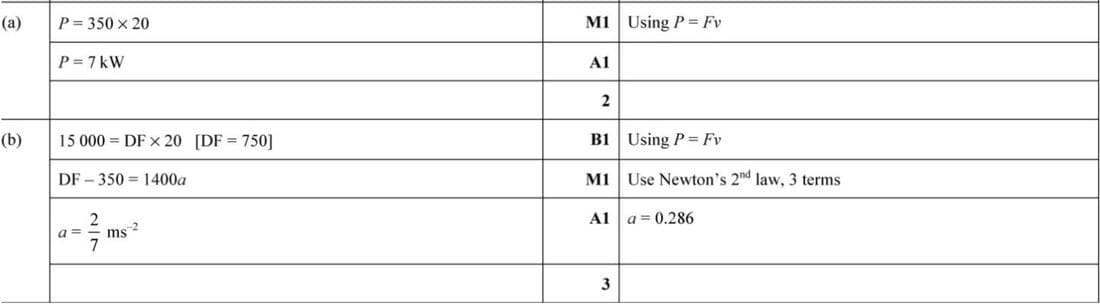
A car of mass 1400 kg is moving along a straight horizontal road against a resistance of magnitude 350 N.
(a) Find, in kW, the rate at which the engine of the car is working when it is travelling at a constant speed of 20 m s-1.
(b) Find the acceleration of the car when its speed is 20 m s-1 and the engine is working at 15 kW.
9709 P43 - Jun 2020 - Q2
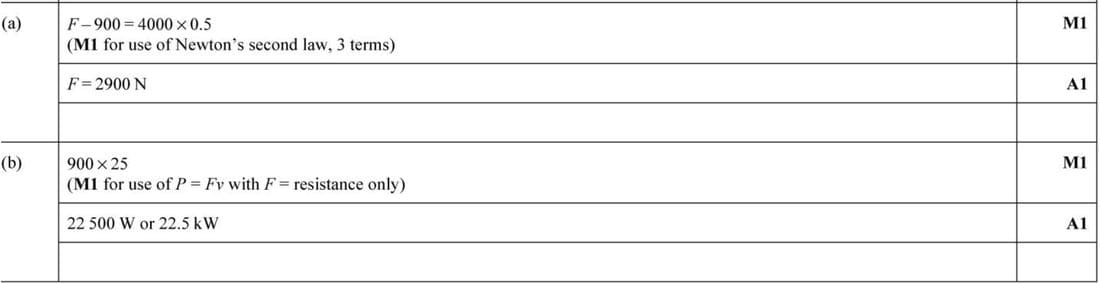
A minibus of mass 4000 kg is travelling along a straight horizontal road. The resistance to motion is 900 N.
(a) Find the driving force when the acceleration of the minibus is 0.5 m s-2.
(b) Find the power required for the minibus to maintain a constant speed of 25 m s-1.
9709 P42 - Jun 2020 - Q5
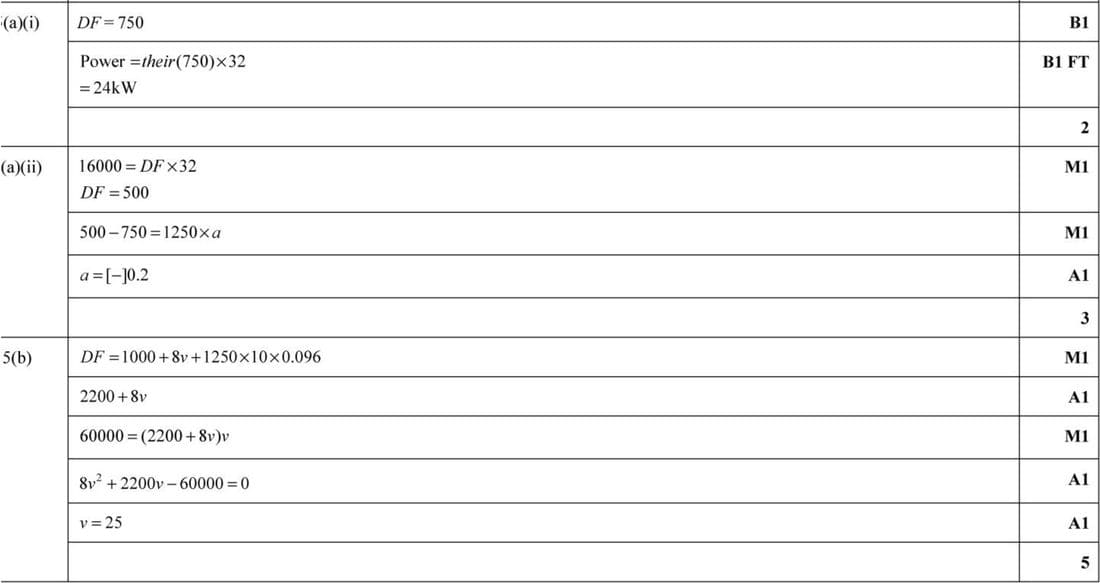
A car of mass 1250 kg is moving on a straight road.
(a) On a horizontal section of the road, the car has a constant speed of 32 m s-1 and there is a constant force of 750 N resisting the motion.
- Calculate, in kW, the power developed by the engine of the car. [2]
- Given that this power is suddenly decreased by 8 kW, find the instantaneous deceleration of the car. [3]
(b) On a section of the road inclined at sin-1 0.096 to the horizontal, the resistance to the motion of the car is (1000 + 8v) N when the speed of the car is v m s-1. The car travels up this section of the road at constant speed with the engine working at 60 kW.
Find this constant speed. [5]
9709 P41 - Jun 2020 - Q2
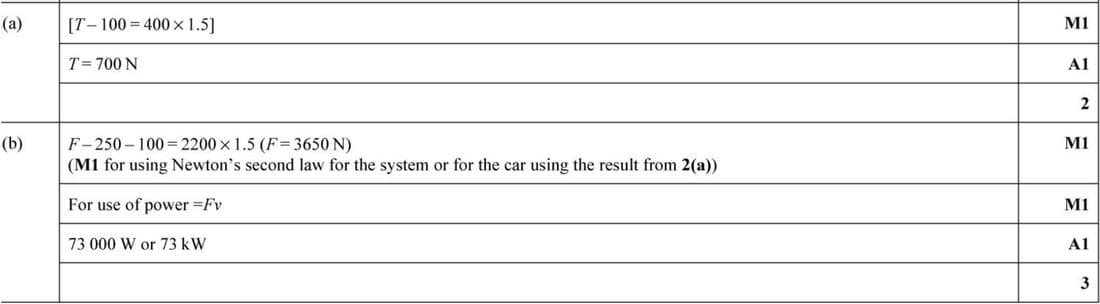
A car of mass 1800 kg is towing a trailer of mass 400 kg along a straight horizontal road. The car and trailer are connected by a light rigid tow-bar. The car is accelerating at 1.5 \(\text{ms}^{-2}\). There are constant resistance forces of 250 N on the car and 100 N on the trailer.
(a) Find the tension in the tow-bar.
(b) Find the power of the engine of the car at the instant when the speed is 20 \(\text{ms}^{-1}\).
9709 P42 - Mar 2020 - Q1
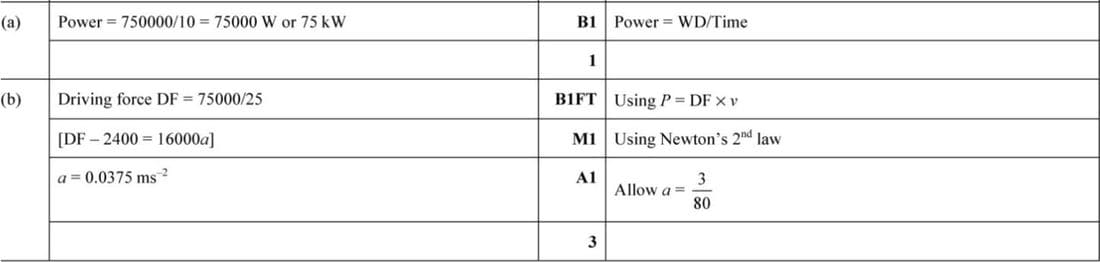
A lorry of mass 16000 kg is travelling along a straight horizontal road. The engine of the lorry is working at constant power. The work done by the driving force in 10 s is 750000 J.
(a) Find the power of the lorry’s engine.
(b) There is a constant resistance force acting on the lorry of magnitude 2400 N.
Find the acceleration of the lorry at an instant when its speed is 25 m s-1.
9709 P41 - Nov 2023 - Q6
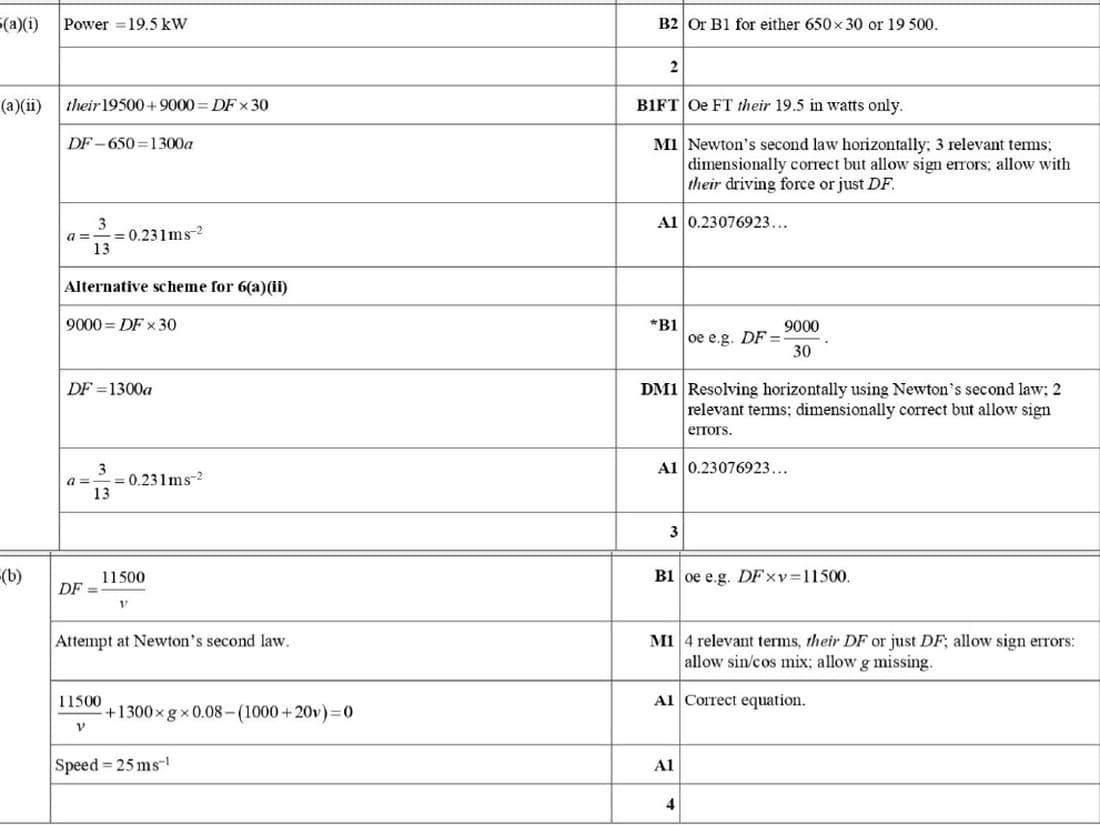
A car of mass 1300 kg is moving on a straight road.
(a) On a horizontal section of the road, the car has a constant speed of 30 m/s and there is a constant force of 650 N resisting the motion.
- Calculate, in kW, the power developed by the engine of the car.
- Given that this power is suddenly increased by 9 kW, find the instantaneous acceleration of the car.
(b) On a section of the road inclined at \(\sin^{-1} 0.08\) to the horizontal, the resistance to the motion of the car is \((1000 + 20v)\) N when the speed of the car is \(v \text{ m/s}\). The car travels downwards along this section of the road at constant speed with the engine working at 11.5 kW.
Find this constant speed.
9709 P43 - Nov 2019 - Q5
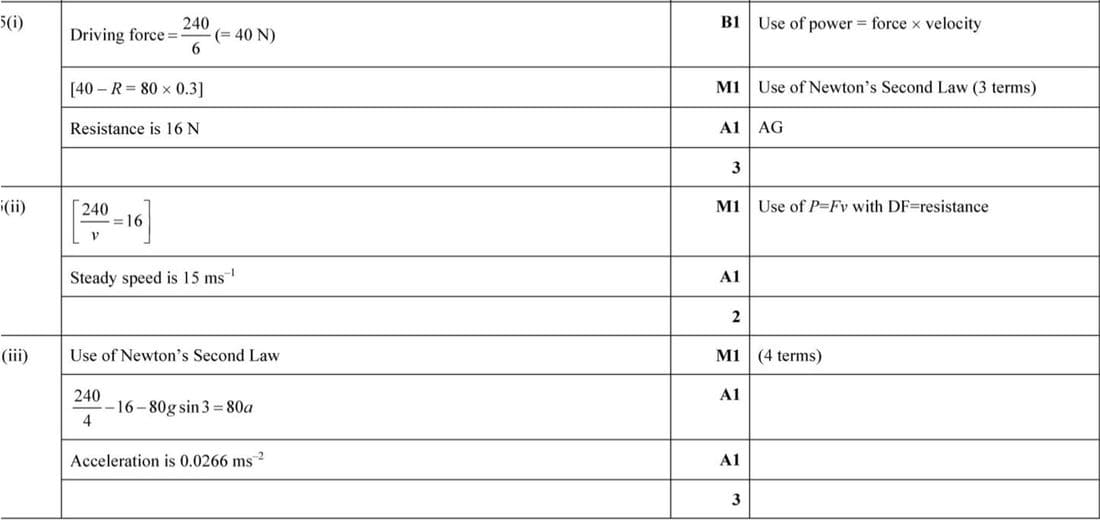
A cyclist is travelling along a straight horizontal road. The total mass of the cyclist and his bicycle is 80 kg. His power output is a constant 240 W. His acceleration when he is travelling at 6 m/s is 0.3 m/s2.
- Show that the resistance to the cyclist’s motion is 16 N.
- Find the steady speed that the cyclist can maintain if his power output and the resistance force are both unchanged.
- The cyclist later ascends a straight hill inclined at 3° to the horizontal. His power output and the resistance force are still both unchanged. Find his acceleration when he is travelling at 4 m/s.
9709 P41 - Nov 2019 - Q1
A crane is lifting a load of 1250 kg vertically at a constant speed \(V\) m s-1. Given that the power of the crane is a constant 20 kW, find the value of \(V\).

9709 P43 - Jun 2019 - Q3
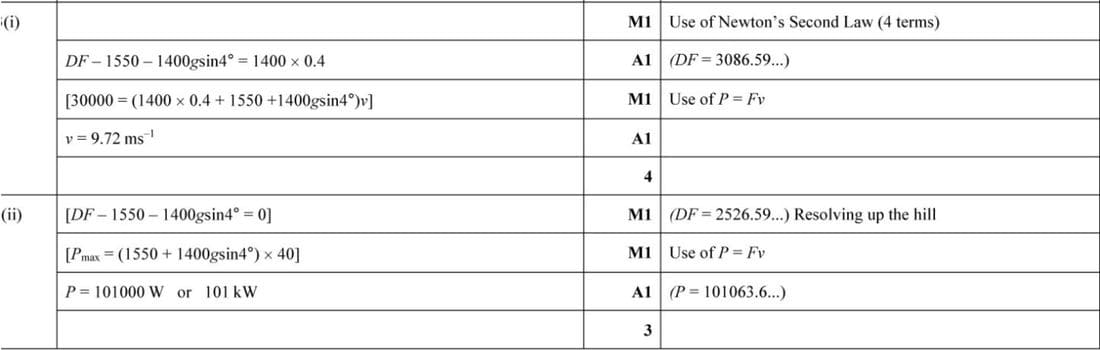
A car of mass 1400 kg is travelling up a hill inclined at an angle of 4° to the horizontal. There is a constant resistance to motion of magnitude 1550 N acting on the car.
(i) Given that the engine of the car is working at 30 kW, find the speed of the car at an instant when its acceleration is 0.4 m s-2.
(ii) The greatest possible constant speed at which the car can travel up the hill is 40 m s-1. Find the maximum possible power of the engine.
9709 P42 - Jun 2019 - Q6
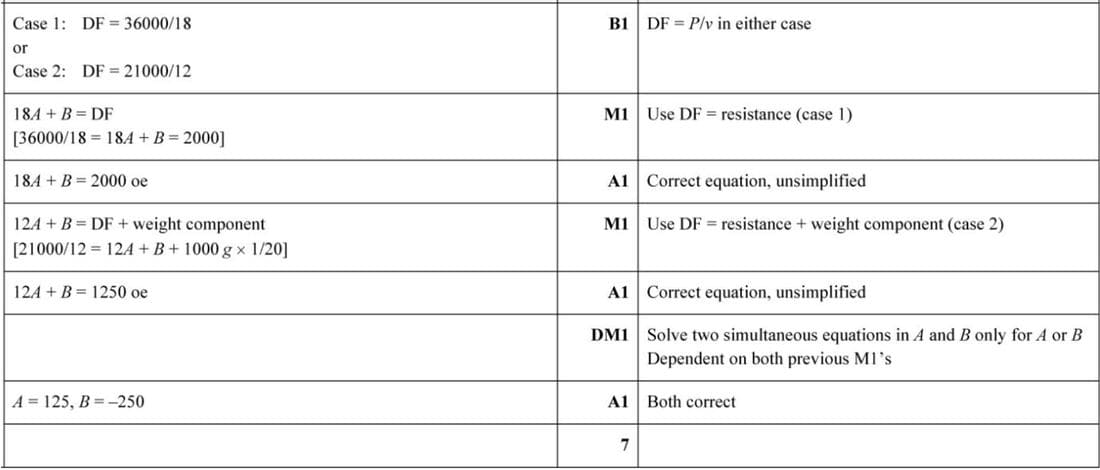
A car has mass 1000 kg. When the car is travelling at a steady speed of \(v \text{ m s}^{-1}\), where \(v > 2\), the resistance to motion of the car is \((Av + B) \text{ N}\), where \(A\) and \(B\) are constants. The car can travel along a horizontal road at a steady speed of \(18 \text{ m s}^{-1}\) when its engine is working at \(36 \text{ kW}\). The car can travel up a hill inclined at an angle of \(\theta\) to the horizontal, where \(\sin \theta = 0.05\), at a steady speed of \(12 \text{ m s}^{-1}\) when its engine is working at \(21 \text{ kW}\). Find \(A\) and \(B\).
9709 P41 - Jun 2019 - Q3
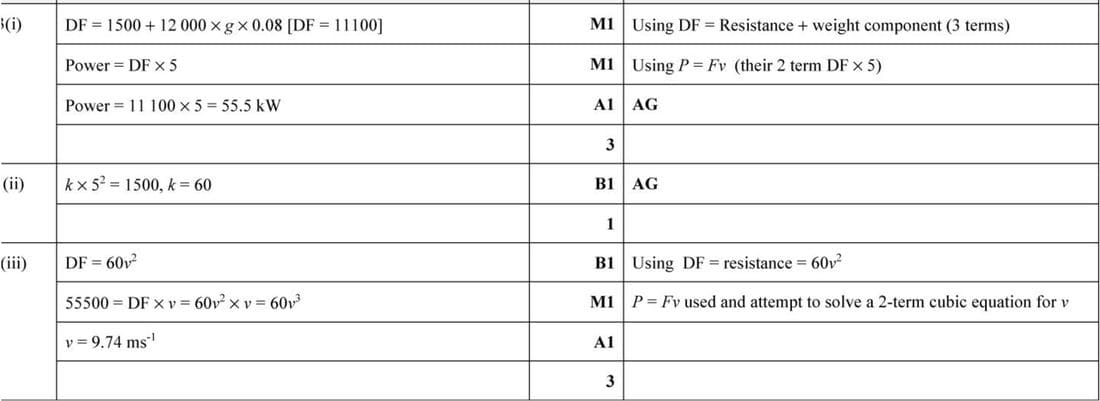
A lorry has mass 12,000 kg.
(i) The lorry moves at a constant speed of 5 m s-1 up a hill inclined at an angle of \(\theta\) to the horizontal, where \(\sin \theta = 0.08\). At this speed, the magnitude of the resistance to motion on the lorry is 1500 N. Show that the power of the lorry’s engine is 55.5 kW.
When the speed of the lorry is \(v\) m s-1 the magnitude of the resistance to motion is \(kv^2\) N, where \(k\) is a constant.
(ii) Show that \(k = 60\).
(iii) The lorry now moves at a constant speed on a straight level road. Given that its engine is still working at 55.5 kW, find the lorry’s speed.
9709 P42 - Mar 2019 - Q4
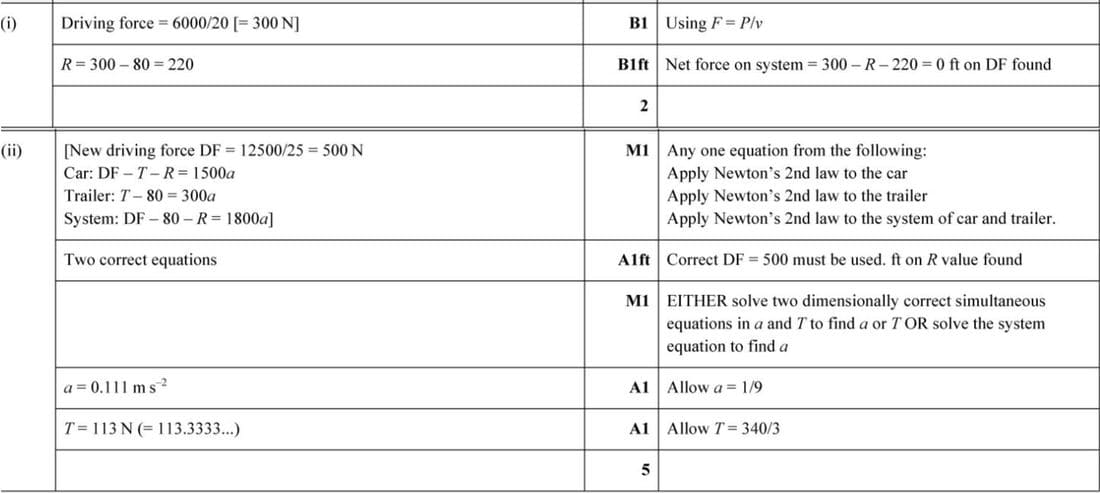
A car of mass 1500 kg is pulling a trailer of mass 300 kg along a straight horizontal road at a constant speed of 20 m s-1. The system of the car and trailer is modelled as two particles, connected by a light rigid horizontal rod. The power of the car’s engine is 6000 W. There are constant resistances to motion of R N on the car and 80 N on the trailer.
(i) Find the value of R.
The power of the car’s engine is increased to 12 500 W. The resistance forces do not change.
(ii) Find the acceleration of the car and trailer and the tension in the rod at an instant when the speed of the car is 25 m s-1.
9709 P43 - Nov 2018 - Q6
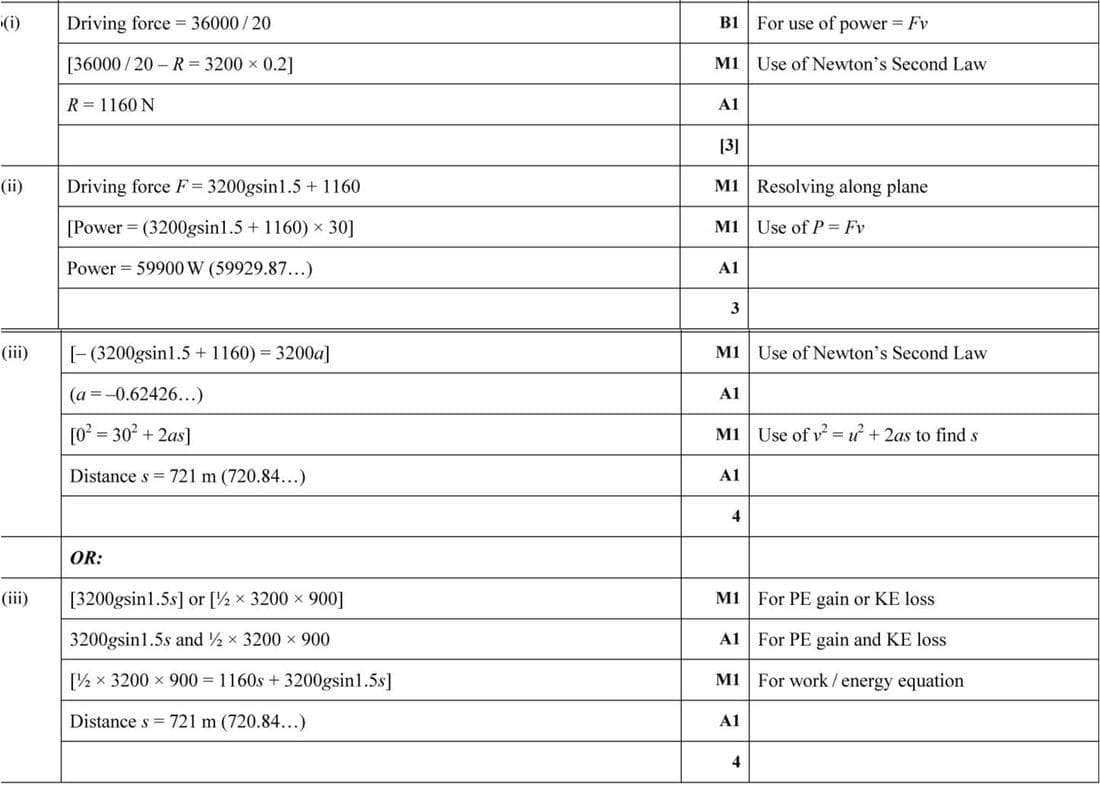
A van of mass 3200 kg travels along a horizontal road. The power of the van’s engine is constant and equal to 36 kW, and there is a constant resistance to motion acting on the van.
- When the speed of the van is 20 m s-1, its acceleration is 0.2 m s-2. Find the resistance force.
- When the van is travelling at 30 m s-1, it begins to ascend a hill inclined at 1.5° to the horizontal. The power is increased and the resistance force is still equal to the value found in part (i). Find the power required to maintain this speed of 30 m s-1.
- The engine is now stopped, with the van still travelling at 30 m s-1, and the van decelerates to rest. Find the distance the van moves up the hill from the point at which the engine is stopped until it comes to rest.
9709 P42 - Nov 2018 - Q6
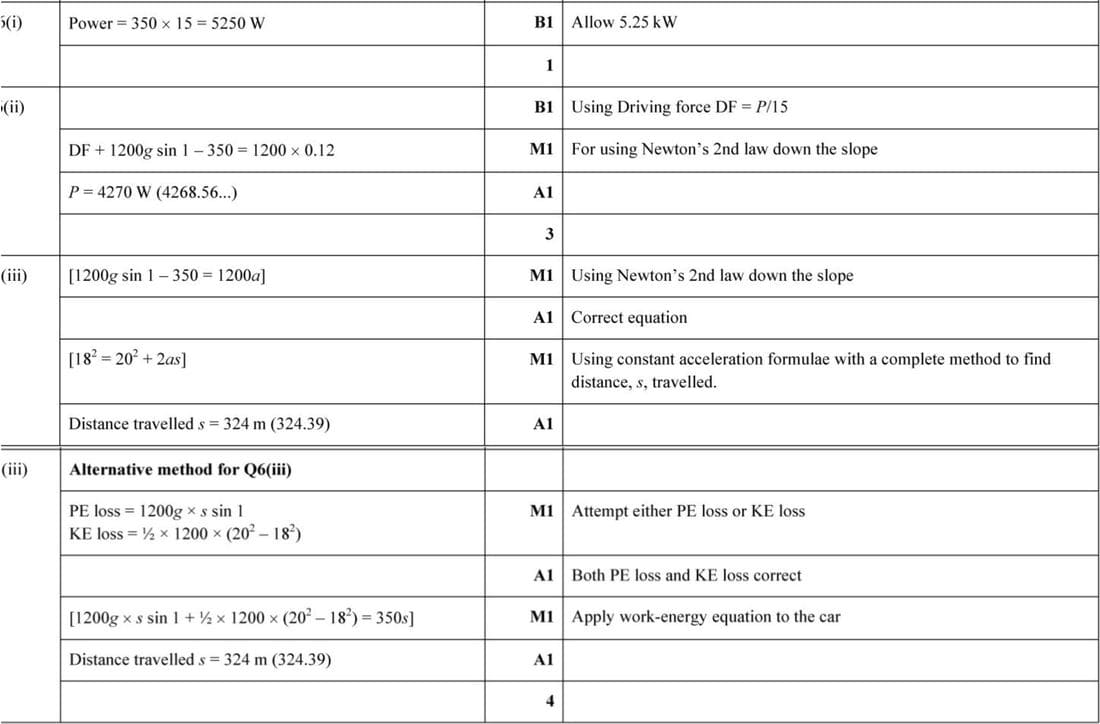
A car of mass 1200 kg is driving along a straight horizontal road at a constant speed of 15 m s-1. There is a constant resistance to motion of 350 N.
- Find the power of the car’s engine.
The car comes to a hill inclined at 1° to the horizontal, still travelling at 15 m s-1.
- The car starts to descend the hill with reduced power and with an acceleration of 0.12 m s-2. Given that there is no change in the resistance force, find the new power of the car’s engine at the instant when it starts to descend the hill.
- When the car is travelling at 20 m s-1 down the hill, the power is cut off and the car gradually slows down. Assuming that the resistance force remains 350 N, find the distance travelled from the moment when the power is cut off until the speed of the car is reduced to 18 m s-1.
9709 P41 - Nov 2018 - Q2
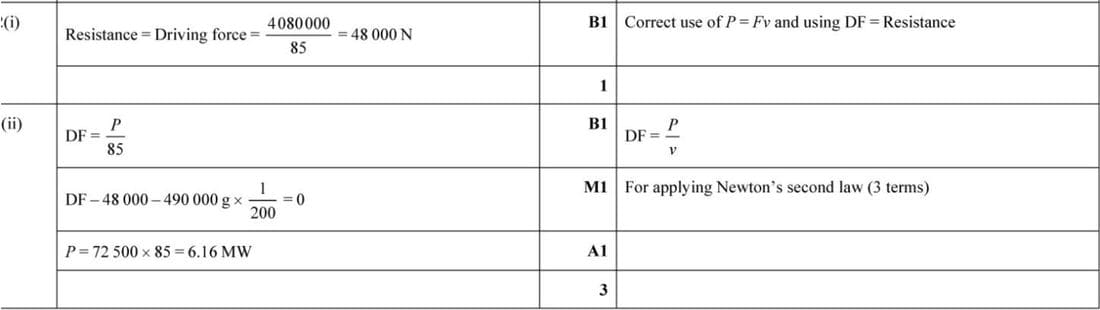
A high-speed train of mass 490,000 kg is moving along a straight horizontal track at a constant speed of 85 m s-1. The engines are supplying 4080 kW of power.
(i) Show that the resistance force is 48,000 N.
(ii) The train comes to a hill inclined at an angle \(\theta\) above the horizontal, where \(\sin \theta = \frac{1}{200}\). Given that the resistance force is unchanged, find the power required for the train to keep moving at the same constant speed of 85 m s-1.
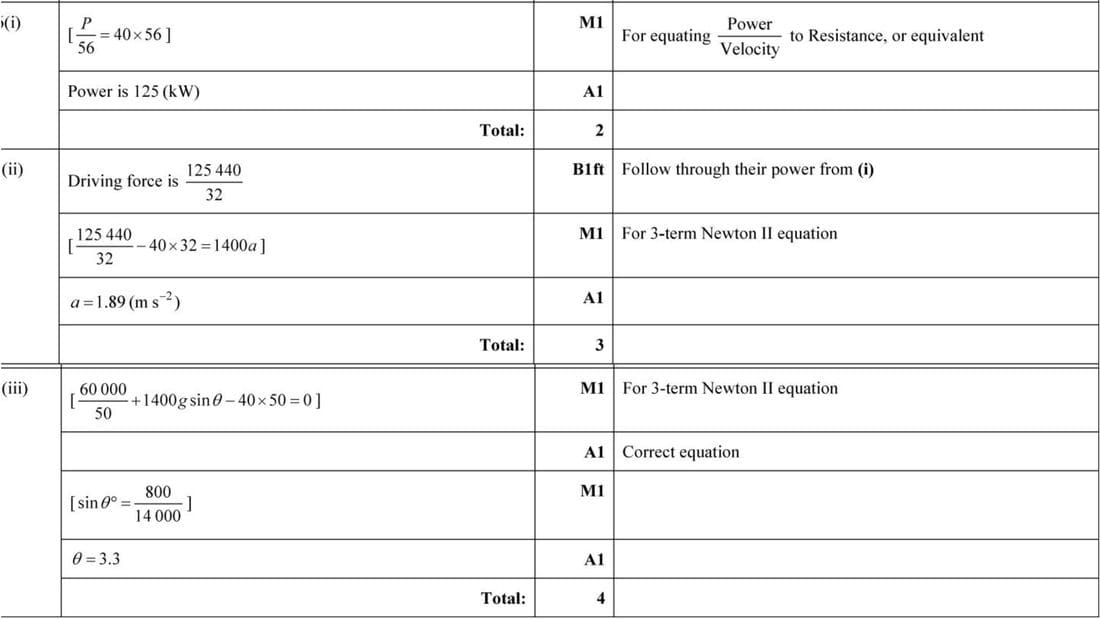
9709 P43 - Jun 2018 - Q6
A car of mass 1400 kg travelling at a speed of \(v \text{ m s}^{-1}\) experiences a resistive force of magnitude \(40v \text{ N}\). The greatest possible constant speed of the car along a straight level road is \(56 \text{ m s}^{-1}\).
- Find, in kW, the greatest possible power of the car’s engine.
- Find the greatest possible acceleration of the car at an instant when its speed on a straight level road is \(32 \text{ m s}^{-1}\).
- The car travels down a hill inclined at an angle of \(\theta^\circ\) to the horizontal at a constant speed of \(50 \text{ m s}^{-1}\). The power of the car’s engine is \(60 \text{ kW}\). Find the value of \(\theta\).
9709 P43 - Jun 2023 - Q4
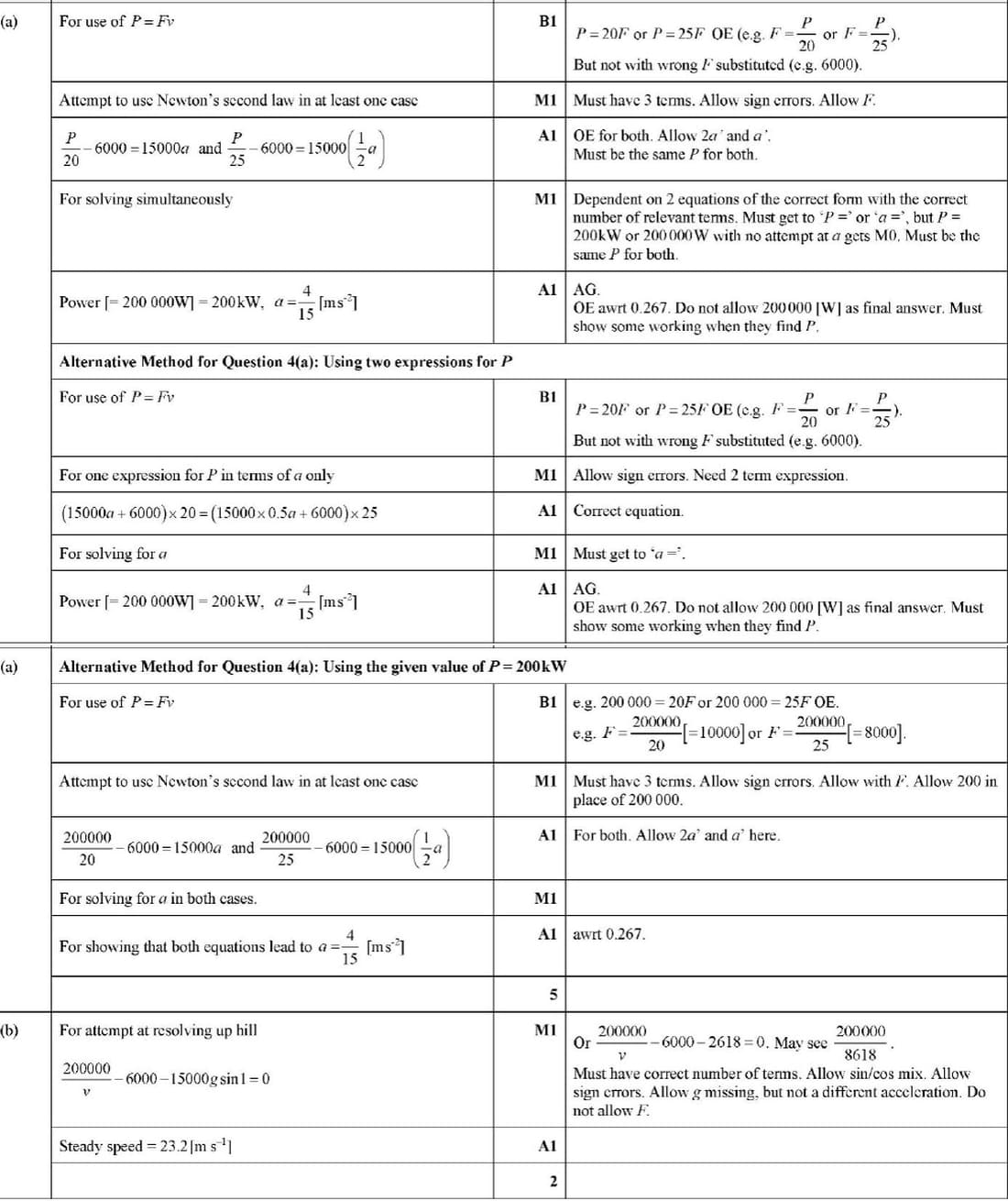
A lorry of mass 15,000 kg moves on a straight horizontal road in the direction from A to B. It passes A and B with speeds 20 m/s and 25 m/s respectively. The power of the lorry’s engine is constant and there is a constant resistance to motion of magnitude 6000 N. The acceleration of the lorry at B is 0.5 times the acceleration of the lorry at A.
(a) Show that the power of the lorry’s engine is 200 kW, and hence find the acceleration of the lorry when it is travelling at 20 m/s.
The lorry begins to ascend a straight hill inclined at 1° to the horizontal. It is given that the power of the lorry’s engine and the resistance force do not change.
(b) Find the steady speed up the hill that the lorry could maintain.
9709 P42 - Jun 2018 - Q2
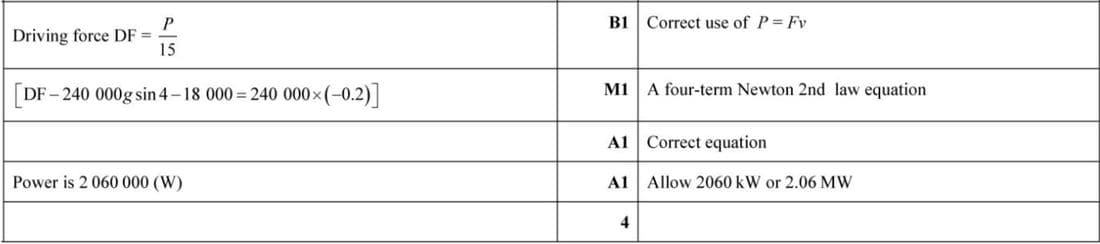
A train of mass 240,000 kg travels up a slope inclined at an angle of 4° to the horizontal. There is a constant resistance of magnitude 18,000 N acting on the train. At an instant when the speed of the train is 15 m/s, its deceleration is 0.2 m/s². Find the power of the engine of the train.
9709 P42 - Mar 2018 - Q6
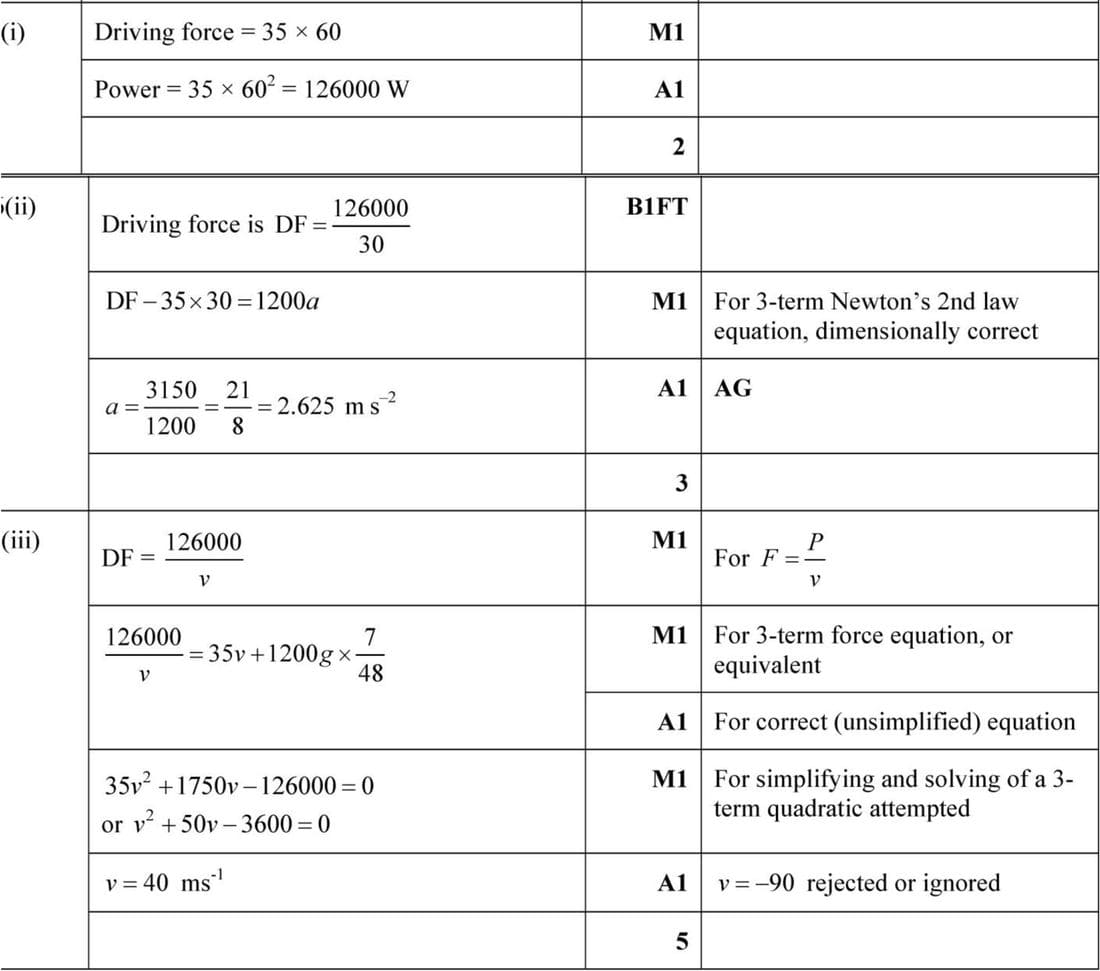
A car of mass 1200 kg has a greatest possible constant speed of 60 m s-1 along a straight level road. When the car is travelling at a speed of v m s-1 there is a resistive force of magnitude 35v N.
- Find the greatest possible power of the car. [2]
- The car travels along a straight level road. Show that, at an instant when its speed is 30 m s-1, the greatest possible acceleration of the car is 2.625 m s-2. [3]
- The car travels at a constant speed up a hill inclined at an angle of sin-1(7/48) to the horizontal. Find the greatest possible speed of the car. [5]