Past Exam Questions
← Back9709 P42 - Jun 2015 - Q2
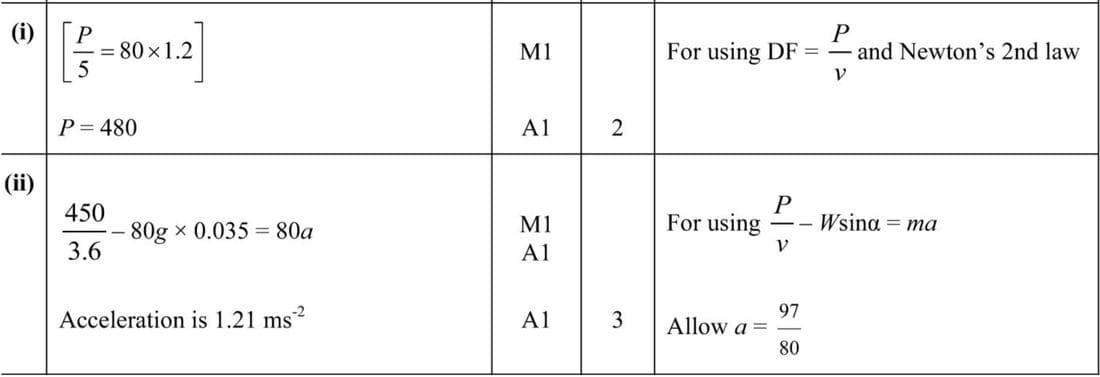
The total mass of a cyclist and his cycle is 80 kg. The resistance to motion is zero.
- The cyclist moves along a horizontal straight road working at a constant rate of \(P\) W. Find the value of \(P\) given that the cyclist’s speed is 5 m s\(^{-1}\) when his acceleration is 1.2 m s\(^{-2}\).
- The cyclist moves up a straight hill inclined at an angle \(\alpha\), where \(\sin \alpha = 0.035\). Find the acceleration of the cyclist at an instant when he is working at a rate of 450 W and has speed 3.6 m s\(^{-1}\).
9709 P41 - Jun 2015 - Q5
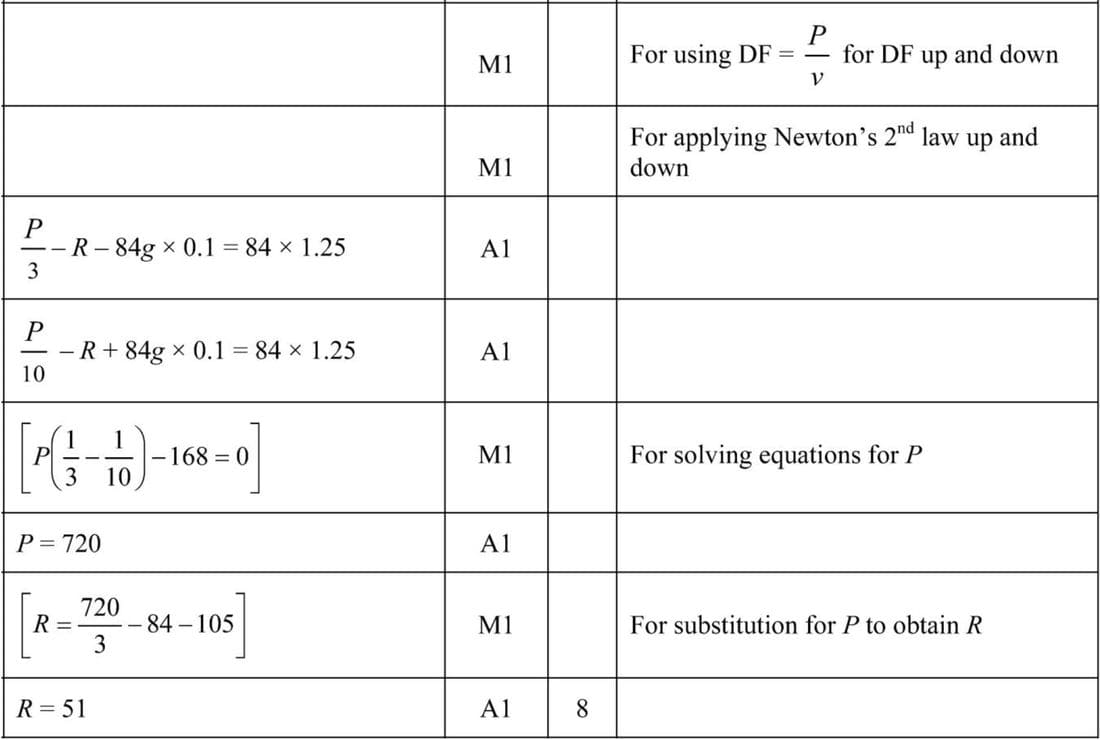
A cyclist and her bicycle have a total mass of 84 kg. She works at a constant rate of \(P \, W\) while moving on a straight road which is inclined to the horizontal at an angle \(\theta\), where \(\sin \theta = 0.1\). When moving uphill, the cyclist’s acceleration is \(1.25 \, \text{m/s}^2\) at an instant when her speed is \(3 \, \text{m/s}\). When moving downhill, the cyclist’s acceleration is \(1.25 \, \text{m/s}^2\) at an instant when her speed is \(10 \, \text{m/s}\). The resistance to the cyclist’s motion, whether the cyclist is moving uphill or downhill, is \(R \, N\). Find the values of \(P\) and \(R\).
9709 P43 - Nov 2014 - Q1
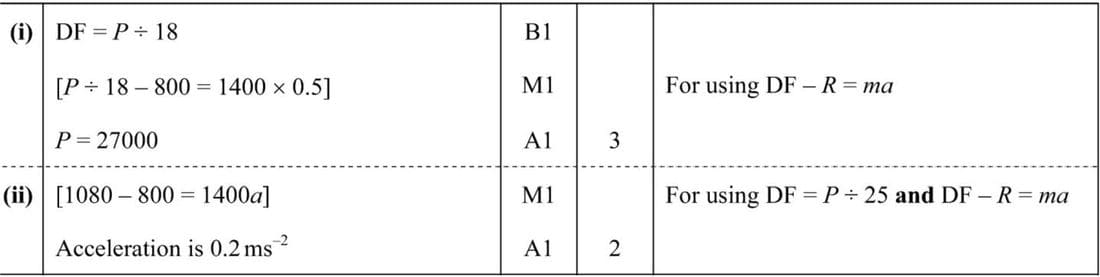
A car of mass 1400 kg moves on a horizontal straight road. The resistance to the car’s motion is constant and equal to 800 N and the power of the car’s engine is constant and equal to \(P\) W. At an instant when the car’s speed is 18 m s-1 its acceleration is 0.5 m s-2.
(i) Find the value of \(P\).
The car continues and passes through another point with speed 25 m s-1.
(ii) Find the car’s acceleration at this point.
9709 P42 - Nov 2014 - Q3
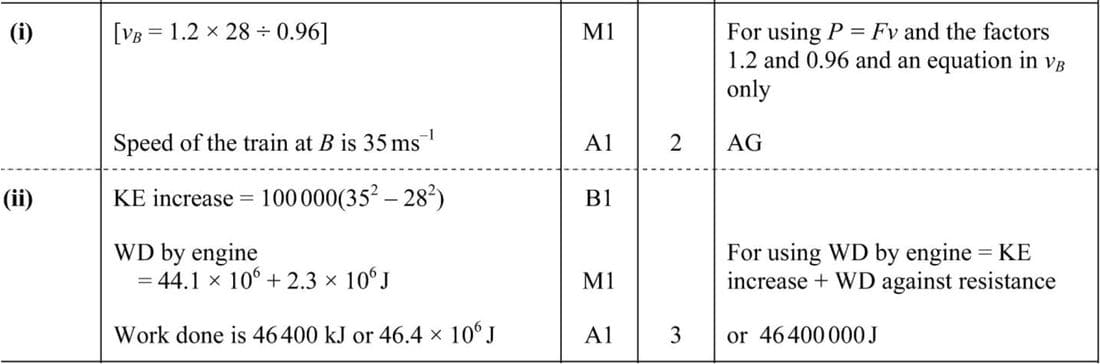
A train of mass 200,000 kg moves on a horizontal straight track. It passes through a point A with speed 28 m/s and later it passes through a point B. The power of the train’s engine at B is 1.2 times the power of the train’s engine at A. The driving force of the train’s engine at B is 0.96 times the driving force of the train’s engine at A.
(i) Show that the speed of the train at B is 35 m/s.
(ii) For the motion from A to B, find the work done by the train’s engine given that the work done against the resistance to the train’s motion is 2.3 × 10⁶ J.
9709 P41 - Nov 2014 - Q1
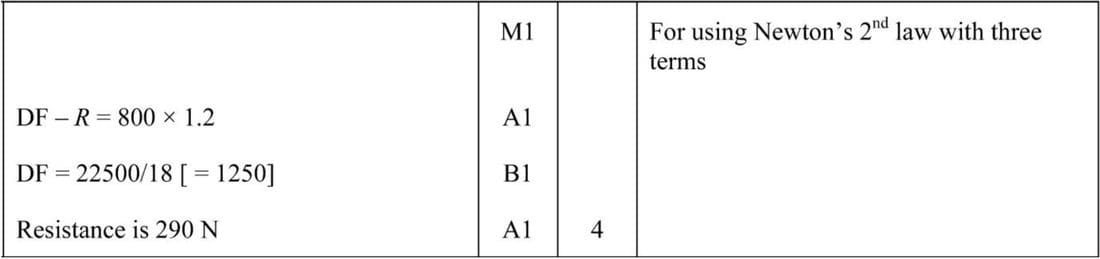
A car of mass 800 kg is moving on a straight horizontal road with its engine working at a rate of 22.5 kW. Find the resistance to the car’s motion at an instant when the car’s speed is 18 m/s and its acceleration is 1.2 m/s2.
9709 P43 - Jun 2014 - Q2
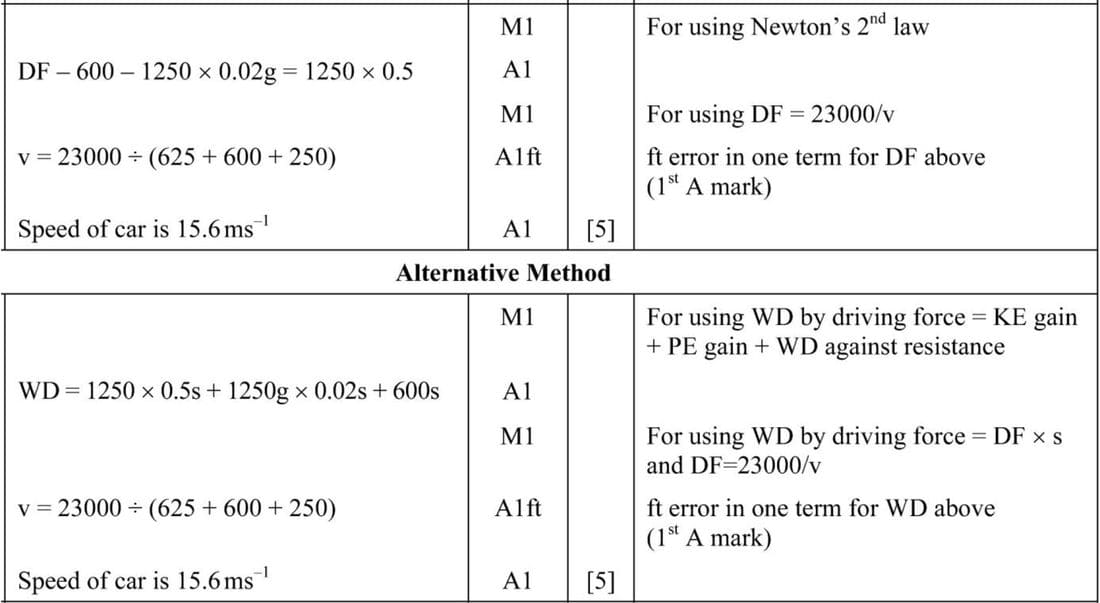
A car of mass 1250 kg travels up a straight hill inclined at an angle \(\alpha\) to the horizontal, where \(\sin \alpha = 0.02\). The power provided by the car’s engine is 23 kW. The resistance to motion is constant and equal to 600 N. Find the speed of the car at an instant when its acceleration is \(0.5 \text{ m/s}^2\).
9709 P42 - Jun 2014 - Q1
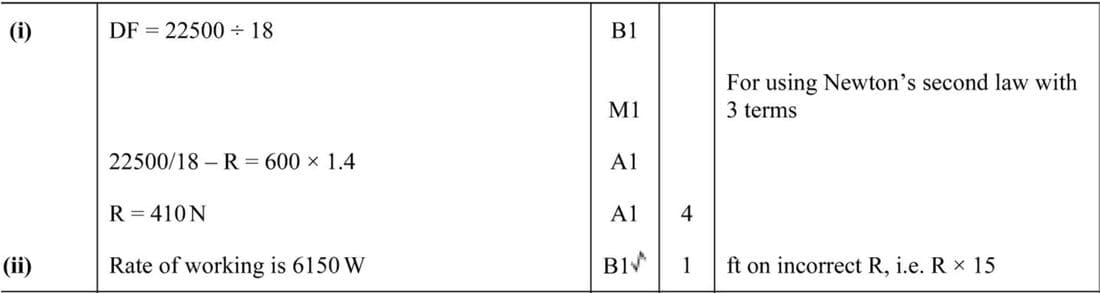
A car of mass 600 kg travels along a straight horizontal road. The resistance to the car’s motion is constant and equal to \(R\) N.
(i) Find the value of \(R\), given that the car’s acceleration is \(1.4 \, \text{m/s}^2\) at an instant when the car’s speed is \(18 \, \text{m/s}\) and its engine is working at a rate of \(22.5 \, \text{kW}\).
(ii) Find the rate of working of the car’s engine when the car is moving with a constant speed of \(15 \, \text{m/s}\).
9709 P41 - Jun 2014 - Q1
A train is moving at constant speed \(V \text{ m s}^{-1}\) along a horizontal straight track. Given that the power of the train’s engine is 1330 kW and the total resistance to the train’s motion is 28 kN, find the value of \(V\).

9709 P43 - Nov 2013 - Q6
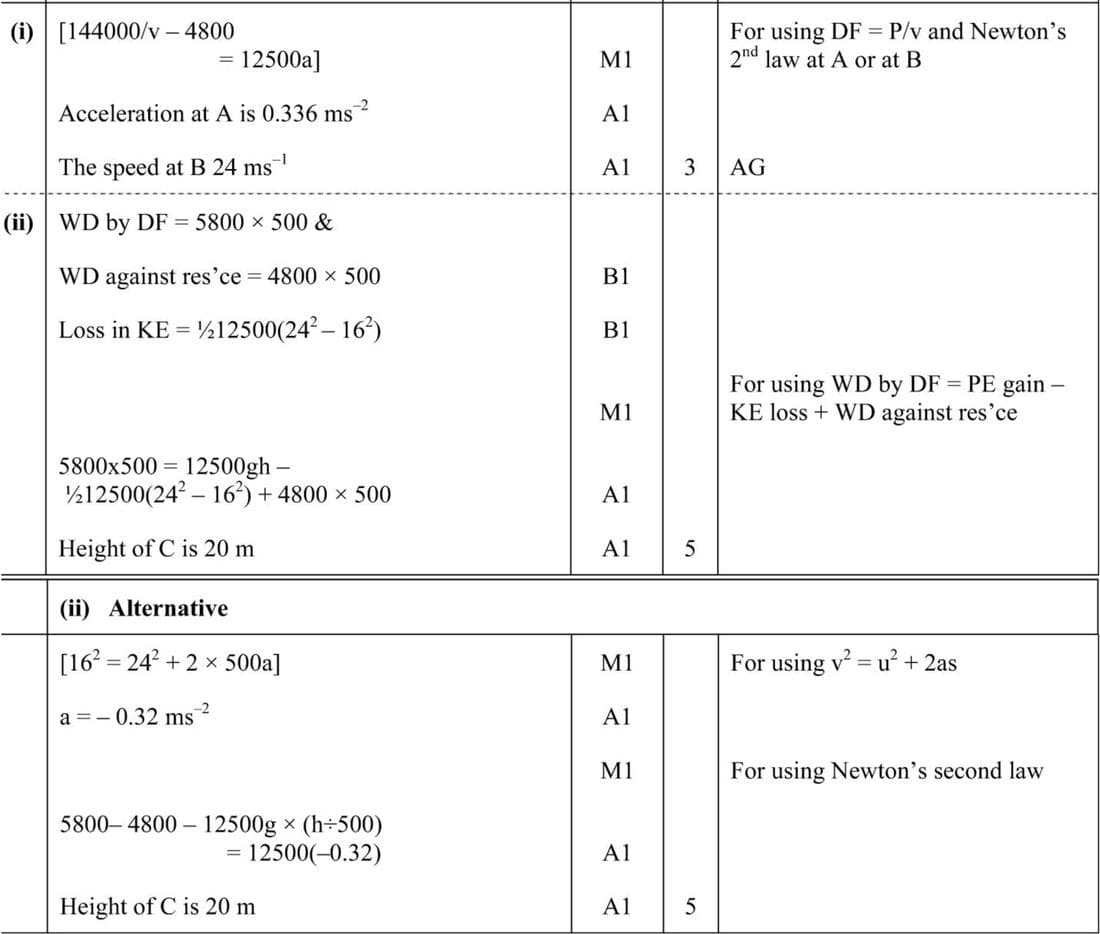
A lorry of mass 12,500 kg travels along a road from A to C passing through a point B. The resistance to motion of the lorry is 4800 N for the whole journey from A to C.
(i) The section AB of the road is straight and horizontal. On this section of the road the power of the lorry’s engine is constant and equal to 144 kW. The speed of the lorry at A is 16 m s-1 and its acceleration at B is 0.096 m s-2. Find the acceleration of the lorry at A and show that its speed at B is 24 m s-1.
(ii) The section BC of the road has length 500 m, is straight and inclined upwards towards C. On this section of the road the lorry’s driving force is constant and equal to 5800 N. The speed of the lorry at C is 16 m s-1. Find the height of C above the level of AB.
9709 P42 - Nov 2013 - Q3
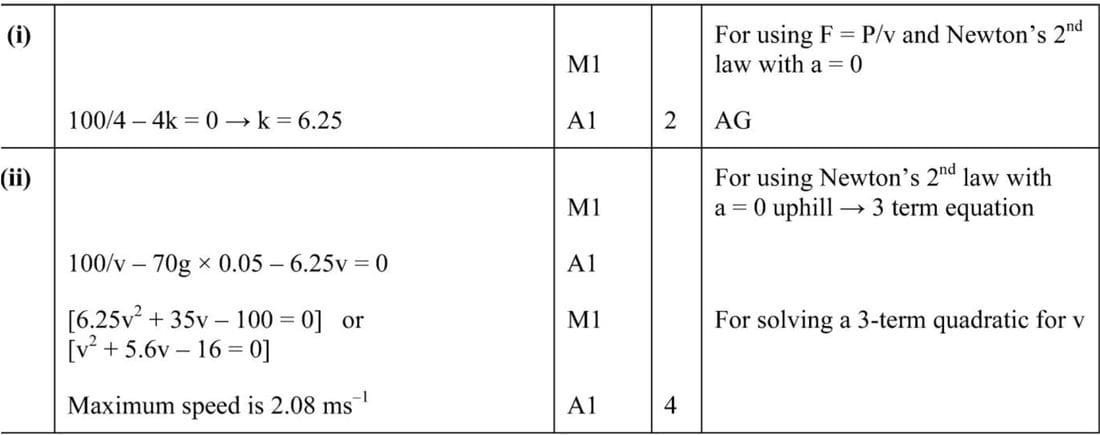
The resistance to motion acting on a runner of mass 70 kg is \(kv\) N, where \(v \text{ m s}^{-1}\) is the runner's speed and \(k\) is a constant. The greatest power the runner can exert is 100 W. The runner's greatest steady speed on horizontal ground is \(4 \text{ m s}^{-1}\).
- Show that \(k = 6.25\).
- Find the greatest steady speed of the runner while running uphill on a straight path inclined at an angle \(\alpha\) to the horizontal, where \(\sin \alpha = 0.05\).
9709 P43 - Nov 2022 - Q6
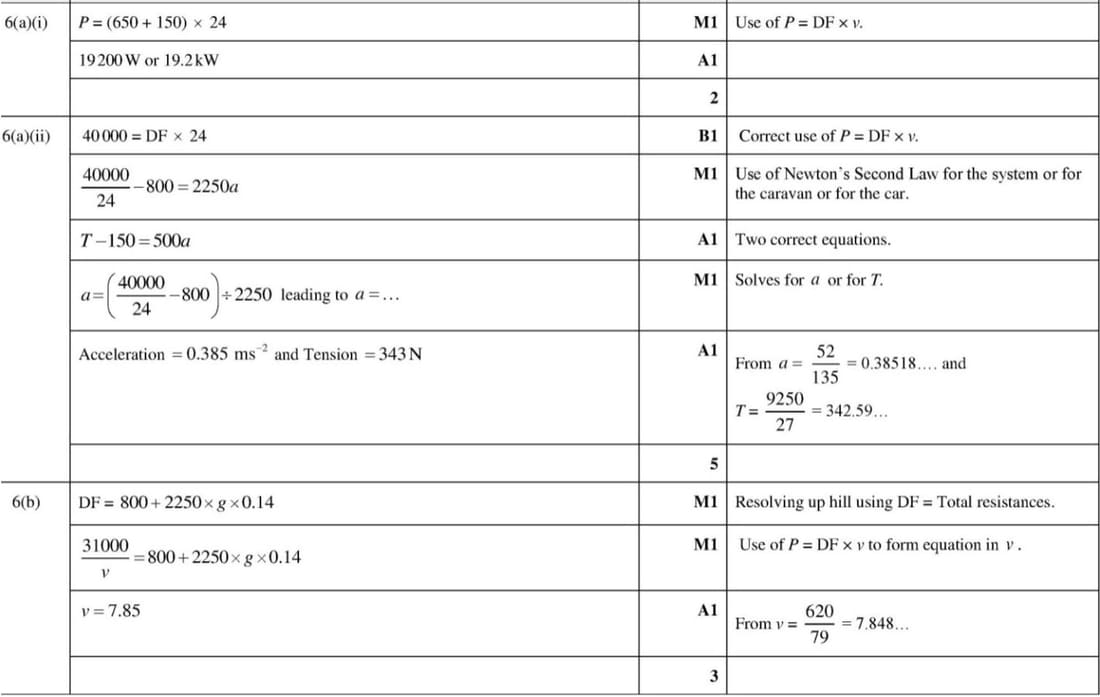
A car of mass 1750 kg is pulling a caravan of mass 500 kg. The car and the caravan are connected by a light rigid tow-bar. The resistances to the motion of the car and caravan are 650 N and 150 N respectively.
(a) The car and caravan are moving along a straight horizontal road at a constant speed of 24 m s-1.
- Find the power of the car’s engine.
- The engine’s power is now suddenly increased to 40 kW. Find the instantaneous acceleration of the car and caravan and find the tension in the tow-bar.
(b) The car and caravan now travel up a straight hill, inclined at an angle sin-1 0.14 to the horizontal, at a constant speed of v m s-1. The car’s engine is working at 31 kW. The resistances to the motion of the car and caravan are unchanged.
Find v.
9709 P43 - Jun 2013 - Q3
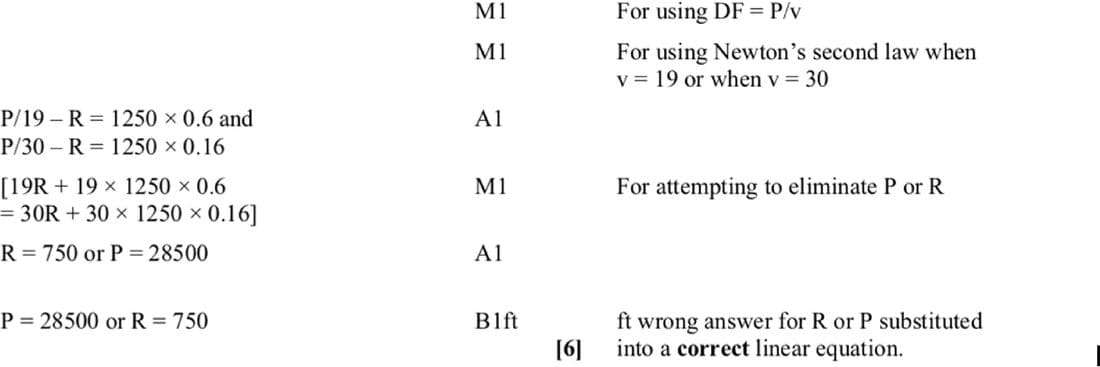
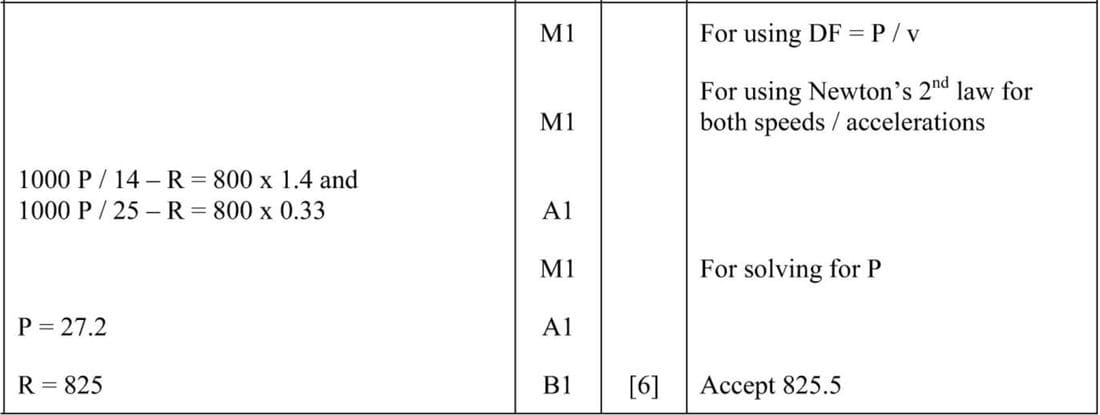
A car has mass 800 kg. The engine of the car generates constant power \(P\) kW as the car moves along a straight horizontal road. The resistance to motion is constant and equal to \(R\) N. When the car's speed is 14 m s\(^{-1}\) its acceleration is 1.4 m s\(^{-2}\), and when the car's speed is 25 m s\(^{-1}\) its acceleration is 0.33 m s\(^{-2}\). Find the values of \(P\) and \(R\).
9709 P42 - Jun 2013 - Q5
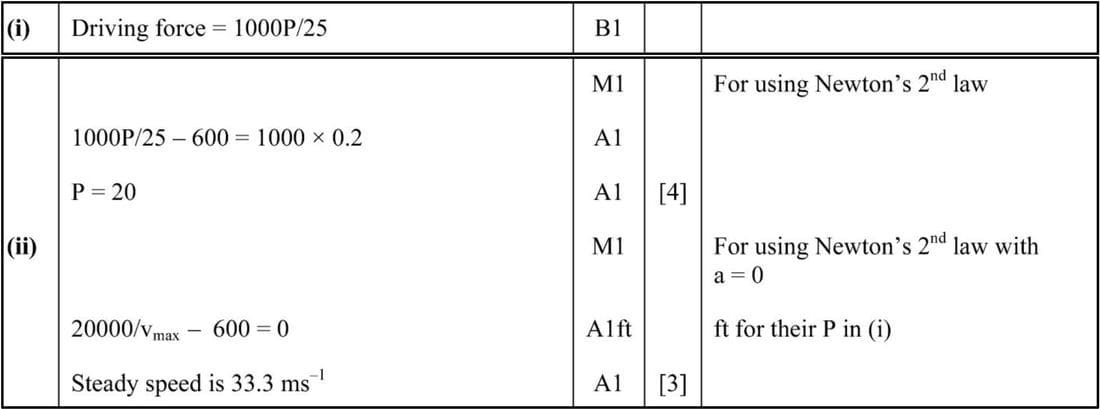
A car of mass 1000 kg is travelling on a straight horizontal road. The power of its engine is constant and equal to \(P\) kW. The resistance to motion of the car is 600 N. At an instant when the car’s speed is 25 m s\(^{-1}\), its acceleration is 0.2 m s\(^{-2}\). Find
- the value of \(P\),
- the steady speed at which the car can travel.
9709 P41 - Jun 2013 - Q4
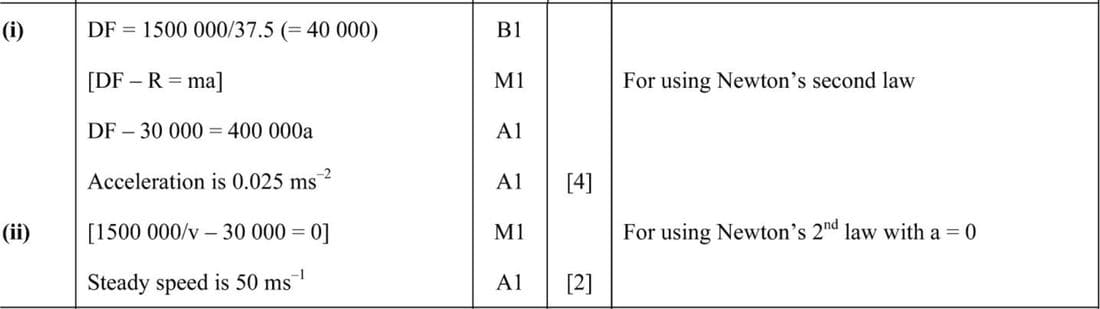
A train of mass 400,000 kg is moving on a straight horizontal track. The power of the engine is constant and equal to 1500 kW and the resistance to the train’s motion is 30,000 N. Find
- the acceleration of the train when its speed is 37.5 m s-1,
- the steady speed at which the train can move.
9709 P41 - Nov 2012 - Q7
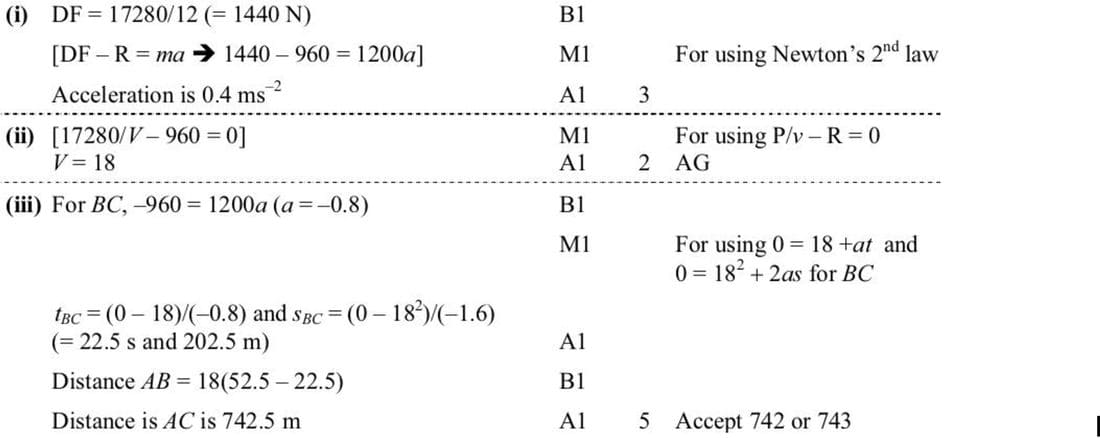
A car of mass 1200 kg moves in a straight line along horizontal ground. The resistance to motion of the car is constant and has magnitude 960 N. The car’s engine works at a rate of 17 280 W.
- Calculate the acceleration of the car at an instant when its speed is 12 m s-1.
The car passes through the points A and B. While the car is moving between A and B it has constant speed V m s-1.
- Show that V = 18.
At the instant that the car reaches B the engine is switched off and subsequently provides no energy. The car continues along the straight line until it comes to rest at the point C. The time taken for the car to travel from A to C is 52.5 s.
- Find the distance AC.
9709 P43 - Jun 2012 - Q4
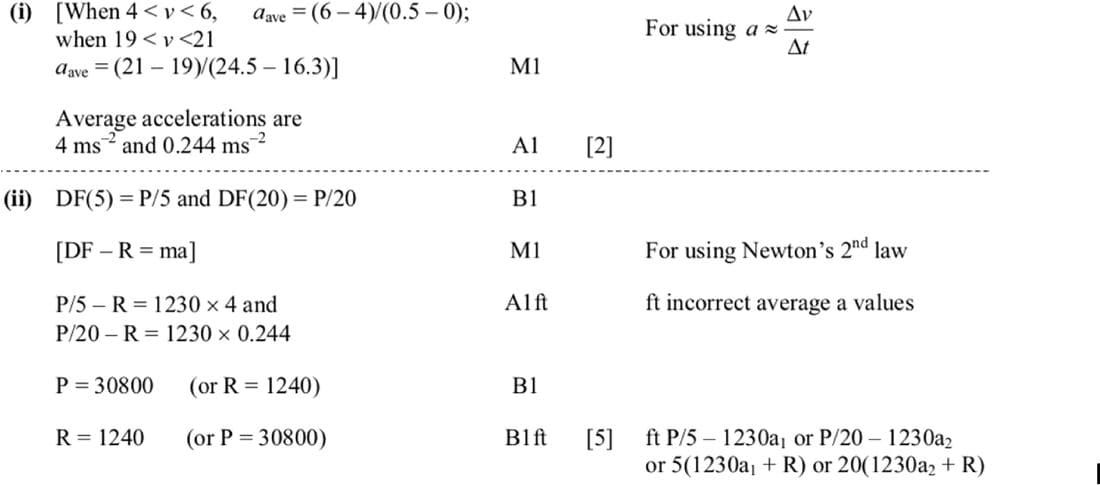
A car of mass 1230 kg increases its speed from 4 m/s to 21 m/s in 24.5 s. The table below shows corresponding values of time \(t\) s and speed \(v\) m/s.
| \(t\) | 0 | 0.5 | 16.3 | 24.5 |
|---|---|---|---|---|
| \(v\) | 4 | 6 | 19 | 21 |
(i) Using the values in the table, find the average acceleration of the car for \(0 < t < 0.5\) and for \(16.3 < t < 24.5\).
While the car is increasing its speed the power output of its engine is constant and equal to \(P\) W, and the resistance to the car’s motion is constant and equal to \(R\) N.
(ii) Assuming that the values obtained in part (i) are approximately equal to the accelerations at \(v = 5\) and at \(v = 20\), find approximations for \(P\) and \(R\).
9709 P41 - Jun 2012 - Q1
A car of mass 880 kg travels along a straight horizontal road with its engine working at a constant rate of \(P\) W. The resistance to motion is 700 N. At an instant when the car's speed is 16 m s-1 its acceleration is 0.625 m s-2. Find the value of \(P\).

9709 P43 - Nov 2011 - Q7
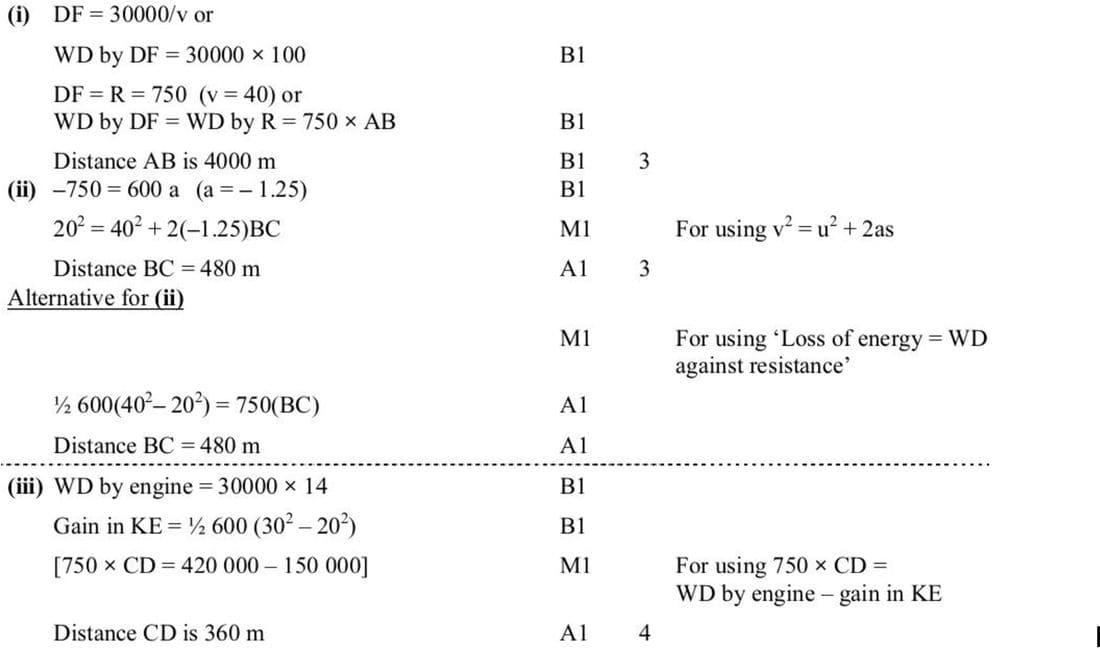
A car of mass 600 kg travels along a straight horizontal road starting from a point A. The resistance to motion of the car is 750 N.
- The car travels from A to B at constant speed in 100 s. The power supplied by the car's engine is constant and equal to 30 kW. Find the distance AB.
- The car's engine is switched off at B and the car's speed decreases until the car reaches C with a speed of 20 m/s. Find the distance BC.
- The car's engine is switched on at C and the power it supplies is constant and equal to 30 kW. The car takes 14 s to travel from C to D and reaches D with a speed of 30 m/s. Find the distance CD.
9709 P42 - Nov 2011 - Q1
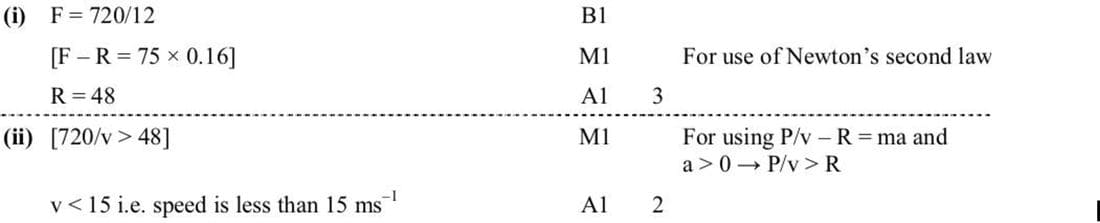
A racing cyclist, whose mass with his cycle is 75 kg, works at a rate of 720 W while moving on a straight horizontal road. The resistance to the cyclist’s motion is constant and equal to \(R N\).
- Given that the cyclist is accelerating at \(0.16 \, \text{m/s}^2\) at an instant when his speed is \(12 \, \text{m/s}\), find the value of \(R\).
- Given that the cyclist’s acceleration is positive, show that his speed is less than \(15 \, \text{m/s}\).
9709 P43 - Jun 2011 - Q2
A car of mass 1250 kg is travelling along a straight horizontal road with its engine working at a constant rate of \(P\) W. The resistance to the car’s motion is constant and equal to \(R\) N. When the speed of the car is 19 m s\(^{-1}\) its acceleration is 0.6 m s\(^{-2}\), and when the speed of the car is 30 m s\(^{-1}\) its acceleration is 0.16 m s\(^{-2}\). Find the values of \(P\) and \(R\).