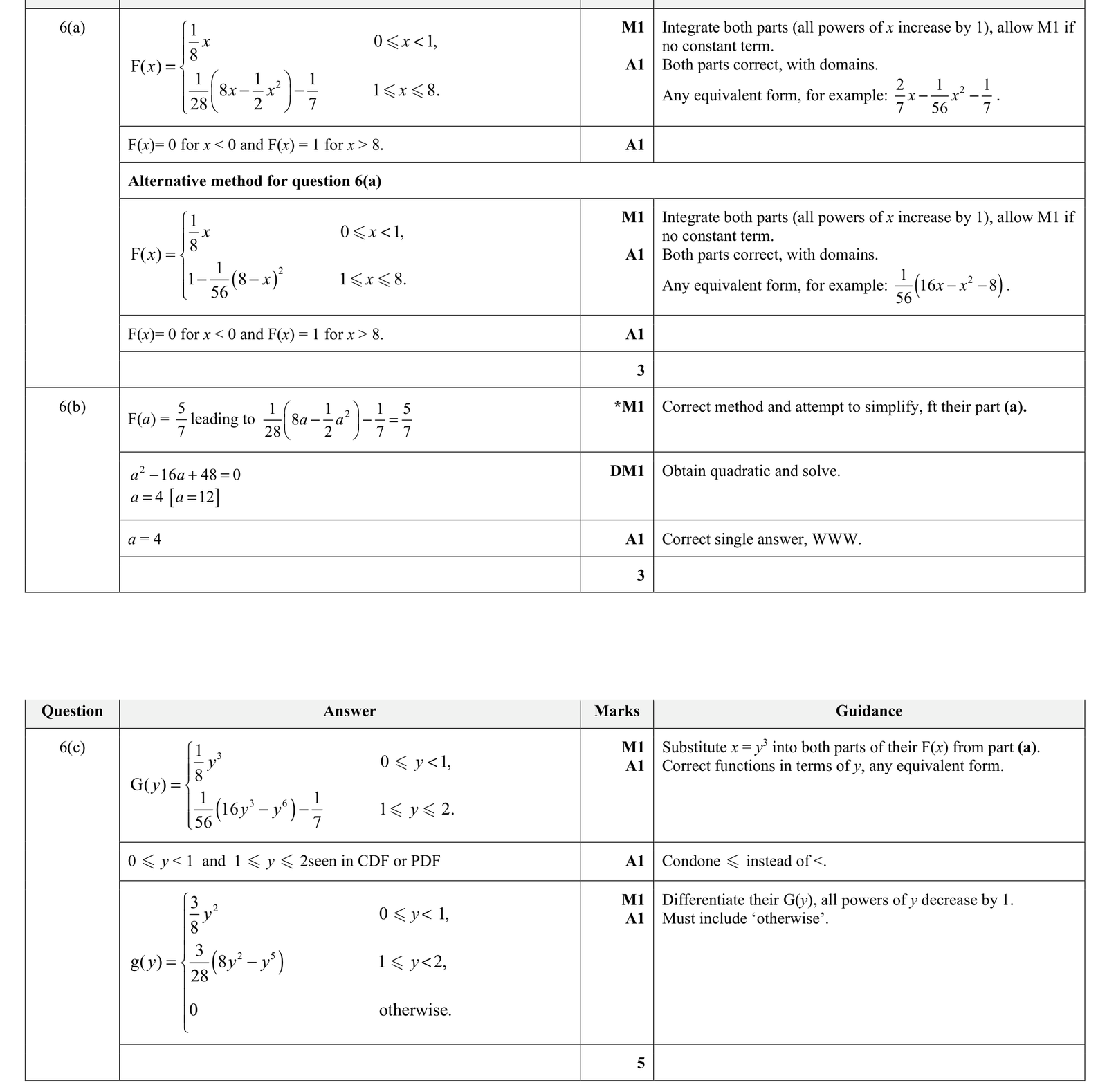
Answer: (a) The cumulative distribution function is
\(F(x)=\mathbb{P}(X\le x)=
\begin{cases}
0,&x\lt 0,\\[4pt]
\dfrac{x}{8},&0\le x\lt 1,\\[6pt]
\dfrac{1}{28}\left(8x-\dfrac{x^2}{2}\right)-\dfrac17,&1\le x\le 8,\\[6pt]
1,&x\gt 8.
\end{cases}\)
An equivalent form for \(1\le x\le 8\) is \(F(x)=1-\dfrac{(8-x)^2}{56}\).
(b) \(a=4\).
(c) Since \(Y=\sqrt[3]{X}\), the density of \(Y\) is
\(g(y)=
\begin{cases}
\dfrac{3}{8}y^2,&0\le y\lt 1,\\[6pt]
\dfrac{3}{28}(8y^2-y^5),&1\le y\le 2,\\[6pt]
0,&\text{otherwise}.
\end{cases}\)
(a) By definition, \(F(x)=\mathbb{P}(X\le x)=\int_{-\infty}^{x} f(t)\,dt\).
We must consider the different regions of the density.
For \(x\lt 0\), there is no probability mass yet, so
\(F(x)=0\).
For \(0\le x\lt 1\),
\(F(x)=\int_0^x \frac18\,dt=\frac{x}{8}.\)
For \(1\le x\le 8\), we add the probability from \(0\) to \(1\), then integrate the second part from \(1\) to \(x\):
\(F(x)=\int_0^1 \frac18\,dt+\int_1^x \frac1{28}(8-t)\,dt.\)
The first integral is
\(\int_0^1 \frac18\,dt=\frac18.\)
The second integral is
\(\int_1^x \frac1{28}(8-t)\,dt=\frac1{28}\left[8t-\frac{t^2}{2}\right]_1^x\)
\(=\frac1{28}\left(8x-\frac{x^2}{2}-8+\frac12\right)=\frac1{28}\left(8x-\frac{x^2}{2}-\frac{15}{2}\right).\)
So
\(F(x)=\frac18+\frac1{28}\left(8x-\frac{x^2}{2}-\frac{15}{2}\right).\)
Simplifying,
\(F(x)=\frac1{28}\left(8x-\frac{x^2}{2}\right)-\frac17.\)
This can also be written as
\(F(x)=1-\frac{(8-x)^2}{56}.\)
For \(x\gt 8\), all the probability has been included, so
\(F(x)=1.\)
Therefore,
\(F(x)=
\begin{cases}
0,&x\lt 0,\\[4pt]
\dfrac{x}{8},&0\le x\lt 1,\\[6pt]
\dfrac{1}{28}\left(8x-\dfrac{x^2}{2}\right)-\dfrac17,&1\le x\le 8,\\[6pt]
1,&x\gt 8.
\end{cases}\)
(b) We need \(\mathbb{P}(X\le a)=\frac57\), so \(F(a)=\frac57\).
Since \(\frac57\) is bigger than \(F(1)=\frac18\), the value of \(a\) lies in the interval \(1\le a\le 8\). So we use the second part of \(F\):
\(\frac{1}{28}\left(8a-\frac{a^2}{2}\right)-\frac17=\frac57.\)
Add \(\frac17\) to both sides:
\(\frac{1}{28}\left(8a-\frac{a^2}{2}\right)=\frac67.\)
Multiply by \(28\):
\(8a-\frac{a^2}{2}=24.\)
Multiply by \(2\):
\(16a-a^2=48.\)
Rearrange:
\(a^2-16a+48=0.\)
Factorise:
\((a-4)(a-12)=0.\)
So \(a=4\) or \(a=12\). But \(X\) only takes values between \(0\) and \(8\), so the valid answer is
\(a=4.\)
(c) We have \(Y=\sqrt[3]{X}\), so \(X=Y^3\).
Because the cube-root function is increasing,
\(G(y)=\mathbb{P}(Y\le y)=\mathbb{P}(\sqrt[3]{X}\le y)=\mathbb{P}(X\le y^3)=F(y^3).\)
The range of \(X\) is \(0\le X\le 8\), so the range of \(Y\) is \(0\le Y\le 2\).
For \(0\le y\lt 1\), we have \(0\le y^3\lt 1\), so
\(G(y)=F(y^3)=\frac{y^3}{8}.\)
For \(1\le y\le 2\), we have \(1\le y^3\le 8\), so
\(G(y)=F(y^3)=\frac1{28}\left(8y^3-\frac{y^6}{2}\right)-\frac17.\)
Now differentiate to get the density \(g(y)=G'(y)\).
For \(0\le y\lt 1\),
\(g(y)=\frac{d}{dy}\left(\frac{y^3}{8}\right)=\frac38 y^2.\)
For \(1\le y\le 2\),
\(g(y)=\frac{d}{dy}\left(\frac1{28}\left(8y^3-\frac{y^6}{2}\right)-\frac17\right)\)
\(=\frac1{28}(24y^2-3y^5)=\frac3{28}(8y^2-y^5).\)
Outside \([0,2]\), the density is \(0\).
Hence
\(g(y)=
\begin{cases}
\dfrac{3}{8}y^2,&0\le y\lt 1,\\[6pt]
\dfrac{3}{28}(8y^2-y^5),&1\le y\le 2,\\[6pt]
0,&\text{otherwise}.
\end{cases}\)