Past Exam Questions
← Back9709 P42 - Jun 2011 - Q1
A load is pulled along horizontal ground for a distance of 76 m, using a rope. The rope is inclined at 5° above the horizontal and the tension in the rope is 65 N.
(i) Find the work done by the tension.
At an instant during the motion the velocity of the load is 1.5 m s-1.
(ii) Find the rate of working of the tension at this instant.

9709 P42 - Nov 2022 - Q4
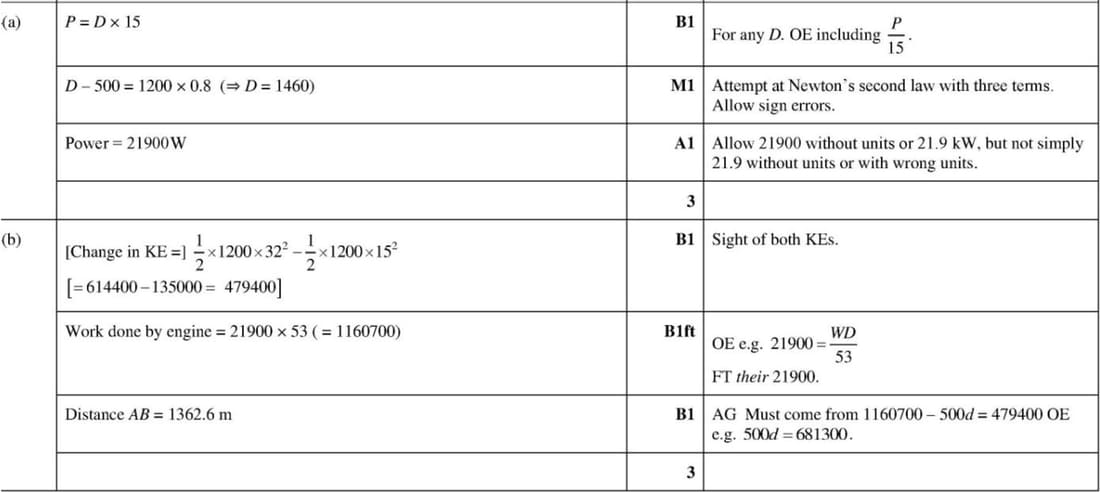
A car of mass 1200 kg is travelling along a straight horizontal road AB. There is a constant resistance force of magnitude 500 N. When the car passes point A, it has a speed of 15 m/s and an acceleration of 0.8 m/s2.
(a) Find the power of the car’s engine at the point A.
The car continues to work with this power as it travels from A to B. The car takes 53 seconds to travel from A to B and the speed of the car at B is 32 m/s-1.
(b) Show that the distance AB is 1362.6 m.
9709 P41 - Jun 2011 - Q2
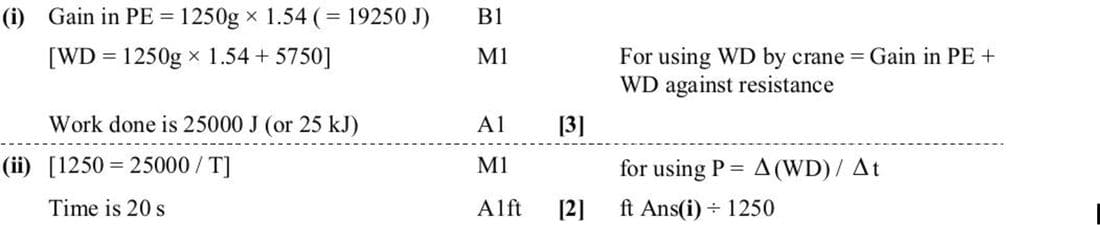
A load of mass 1250 kg is raised by a crane from rest on horizontal ground, to rest at a height of 1.54 m above the ground. The work done against the resistance to motion is 5750 J.
- Find the work done by the crane.
- Assuming the power output of the crane is constant and equal to 1.25 kW, find the time taken to raise the load.
9709 P41 - Jun 2011 - Q1
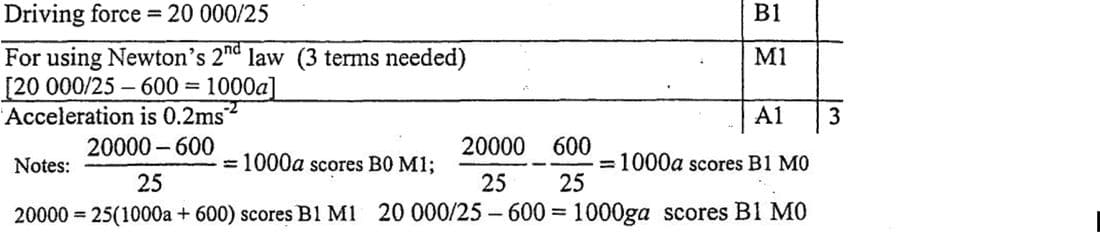
A car of mass 700 kg is travelling along a straight horizontal road. The resistance to motion is constant and equal to 600 N.
- Find the driving force of the car’s engine at an instant when the acceleration is 2 m s-2.
- Given that the car’s speed at this instant is 15 m s-1, find the rate at which the car’s engine is working.

9709 P43 - Nov 2010 - Q7
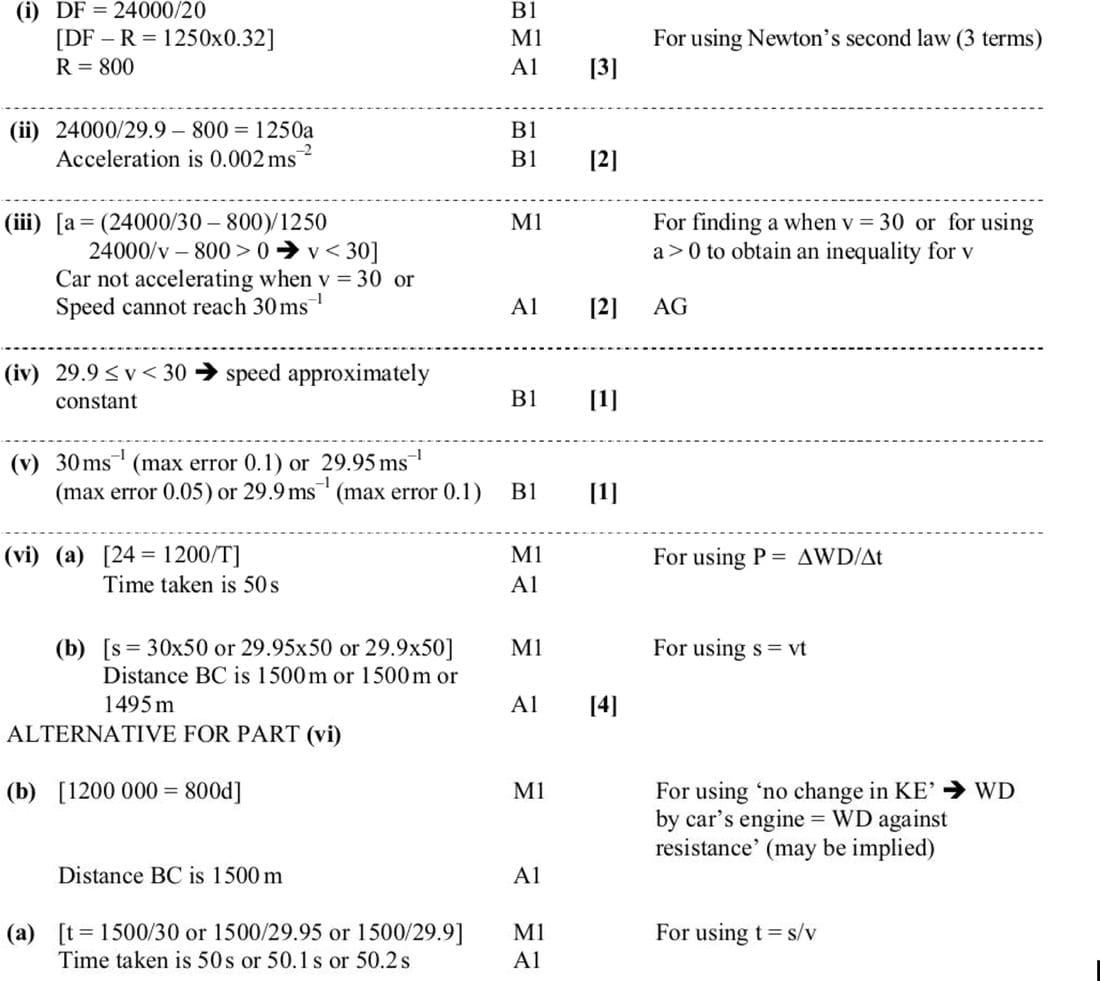
A car of mass 1250 kg travels along a horizontal straight road. The power of the car’s engine is constant and equal to 24 kW and the resistance to the car’s motion is constant and equal to \(R\) N. The car passes through the point \(A\) on the road with speed 20 m/s and acceleration 0.32 m/s2.
- Find the value of \(R\).
The car continues with increasing speed, passing through the point \(B\) on the road with speed 29.9 m/s. The car subsequently passes through the point \(C\).
- Find the acceleration of the car at \(B\), giving the answer in m/s2 correct to 3 decimal places.
- Show that, while the car’s speed is increasing, it cannot reach 30 m/s.
- Explain why the speed of the car is approximately constant between \(B\) and \(C\).
- State a value of the approximately constant speed, and the maximum possible error in this value at any point between \(B\) and \(C\).
The work done by the car’s engine during the motion from \(B\) to \(C\) is 1200 kJ.
- By assuming the speed of the car is constant from \(B\) to \(C\), find, in either order,
- the approximate time taken for the car to travel from \(B\) to \(C\),
- an approximation for the distance \(BC\).
9709 P42 - Nov 2010 - Q2
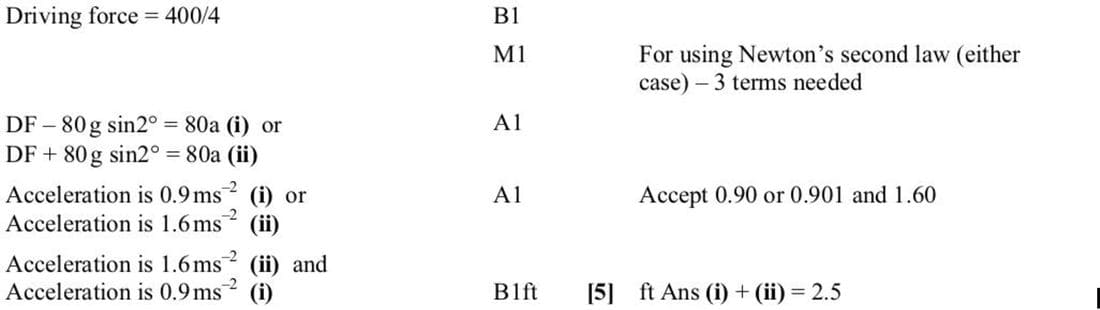
A cyclist, working at a constant rate of 400 W, travels along a straight road which is inclined at 2° to the horizontal. The total mass of the cyclist and his cycle is 80 kg. Ignoring any resistance to motion, find, correct to 1 decimal place, the acceleration of the cyclist when he is travelling
- uphill at 4 m s-1,
- downhill at 4 m s-1.
9709 P41 - Nov 2010 - Q2
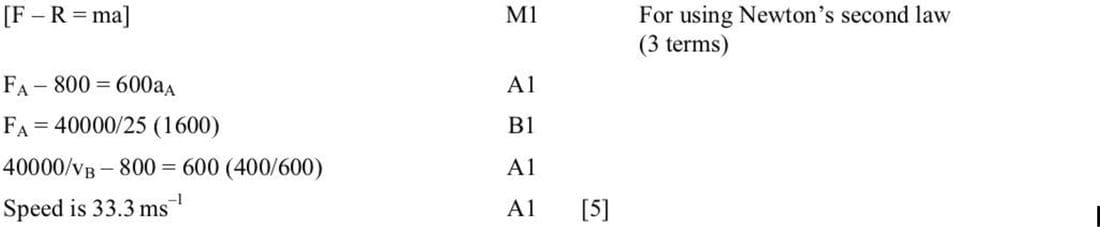
A car of mass 600 kg travels along a horizontal straight road, with its engine working at a rate of 40 kW. The resistance to motion of the car is constant and equal to 800 N. The car passes through the point A on the road with speed 25 m s-1. The car’s acceleration at the point B on the road is half its acceleration at A. Find the speed of the car at B.
9709 P41 - Jun 2010 - Q1
A car of mass 1150 kg travels up a straight hill inclined at 1.2° to the horizontal. The resistance to motion of the car is 975 N. Find the acceleration of the car at an instant when it is moving with speed 16 m s-1 and the engine is working at a power of 35 kW.

9709 P42 - Nov 2009 - Q3
A car of mass 1250 kg travels along a horizontal straight road with increasing speed. The power provided by the car’s engine is constant and equal to 24 kW. The resistance to the car’s motion is constant and equal to 600 N.
(i) Show that the speed of the car cannot exceed 40 m s-1.
(ii) Find the acceleration of the car at an instant when its speed is 15 m s-1.

9709 P4 - Nov 2008 - Q3
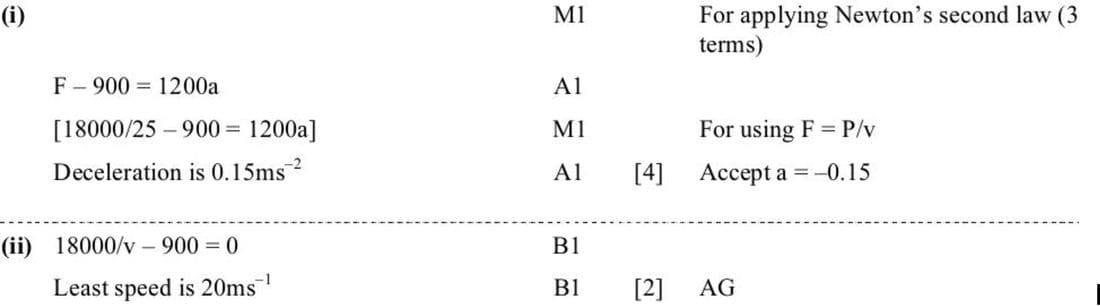
A car of mass 1200 kg is travelling on a horizontal straight road and passes through a point A with speed 25 m s-1. The power of the car’s engine is 18 kW and the resistance to the car’s motion is 900 N.
(i) Find the deceleration of the car at A.
(ii) Show that the speed of the car does not fall below 20 m s-1 while the car continues to move with the engine exerting a constant power of 18 kW.
9709 P4 - Jun 2008 - Q2
A block is being pulled along a horizontal floor by a rope inclined at 20° to the horizontal. The tension in the rope is 851 N and the block moves at a constant speed of 2.5 m s-1.
(i) Show that the work done on the block in 12 s is approximately 24 kJ.
(ii) Hence find the power being applied to the block, giving your answer to the nearest kW.

9709 P4 - Nov 2007 - Q1
A car of mass 900 kg travels along a horizontal straight road with its engine working at a constant rate of \(P\) kW. The resistance to motion of the car is 550 N. Given that the acceleration of the car is 0.2 m s\(^{-2}\) at an instant when its speed is 30 m s\(^{-1}\), find the value of \(P\).

9709 P41 - Nov 2022 - Q3
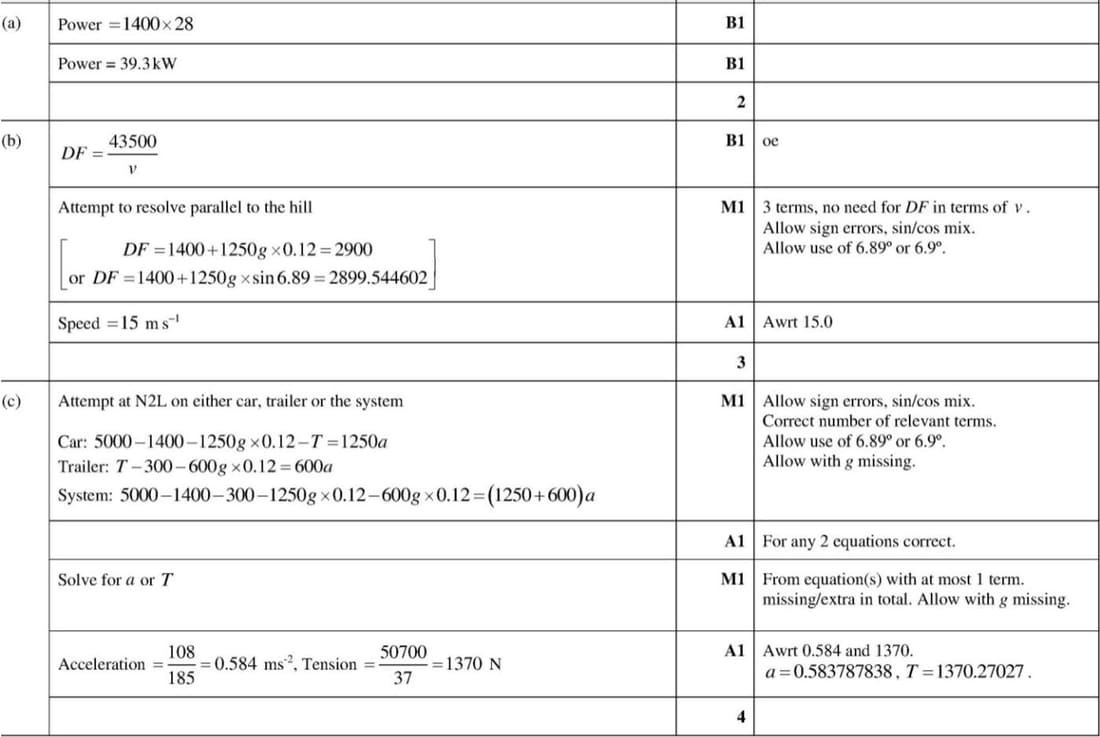
A constant resistance of magnitude 1400 N acts on a car of mass 1250 kg.
- The car is moving along a straight level road at a constant speed of 28 m s-1. Find, in kW, the rate at which the engine of the car is working.
- The car now travels at a constant speed up a hill inclined at an angle of θ to the horizontal, where sin θ = 0.12, with the engine working at 43.5 kW. Find this speed.
- On another occasion, the car pulls a trailer of mass 600 kg up the same hill. The system of the car and the trailer is modelled as particles connected by a light inextensible cable. The car’s engine produces a driving force of 5000 N and the resistance to the motion of the trailer is 300 N. The resistance to the motion of the car remains 1400 N. Find the acceleration of the system and the tension in the cable.
9709 P4 - Jun 2007 - Q3
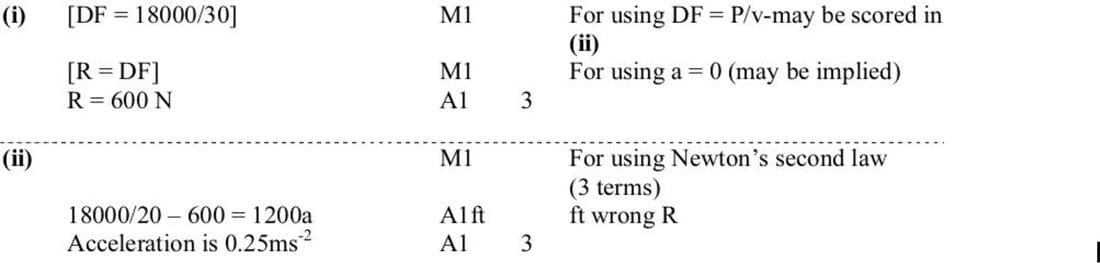
A car travels along a horizontal straight road with increasing speed until it reaches its maximum speed of 30 m s-1. The resistance to motion is constant and equal to RN, and the power provided by the car's engine is 18 kW.
- Find the value of R.
- Given that the car has mass 1200 kg, find its acceleration at the instant when its speed is 20 m s-1.
9709 P4 - Nov 2006 - Q3
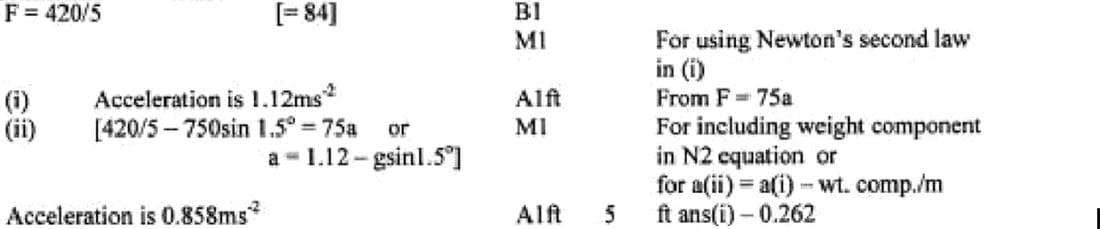
A cyclist travels along a straight road working at a constant rate of 420 W. The total mass of the cyclist and her cycle is 75 kg. Ignoring any resistance to motion, find the acceleration of the cyclist at an instant when she is travelling at 5 m/s-1,
- given that the road is horizontal,
- given instead that the road is inclined at 1.5° to the horizontal and the cyclist is travelling up the slope.
9709 P4 - Nov 2004 - Q3
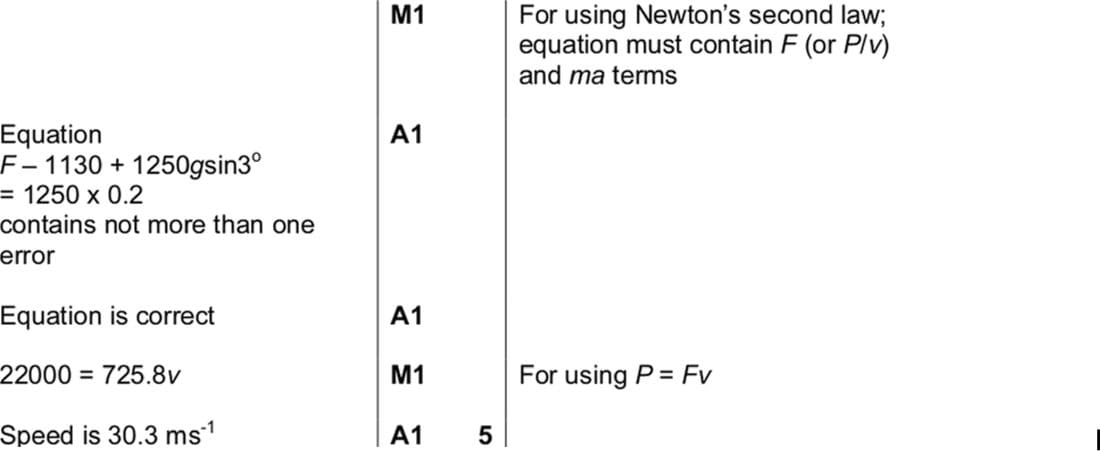
A car of mass 1250 kg travels down a straight hill with the engine working at a power of 22 kW. The hill is inclined at 3° to the horizontal and the resistance to motion of the car is 1130 N. Find the speed of the car at an instant when its acceleration is 0.2 m/s-2.
9709 P4 - Jun 2004 - Q6
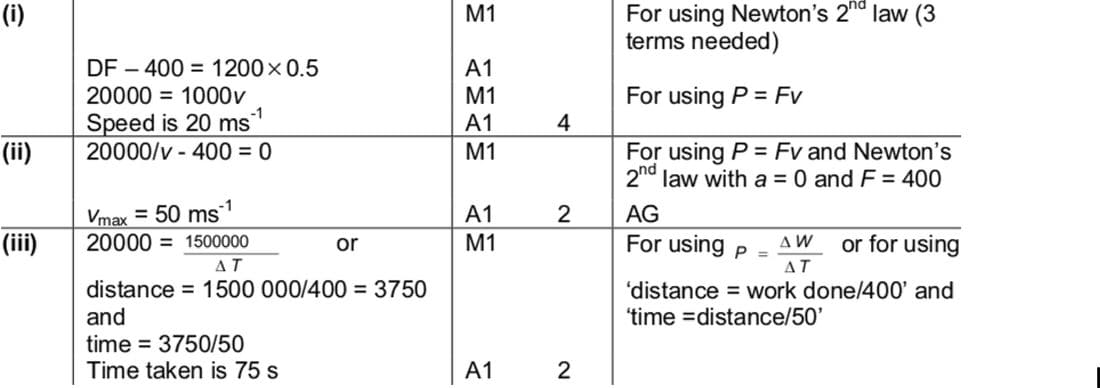
A car of mass 1200 kg travels along a horizontal straight road. The power of the car's engine is 20 kW. The resistance to the car's motion is 400 N.
- Find the speed of the car at an instant when its acceleration is 0.5 m/s2.
- Show that the maximum possible speed of the car is 50 m/s.
The work done by the car’s engine as the car travels from a point A to a point B is 1500 kJ.
- Given that the car is travelling at its maximum possible speed between A and B, find the time taken to travel from A to B.
9709 P4 - Nov 2003 - Q1
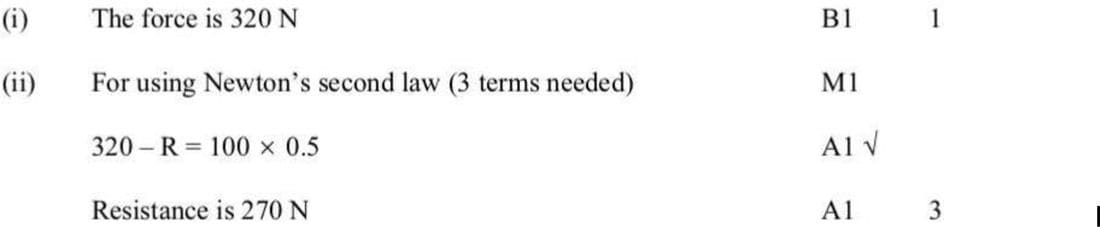
A motorcycle of mass 100 kg is travelling on a horizontal straight road. Its engine is working at a rate of 8 kW. At an instant when the speed of the motorcycle is 25 m s-1 its acceleration is 0.5 m s-2. Find, at this instant,
- the force produced by the engine,
- the resistance to motion of the motorcycle.
9709 P4 - Jun 2003 - Q1
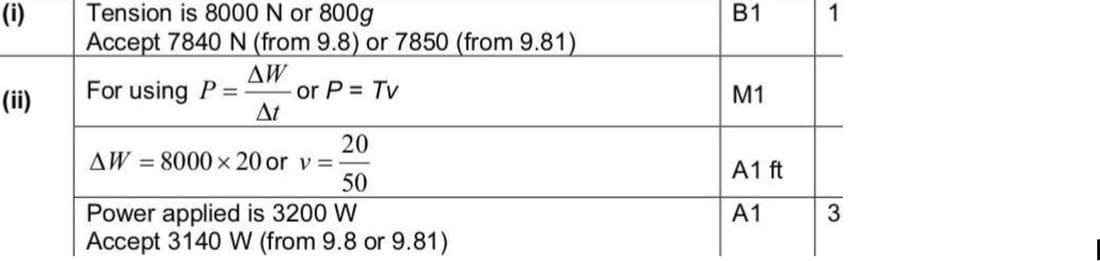
A crate of mass 800 kg is lifted vertically, at constant speed, by the cable of a crane. Find
- the tension in the cable,
- the power applied to the crate in increasing the height by 20 m in 50 s.
9709 P4 - Nov 2002 - Q1
A car of mass 1000 kg travels along a horizontal straight road with its engine working at a constant rate of 20 kW. The resistance to motion of the car is 600 N. Find the acceleration of the car at an instant when its speed is 25 m s-1.