Answer: \(\theta=0.75\), perimeter \(=16.3\), area \(=8.7\).
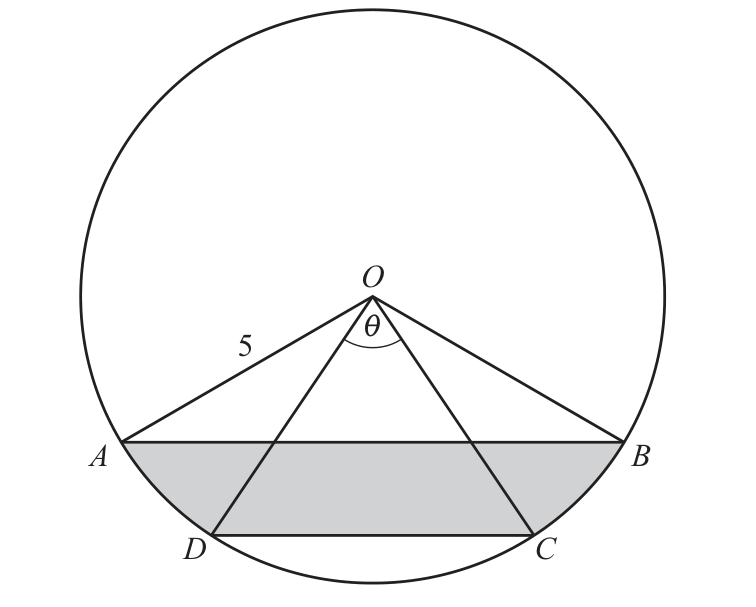
We start with the main method. Use the measurements and relationships shown in the diagram, then translate them into algebraic or trigonometric equations. Use the right-triangle information to find the angle in radians, then apply arc length and sector area formulae.
The radius is \(5\), and the length of minor arc \(DC\) is \(3.75\).
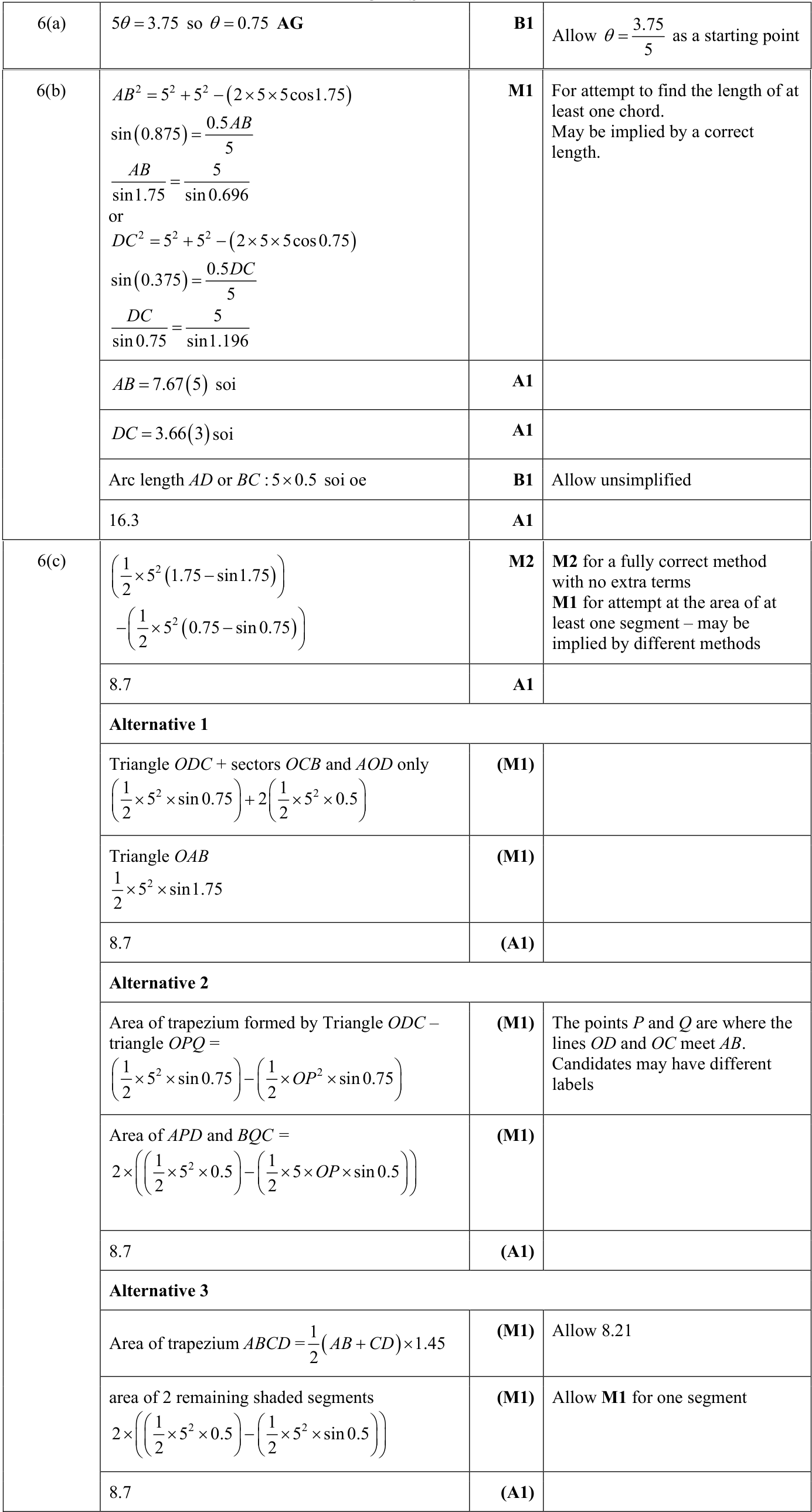
Using arc length \(s=r\theta\),
\(3.75=5\theta.\)
Therefore
\(\theta=\frac{3.75}{5}=0.75.\)
For the perimeter of the shaded region, the boundary consists of the chord \(AB\), the chord \(DC\), and the arcs \(AD\) and \(CB\).
The central angle \(AOB\) is
\(0.5+0.75+0.5=1.75.\)
So
\(AB=2(5)\sin\frac{1.75}{2}=10\sin0.875=7.675\ldots\)
The central angle \(DOC\) is \(0.75\), so
\(DC=2(5)\sin\frac{0.75}{2}=10\sin0.375=3.663\ldots\)
The two arcs \(AD\) and \(CB\) each have angle \(0.5\), so their total length is
\(5(0.5)+5(0.5)=5.\)
Therefore the perimeter is
\(7.675\ldots+3.663\ldots+5=16.338\ldots\)
So the perimeter is
\(16.3\) to 3 significant figures.
For the area, take the larger segment with angle \(1.75\), then subtract the smaller segment with angle \(0.75\).
The area of a segment with radius \(r\) and angle \(\alpha\) is
\(\frac12r^2(\alpha-\sin\alpha).\)
Thus the shaded area is
\(\frac12(5^2)(1.75-\sin1.75)-\frac12(5^2)(0.75-\sin0.75).\)
This gives
\(8.7\) to 2 significant figures.
This completes the solution and gives the required result.