Answer: \(\theta=1.85\text{ rad}\), perimeter \(=18.5\text{ cm}\), area \(=22.4\text{ cm}^2\) approximately.
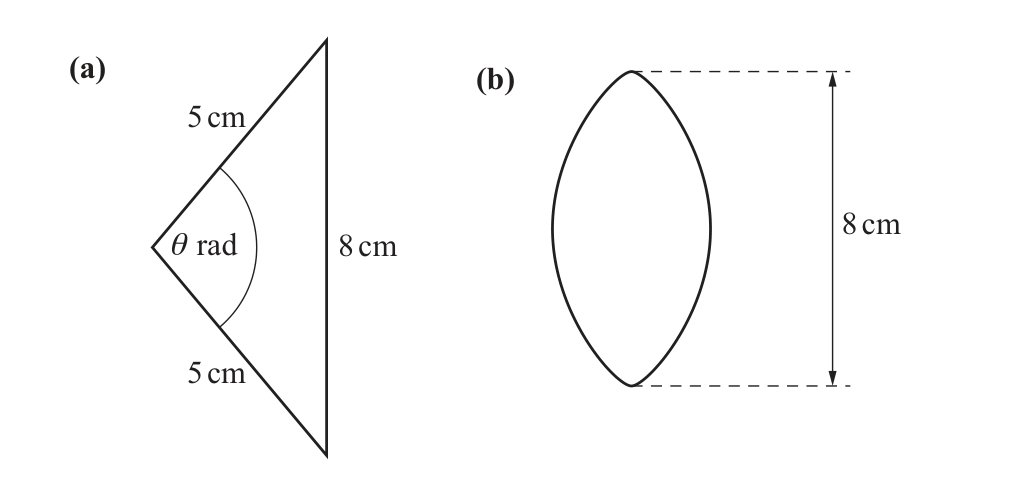
(a) In the isosceles triangle, the two equal sides are \(5\text{ cm}\) and the base is \(8\text{ cm}\). Bisecting the angle \(\theta\) splits the triangle into two right-angled triangles.
Each right-angled triangle has hypotenuse \(5\) and opposite side \(4\) for the angle \(\dfrac\theta2\). Therefore
\(\sin\dfrac\theta2=\dfrac45.\)
Hence
\(\dfrac\theta2=\sin^{-1}\left(\dfrac45\right),\)
so
\(\theta=2\sin^{-1}\left(\dfrac45\right)=1.854\ldots\text{ rad}.\)
Thus
\(\theta=1.85\text{ rad}\)
to 3 significant figures.
(b)(i) Each arc has radius \(5\text{ cm}\) and angle \(\theta\) radians. The length of one arc is
\(r\theta=5\theta.\)
There are two equal arcs, so the perimeter is
\(2(5\theta)=10\theta.\)
Using \(\theta=1.854\ldots\),
\(\text{perimeter}=10(1.854\ldots)=18.54\ldots\text{ cm}.\)
Therefore the perimeter is
\(18.5\text{ cm}\)
to 3 significant figures.
(b)(ii) The area of one circular segment is the area of the sector minus the area of the isosceles triangle:
\(\dfrac12r^2\theta-\dfrac12r^2\sin\theta=\dfrac12r^2(\theta-\sin\theta).\)
Here \(r=5\), and the shape consists of two identical segments. So
\(\text{area}=2\cdot\dfrac12(5)^2(\theta-\sin\theta)=25(\theta-\sin\theta).\)
Using \(\theta=1.854\ldots\),
\(\text{area}=25(1.854\ldots-\sin1.854\ldots)=22.36\ldots\text{ cm}^2.\)
Therefore the area is
\(22.4\text{ cm}^2\)
to 3 significant figures.