Past Exam Questions
← Back9231 P21 - Nov 2019 - Q10 - 10 marks
The random variable \(X\) has probability density function f given by
\[f(x)=\left\{\begin{array}{ll}
\frac{1}{30}\left(\frac{8}{x^{2}}+3 x^{2}-14\right) & 2 \leqslant x \leqslant 4 \\
0 & \text { otherwise. }
\end{array}\right.\]
(i) Find the distribution function of \(X\).
The random variable \(Y\) is defined by \(Y=X^{2}\).
(ii) Find the probability density function of \(Y\).
(iii) Find the value of \(y\) such that \(\mathrm{P}(Y<y)=0.8\).

9231 P22 - Nov 2018 - Q7 - 6 marks
The continuous random variable \(X\) has distribution function given by
\[\mathrm{F}(x)=\left\{\begin{array}{ll}
0 & x<0, \\
\frac{1}{90}\left(x^{2}+x^{4}\right) & 0 \leqslant x \leqslant 3, \\
1 & x>3 .
\end{array}\right.\]
The random variable \(Y\) is defined by \(Y=X^{2}\).
(i) Find the probability density function of \(Y\).
(ii) Find the mean value of \(Y\).

9231 P21 - Jun 2017 - Q8 - 10 marks
The continuous random variable \(X\) has probability density function f given by
\[f(x)=\left\{\begin{array}{ll}
\frac{1}{4}(x-1) & 2 \leqslant x \leqslant 4 \\
0 & \text { otherwise }
\end{array}\right.\]
(i) Find the distribution function of \(X\).
The random variable \(Y\) is defined by \(Y=(X-1)^{3}\).
(ii) Find the probability density function of \(Y\).
(iii) Find the median value of \(Y\).
9231 P23 - Jun 2017 - Q9 - 12 marks
The continuous random variable \(X\) has probability density function f given by
\[\mathrm{f}(x)=\left\{\begin{array}{ll}
0 & x<0, \\
a \mathrm{e}^{-x \ln 2} & x \geqslant 0,
\end{array}\right.\]
where \(a\) is a positive constant.
(i) Find the value of \(a\).
(ii) State the value of \(\mathrm{E}(X)\).
(iii) Find the interquartile range of \(X\).
The variable \(Y\) is related to \(X\) by \(Y=2^{X}\).
(iv) Find the probability density function of \(Y\).
9231 P23 - Jun 2018 - Q9 - 9 marks
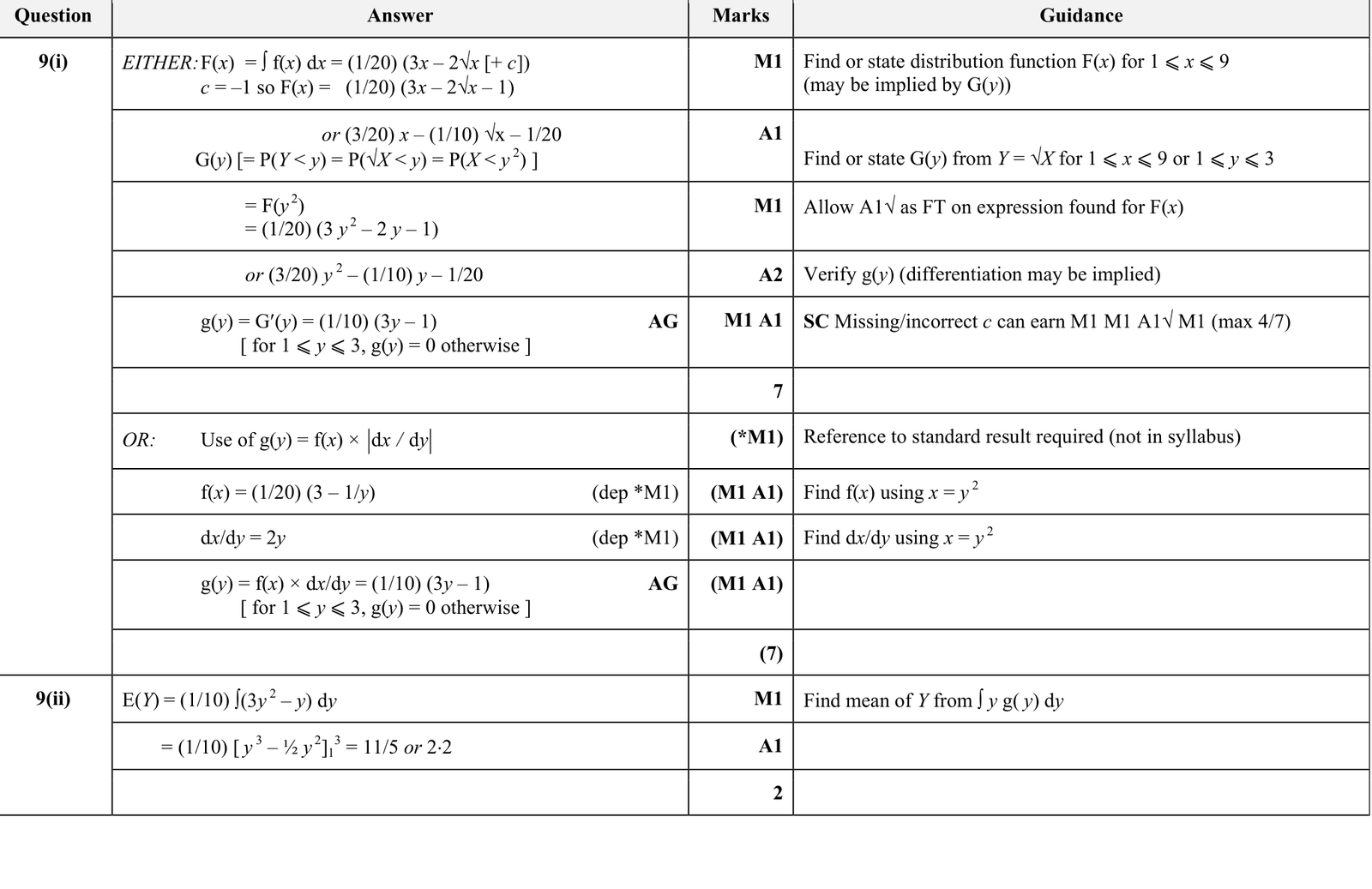
The continuous random variable \(X\) has probability density function given by
\[f(x)=\left\{\begin{array}{ll}
\frac{1}{20}\left(3-\frac{1}{\sqrt{ } x}\right) & 1 \leqslant x \leqslant 9 \\
0 & \text { otherwise } .
\end{array}\right.\]
The random variable \(Y\) is defined by \(Y=\sqrt{ } X\).
(i) Show that the probability density function of \(Y\) is given by
\[g(y)=\left\{\begin{array}{ll}
\frac{1}{10}(3 y-1) & 1 \leqslant y \leqslant 3, \\
0 & \text { otherwise } .
\end{array}\right.\]
(ii) Find the mean value of \(Y\).
9231 P41 - Nov 2025 - Q5 - 10 marks
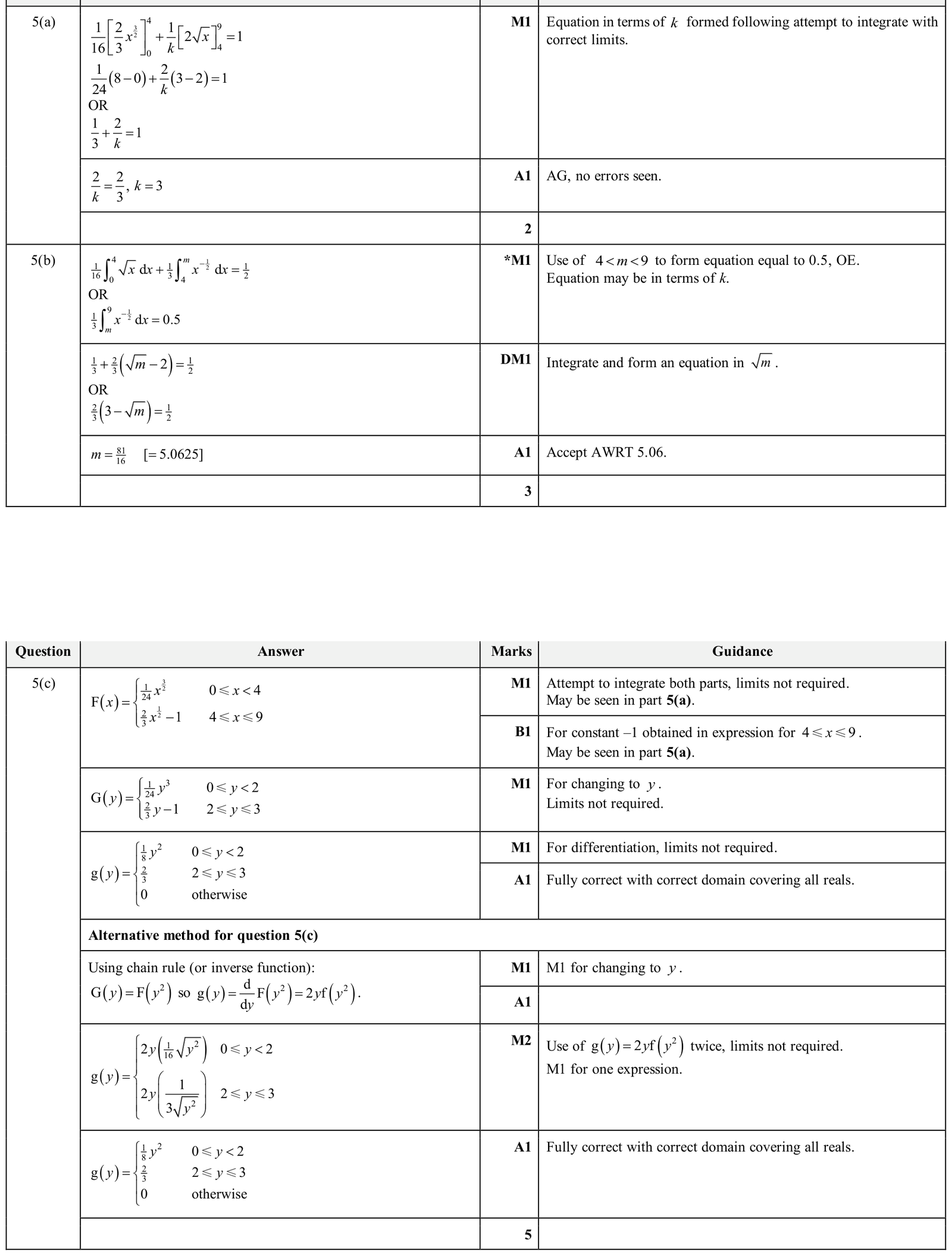
A continuous random variable \(X\) has probability density function f given by \(f(x)=\left\{\begin{array}{ll} \frac{1}{16} \sqrt{x} & 0 \leqslant x\lt 4 \\ \frac{1}{k \sqrt{x}} & 4 \leqslant x \leqslant 9 \\ 0 & \text { otherwise } \end{array}\right.\) where \(k\) is a constant. (a) Show that \(k=3\). (b) Find the median value of \(X\). The random variable \(Y\) is defined by \(Y=\sqrt{X}\). (c) Find the probability density function of \(Y\).
9231 P44 - Nov 2025 - Q2 - 10 marks
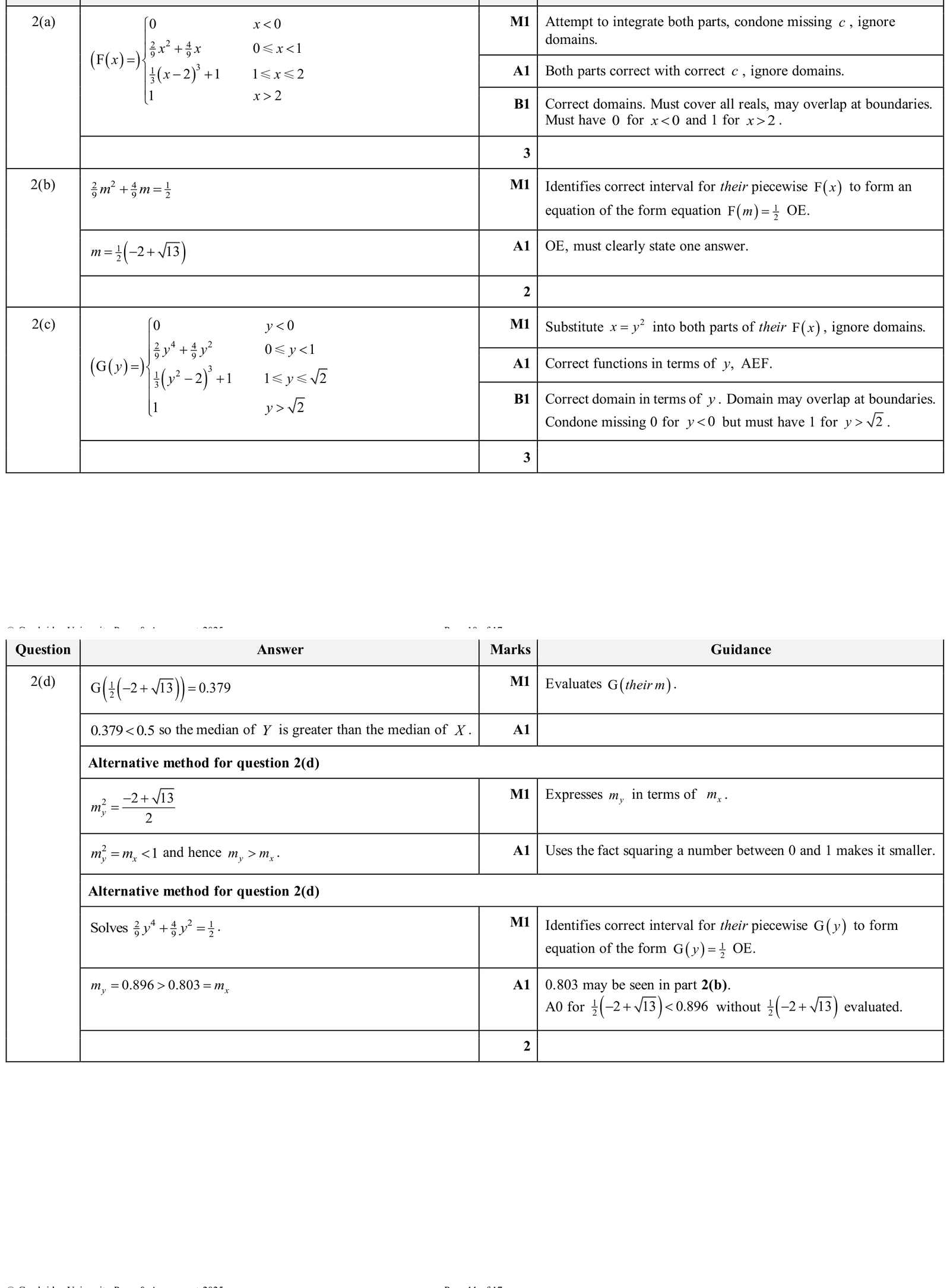
The continuous random variable \(X\) has probability density function f given by \(f(x)=\left\{\begin{array}{ll} \frac{4}{9}(x+1) & 0 \leqslant x \leqslant 1 \\ (x-2)^{2} & 1\lt x \leqslant 2 \\ 0 & \text { otherwise } \end{array}\right.\) (a) Find the cumulative distribution function of \(X\). (b) Find the exact value of the median of \(X\). The random variable \(Y\) is defined by \(Y=\sqrt{X}\). (c) Find the cumulative distribution function of \(Y\). (d) Determine whether the median of \(Y\) is greater than, or less than, the median of \(X\).
9231 P41 - Jun 2025 - Q2 - 12 marks
As shown in the diagram, the continuous random variable \(X\) has probability density function f given by
\(f(x)=\left\{\begin{array}{ll} a & 0 \leqslant x \leqslant 5 \\ b-c x & 5 \leqslant x \leqslant 8 \\ 0 & \text { otherwise } \end{array}\right.\)
where \(a, b\) and \(c\) are constants.
(a) Show that \(a=\frac{2}{13}\) and find the values of \(b\) and \(c\).
(b) Find the mean of \(X\).
(c) Find the median of \(X\).
The random variable \(Y\) is defined by \(Y=X^{2}\).
(d) Find the cumulative distribution function for \(Y\).

9231 P43 - Jun 2025 - Q3 - 10 marks
A continuous random variable \(X\) has probability density function f given by
\(f(x)=\left\{\begin{array}{ll} k x & 0 \leqslant x\lt 1 \\ k(8-x) & 1 \leqslant x \leqslant 8 \\ 0 & \text { otherwise } \end{array}\right.\)
where \(k\) is a constant.
(a) Show that \(k=\frac{1}{25}\).
(b) Find the median value of \(X\).
The random variable \(Y\) is defined by \(Y=\sqrt[3]{X}\).
(c) Find the probability density function of \(Y\).

9231 P41 - Jun 2024 - Q7 - 10 marks
The continuous random variable \(X\) has probability density function f given by
\(f(x)=\left\{\begin{array}{cc} \frac{x}{4}\left(4-x^{2}\right) & 0 \leqslant x \leqslant 2 \\ 0 & \text { otherwise } \end{array}\right.\)
(a) Find \(\operatorname{Var}(\sqrt{X})\).
The continuous random variable \(Y\) is defined by \(Y=X^{2}\).
(b) Find the probability density function of \(Y\).
(c) Find the exact value of the median of \(Y\).


9231 P41 - Jun 2023 - Q6 - 11 marks
The continuous random variable \(X\) has probability density function f given by
\(\mathrm{f}(x)=\left\{\begin{array}{ll} \frac{3}{28}\left(\mathrm{e}^{\frac{1}{2} x}+4 \mathrm{e}^{-\frac{1}{2} x}\right) & 0 \leqslant x \leqslant 2 \ln 3 \\ 0 & \text { otherwise } \end{array}\right.\)
(a) Find the cumulative distribution function of \(X\).
The random variable \(Y\) is defined by \(Y=\mathrm{e}^{\frac{1}{2}(X)}\).
(b) Find the probability density function of \(Y\).
(c) Find the 30th percentile of \(Y\).
(d) Find \(\mathrm{E}\left(Y^{4}\right)\).

9231 P43 - Jun 2023 - Q1 - 8 marks
The continuous random variable \(X\) has probability density function f given by
\(f(x)=\left\{\begin{array}{ll} \frac{1}{6}\left(x^{-\frac{1}{3}}-x^{-\frac{2}{3}}\right) & 1 \leqslant x \leqslant 27 \\ 0 & \text { otherwise } \end{array}\right.\)
(a) Find the cumulative distribution function of \(X\).
The random variable \(Y\) is defined by \(Y=X^{\frac{1}{3}}\).
(b) Find the probability density function of \(Y\).
(c) Find the exact value of the median of \(Y\).

9231 P43 - Jun 2022 - Q4 - 10 marks
The continuous random variable \(X\) has probability density function \(f\) given by
\(f(x)=\left\{\begin{array}{ll} \frac{3}{8}\left(1+\frac{1}{x^{2}}\right) & 1 \leqslant x \leqslant 3 \\ 0 & \text { otherwise } \end{array}\right.\)
(a) Find \(\mathrm{E}(\sqrt{X})\).
The random variable \(Y\) is given by \(Y=X^{2}\).
(b) Find the probability density function of \(Y\).
(c) Find the 40th percentile of \(Y\).

9231 P41 - Nov 2022 - Q5 - 10 marks
The continuous random variable \(X\) has cumulative distribution function F given by
\(F(x)=\left\{\begin{array}{ll} 0 & x\lt 0, \\ 1-\frac{1}{144}(12-x)^{2} & 0 \leqslant x \leqslant 12, \\ 1 & x\gt 12 . \end{array}\right.\)
(a) Find the upper quartile of \(X\).
(b) Find \(\operatorname{Var}\left(X^{2}\right)\).
The random variable \(Y\) is given by \(Y=\sqrt{X}\).
(c) Find the probability density function of \(Y\).

9231 P43 - Jun 2021 - Q6 - 11 marks
The continuous random variable \(X\) has probability density function f given by
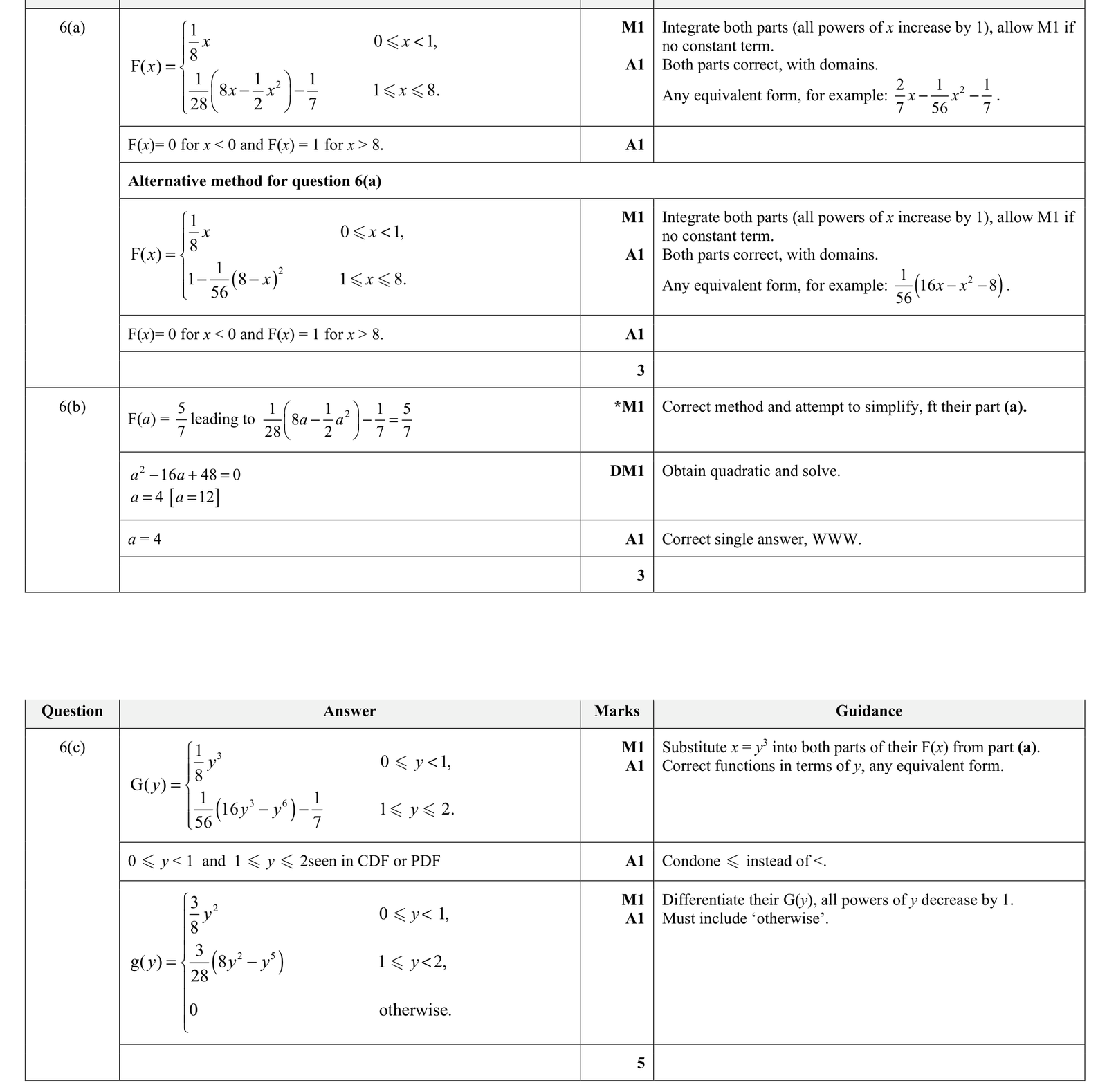
\(f(x)=\left\{\begin{array}{ll} \frac{1}{8} & 0 \leqslant x\lt 1 \\ \frac{1}{28}(8-x) & 1 \leqslant x \leqslant 8 \\ 0 & \text { otherwise } \end{array}\right.\)
(a) Find the cumulative distribution function of \(X\).
(b) Find the value of the constant \(a\) such that \(\mathrm{P}(X \leqslant a)=\frac{5}{7}\).
The random variable \(Y\) is given by \(Y=\sqrt[3]{X}\).
(c) Find the probability density function of \(Y\).
9231 P41 - Jun 2020 - Q3 - 8 marks
The continuous random variable \(X\) has probability density function \(f\) given by
\(f(x)=\left\{\begin{array}{ll} \frac{3}{16}(2-\sqrt{x}) & 0 \leqslant x\lt 1 \\ \frac{3}{16 \sqrt{x}} & 1 \leqslant x \leqslant 9 \\ 0 & \text { otherwise } \end{array}\right.\)
(a) Find \(\mathrm{E}(X)\).
The random variable \(Y\) is such that \(Y=\sqrt{X}\).
(b) Find the probability density function of \(Y\).

9231 P41 - Nov 2020 - Q6 - 11 marks
The continuous random variable \(X\) has cumulative distribution function F given by
\(F(x)=\left\{\begin{array}{ll} 0 & x\lt 0, \\ \frac{1}{60}\left(16 x-x^{2}\right) & 0 \leqslant x \leqslant 6, \\ 1 & x\gt 6 . \end{array}\right.\)
(a) Find the interquartile range of \(X\).
(b) Find \(\mathrm{E}\left(X^{3}\right)\).
The random variable \(Y\) is such that \(Y=\sqrt{X}\).
(c) Find the probability density function of \(Y\).

9231 P42 - Nov 2020 - Q4 - 9 marks
The continuous random variable \(X\) has cumulative distribution function F given by
\(\mathrm{F}(x)=\left\{\begin{array}{ll} 0 & x\lt 2, \\ \frac{1}{60} x^{2}-\frac{1}{15} & 2 \leqslant x \leqslant 8, \\ 1 & x\gt 8 . \end{array}\right.\)
(a) Find \(\mathrm{P}(3 \leqslant X \leqslant 6)\).
(b) Find \(\mathrm{E}(\sqrt{X})\).
(c) Find \(\operatorname{Var}(\sqrt{X})\).
(d) The random variable \(Y\) is defined by \(Y=X^{3}\). Find the probability density function of \(Y\).

9231 P42 - Nov 2024 - Q4 - 10 marks
The random variable \(X\) has probability density function f given by
\(f(x)=\left\{\begin{array}{ll} \frac{1}{21}(x-1)^{2} & 2 \leqslant x \leqslant 5 \\ 0 & \text { otherwise } \end{array}\right.\)
(a) Find the cumulative distribution function of \(X\).
The random variable \(Y\) is defined by \(Y=(X-1)^{4}\).
(b) Find the probability density function of \(Y\).
(c) Find the median value of \(Y\).
(d) Find \(\mathrm{E}(Y)\).

0606 P12 - Jun 2025 - Q10 - 8 marks
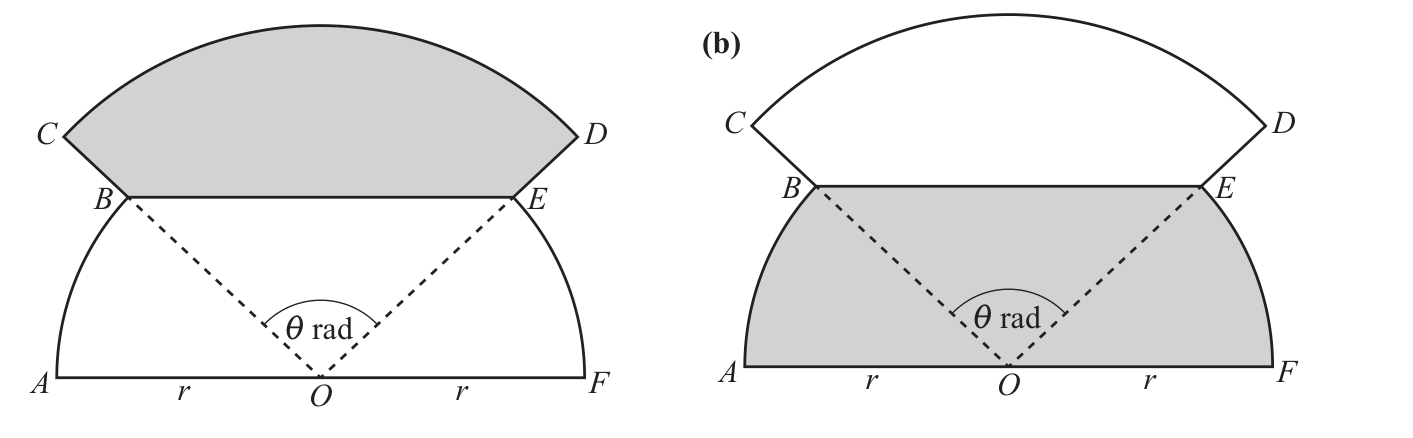
The diagram shows the shape \(OABCDEF\). \(AOF\) is a straight line.
\(OAB\) and \(OEF\) are sectors of a circle with centre \(O\) and radius \(r\). Angle \(BOA=\) angle \(EOF\).
\(OCD\) is a sector of a circle with centre \(O\) and radius \(\frac{4r}{3}\). Angle \(COD\) is \(\theta\) radians.
The point \(B\) lies on the line \(OC\) and the point \(E\) lies on the line \(OD\). The line \(BE\) is parallel to the line \(AOF\).
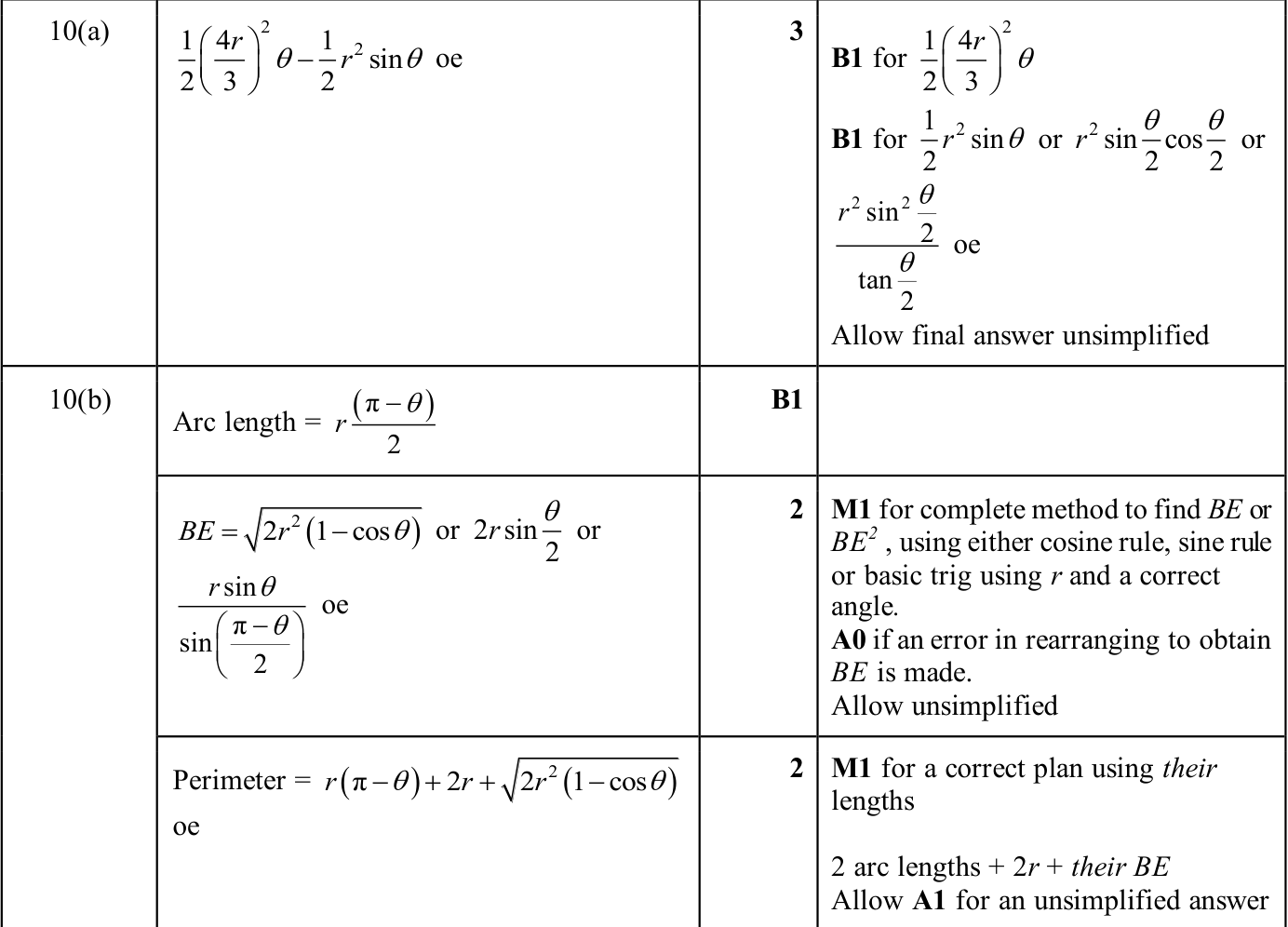
(a) Find, in terms of \(r\) and \(\theta\), the area of the shaded region \(BCDE\).
(b) The diagram shows the shape from part (a) with region \(OABEF\) shaded. Find, in terms of \(r\) and \(\theta\), the perimeter of the shaded region.