Past Exam Questions
← Back9709 P42 - Mar 2022 - Q4
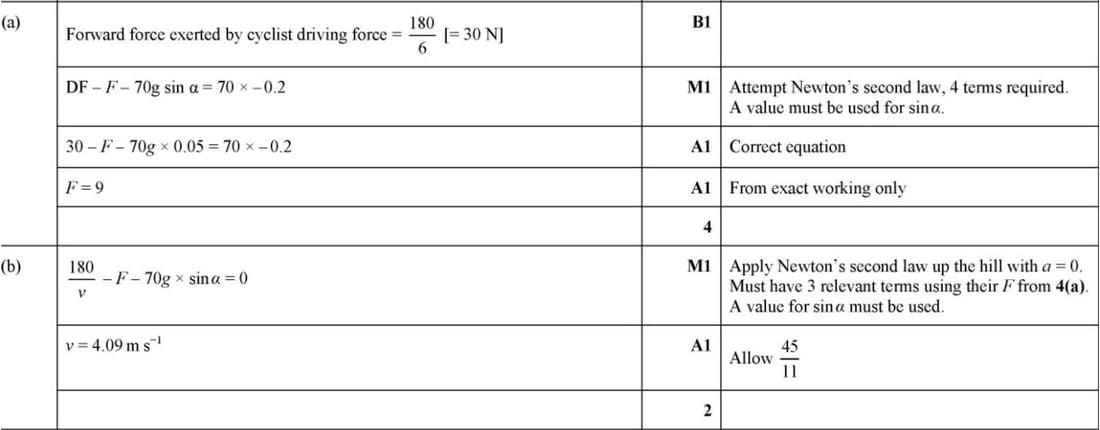
The total mass of a cyclist and her bicycle is 70 kg. The cyclist is riding with constant power of 180 W up a straight hill inclined at an angle \(\alpha\) to the horizontal, where \(\sin \alpha = 0.05\). At an instant when the cyclist’s speed is 6 m s\(^{-1}\), her acceleration is \(-0.2 \text{ m s}^{-2}\). There is a constant resistance to motion of magnitude \(F \text{ N}\).
(a) Find the value of \(F\).
(b) Find the steady speed that the cyclist could maintain up the hill when working at this power.
9231 P21 - Nov 2018 - Q7 - 7 marks
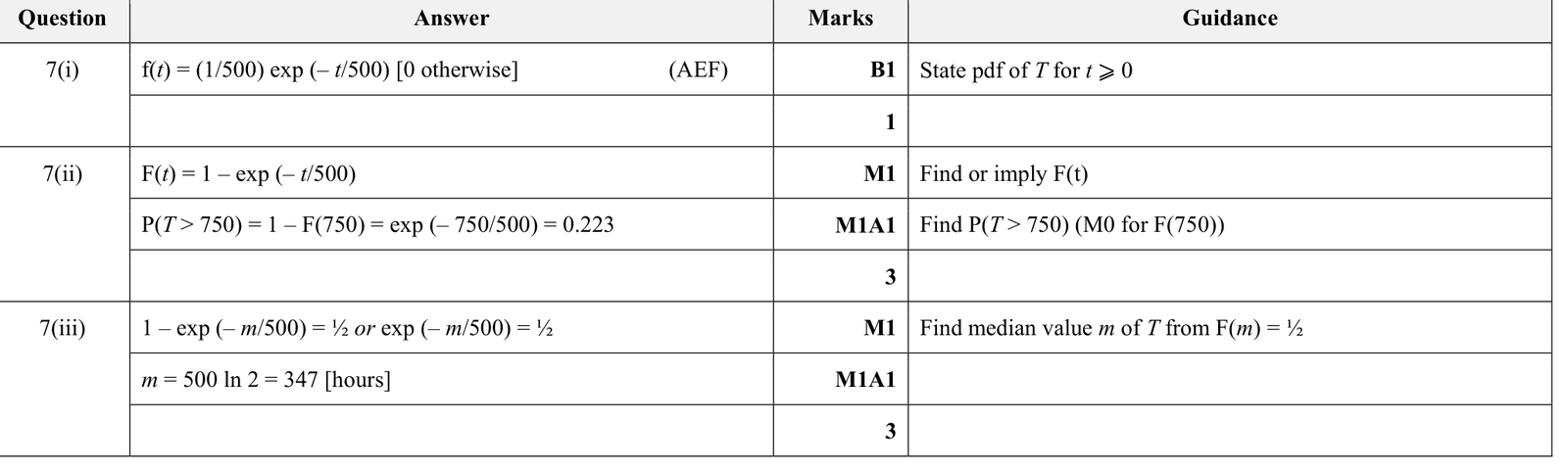
The random variable \(T\) is the lifetime, in hours, of a particular type of battery. It is given that \(T\) has a negative exponential distribution with mean 500 hours.
(i) Write down the probability density function of \(T\).
(ii) Find the probability that a randomly chosen battery of this type has a lifetime of more than 750 hours.
(iii) Find the median value of \(T\).
9231 P21 - Nov 2019 - Q7 - 7 marks
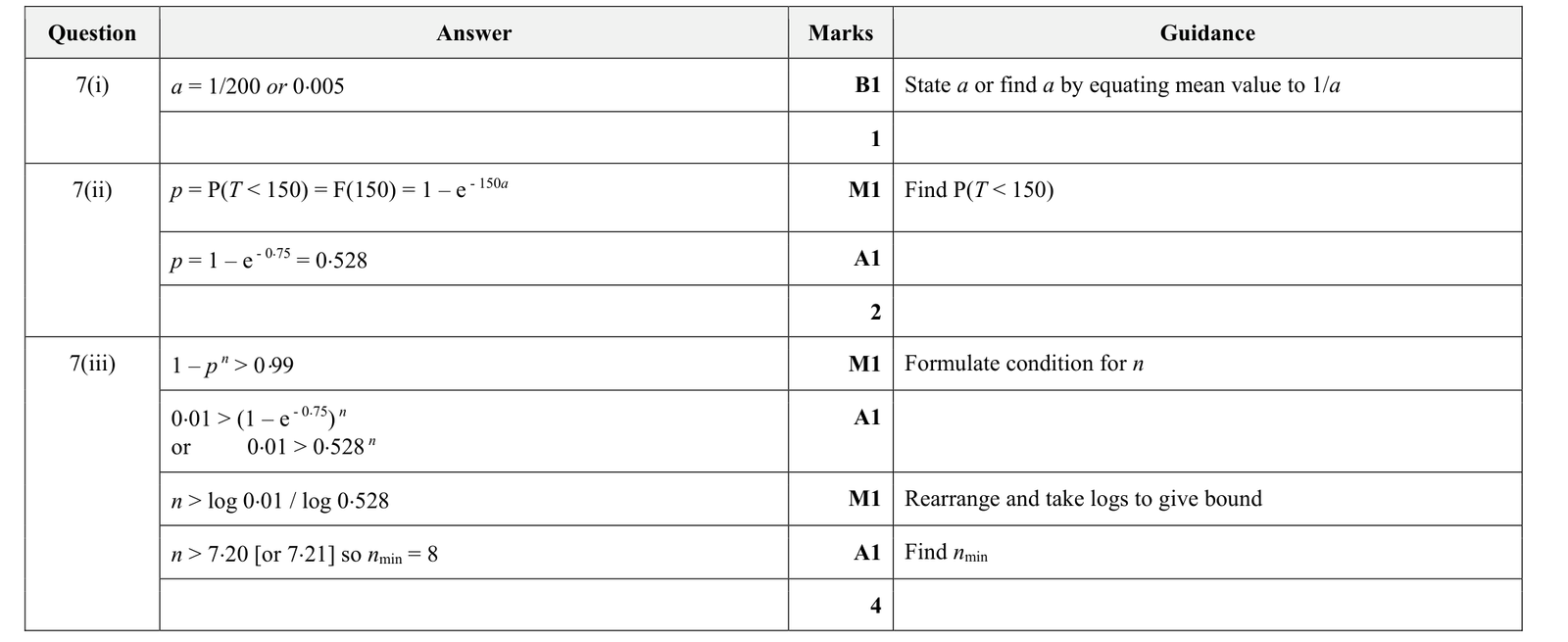
The time, \(T\) days, before an electrical component develops a fault has distribution function F given by
\[\mathrm{F}(t)=\left\{\begin{array}{ll}
1-\mathrm{e}^{-a t} & t \geqslant 0 \\
0 & \text { otherwise }
\end{array}\right.\]
where \(a\) is a positive constant. The mean value of \(T\) is 200 .
(i) Write down the value of \(a\).
(ii) Find the probability that an electrical component of this type develops a fault in less than 150 days.
A piece of equipment contains \(n\) of these components, which develop faults independently of each other. The probability that, after 150 days, at least one of the \(n\) components has not developed a fault is greater than 0.99 .
(iii) Find the smallest possible value of \(n\).
9231 P23 - Jun 2019 - Q6 - 6 marks
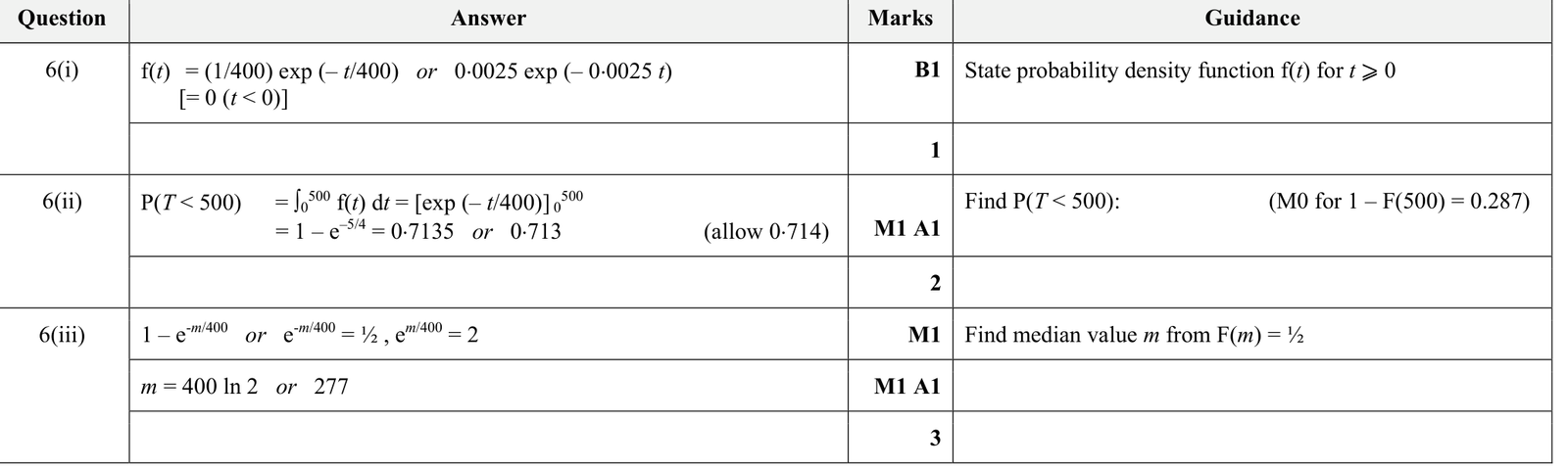
The random variable \(T\) is the lifetime, in hours, of a randomly chosen battery of a particular type. It is given that \(T\) has a negative exponential distribution with mean 400 hours.
(i) Write down the probability density function of \(T\).
(ii) Find the probability that a battery of this type has a lifetime that is less than 500 hours.
(iii) Find the median of the distribution.
9231 P41 - Nov 2023 - Q4 - 9 marks
As shown in the diagram, the continuous random variable \(X\) has probability density function f given by
\(f(x)=\left\{\begin{array}{ll} m x & 0 \leqslant x \leqslant 2, \\ \frac{k}{x^{2}}+c & 2 \leqslant x \leqslant 6, \\ 0 & \text { otherwise, } \end{array}\right.\)
where \(m, k\) and \(c\) are constants.
(a) Given that \(\mathrm{P}(X \leqslant 2)=\frac{1}{3}\), show that \(m=\frac{1}{6}\) and find the values of \(k\) and \(c\).
(b) Find the exact numerical value of the interquartile range of \(X\).

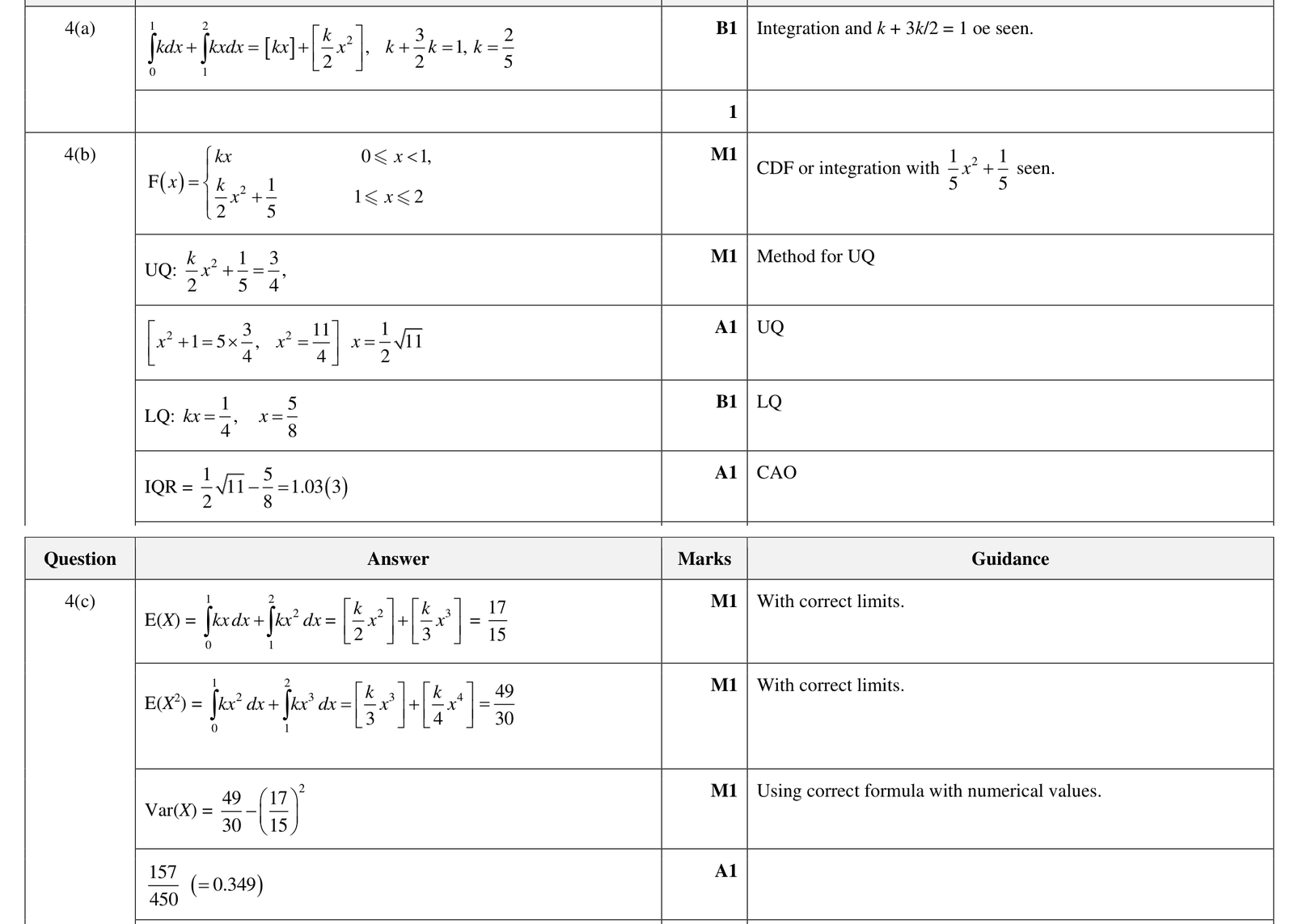
9231 P42 - Nov 2022 - Q4 - 10 marks
The continuous random variable \(X\) has probability density function \(f\) given by
\(\mathrm{f}(x)=\left\{\begin{array}{ll} k & 0 \leqslant x\lt 1 \\ k x & 1 \leqslant x \leqslant 2 \\ 0 & \text { otherwise } \end{array}\right.\)
where \(k\) is a constant.
(a) Show that \(k=\frac{2}{5}\).
(b) Find the interquartile range of \(X\).
(c) Find \(\operatorname{Var}(X)\).
9231 P21 - Jun 2019 - Q7 - 8 marks
The continuous random variable \(X\) has probability density function f given by
\[f(x)=\left\{\begin{array}{ll}
\frac{3}{4 x^{2}}+\frac{1}{4} & 1 \leqslant x \leqslant 3 \\
0 & \text { otherwise }
\end{array}\right.\]
(i) Find the distribution function of \(X\).
(ii) Find the exact value of the interquartile range of \(X\).

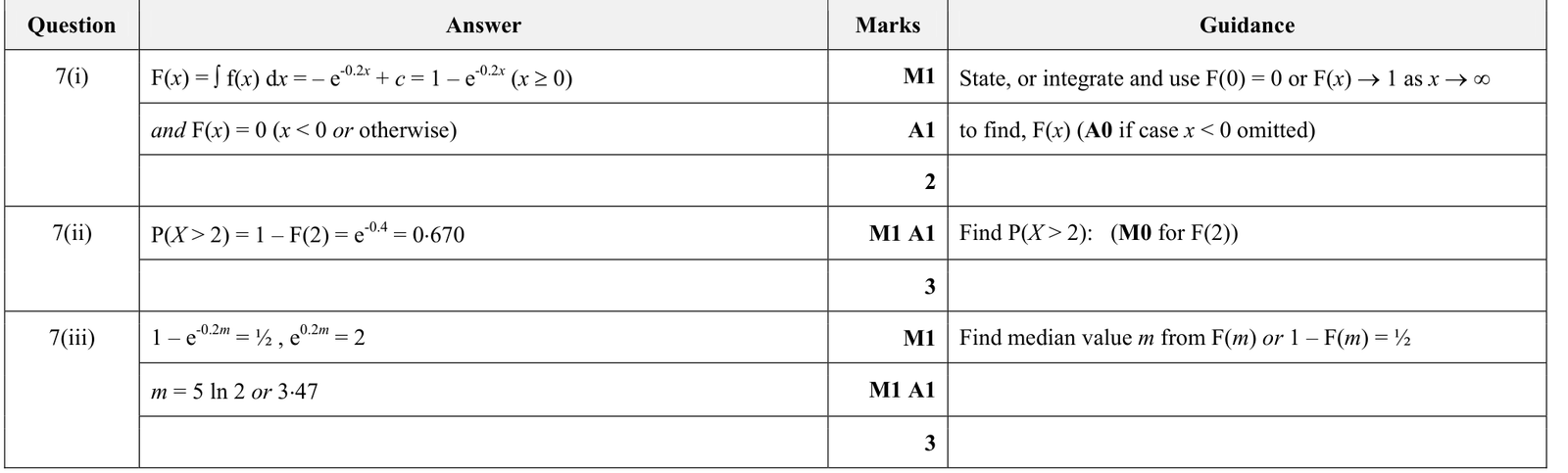
9231 P21 - Nov 2017 - Q7 - 7 marks
The random variable \(X\) has probability density function f given by
\[\mathrm{f}(x)=\left\{\begin{array}{ll}
0.2 \mathrm{e}^{-0.2 x} & x \geqslant 0 \\
0 & \text { otherwise }
\end{array}\right.\]
(i) Find the distribution function of \(X\).
(ii) Find \(\mathrm{P}(X>2)\).
(iii) Find the median of \(X\).
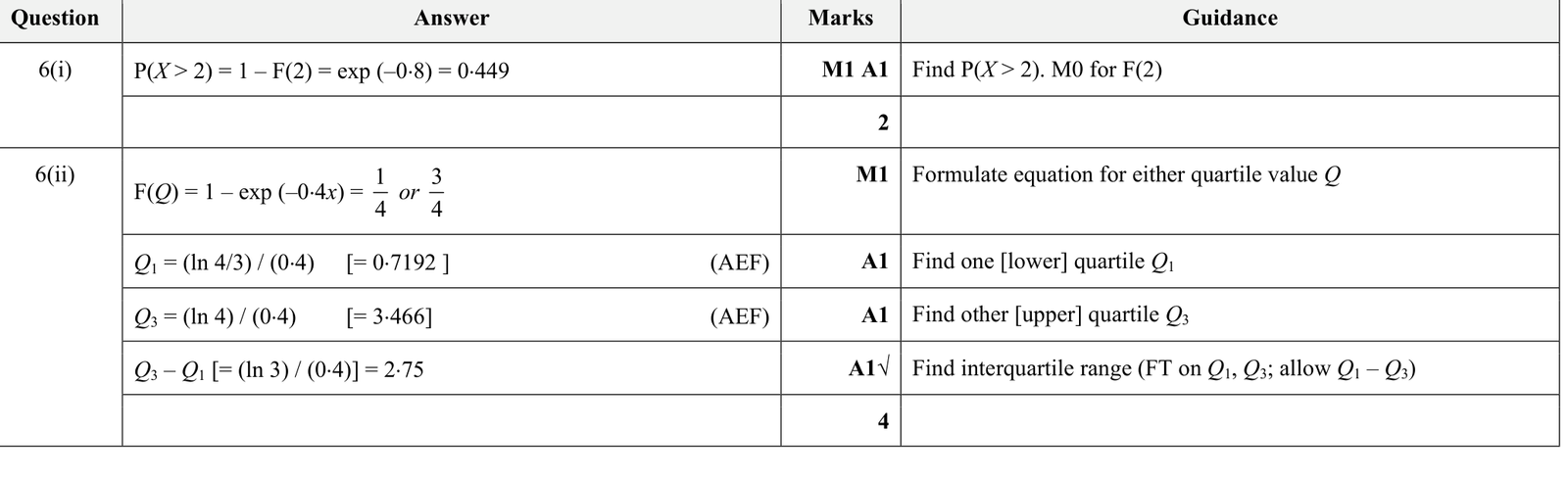
9231 P21 - Jun 2018 - Q6 - 6 marks
The continuous random variable \(X\) has distribution function given by
\[\mathrm{F}(x)=\left\{\begin{array}{ll}
1-\mathrm{e}^{-0.4 x} & x \geqslant 0 \\
0 & \text { otherwise }
\end{array}\right.\]
(i) Find \(\mathrm{P}(X>2)\).
(ii) Find the interquartile range of \(X\).
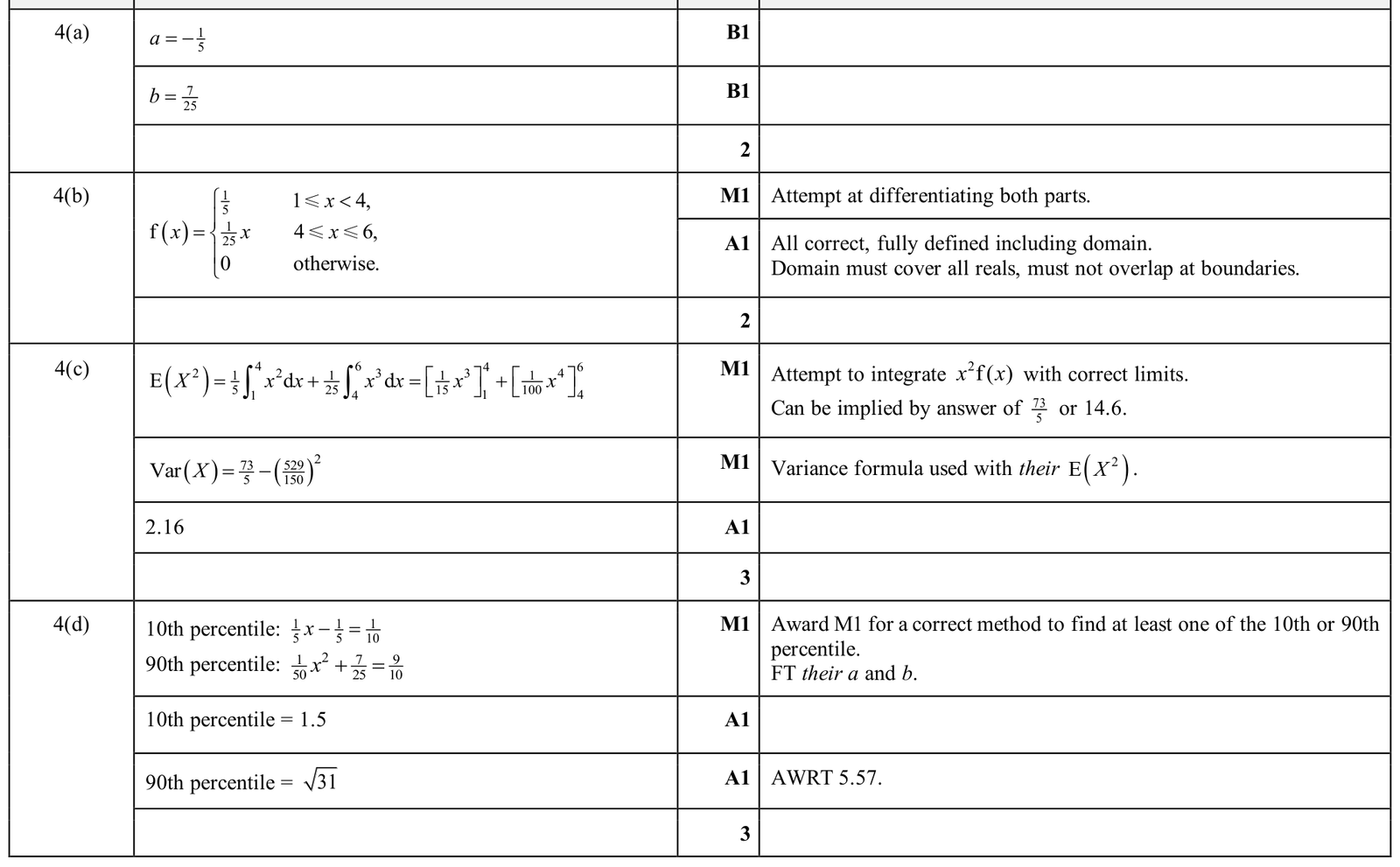
9231 P42 - Nov 2025 - Q4 - 10 marks
A continuous random variable \(X\) has cumulative distribution function \(F\) given by
\(F(x)=\begin{cases}0, & x\lt 1,\\ \frac{1}{5}x+a, & 1\leqslant x\lt 4,\\ \frac{1}{50}x^2+b, & 4\leqslant x\leqslant 6,\\ 1, & x\gt 6,\end{cases}\)
where \(a\) and \(b\) are constants.
(a) Find the value of \(a\) and the value of \(b\).
(b) Find the probability density function of \(X\).
(c) Given that \(\mathrm{E}(X)=\frac{529}{150}\), find \(\operatorname{Var}(X)\).
(d) Find the 10th and 90th percentiles of \(X\).
9231 P43 - Jun 2024 - Q5 - 10 marks
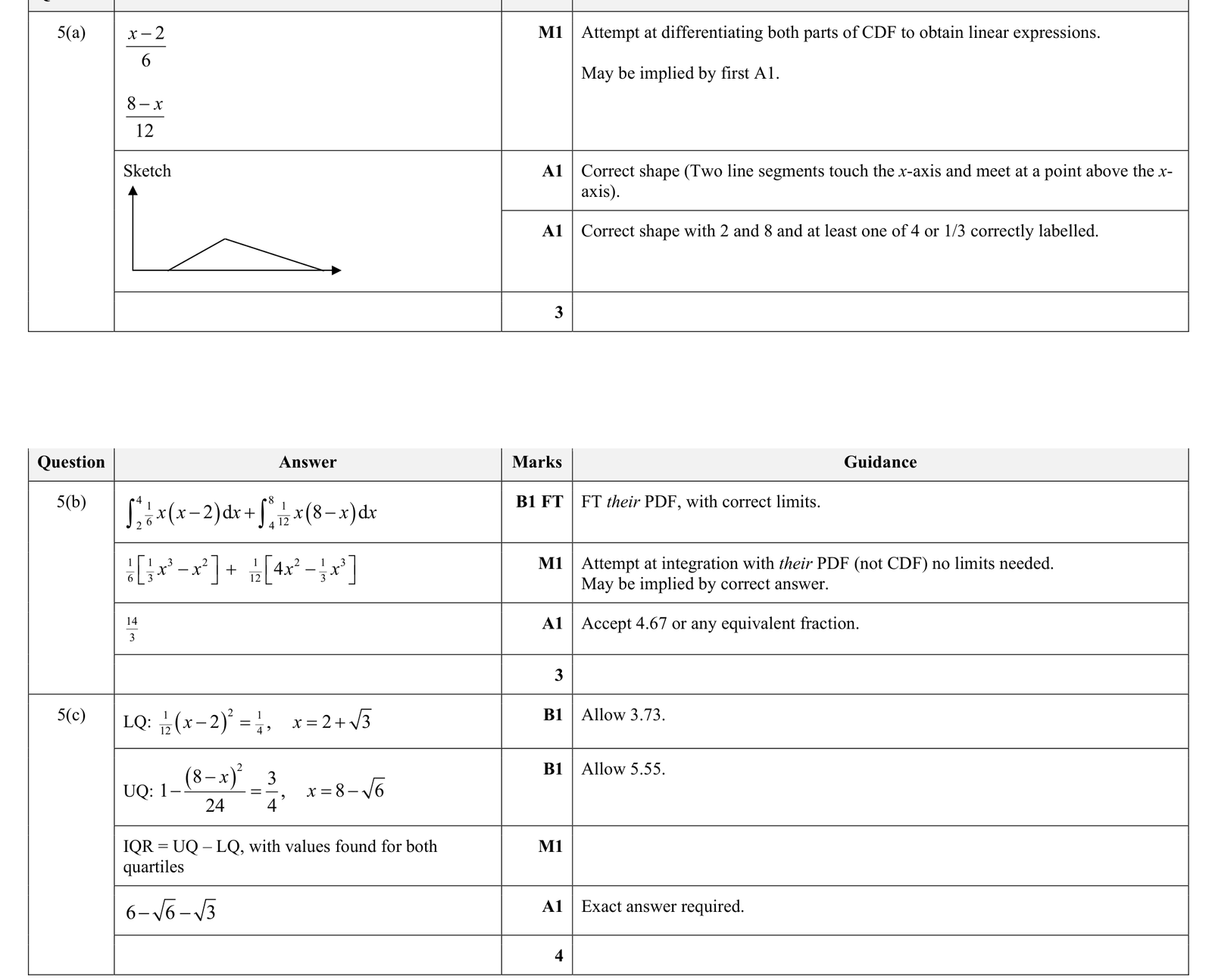
The continuous random variable \(X\) has cumulative distribution function F given by
\(F(x)=\left\{\begin{array}{ll} 0 & x\lt 2, \\ \frac{(x-2)^{2}}{12} & 2 \leqslant x\lt 4, \\ 1-\frac{(8-x)^{2}}{24} & 4 \leqslant x \leqslant 8, \\ 1 & x\gt 8 . \end{array}\right.\)
(a) Sketch the graph of the probability density function of \(X\).
(b) Find \(\mathrm{E}(X)\).
(c) Find the exact value of the interquartile range of \(X\).
9231 P42 - Nov 2023 - Q4 - 10 marks
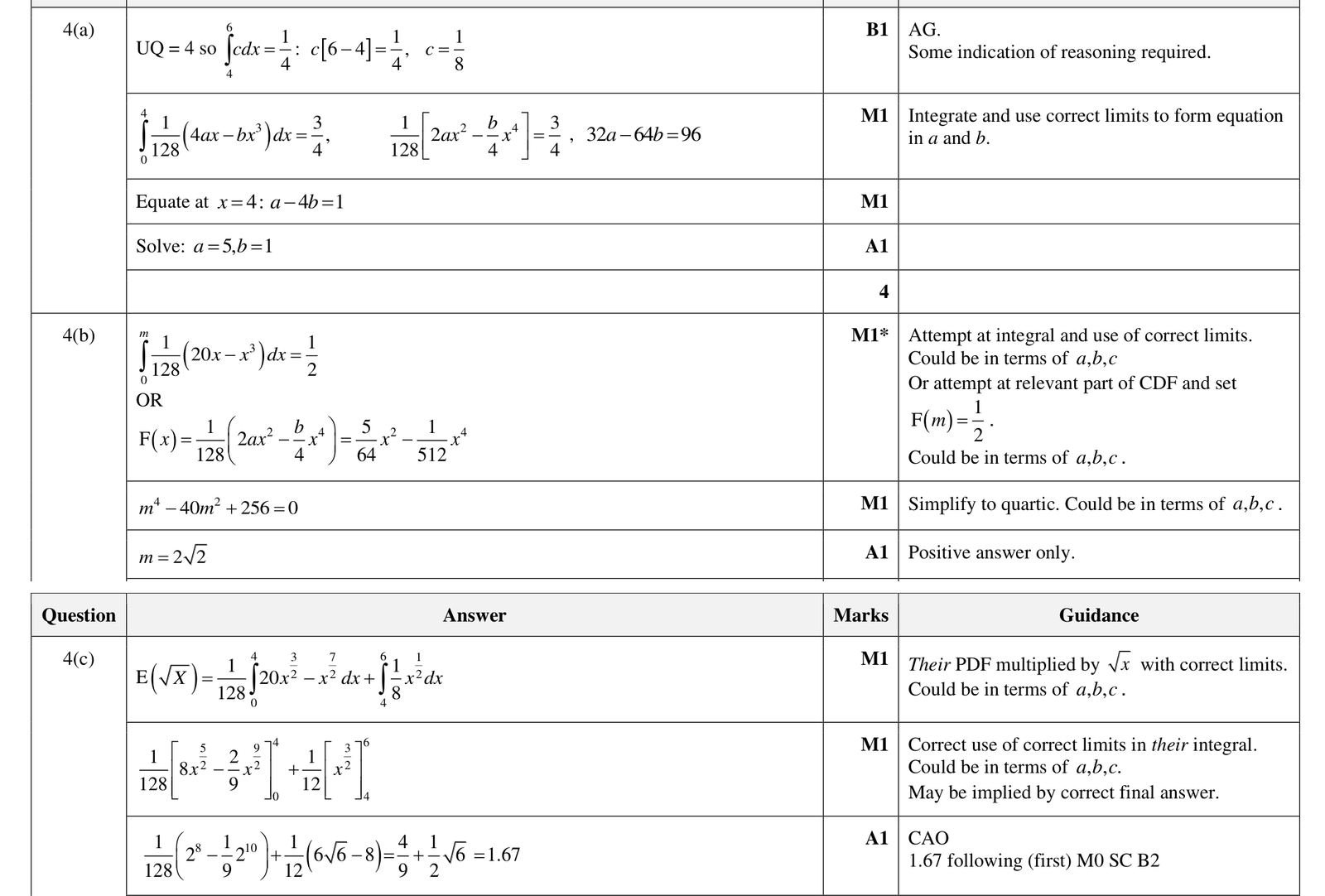
The continuous random variable \(X\) has probability density function \(f\) given by
\(f(x)=\left\{\begin{array}{ll} \frac{1}{128}\left(4ax-bx^{3}\right) & 0 \leqslant x \leqslant 4 \\ c & 4 \leqslant x \leqslant 6 \\ 0 & \text{otherwise} \end{array}\right.\)
where \(a\), \(b\) and \(c\) are constants.
The upper quartile of \(X\) is equal to 4.
(a) Show that \(c=\frac{1}{8}\) and find the values of \(a\) and \(b\).
(b) Find the exact value of the median of \(X\).
(c) Find \(\mathrm{E}(\sqrt{X})\), giving your answer correct to 2 decimal places.
9231 P41 - Jun 2022 - Q3 - 8 marks
The continuous random variable \(X\) has probability density function \(f\) given by
\(\mathrm{f}(x)=\left\{\begin{array}{ll} k x(4-x) & 0 \leqslant x\lt 2 \\ k(6-x) & 2 \leqslant x \leqslant 6 \\ 0 & \text { otherwise } \end{array}\right.\)
where \(k\) is a constant.
(a) Show that \(k=\frac{3}{40}\).
(b) Given that \(\mathrm{E}(X)=2.5\), find \(\operatorname{Var}(X)\).
(c) Find the median value of \(X\).

9231 P41 - Jun 2021 - Q3 - 8 marks
The continuous random variable \(X\) has cumulative distribution function F given by
\(F(x)=\left\{\begin{array}{ll} 0 & x\lt 0, \\ \frac{1}{81} x^{2} & 0 \leqslant x \leqslant 9, \\ 1 & x\gt 9 . \end{array}\right.\)
(a) Find \(\mathrm{E}(\sqrt{X})\).
(b) Find \(\operatorname{Var}(\sqrt{X})\).
(c) The random variable \(Y\) is given by \(Y^{3}=X\). Find the probability density function of \(Y\).

9231 P41 - Nov 2021 - Q2 - 8 marks
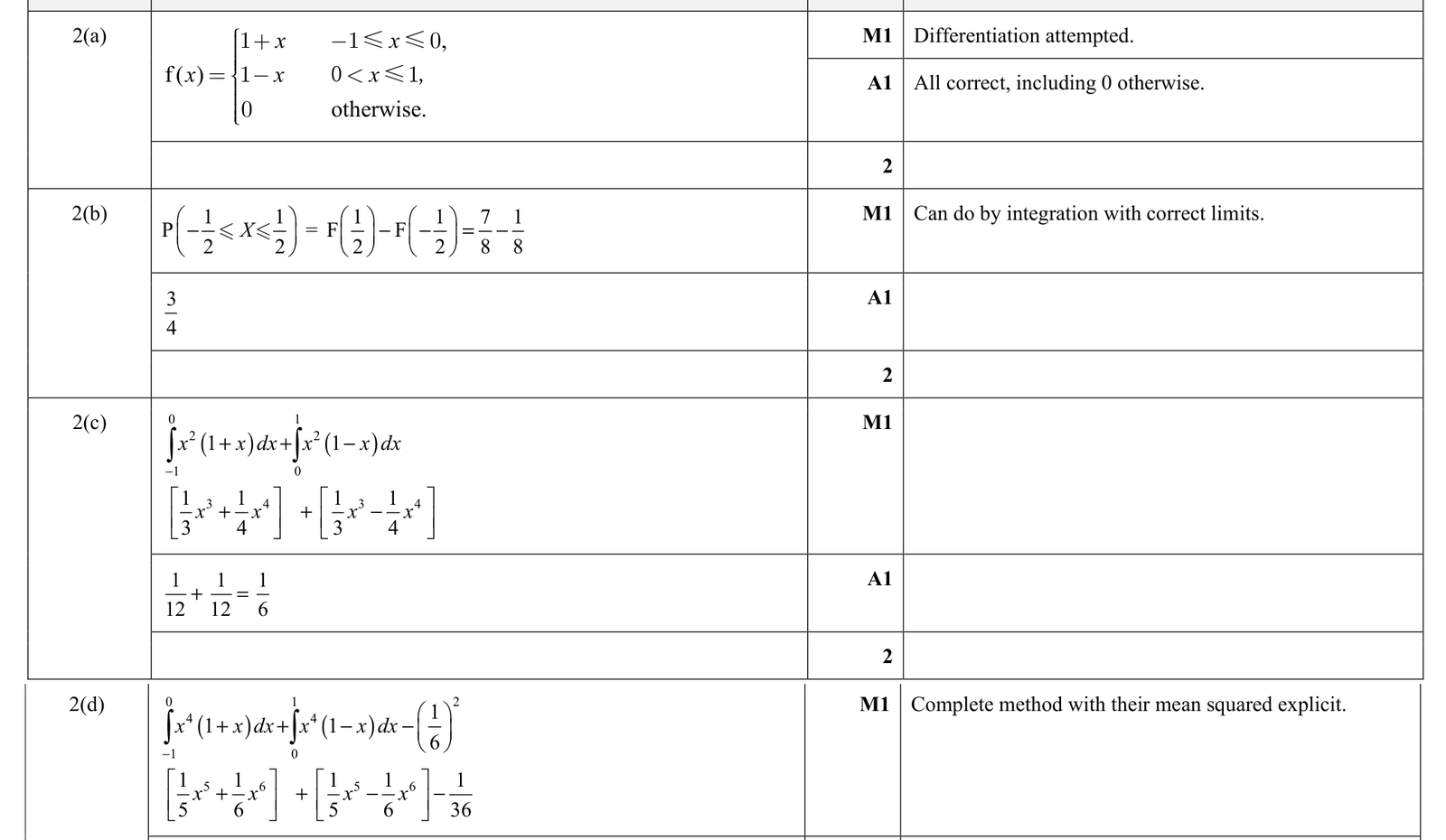
The continuous random variable \(X\) has cumulative distribution function F given by
\(F(x)=\left\{\begin{array}{lc} 0 & x\lt -1, \\ \frac{1}{2}(1+x)^{2} & -1 \leqslant x \leqslant 0, \\ 1-\frac{1}{2}(1-x)^{2} & 0\lt x \leqslant 1, \\ 1 & x\gt 1 . \end{array}\right.\)
(a) Find the probability density function of \(X\).
(b) Find \(\mathrm{P}\left(-\frac{1}{2} \leqslant X \leqslant \frac{1}{2}\right)\).
(c) Find \(\mathrm{E}\left(X^{2}\right)\).
(d) Find \(\operatorname{Var}\left(X^{2}\right)\).
9231 P42 - Nov 2021 - Q3 - 8 marks
The continuous random variable \(X\) has probability density function \(f\) given by
\(f(x)=\left\{\begin{array}{ll} a+\frac{1}{5} x & 0 \leqslant x\lt 1 \\ 2 a-\frac{1}{5} x & 1 \leqslant x \leqslant 2 \\ 0 & \text { otherwise } \end{array}\right.\)
where \(a\) is a constant.
(a) Find the value of \(a\).
(b) Find \(\mathrm{E}\left(X^{2}\right)\).
(c) Find the cumulative distribution function of \(X\).

9231 P43 - Jun 2020 - Q3 - 9 marks
The continuous random variable \(X\) has probability density function \(f\) given by
\(f(x)=\left\{\begin{array}{ll} \frac{1}{5} x & 0 \leqslant x\lt 2 \\ \frac{2}{15}(5-x) & 2 \leqslant x \leqslant 5 \\ 0 & \text { otherwise } \end{array}\right.\)
(a) Find the cumulative distribution function of \(X\).
(b) Find the median value of \(X\).
(c) Find \(\mathrm{E}\left(X^{2}\right)\).
(d) Find \(\mathrm{P}(1 \leqslant X \leqslant 3)\).

9231 P41 - Nov 2024 - Q4 - 10 marks
The continuous random variable \(X\) has probability density function f given by
\(f(x)=\left\{\begin{array}{ll} k x^{3} & 0 \leqslant x\lt 1 \\ k(5-x) & 1 \leqslant x \leqslant 5 \\ 0 & \text { otherwise } \end{array}\right.\)
where \(k\) is a constant.
(a) Sketch the graph of f.
(b) Show that \(k=\frac{4}{33}\).
(c) Find the cumulative distribution function of \(X\).
(d) Find the median value of \(X\).

9231 P44 - Jun 2025 - Q4 - 9 marks
The continuous random variable \(X\) has probability density function f given by
\(\mathrm{f}(x)=\left\{\begin{array}{ll} k x & 0 \leqslant x\lt 1, \\ k x^{2} & 1 \leqslant x \leqslant 2, \\ 0 & \text { otherwise. } \end{array}\right.\)
(a) Show that \(k=\frac{6}{17}\).
(b) Find the cumulative distribution function of \(X\).
(c) Find the median value of \(X\).
(d) Find \(\mathrm{E}\left(\frac{1}{X}\right)\).

9231 P21 - Nov 2018 - Q6 - 6 marks
The continuous random variable \(X\) has probability density function f given by
\[f(x)=\left\{\begin{array}{ll}
\frac{1}{80}\left(3 \sqrt{ } x-\frac{8}{\sqrt{ } x}\right) & 4 \leqslant x \leqslant 16 \\
0 & \text { otherwise. }
\end{array}\right.\]
(i) Find the distribution function of \(X\).
The random variable \(Y\) is defined by \(Y=\sqrt{ } X\).
(ii) Find the probability density function of \(Y\).
