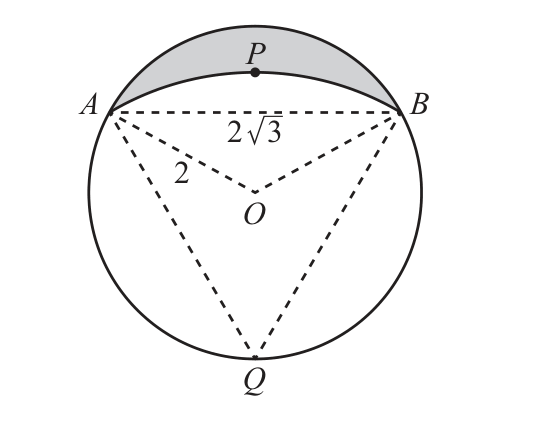
Answer: (a) \(\dfrac{\pi}{3}\). (b) \(2\sqrt3-\dfrac{2\pi}{3}\).
(a) In the circle with centre \(O\), the radius is \(2\) and the chord \(AB\) has length \(2\sqrt3\).
Let
\(\angle AOB=\theta\).
Using the chord formula \(\text{chord}=2r\sin\left(\frac{\theta}{2}\right)\),
\(2\sqrt3=2(2)\sin\left(\frac{\theta}{2}\right)\).
So
\(\sin\left(\frac{\theta}{2}\right)=\frac{\sqrt3}{2}\).
Hence
\(\frac{\theta}{2}=\frac{\pi}{3}\),
so
\(\theta=\frac{2\pi}{3}\).
The point \(Q\) lies on the circle and \(AQ=BQ\), so \(Q\) is on the perpendicular bisector of \(AB\). The angle \(AQB\) is an angle at the circumference subtending the chord \(AB\). Therefore it is half the central angle subtending the same chord:
\(\angle AQB=\frac12\angle AOB=\frac12\cdot\frac{2\pi}{3}=\frac{\pi}{3}\).
(b) Since \(Q\) lies on the original circle and \(AQ=BQ\), we have
\(AQ=BQ=2\sqrt3\).
First find the area of the circular segment of the circle with centre \(O\), cut off by chord \(AB\). This segment has radius \(2\) and angle \(\frac{2\pi}{3}\), so its area is
\(\frac12(2)^2\left(\frac{2\pi}{3}\right)-\frac12(2)^2\sin\left(\frac{2\pi}{3}\right)\).
This simplifies to
\(\frac{4\pi}{3}-\sqrt3\).
Next find the area of the circular segment of the circle with centre \(Q\), cut off by the same chord \(AB\). This circle has radius \(2\sqrt3\) and angle \(\frac{\pi}{3}\), so this segment has area
\(\frac12(2\sqrt3)^2\left(\frac{\pi}{3}\right)-\frac12(2\sqrt3)^2\sin\left(\frac{\pi}{3}\right)\).
This simplifies to
\(2\pi-3\sqrt3\).
The shaded region is the difference between these two segments, so its area is
\(\left(\frac{4\pi}{3}-\sqrt3\right)-\left(2\pi-3\sqrt3\right)\).
Therefore
\(\text{area}=2\sqrt3-\frac{2\pi}{3}\).