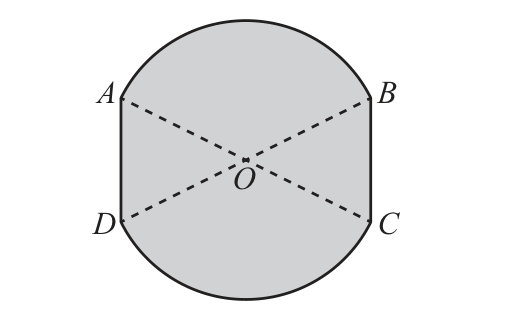
Answer: \(\angle AOB=2.46\text{ rad}\), perimeter \(=37.5\text{ cm}\), and area \(=111\text{ cm}^2\) approximately.
Since \(AC\) and \(BD\) are each \(12\text{ cm}\) and are bisected by \(O\), each radius of the circle is
\(OA=OB=OC=OD=6\text{ cm}\).
Let the smaller angle \(\angle BOC\) be \(\theta\). The chord \(BC\) has length \(4\text{ cm}\), so
\(4=2(6)\sin\left(\frac{\theta}{2}\right)\).
Thus
\(\sin\left(\frac{\theta}{2}\right)=\frac13\),
and
\(\theta=2\sin^{-1}\left(\frac13\right)=0.6796\ldots\text{ rad}\).
Because \(A\) is opposite \(C\) and \(B\) is opposite \(D\), the obtuse angle \(AOB\) is
\(\angle AOB=\pi-\theta=\pi-2\sin^{-1}\left(\frac13\right)=2.4619\ldots\text{ rad}\).
Hence
\(\angle AOB=2.46\text{ rad}\quad\text{to 3 significant figures.}\)
The perimeter consists of the two straight sides \(AD\) and \(BC\), each of length \(4\), and two equal arcs, each with radius \(6\) and angle \(\angle AOB\). Therefore
\(\text{perimeter}=4+4+2(6)(2.4619\ldots)=37.54\ldots\text{ cm}\).
So the perimeter is
\(37.5\text{ cm}\quad\text{to 3 significant figures.}\)
For the area, it is helpful to view the shaded region as the area of the whole circle minus two identical small circular segments cut off by the chords \(AD\) and \(BC\).
For one of these small segments, the central angle is \(\theta=0.6796\ldots\). Its area is
\(\frac12(6)^2\theta-\frac12(6)^2\sin\theta=18\theta-18\sin\theta\).
So the shaded area is
\(36\pi-2(18\theta-18\sin\theta)=36\pi-36\theta+36\sin\theta\).
Using \(\theta=2\sin^{-1}\left(\frac13\right)\),
\(\text{area}=111.26\ldots\text{ cm}^2\).
Hence the area is
\(111\text{ cm}^2\quad\text{to 3 significant figures.}\)