Answer: (a) \(37.3\text{ cm}\); (b) \(63.9\text{ cm}^2\).
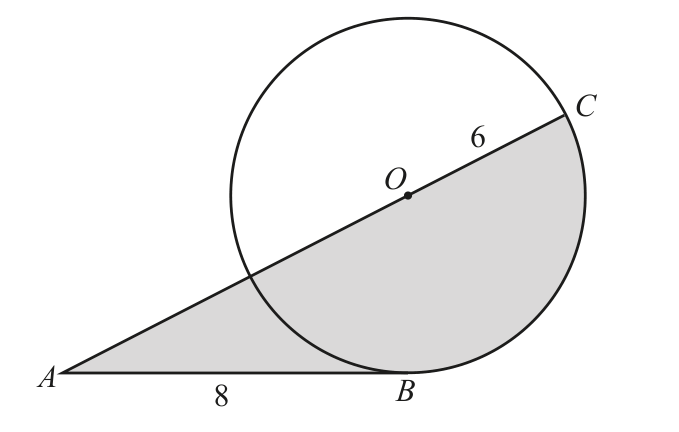
We start with the main method. Use the measurements and relationships shown in the diagram, then translate them into algebraic or trigonometric equations. Use the right-triangle information to find the angle in radians, then apply arc length and sector area formulae.
Since \(AB\) is a tangent at \(B\), \(OB\) is perpendicular to \(AB\).
In right-angled triangle \(AOB\),
\(OB=6,\quad AB=8.\)
Therefore
\(OA=\sqrt{6^2+8^2}=10.\)
Let \(\theta=\angle AOB\). Then
\(\cos\theta=\frac{OB}{OA}=\frac6{10}=0.6.\)
So
\(\theta=\cos^{-1}(0.6)\approx0.9273.\)
Since \(A\), \(O\) and \(C\) are in a straight line,
\(\angle BOC=\pi-\theta.\)
Thus
\(\angle BOC\approx\pi-0.9273=2.2143.\)
(a) The arc length \(BC\) is
\(6(2.2143)\approx13.2858.\)
Also,
\(AC=AO+OC=10+6=16.\)
The perimeter of the shaded region is
\(AB+AC+\text{arc }BC.\)
So
\(P=8+16+13.2858=37.2858\ldots.\)
Therefore
\(P=37.3\text{ cm}\) to 3 significant figures.
(b) The shaded area is the area of triangle \(AOB\) plus the area of sector \(BOC\).
The area of triangle \(AOB\) is
\(\frac12(8)(6)=24.\)
The sector area is
\(\frac12(6^2)(2.2143)\approx39.8574.\)
So the shaded area is
\(24+39.8574=63.8574\ldots.\)
Therefore
\(63.9\text{ cm}^2\) to 3 significant figures.
This completes the solution and gives the required result.