Past Exam Questions
← Back9709 P43 - Nov 2012 - Q5
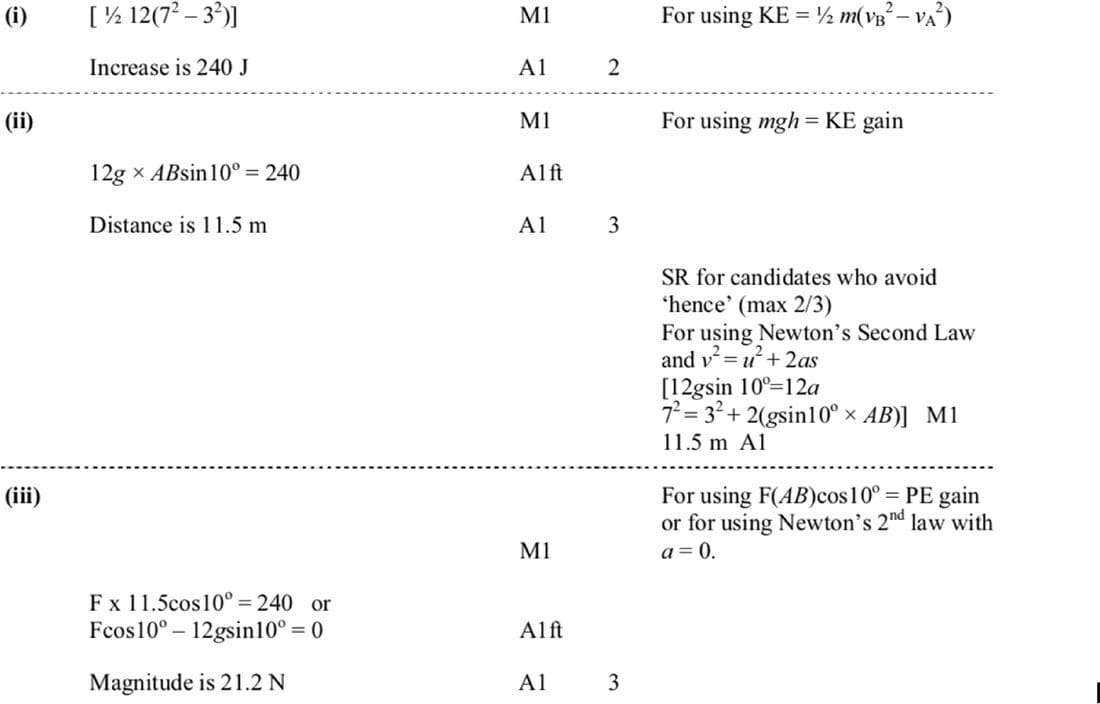
An object of mass 12 kg slides down a line of greatest slope of a smooth plane inclined at 10° to the horizontal. The object passes through points A and B with speeds 3 m/s and 7 m/s respectively.
- Find the increase in kinetic energy of the object as it moves from A to B.
- Hence find the distance AB, assuming there is no resisting force acting on the object.
The object is now pushed up the plane from B to A, with constant speed, by a horizontal force.
- Find the magnitude of this force.
9709 P43 - Nov 2012 - Q1
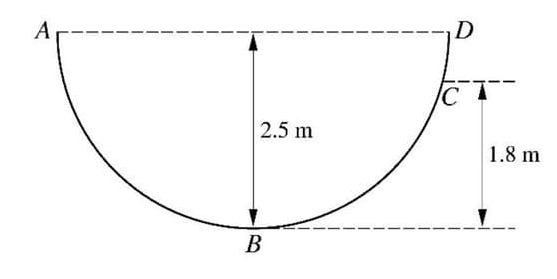
ABCD is a semi-circular cross-section, in a vertical plane, of the inner surface of half a hollow cylinder of radius 2.5 m which is fixed with its axis horizontal. AD is horizontal, B is the lowest point of the cross-section and C is at a height of 1.8 m above the level of B (see diagram). A particle P of mass 0.8 kg is released from rest at A and comes to instantaneous rest at C.
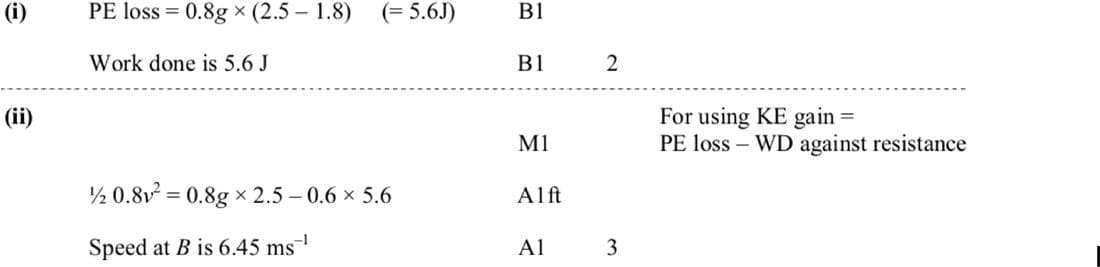
(i) Find the work done on P by the resistance to motion while P travels from A to C.
The work done on P by the resistance to motion while P travels from A to B is 0.6 times the work done while P travels from A to C.
(ii) Find the speed of P when it passes through B.
9709 P42 - Nov 2012 - Q6
A car of mass 1250 kg moves from the bottom to the top of a straight hill of length 500 m. The top of the hill is 30 m above the level of the bottom. The power of the car’s engine is constant and equal to 30000 W. The car’s acceleration is 4 m/s2 at the bottom of the hill and is 0.2 m/s2 at the top. The resistance to the car’s motion is 1000 N. Find
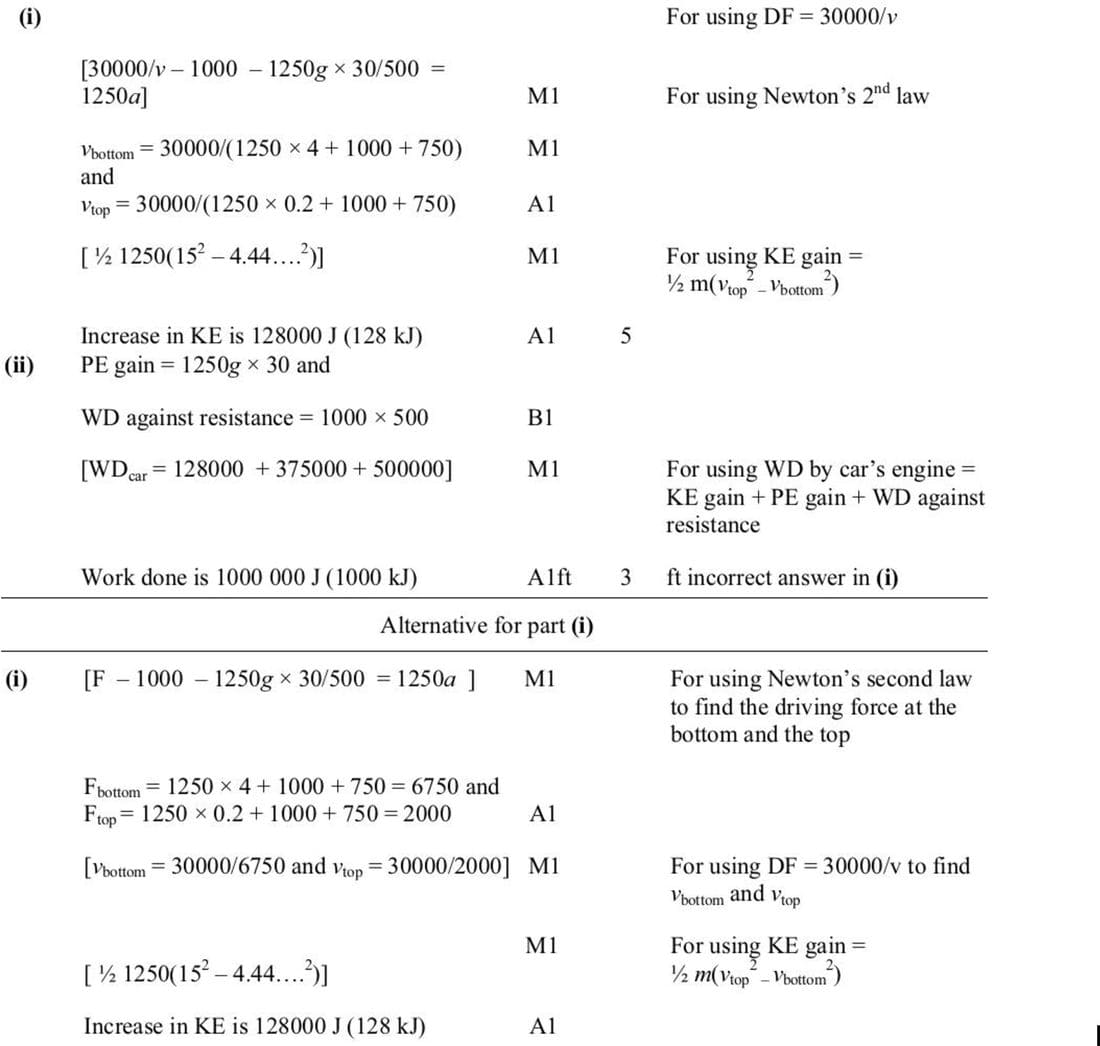
- the car’s gain in kinetic energy,
- the work done by the car’s engine.
9709 P41 - Nov 2012 - Q6
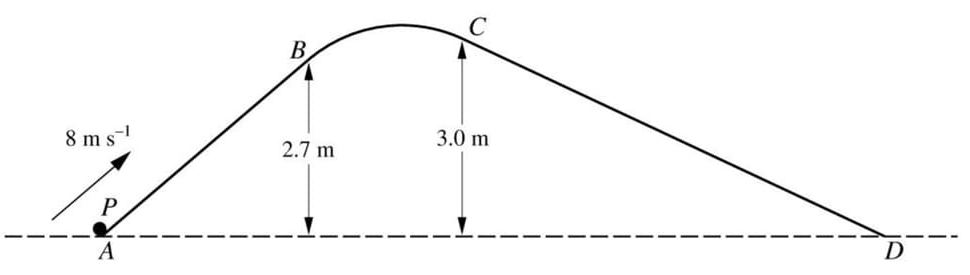
The diagram shows the vertical cross-section ABCD of a surface. BC is a circular arc, and AB and CD are tangents to BC at B and C respectively. A and D are at the same horizontal level, and B and C are at heights 2.7 m and 3.0 m respectively above the level of A and D. A particle P of mass 0.2 kg is given a velocity of 8 m s-1 at A, in the direction of AB (see diagram). The parts of the surface containing AB and BC are smooth.
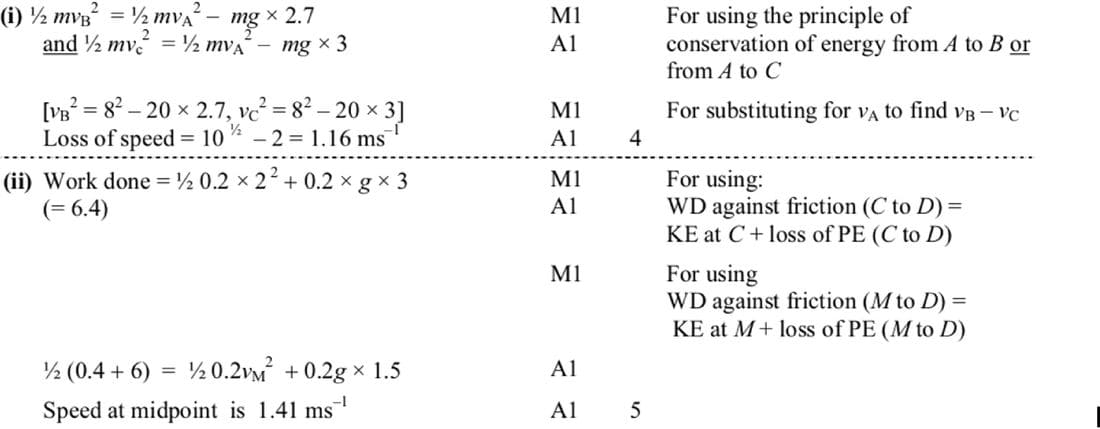
- Find the decrease in the speed of P as P moves along the surface from B to C.
- The part of the surface containing CD exerts a constant frictional force on P, as it moves from C to D, and P comes to rest as it reaches D.
- Find the speed of P when it is at the mid-point of CD.
9709 P43 - Jun 2012 - Q5
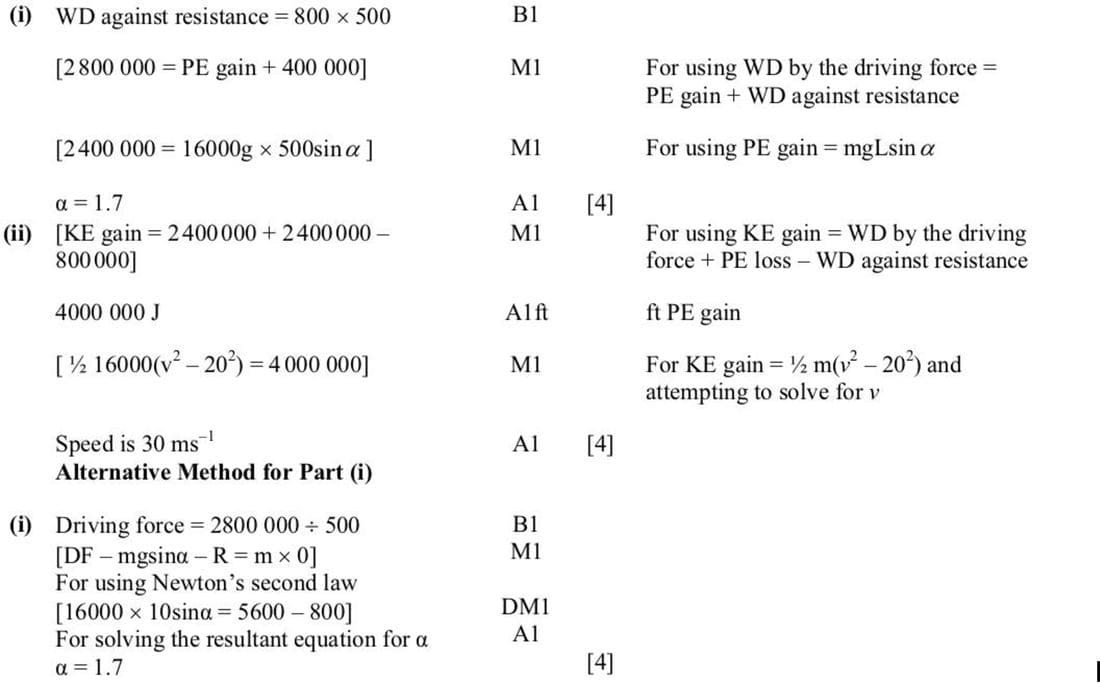
A lorry of mass 16,000 kg moves on a straight hill inclined at angle \(\alpha^\circ\) to the horizontal. The length of the hill is 500 m.
- While the lorry moves from the bottom to the top of the hill at constant speed, the resisting force acting on the lorry is 800 N and the work done by the driving force is 2800 kJ. Find the value of \(\alpha\).
- On the return journey the speed of the lorry is 20 m s\(^{-1}\) at the top of the hill. While the lorry travels down the hill, the work done by the driving force is 2400 kJ and the work done against the resistance to motion is 800 kJ. Find the speed of the lorry at the bottom of the hill.
9709 P42 - Jun 2012 - Q7
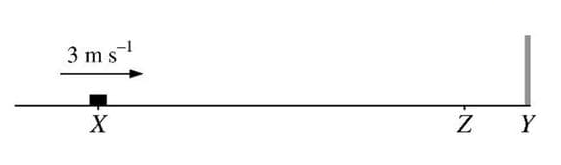
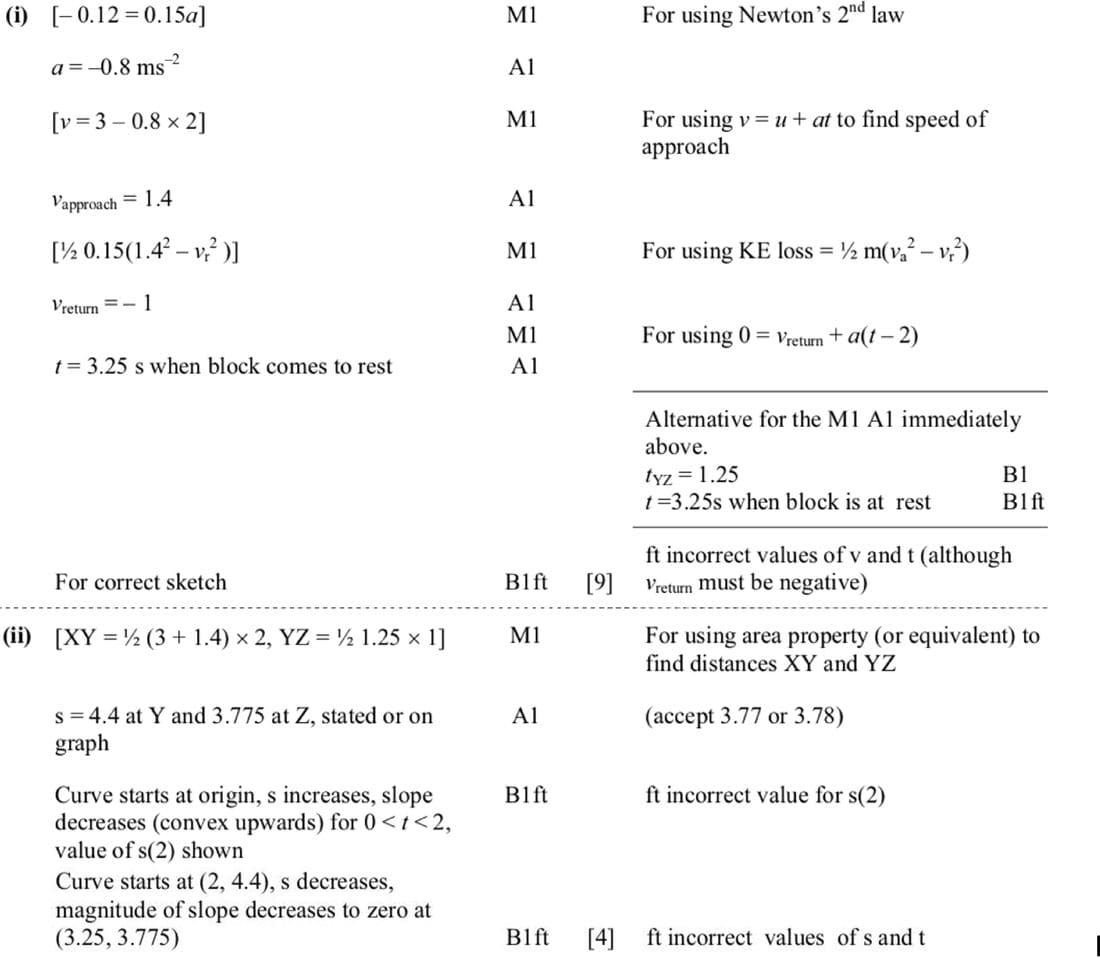
The frictional force acting on a small block of mass 0.15 kg, while it is moving on a horizontal surface, has magnitude 0.12 N. The block is set in motion from a point X on the surface, with speed 3 m/s-1. It hits a vertical wall at a point Y on the surface 2 s later. The block rebounds from the wall and moves directly towards X before coming to rest at the point Z (see diagram). At the instant that the block hits the wall it loses 0.072 J of its kinetic energy. The velocity of the block, in the direction from X to Y, is v m/s-1 at time t s after it leaves X.
- Find the values of v when the block arrives at Y and when it leaves Y, and find also the value of t when the block comes to rest at Z. Sketch the velocity-time graph.
- The displacement of the block from X, in the direction from X to Y, is s m at time t s. Sketch the displacement-time graph. Show on your graph the values of s and t when the block is at Y and when it comes to rest at Z.
9709 P42 - Jun 2012 - Q6
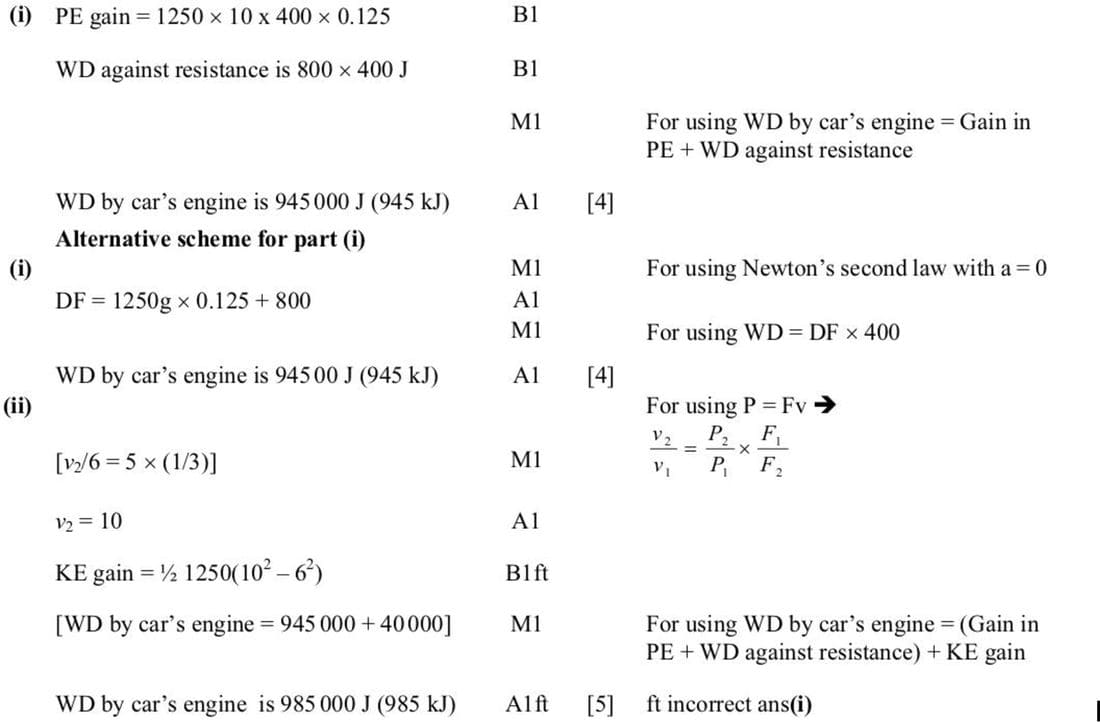
A car of mass 1250 kg travels from the bottom to the top of a straight hill which has length 400 m and is inclined to the horizontal at an angle of \(\alpha\), where \(\sin \alpha = 0.125\). The resistance to the car’s motion is 800 N. Find the work done by the car’s engine in each of the following cases.
- The car’s speed is constant.
- The car’s initial speed is 6 m s\(^{-1}\), the car’s driving force is 3 times greater at the top of the hill than it is at the bottom, and the car’s power output is 5 times greater at the top of the hill than it is at the bottom.
9709 P41 - Jun 2012 - Q5
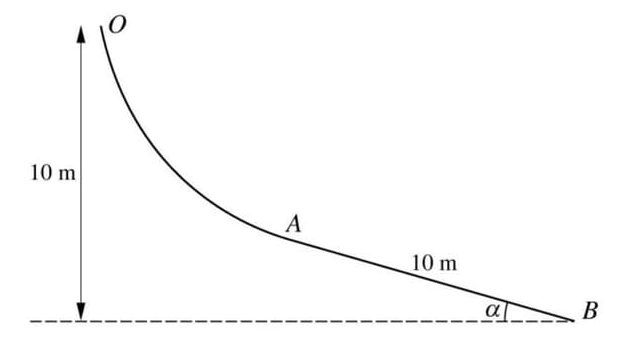
The diagram shows the vertical cross-section OAB of a slide. The straight line AB is tangential to the curve OA at A. The line AB is inclined at \(\alpha\) to the horizontal, where \(\sin \alpha = 0.28\). The point O is 10 m higher than B, and AB has length 10 m (see diagram). The part of the slide containing the curve OA is smooth and the part containing AB is rough. A particle P of mass 2 kg is released from rest at O and moves down the slide.
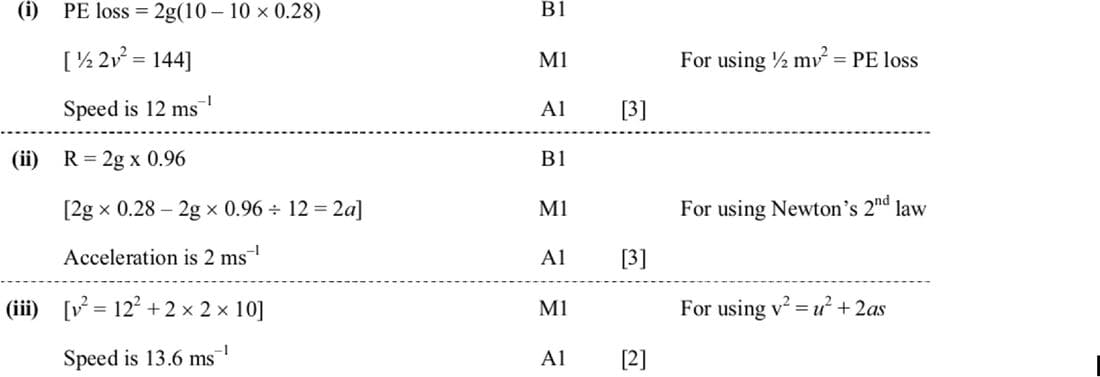
- Find the speed of P when it passes through A.
- The coefficient of friction between P and the part of the slide containing AB is \(\frac{1}{12}\). Find
- the acceleration of P when it is moving from A to B
- the speed of P when it reaches B.
9709 P43 - Nov 2022 - Q2
A box of mass 5 kg is pulled at a constant speed of 1.8 m/s for 15 s up a rough plane inclined at an angle of 20° to the horizontal. The box moves along a line of greatest slope against a frictional force of 40 N. The force pulling the box is parallel to the line of greatest slope.
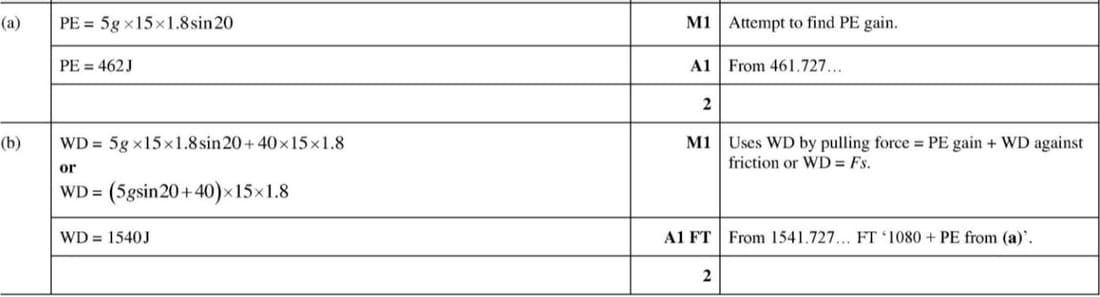
(a) Find the change in gravitational potential energy of the box.
(b) Find the work done by the pulling force.
9709 P41 - Jun 2012 - Q3
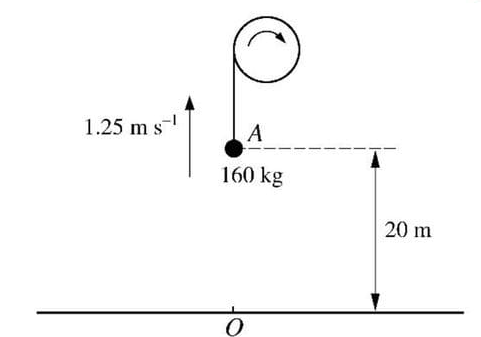
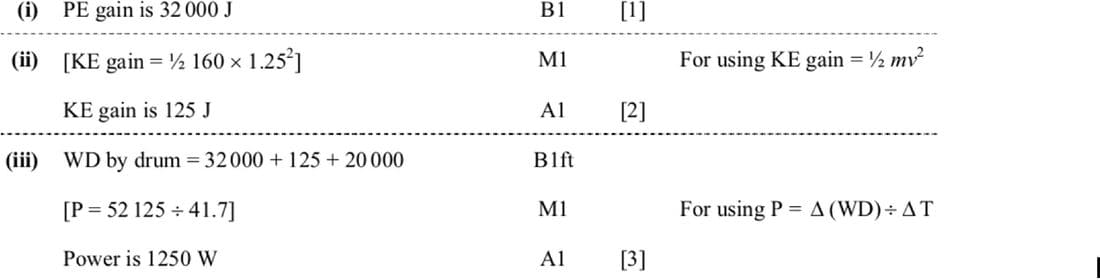
A load of mass 160 kg is pulled vertically upwards, from rest at a fixed point O on the ground, using a winding drum. The load passes through a point A, 20 m above O, with a speed of 1.25 m s-1 (see diagram). Find, for the motion from O to A,
- the gain in the potential energy of the load,
- the gain in the kinetic energy of the load.
The power output of the winding drum is constant while the load is in motion.
- Given that the work done against the resistance to motion from O to A is 20 kJ and that the time taken for the load to travel from O to A is 41.7 s, find the power output of the winding drum.
9709 P43 - Nov 2011 - Q4
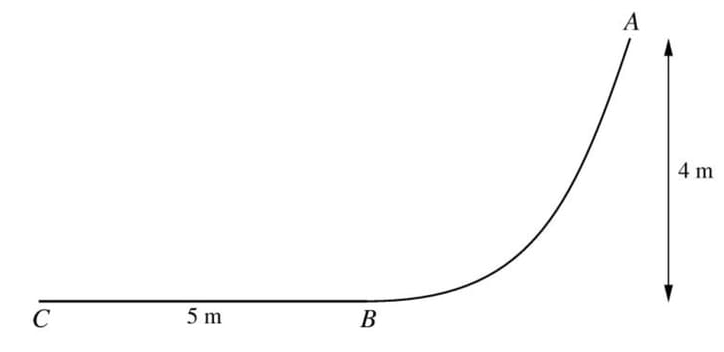
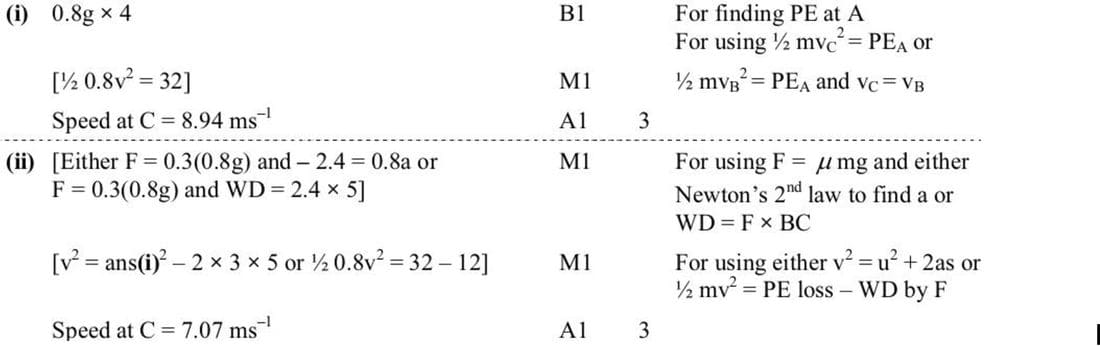
ABC is a vertical cross-section of a surface. The part of the surface containing AB is smooth and A is 4 m higher than B. The part of the surface containing BC is horizontal and the distance BC is 5 m (see diagram). A particle of mass 0.8 kg is released from rest at A and slides along ABC. Find the speed of the particle at C in each of the following cases.
- The horizontal part of the surface is smooth.
- The coefficient of friction between the particle and the horizontal part of the surface is 0.3.
9709 P42 - Nov 2011 - Q6
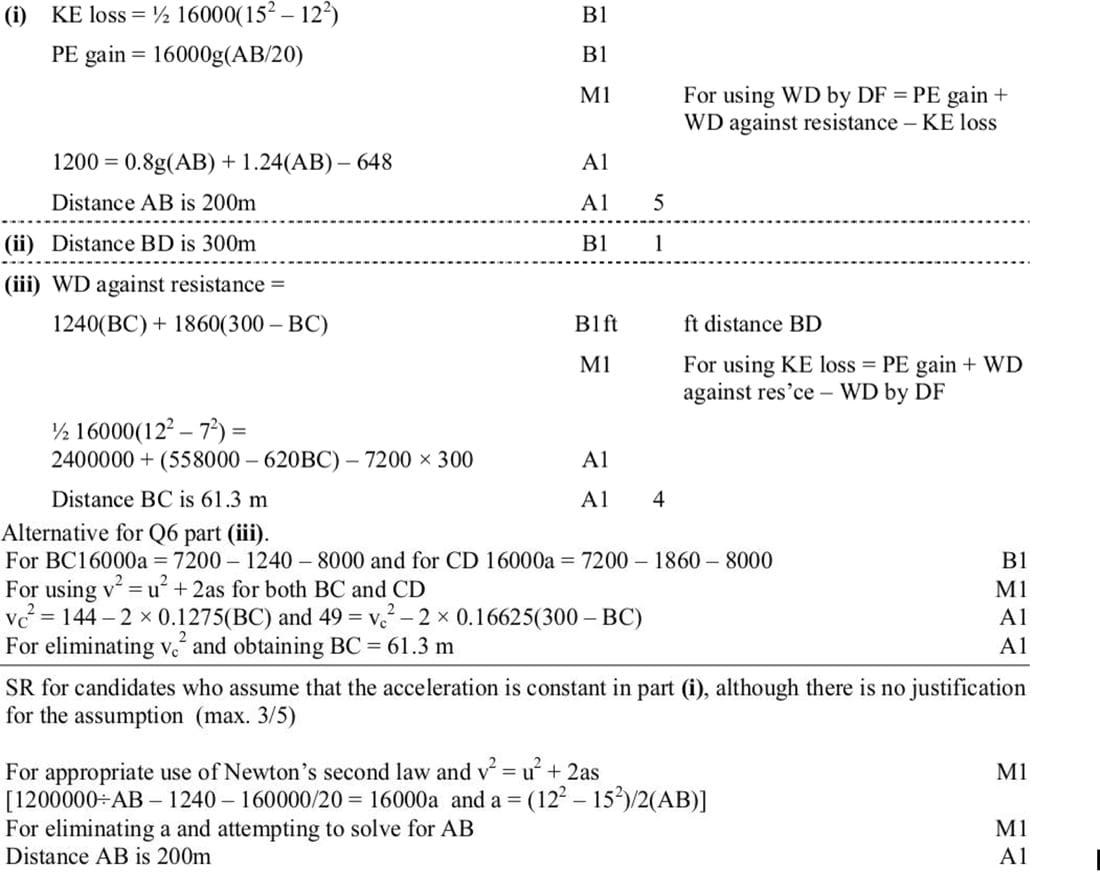
A lorry of mass 16000 kg climbs a straight hill ABCD which makes an angle \(\theta\) with the horizontal, where \(\sin \theta = \frac{1}{20}\). For the motion from A to B, the work done by the driving force of the lorry is 1200 kJ and the resistance to motion is constant and equal to 1240 N. The speed of the lorry is 15 m/s at A and 12 m/s at B.
- Find the distance AB.
For the motion from B to D the gain in potential energy of the lorry is 2400 kJ.
- Find the distance BD.
For the motion from B to D the driving force of the lorry is constant and equal to 7200 N. From B to C the resistance to motion is constant and equal to 1240 N and from C to D the resistance to motion is constant and equal to 1860 N.
- Given that the speed of the lorry at D is 7 m/s, find the distance BC.
9709 P41 - Nov 2011 - Q6
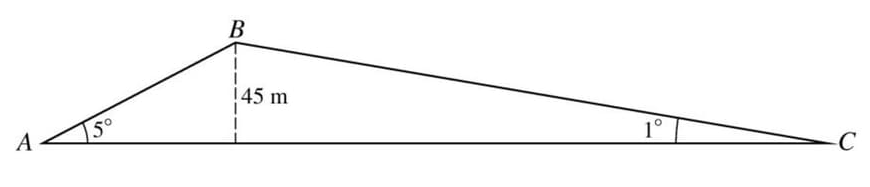
AB and BC are straight roads inclined at 5° to the horizontal and 1° to the horizontal respectively. A and C are at the same horizontal level and B is 45 m above the level of A and C (see diagram, which is not to scale). A car of mass 1200 kg travels from A to C passing through B.
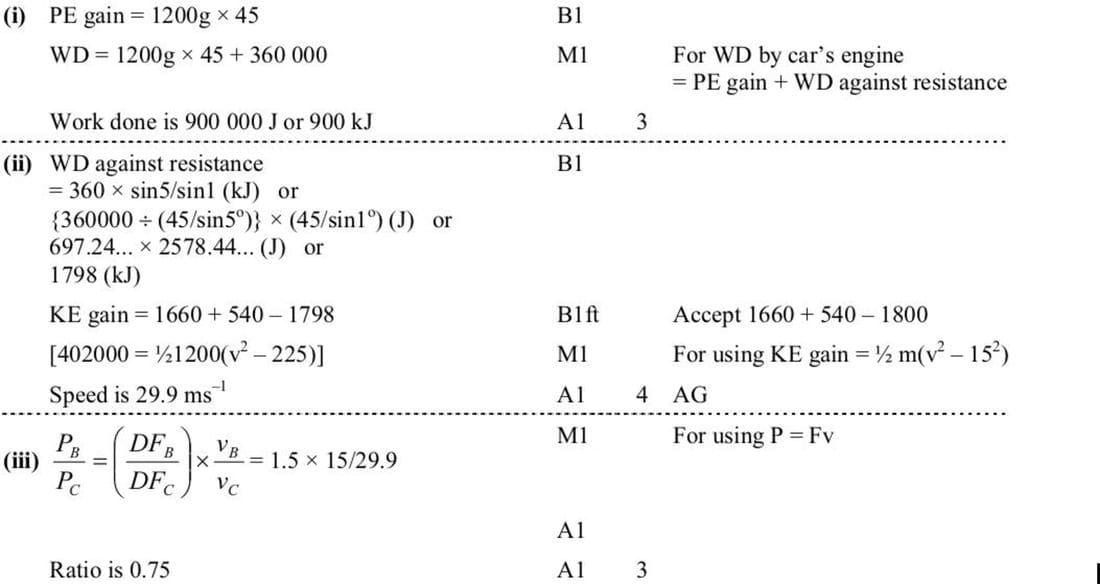
(i) For the motion from A to B, the speed of the car is constant and the work done against the resistance to motion is 360 kJ. Find the work done by the car’s engine from A to B.
The resistance to motion is constant throughout the whole journey.
(ii) For the motion from B to C the work done by the driving force is 1660 kJ. Given that the speed of the car at B is 15 m s−1, show that its speed at C is 29.9 m s−1, correct to 3 significant figures.
(iii) The car’s driving force immediately after leaving B is 1.5 times the driving force immediately before reaching C. Find, correct to 2 significant figures, the ratio of the power developed by the car’s engine immediately after leaving B to the power developed immediately before reaching C.
9709 P43 - Jun 2011 - Q6
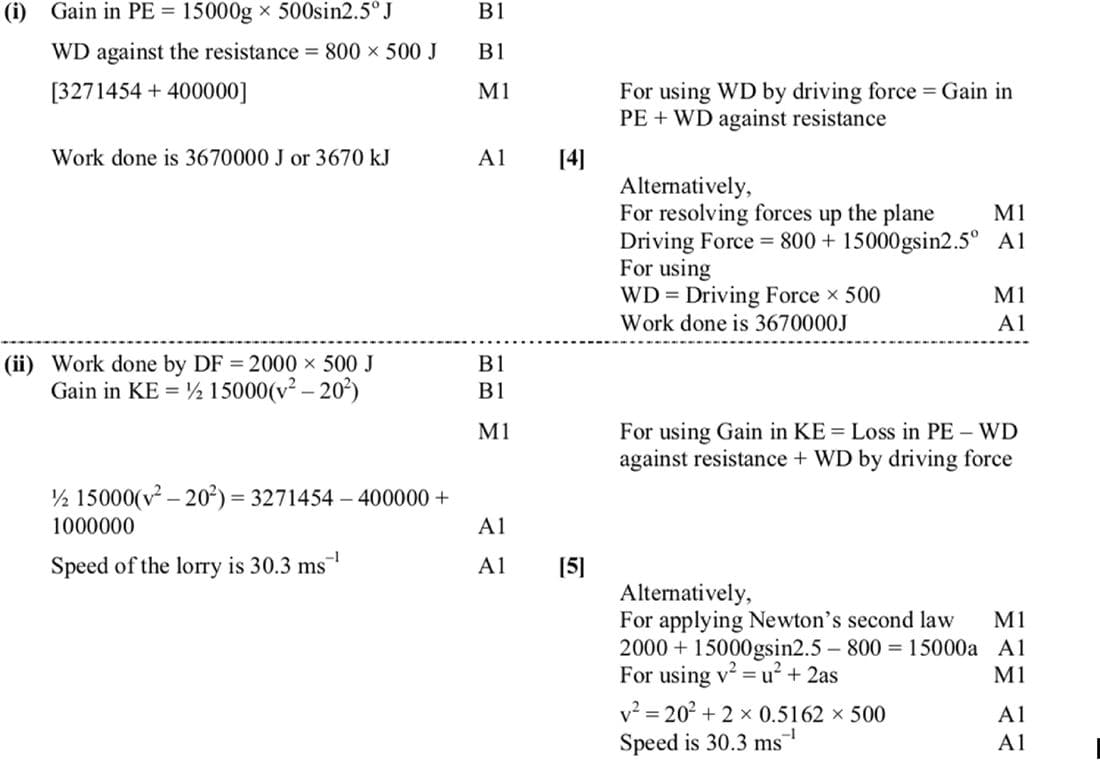
A lorry of mass 15,000 kg climbs a hill of length 500 m at a constant speed. The hill is inclined at 2.5° to the horizontal. The resistance to the lorry’s motion is constant and equal to 800 N.
- Find the work done by the lorry’s driving force.
On its return journey the lorry reaches the top of the hill with speed 20 m/s and continues down the hill with a constant driving force of 2000 N. The resistance to the lorry’s motion is again constant and equal to 800 N.
- Find the speed of the lorry when it reaches the bottom of the hill.
9709 P42 - Jun 2011 - Q2
An object of mass 8 kg slides down a line of greatest slope of an inclined plane. Its initial speed at the top of the plane is 3 m s-1 and its speed at the bottom of the plane is 8 m s-1. The work done against the resistance to motion of the object is 120 J. Find the height of the top of the plane above the level of the bottom.

9709 P41 - Jun 2011 - Q7
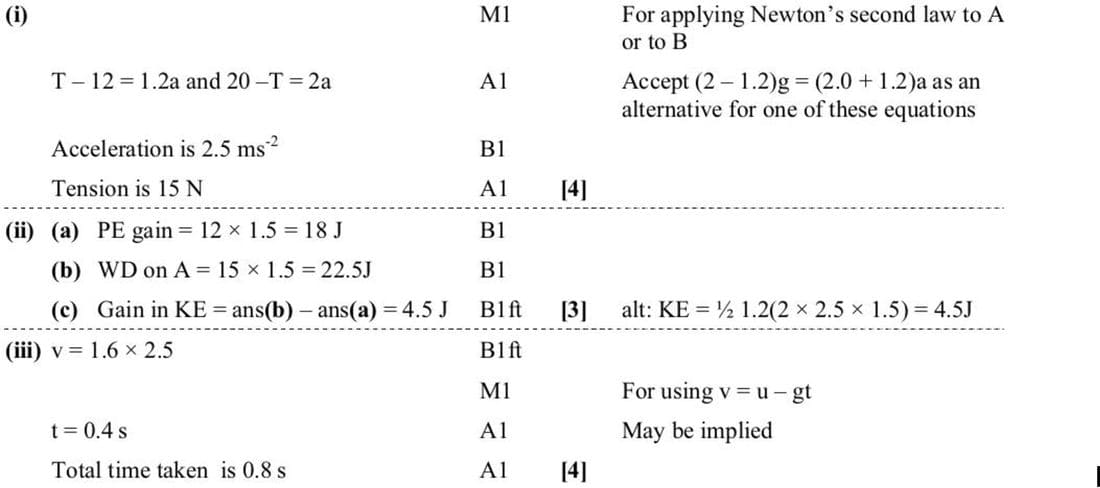
Loads A and B, of masses 1.2 kg and 2.0 kg respectively, are attached to the ends of a light inextensible string which passes over a fixed smooth pulley. A is held at rest and B hangs freely, with both straight parts of the string vertical. A is released and starts to move upwards. It does not reach the pulley in the subsequent motion.
- Find the acceleration of A and the tension in the string.
- Find, for the first 1.5 metres of A’s motion,
- A’s gain in potential energy,
- the work done on A by the tension in the string,
- A’s gain in kinetic energy.
- B hits the floor 1.6 seconds after A is released. B comes to rest without rebounding and the string becomes slack.
- Find the time from the instant the string becomes slack until it becomes taut again.
9709 P43 - Nov 2010 - Q2
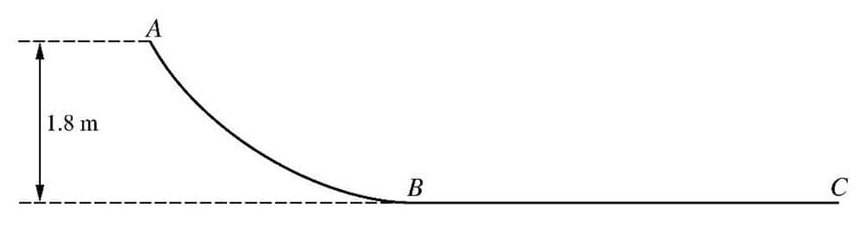
The diagram shows the vertical cross-section ABC of a fixed surface. AB is a curve and BC is a horizontal straight line. The part of the surface containing AB is smooth and the part containing BC is rough. A is at a height of 1.8 m above BC. A particle of mass 0.5 kg is released from rest at A and travels along the surface to C.
- Find the speed of the particle at B.
- Given that the particle reaches C with a speed of 5 m s-1, find the work done against the resistance to motion as the particle moves from B to C.

9709 P42 - Nov 2010 - Q4
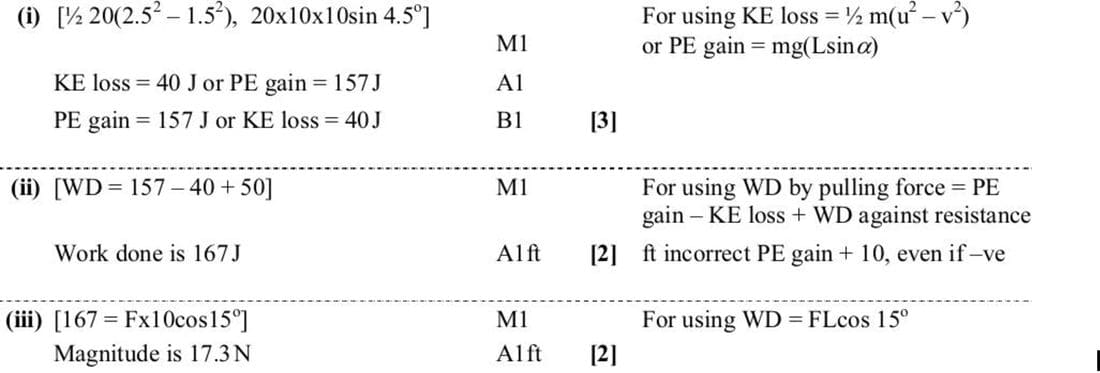
A block of mass 20 kg is pulled from the bottom to the top of a slope. The slope has length 10 m and is inclined at 4.5° to the horizontal. The speed of the block is 2.5 m/s at the bottom of the slope and 1.5 m/s at the top of the slope.
- Find the loss of kinetic energy and the gain in potential energy of the block.
- Given that the work done against the resistance to motion is 50 J, find the work done by the pulling force acting on the block.
- Given also that the pulling force is constant and acts at an angle of 15° upwards from the slope, find its magnitude.
9709 P41 - Nov 2010 - Q6
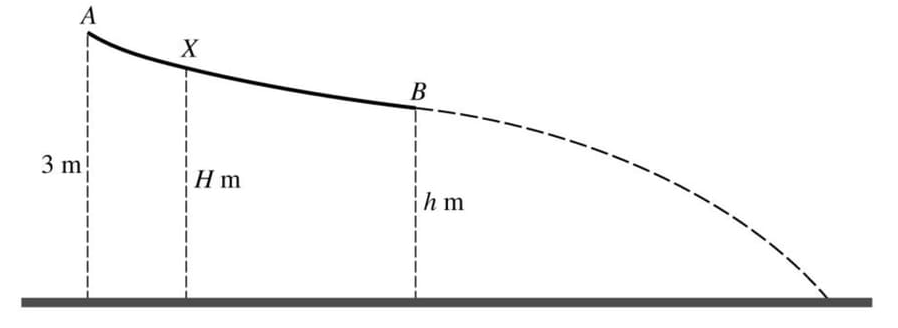
A smooth slide AB is fixed so that its highest point A is 3 m above horizontal ground. B is h m above the ground. A particle P of mass 0.2 kg is released from rest at a point on the slide. The particle moves down the slide and, after passing B, continues moving until it hits the ground (see diagram). The speed of P at B is vB and the speed at which P hits the ground is vG.
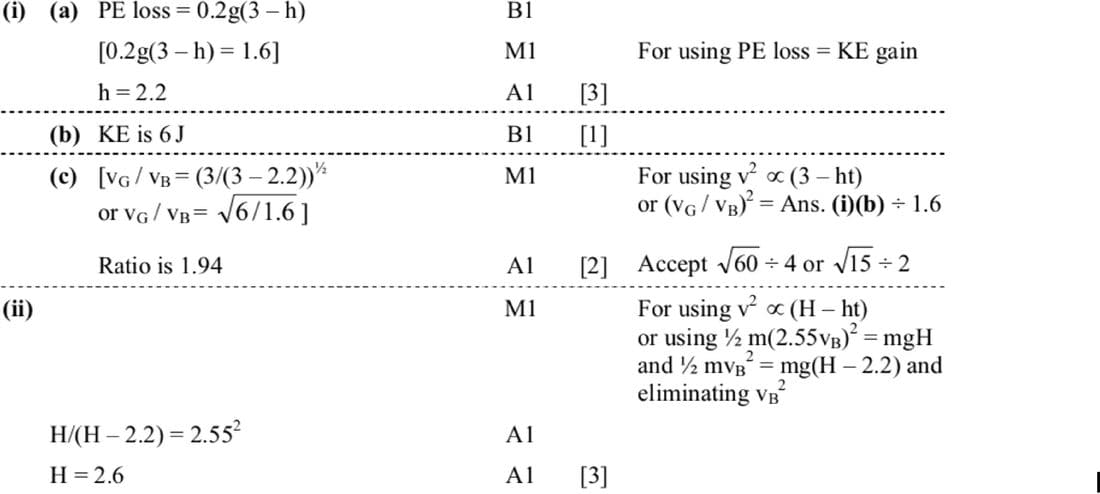
(i) In the case that P is released at A, it is given that the kinetic energy of P at B is 1.6 J. Find
- the value of h,
- the kinetic energy of the particle immediately before it reaches the ground,
- the ratio vG : vB.
(ii) In the case that P is released at the point X of the slide, which is H m above the ground (see diagram), it is given that vG : vB = 2.55. Find the value of H correct to 2 significant figures.
9709 P41 - Nov 2022 - Q6
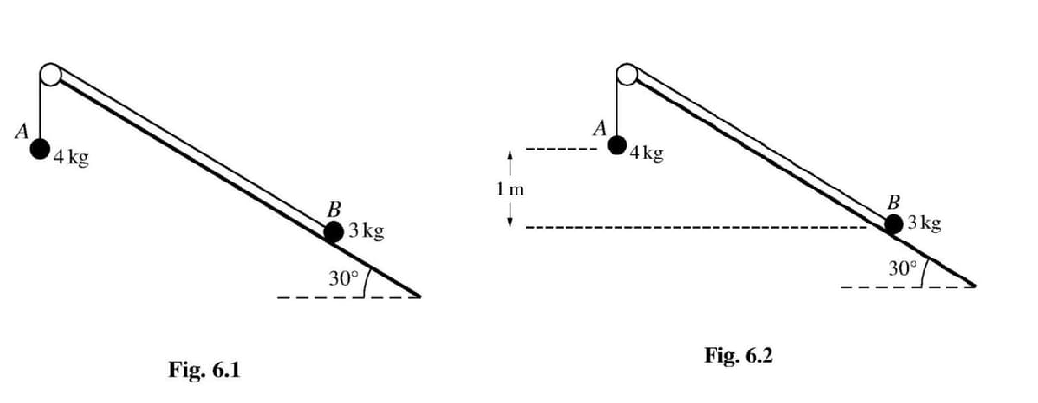
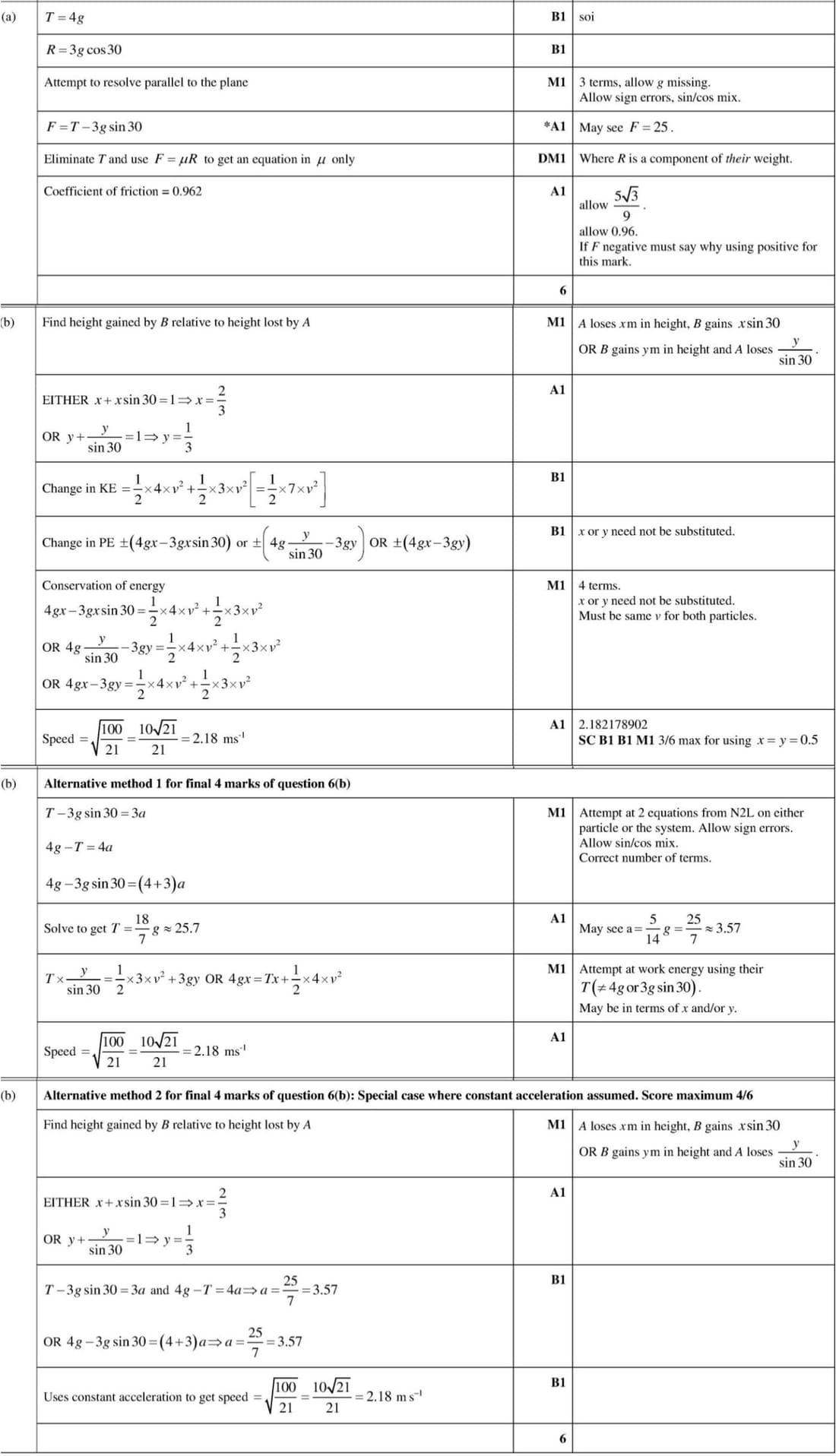
Fig. 6.1 shows particles A and B, of masses 4 kg and 3 kg respectively, attached to the ends of a light inextensible string that passes over a small smooth pulley. The pulley is fixed at the top of a plane which is inclined at an angle of 30° to the horizontal. A hangs freely below the pulley and B is on the inclined plane. The string is taut and the section of the string between B and the pulley is parallel to a line of greatest slope of the plane.
(a) It is given that the plane is rough and the particles are in limiting equilibrium.
Find the coefficient of friction between B and the plane.
(b) It is given instead that the plane is smooth and the particles are released from rest when the difference in the vertical heights of the particles is 1 m (see Fig. 6.2).
Use an energy method to find the speed of the particles at the instant when the particles are at the same horizontal level.