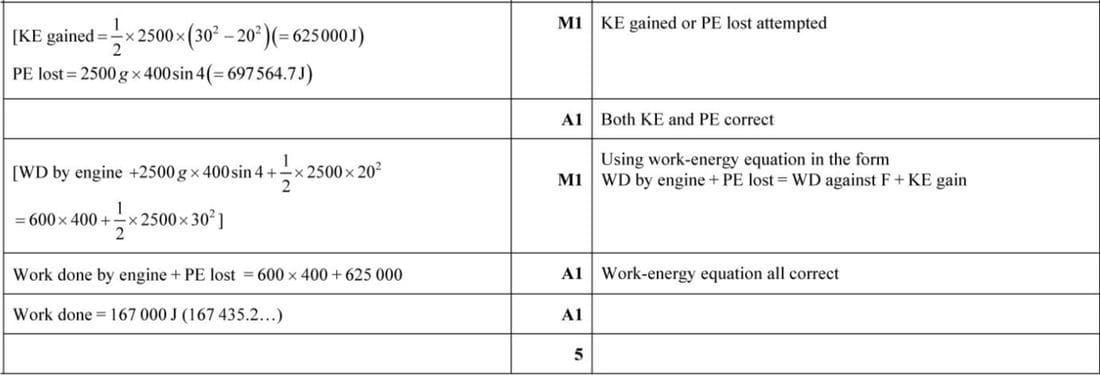
First, calculate the kinetic energy gained by the van:
\(\text{KE gained} = \frac{1}{2} \times 2500 \times (30^2 - 20^2) = 625,000 \text{ J}\)
Next, calculate the potential energy lost as the van descends the hill:
\(\text{PE lost} = 2500 \times 9.8 \times 400 \times \sin 4^{\circ} \approx 697,564.7 \text{ J}\)
Using the work-energy principle, the work done by the engine plus the potential energy lost equals the work done against resistance plus the kinetic energy gained:
\(\text{WD by engine} + \text{PE lost} = 600 \times 400 + 625,000\)
Solving for the work done by the engine:
\(\text{WD by engine} = 600 \times 400 + 625,000 - 697,564.7\)
\(\text{WD by engine} = 167,000 \text{ J}\)