Past Exam Questions
← Back9709 P12 - Nov 2013 - Q6
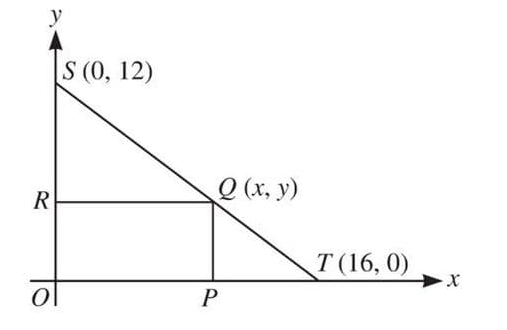
In the diagram, S is the point (0, 12) and T is the point (16, 0). The point Q lies on ST, between S and T, and has coordinates (x, y). The points P and R lie on the x-axis and y-axis respectively and OPQR is a rectangle.
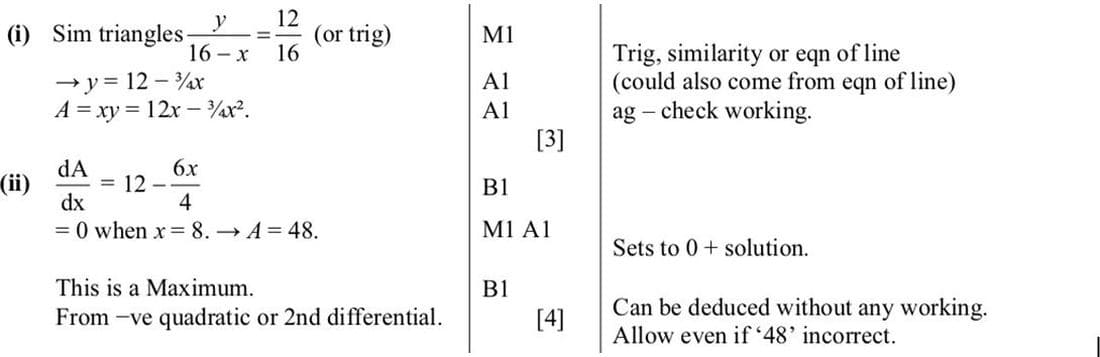
- Show that the area, A, of the rectangle OPQR is given by \(A = 12x - \frac{3}{4}x^2\).
- Given that x can vary, find the stationary value of A and determine its nature.
9709 P11 - Nov 2013 - Q8
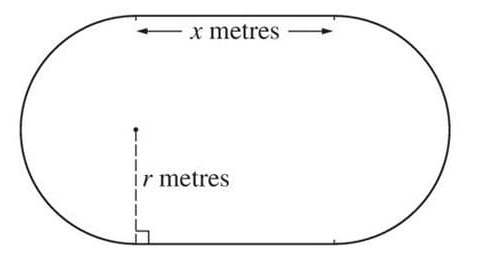
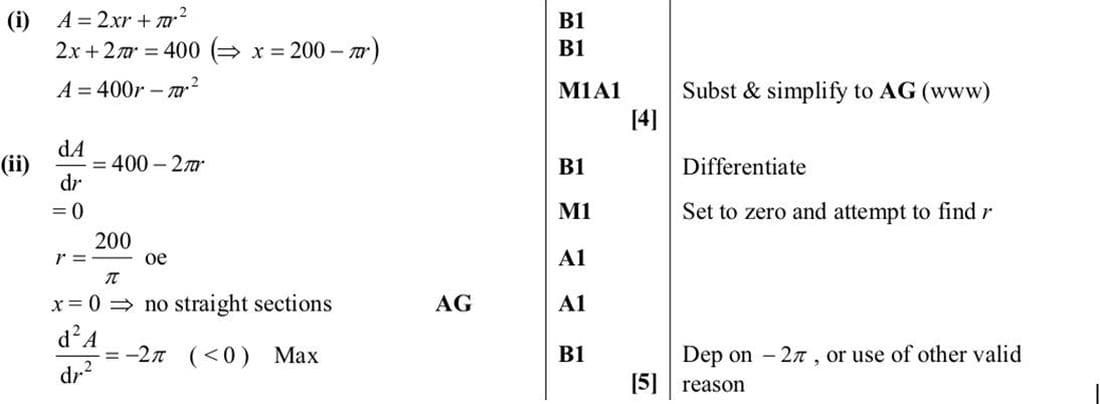
The inside lane of a school running track consists of two straight sections each of length x metres, and two semicircular sections each of radius r metres, as shown in the diagram. The straight sections are perpendicular to the diameters of the semicircular sections. The perimeter of the inside lane is 400 metres.
\((i) Show that the area, A m2, of the region enclosed by the inside lane is given by A = 400r - \pi r^2.\)
(ii) Given that x and r can vary, show that, when A has a stationary value, there are no straight sections in the track. Determine whether the stationary value is a maximum or a minimum.
9709 P43 - Nov 2023 - Q4
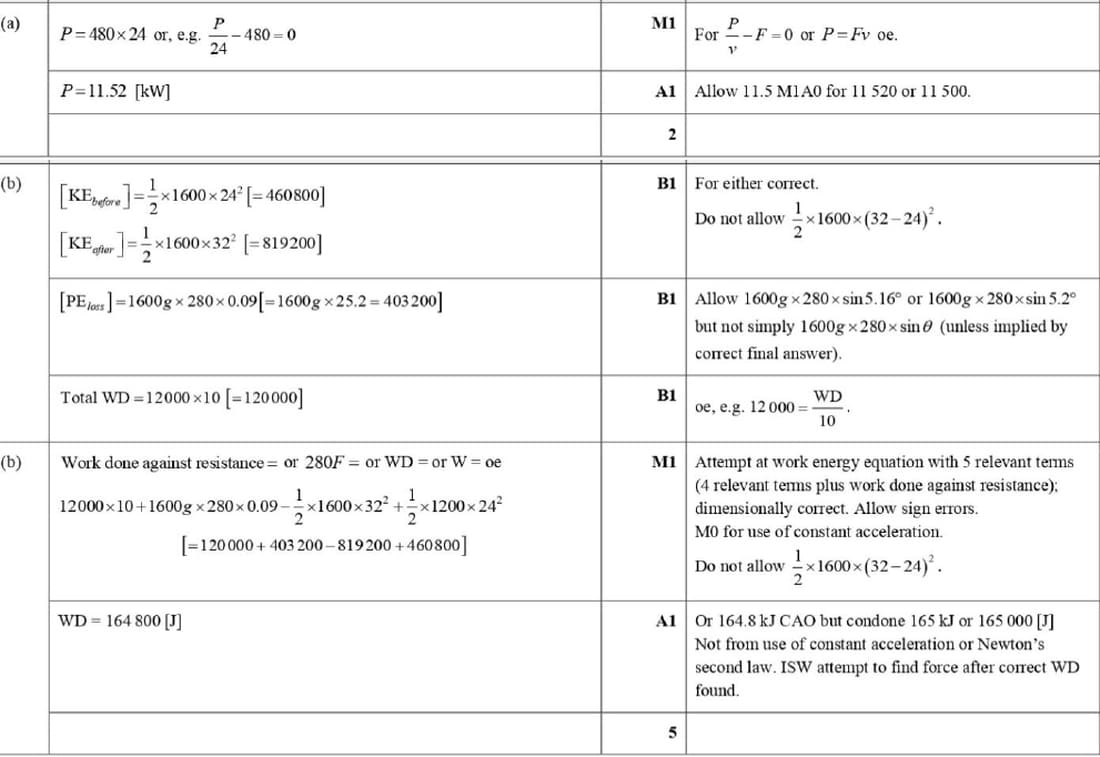
A car has mass 1600 kg.
(a) The car is moving along a straight horizontal road at a constant speed of 24 m/s and is subject to a constant resistance of magnitude 480 N.
Find, in kW, the rate at which the engine of the car is working.
The car now moves down a hill inclined at an angle of \(\theta\) to the horizontal, where \(\sin \theta = 0.09\). The engine of the car is working at a constant rate of 12 kW. The speed of the car is 24 m/s at the top of the hill. Ten seconds later the car has travelled 280 m down the hill and has speed 32 m/s.
(b) Given that the resistance is not constant, use an energy method to find the total work done against the resistance during the ten seconds.
9709 P42 - Jun 2022 - Q6
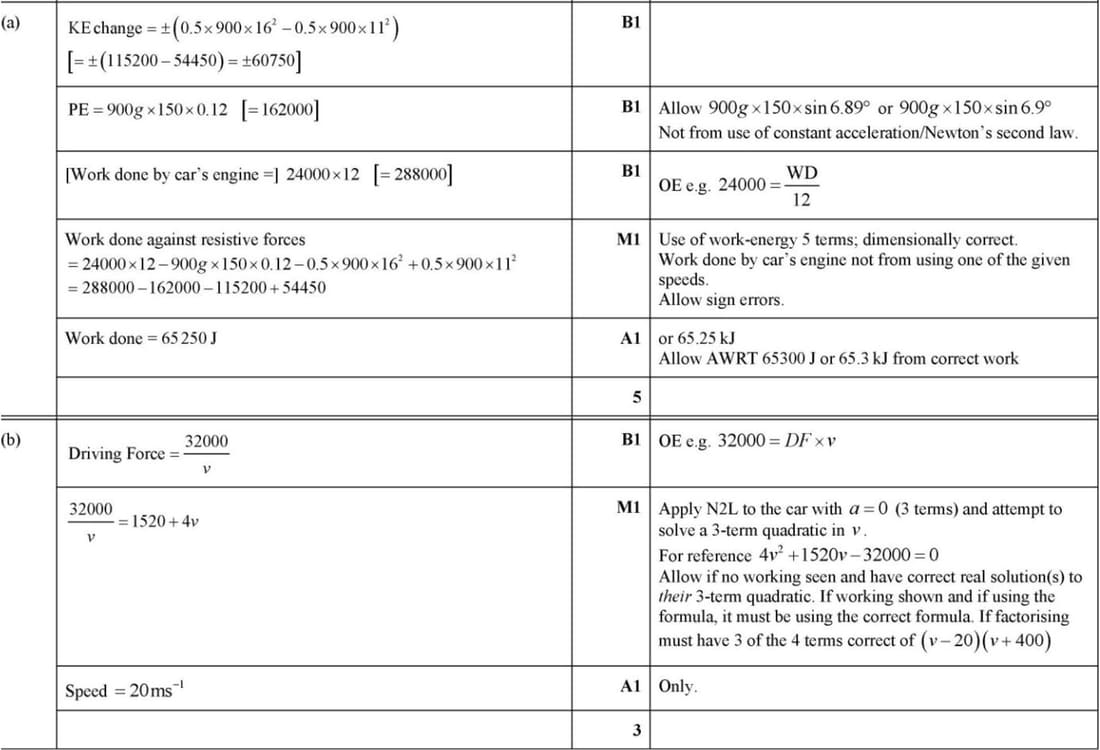
A car of mass 900 kg is moving up a hill inclined at \(\sin^{-1} 0.12\) to the horizontal. The initial speed of the car is 11 m s\(^{-1}\). After 12 s, the car has travelled 150 m up the hill and has speed 16 m s\(^{-1}\). The engine of the car is working at a constant rate of 24 kW.
(a) Find the work done against the resistive forces during the 12 s.
The car then travels along a straight horizontal road. There is a resistance to the motion of the car of \((1520 + 4v)\) N when the speed of the car is \(v\) m s\(^{-1}\). The car travels at a constant speed with the engine working at a constant rate of 32 kW.
(b) Find this speed.
9709 P41 - Jun 2022 - Q5
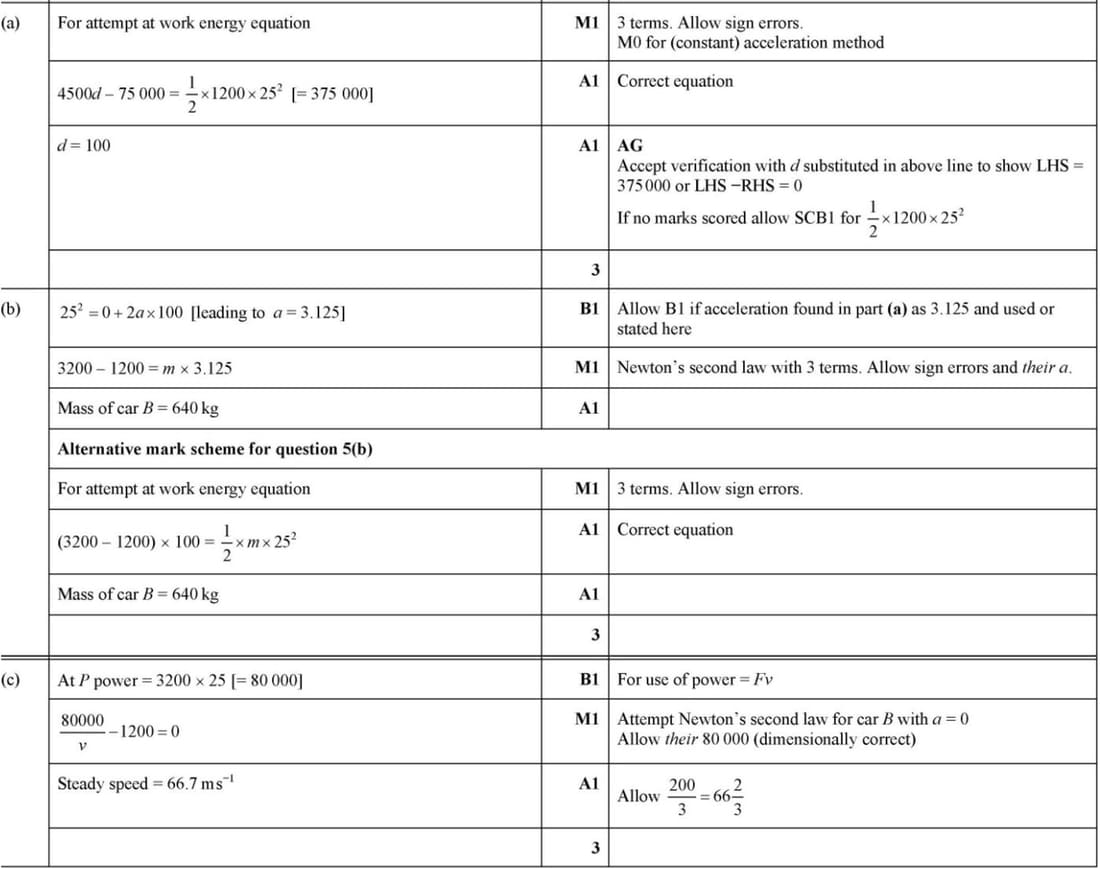
Two racing cars A and B are at rest alongside each other at a point O on a straight horizontal test track. The mass of A is 1200 kg. The engine of A produces a constant driving force of 4500 N. When A arrives at a point P its speed is 25 m/s. The distance OP is d m. The work done against the resistance force experienced by A between O and P is 75000 J.
- Show that d = 100.
- Car B starts off at the same instant as car A. The two cars arrive at P simultaneously and with the same speed. The engine of B produces a driving force of 3200 N and the car experiences a constant resistance to motion of 1200 N.
- Find the mass of B.
- Find the steady speed which B can maintain when its engine is working at the same rate as it is at P.
9709 P42 - Mar 2022 - Q3
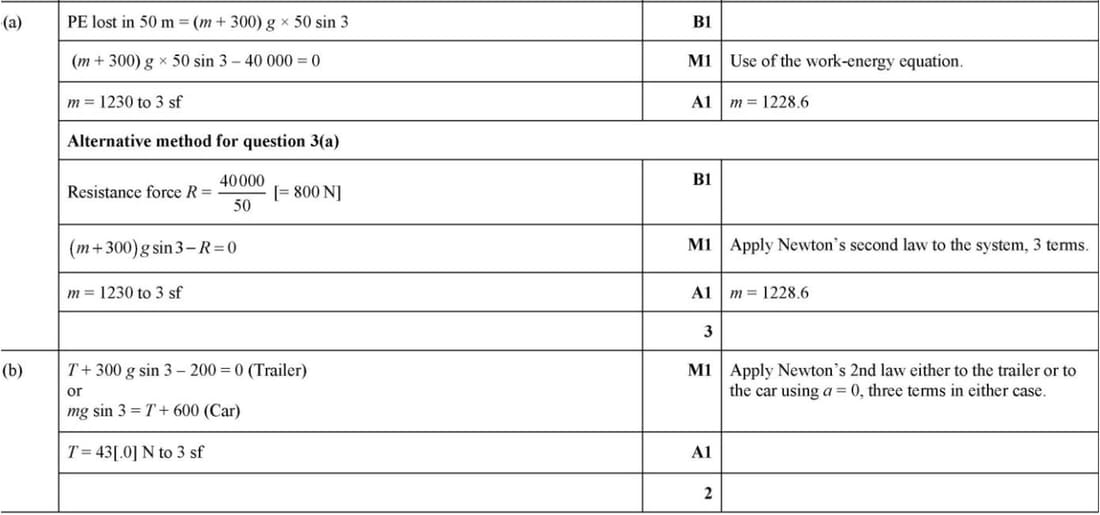
A car of mass m kg is towing a trailer of mass 300 kg down a straight hill inclined at 3° to the horizontal at a constant speed. There are resistance forces on the car and on the trailer, and the total work done against the resistance forces in a distance of 50 m is 40000 J. The engine of the car is doing no work and the tow-bar is light and rigid.
(a) Find the value of m.
The resistance force on the trailer is 200 N.
(b) Find the tension in the tow-bar between the car and the trailer.
9709 P42 - Mar 2022 - Q1
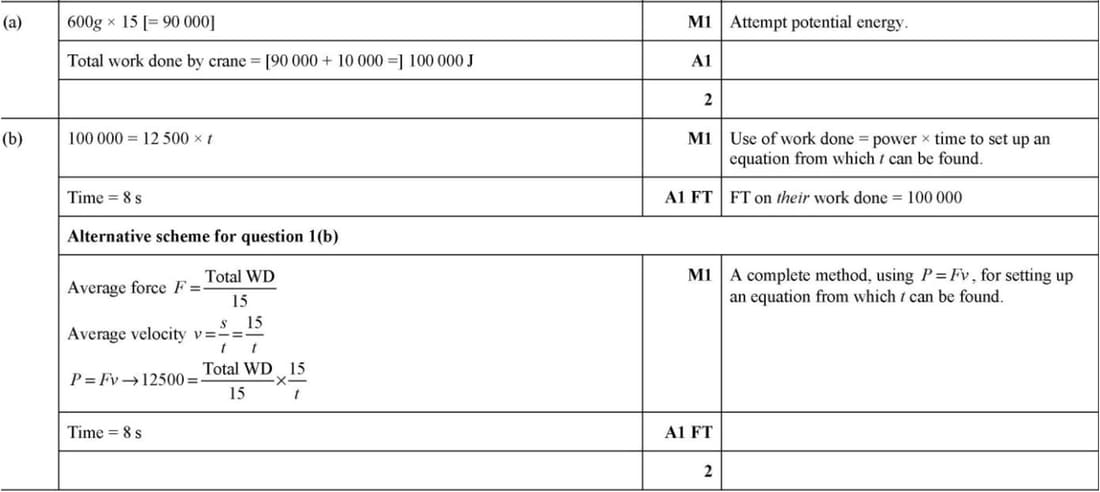
A crane is used to raise a block of mass 600 kg vertically upwards at a constant speed through a height of 15 m. There is a resistance to the motion of the block, which the crane does 10,000 J of work to overcome.
(a) Find the total work done by the crane.
(b) Given that the average power exerted by the crane is 12.5 kW, find the total time for which the block is in motion.
9709 P43 - Nov 2021 - Q3
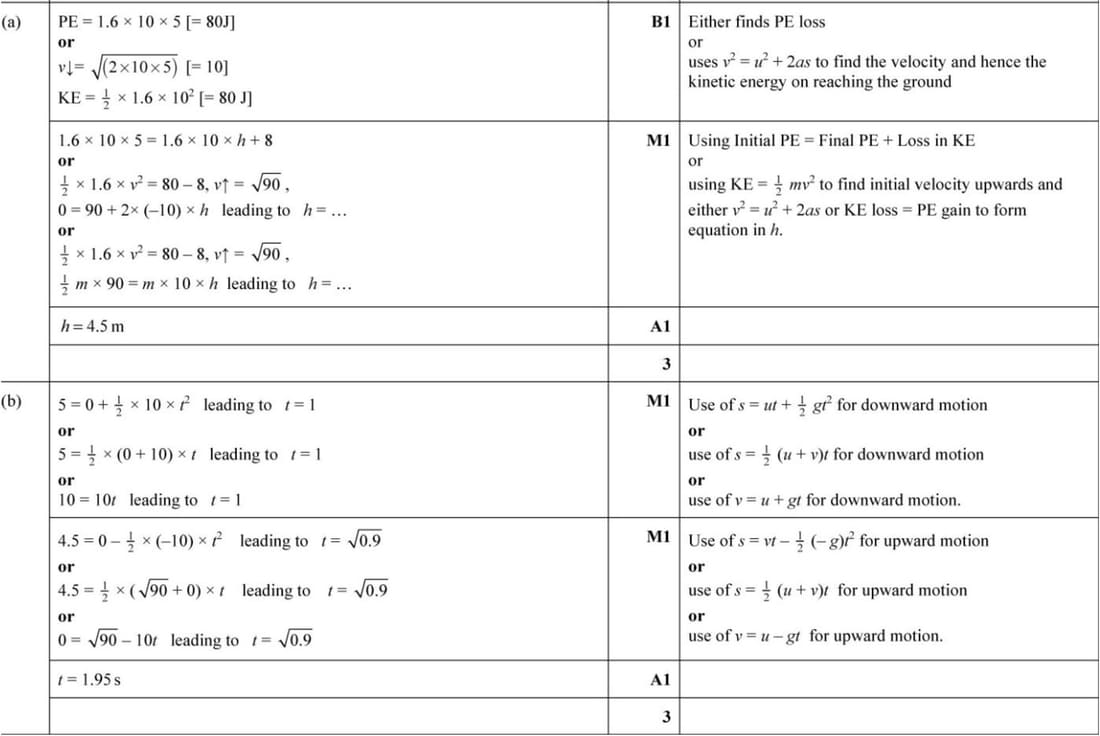
A ball of mass 1.6 kg is released from rest at a point 5 m above horizontal ground. When the ball hits the ground it instantaneously loses 8 J of kinetic energy and starts to move upwards.
(a) Use an energy method to find the greatest height that the ball reaches after hitting the ground.
(b) Find the total time taken, from the initial release of the ball until it reaches this greatest height.
9709 P42 - Nov 2021 - Q5
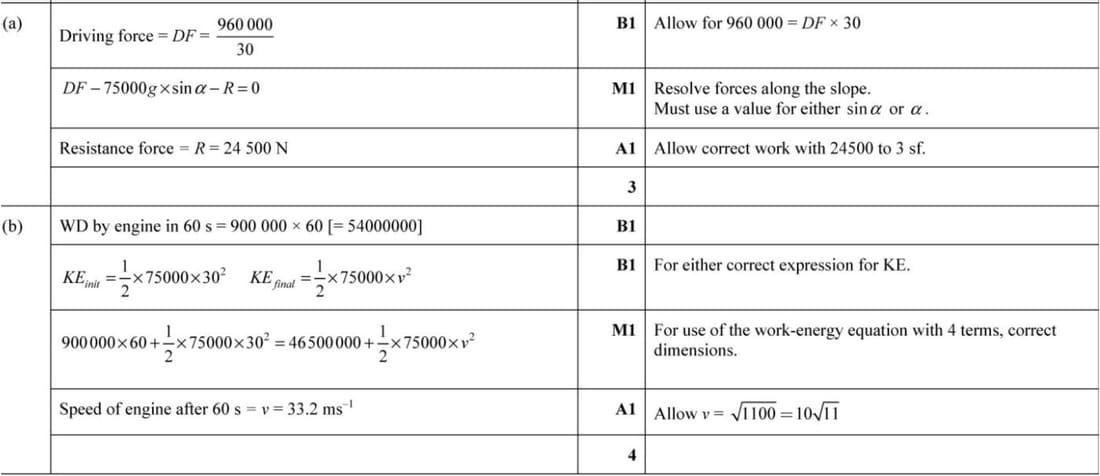
A railway engine of mass 75,000 kg is moving up a straight hill inclined at an angle \(\alpha\) to the horizontal, where \(\sin \alpha = 0.01\). The engine is travelling at a constant speed of 30 m s\(^{-1}\). The engine is working at 960 kW. There is a constant force resisting the motion of the engine.
(a) Find the resistance force.
The engine comes to a section of track which is horizontal. At the start of the section the engine is travelling at 30 m s\(^{-1}\) and the power of the engine is now reduced to 900 kW. The resistance to motion is no longer constant, but in the next 60 s the work done against the resistance force is 46,500 kJ.
(b) Find the speed of the engine at the end of the 60 s.
9709 P42 - Nov 2021 - Q3
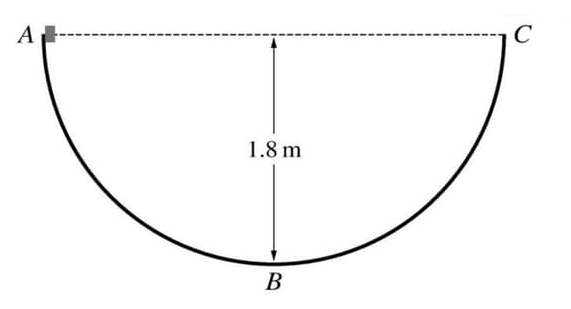
The diagram shows a semi-circular track ABC of radius 1.8 m which is fixed in a vertical plane. The points A and C are at the same horizontal level and the point B is at the bottom of the track. The section AB is smooth and the section BC is rough. A small block is released from rest at A.
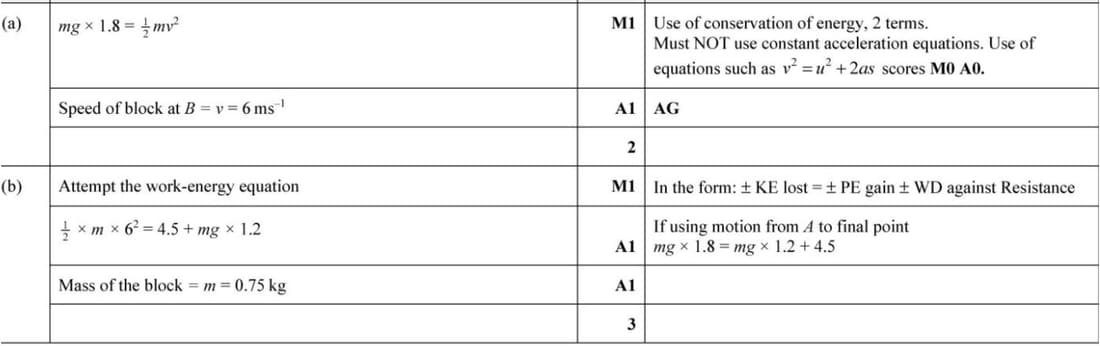
(a) Show that the speed of the block at B is 6 m s-1.
The block comes to instantaneous rest for the first time at a height of 1.2 m above the level of B. The work done against the resistance force during the motion of the block from B to this point is 4.5 J.
(b) Find the mass of the block.
9709 P41 - Nov 2021 - Q5
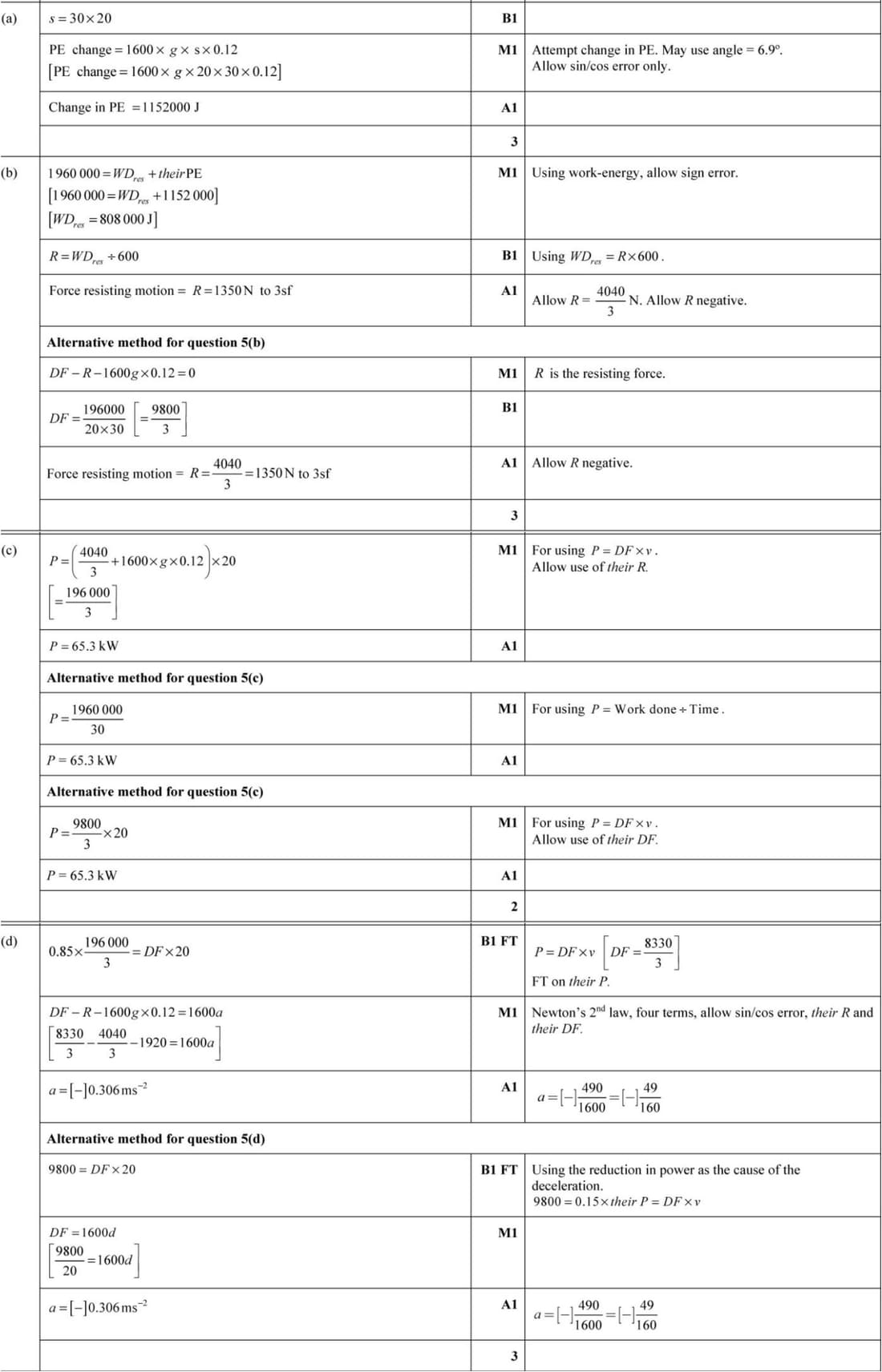
A car of mass 1600 kg travels at constant speed 20 m s-1 up a straight road inclined at an angle of \(\sin^{-1} 0.12\) to the horizontal.
(a) Find the change in potential energy of the car in 30 s.
(b) Given that the total work done by the engine of the car in this time is 1960 kJ, find the constant force resisting the motion.
(c) Calculate, in kW, the power developed by the engine of the car.
(d) Given that this power is suddenly decreased by 15%, find the instantaneous deceleration of the car.
9709 P43 - Jun 2021 - Q5
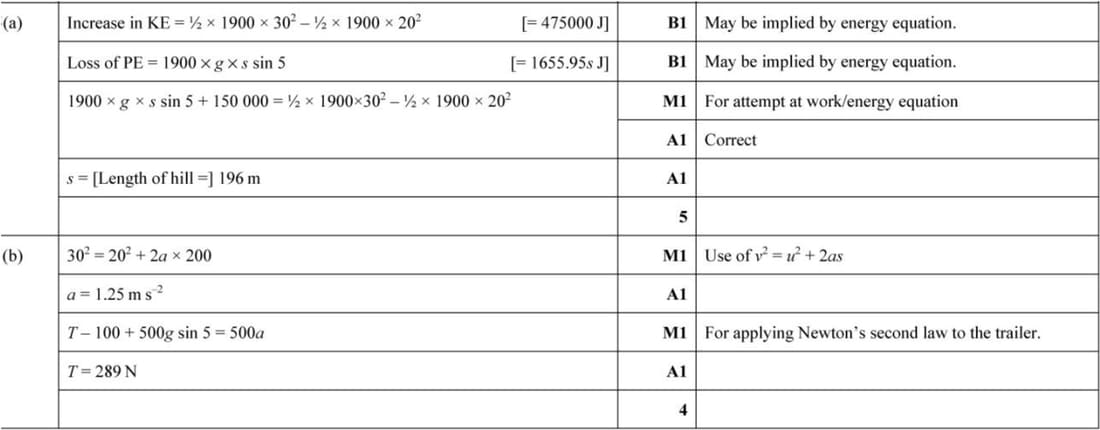
A car of mass 1400 kg is towing a trailer of mass 500 kg down a straight hill inclined at an angle of 5° to the horizontal. The car and trailer are connected by a light rigid tow-bar. At the top of the hill the speed of the car and trailer is 20 m s-1 and at the bottom of the hill their speed is 30 m s-1.
(a) It is given that as the car and trailer descend the hill, the engine of the car does 150,000 J of work, and there are no resistance forces.
Find the length of the hill.
(b) It is given instead that there is a resistance force of 100 N on the trailer, the length of the hill is 200 m, and the acceleration of the car and trailer is constant.
Find the tension in the tow-bar between the car and trailer.
9709 P42 - Jun 2021 - Q5
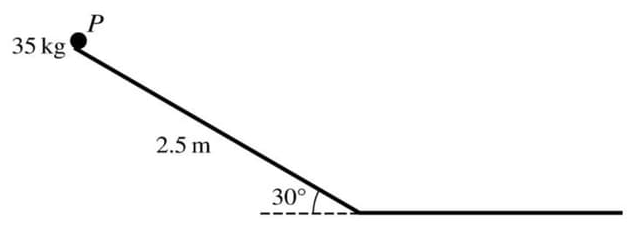
A car of mass 1250 kg is pulling a caravan of mass 800 kg along a straight road. The resistances to the motion of the car and caravan are 440 N and 280 N respectively. The car and caravan are connected by a light rigid tow-bar.
(a) The car and caravan move along a horizontal part of the road at a constant speed of 30 m s-1.
- Calculate, in kW, the power developed by the engine of the car.
- Given that this power is suddenly decreased by 8 kW, find the instantaneous deceleration of the car and caravan and the tension in the tow-bar.
(b) The car and caravan now travel along a part of the road inclined at sin-1 0.06 to the horizontal. The car and caravan travel up the incline at constant speed with the engine of the car working at 28 kW.
- Find this constant speed.
- Find the increase in the potential energy of the caravan in one minute.
9709 P41 - Nov 2023 - Q1
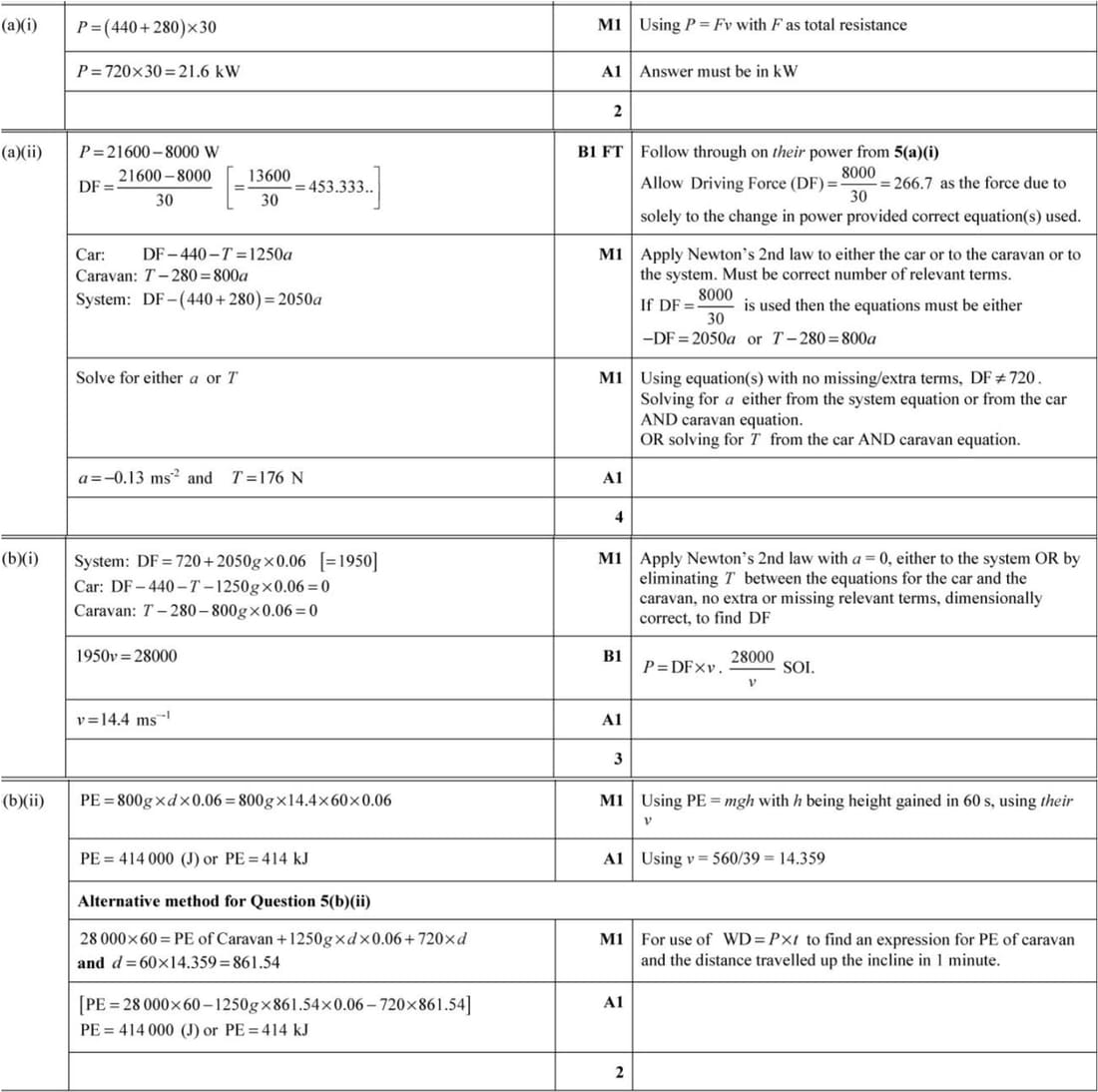
A particle of mass 1.6 kg is projected with a speed of 20 m/s up a line of greatest slope of a smooth plane inclined at \(\alpha\) to the horizontal, where \(\tan \alpha = \frac{3}{4}\).
Use an energy method to find the distance the particle moves up the plane before coming to instantaneous rest.
9709 P42 - Jun 2021 - Q1
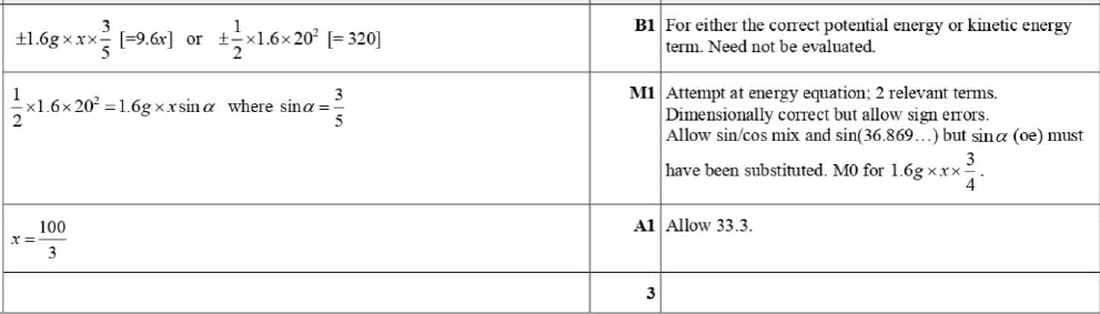
A particle of mass 0.6 kg is projected with a speed of 4 m s-1 down a line of greatest slope of a smooth plane inclined at 10° to the horizontal.
Use an energy method to find the speed of the particle after it has moved 15 m down the plane.
9709 P41 - Jun 2021 - Q7
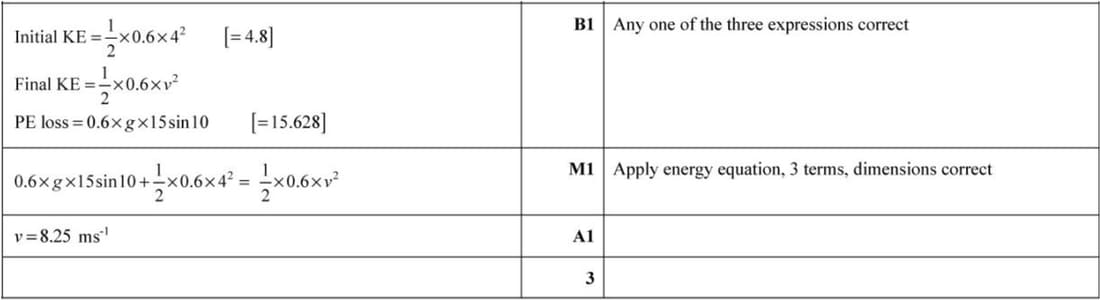
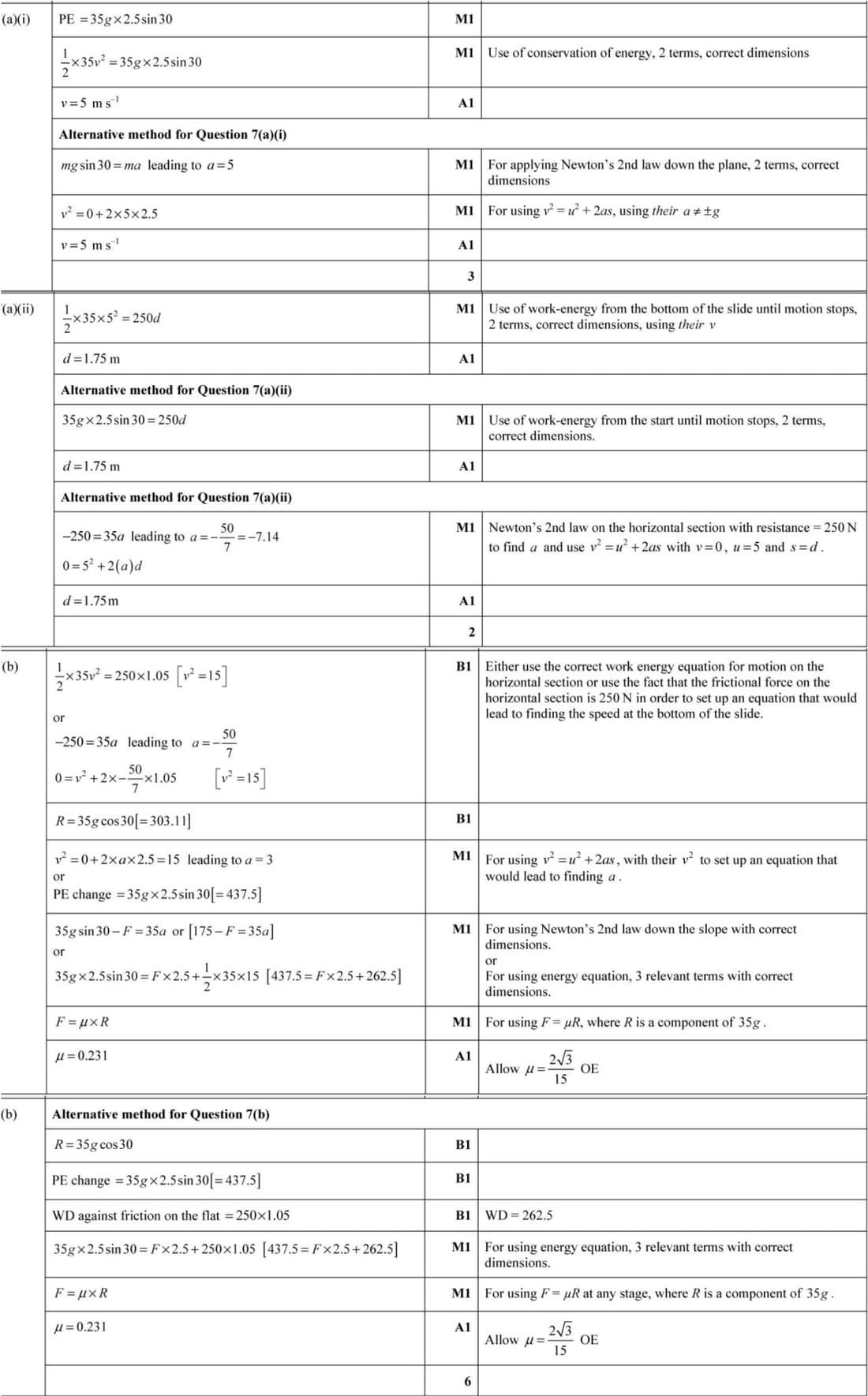
A slide in a playground descends at a constant angle of 30° for 2.5 m. It then has a horizontal section in the same vertical plane as the sloping section. A child of mass 35 kg, modelled as a particle P, starts from rest at the top of the slide and slides straight down the sloping section. She then continues along the horizontal section until she comes to rest (see diagram). There is no instantaneous change in speed when the child goes from the sloping section to the horizontal section.
The child experiences a resistance force on the horizontal section of the slide, and the work done against the resistance force on the horizontal section of the slide is 250 J per metre.
(a) It is given that the sloping section of the slide is smooth.
- Find the speed of the child when she reaches the bottom of the sloping section.
- Find the distance that the child travels along the horizontal section of the slide before she comes to rest.
(b) It is given instead that the sloping section of the slide is rough and that the child comes to rest on the slide 1.05 m after she reaches the horizontal section.
Find the coefficient of friction between the child and the sloping section of the slide.
9709 P42 - Mar 2021 - Q7
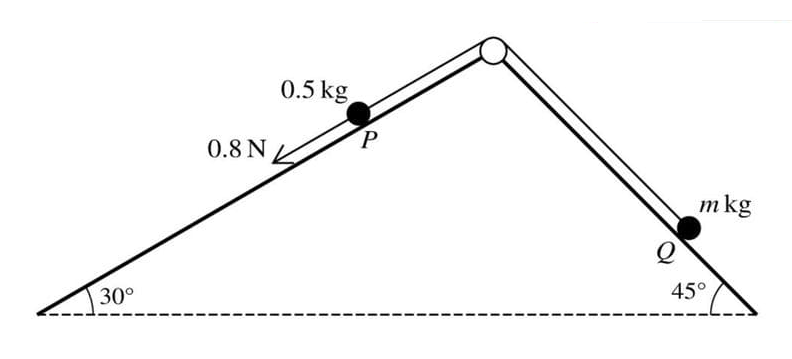
Two particles P and Q of masses 0.5 kg and m kg respectively are attached to the ends of a light inextensible string. The string passes over a fixed smooth pulley which is attached to the top of two inclined planes. The particles are initially at rest with P on a smooth plane inclined at 30° to the horizontal and Q on a plane inclined at 45° to the horizontal. The string is taut and the particles can move on lines of greatest slope of the two planes. A force of magnitude 0.8 N is applied to P acting down the plane, causing P to move down the plane (see diagram).
\((a) It is given that m = 0.3, and that the plane on which Q rests is smooth.\)
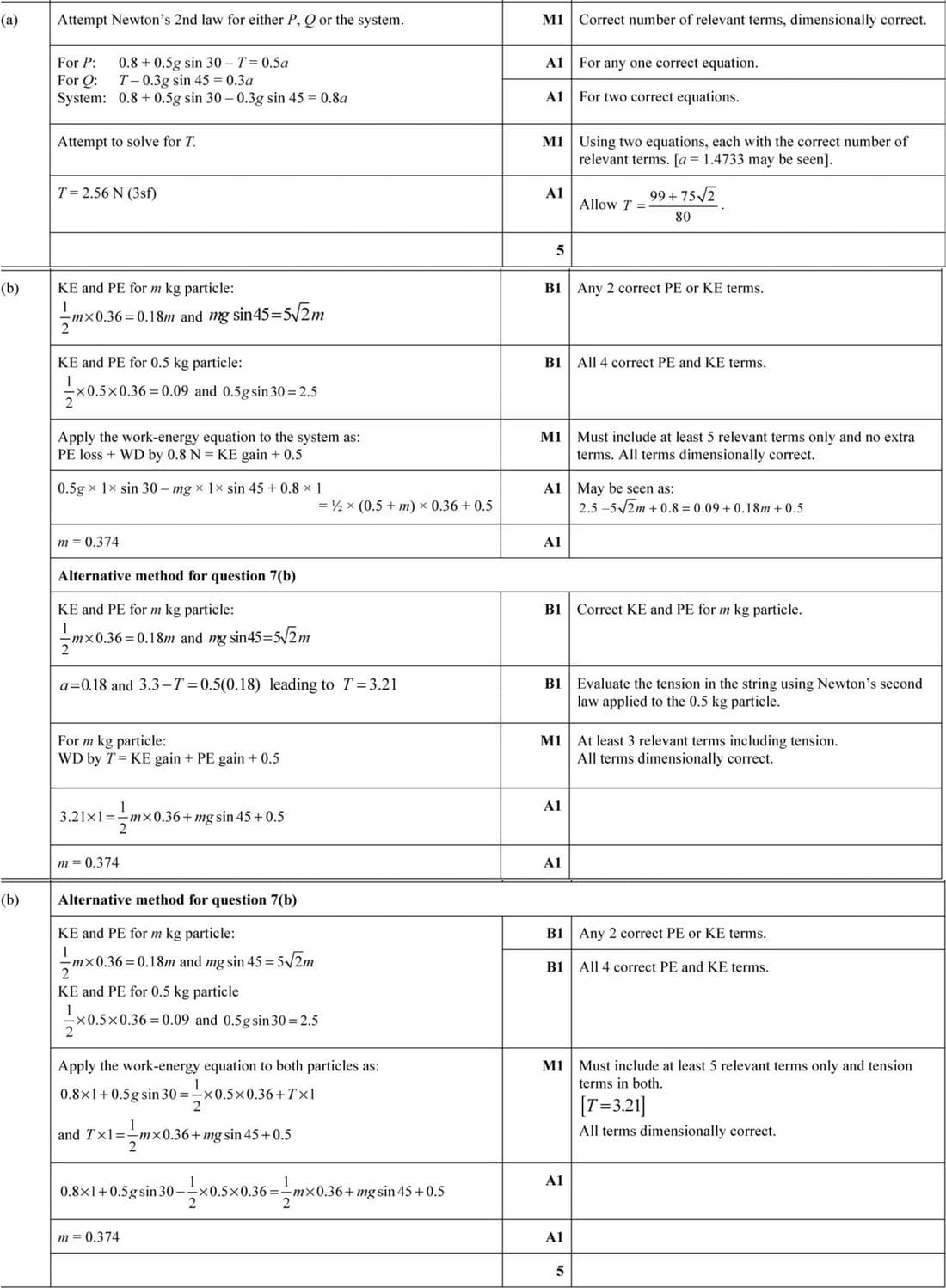
Find the tension in the string.
(b) It is given instead that the plane on which Q rests is rough, and that after each particle has moved a distance of 1 m, their speed is 0.6 m s-1. The work done against friction in this part of the motion is 0.5 J.
Use an energy method to find the value of m.
9709 P43 - Nov 2020 - Q2
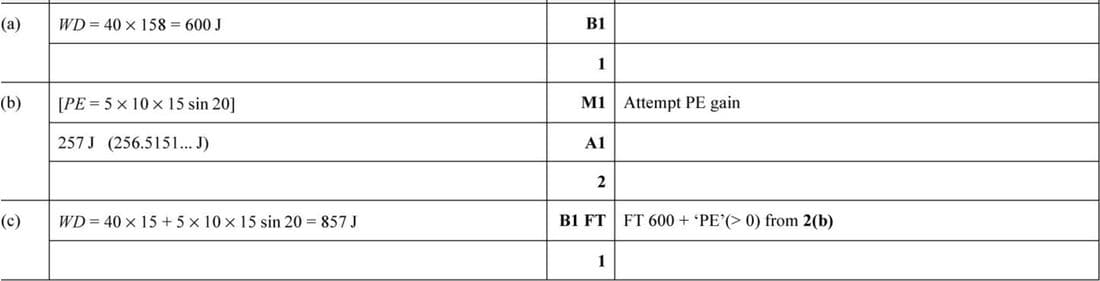
A box of mass 5 kg is pulled at a constant speed a distance of 15 m up a rough plane inclined at an angle of 20° to the horizontal. The box moves along a line of greatest slope against a frictional force of 40 N. The force pulling the box is parallel to the line of greatest slope.
(a) Find the work done against friction.
(b) Find the change in gravitational potential energy of the box.
(c) Find the work done by the pulling force.
9709 P42 - Nov 2020 - Q8
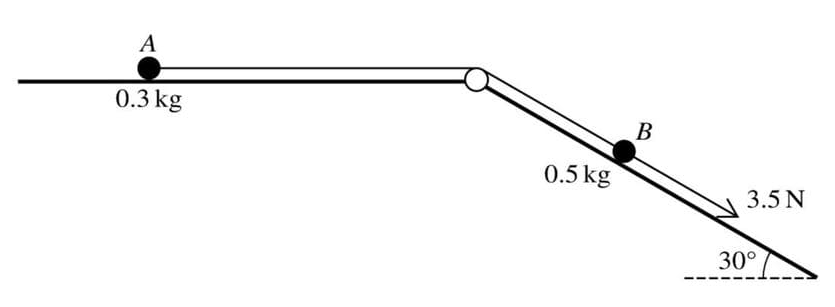
Two particles A and B, of masses 0.3 kg and 0.5 kg respectively, are attached to the ends of a light inextensible string. The string passes over a fixed smooth pulley which is attached to a horizontal plane and to the top of an inclined plane. The particles are initially at rest with A on the horizontal plane and B on the inclined plane, which makes an angle of 30° with the horizontal. The string is taut and B can move on a line of greatest slope of the inclined plane. A force of magnitude 3.5 N is applied to B acting down the plane (see diagram).
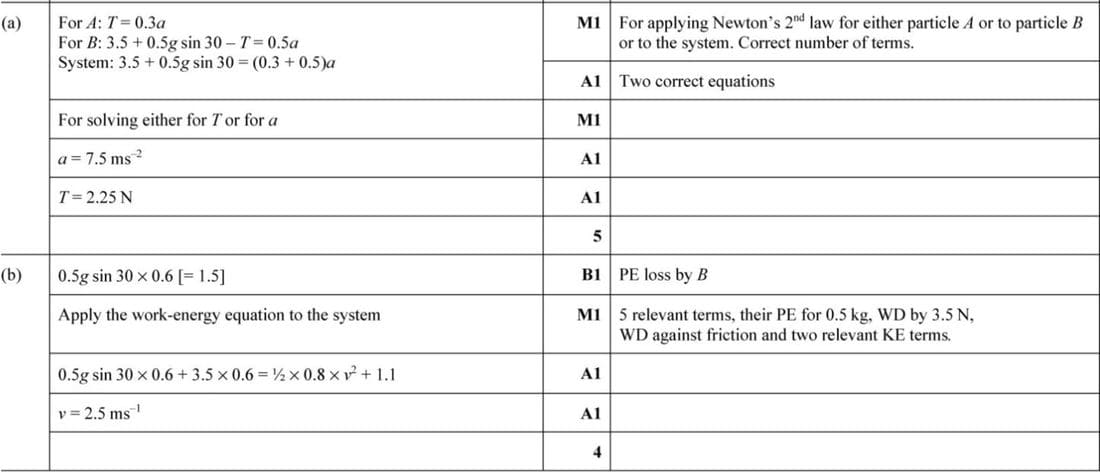
(a) Given that both planes are smooth, find the tension in the string and the acceleration of B. [5]
(b) It is given instead that the two planes are rough. When each particle has moved a distance of 0.6 m from rest, the total amount of work done against friction is 1.1 J.
Use an energy method to find the speed of B when it has moved this distance down the plane. [You should assume that the string is sufficiently long so that A does not hit the pulley when it moves 0.6 m.] [4]
9709 P41 - Nov 2020 - Q6
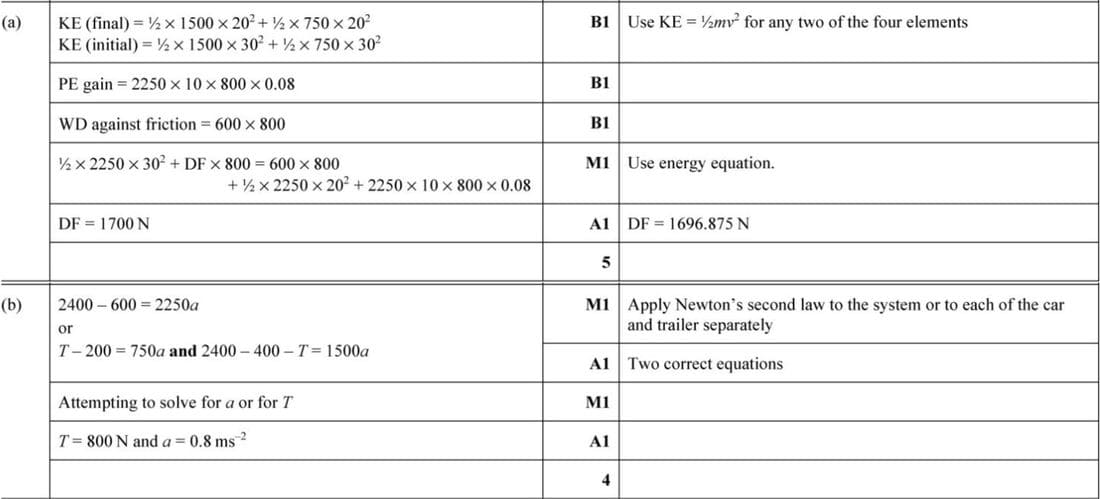
A car of mass 1500 kg is pulling a trailer of mass 750 kg up a straight hill of length 800 m inclined at an angle of \(\sin^{-1} 0.08\) to the horizontal. The resistances to the motion of the car and trailer are 400 N and 200 N respectively. The car and trailer are connected by a light rigid tow-bar. The car and trailer have speed 30 m/s at the bottom of the hill and 20 m/s at the top of the hill.
(a) Use an energy method to find the constant driving force as the car and trailer travel up the hill. [5]
After reaching the top of the hill the system consisting of the car and trailer travels along a straight level road. The driving force of the car’s engine is 2400 N and the resistances to motion are unchanged.
(b) Find the acceleration of the system and the tension in the tow-bar. [4]