Browsing as Guest. Progress, bookmarks and attempts are disabled.
Log in to track your work.
Nov 2011 p43 q4
3561
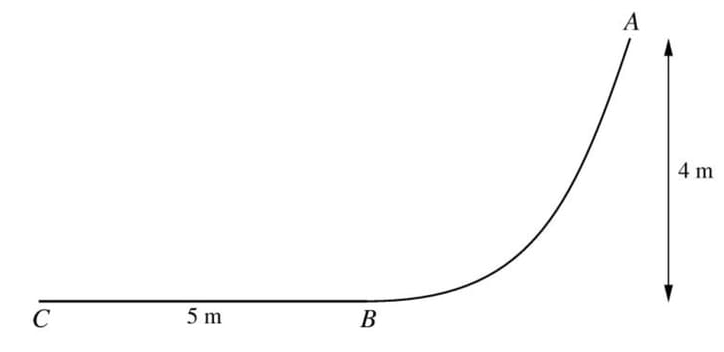
ABC is a vertical cross-section of a surface. The part of the surface containing AB is smooth and A is 4 m higher than B. The part of the surface containing BC is horizontal and the distance BC is 5 m (see diagram). A particle of mass 0.8 kg is released from rest at A and slides along ABC. Find the speed of the particle at C in each of the following cases.
The horizontal part of the surface is smooth.
The coefficient of friction between the particle and the horizontal part of the surface is 0.3.
Solution
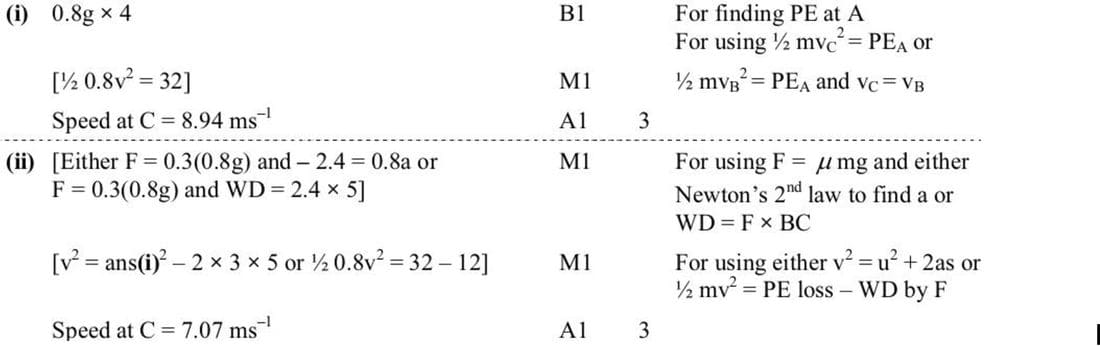
(i) The potential energy (PE) at A is given by \(0.8g \times 4\), where \(g\) is the acceleration due to gravity. This energy is converted into kinetic energy (KE) at C. Therefore, \(\frac{1}{2} \times 0.8 \times v^2 = 0.8g \times 4\). Solving for \(v\), we get \(v = 8.94 \text{ ms}^{-1}\).
(ii) The force of friction \(F\) is \(0.3 \times 0.8g\). The work done against friction over the distance BC is \(F \times 5\). The loss in potential energy is \(0.8g \times 4\). The kinetic energy at C is given by \(\frac{1}{2} \times 0.8 \times v^2 = 0.8g \times 4 - F \times 5\). Solving for \(v\), we get \(v = 7.07 \text{ ms}^{-1}\).